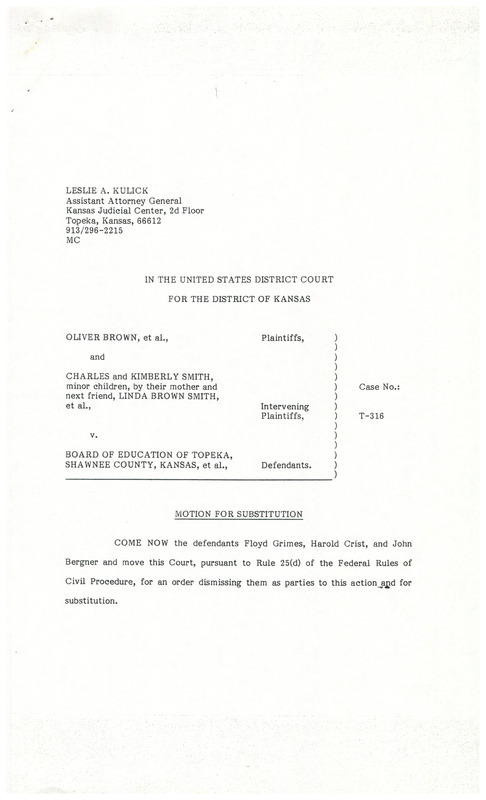
Case Data and Exhibits for Brown III, a relitigation of Brown v. Topeka Board of Education (1954) that corrected resegregation issues caused by open enrollment school choice in 1992. A motion of substitution from the defense team requesting that 3 people be removed as parties from the case because they are no longer members of the school board.
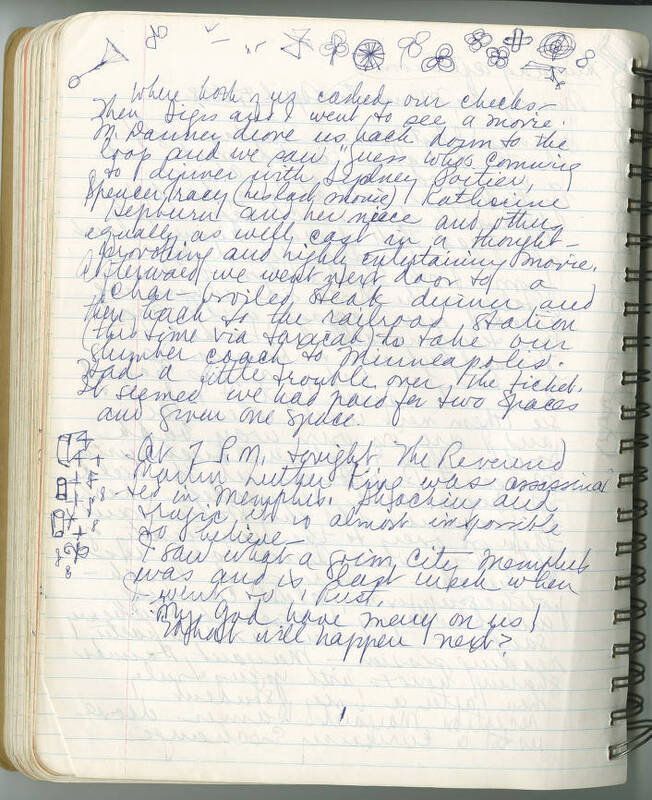
In this entry, Margaret Walker is writing from Minneapolis, Minnesota. She is reacting to the assassanation that day of Martin Luther King Jr., writing, “May God have mercy on us! What will happen next?” This page also reflects her doodling, which can be found across the entire collection of her journals.
A paper by Yale Law School student Mary Dudziak representing the “current stage of my continuing research on the history of school segregation in Topeka Kansas.” She thanks the ACLU for research and travel funds. Handwritten notes from Lamson throughout the paper and attached sheets with handwritten notes from Lamson.
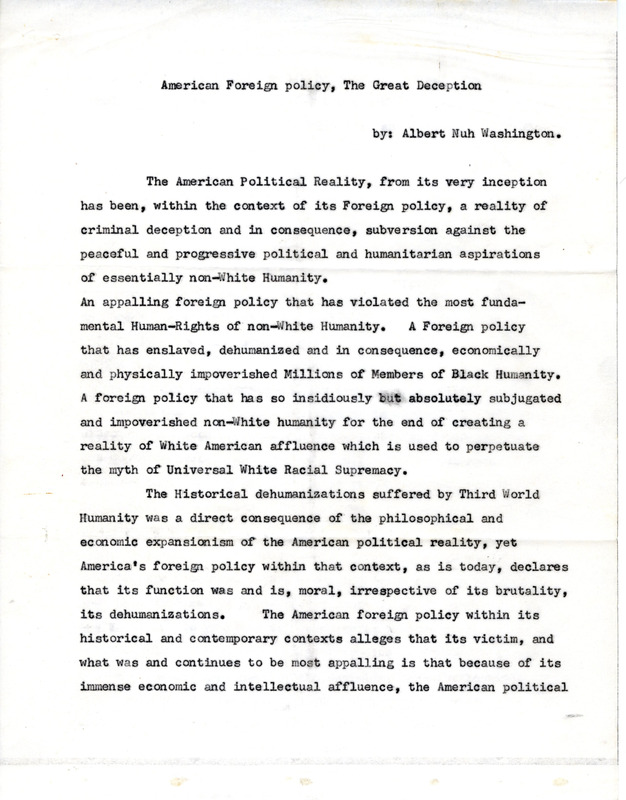
A paper by Albert Nuh Washington (Nuh Abdul Qaiyum) arguing that America's foreign policy serves the larger function of the subjugation of non-white people in the United States. Nuh Abdul Qaiyum was sentenced to prison in 1975 for a 1971 Black Liberation Army (BLA) connected shooting of police officers in New York,
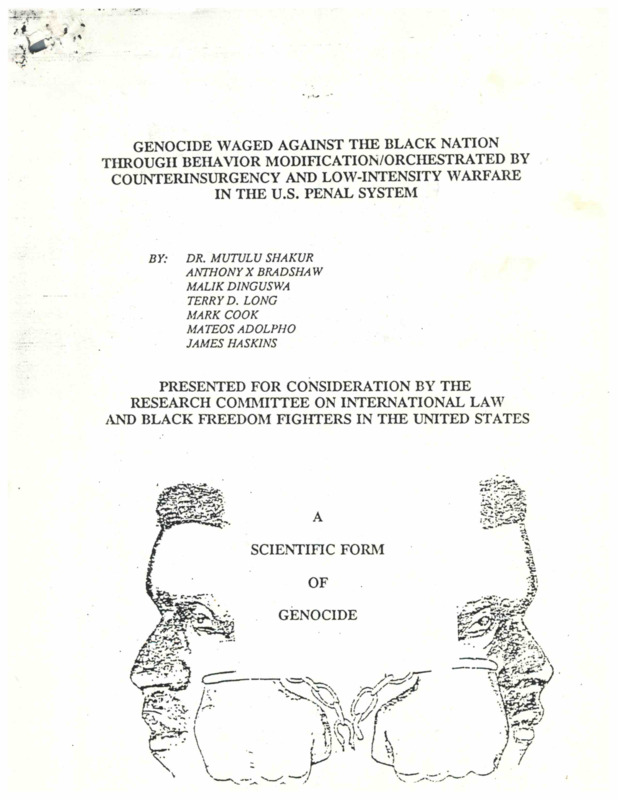
A paper by a team of Black prisoners who experienced behavior modification in prison. In this paper they argue that Black prisoners being given behavior modification is a form of genocide against Black people. The paper was presented for consideration by the Research Committee on International Law and Black Freedom Fighters in the United States.
A paper by Dr. Mutulu Shakur that argues the existence of political prisoners reveals the violations of human rights perpetuated by the United States government against Black people. Dr. Shakur wrote this from prison, where he was serving a 60 year sentence for his role in a Black Liberation Army (BLA) led robbery in 1981.
A paper by a student in Frankye Adams-Johnson (Malika)'s English 101 class about the history of the Black Panther Party. The author argues that the members of the Black Panther Party were not born revolutionaries, but were forced into this mind set by the oppressive ways of American society and deemed all of their actions necessary for liberation.
A paper by Dr. Mutulu Shakur arguing that the Black nation in the imperialistic United States is a captive nation and thus must look at the situation and solutions through the lens of international law. Dr. Shakur wrote this from prison, where he was serving a 60 year sentence for his role in a Black Liberation Army (BLA) led robbery in 1981.
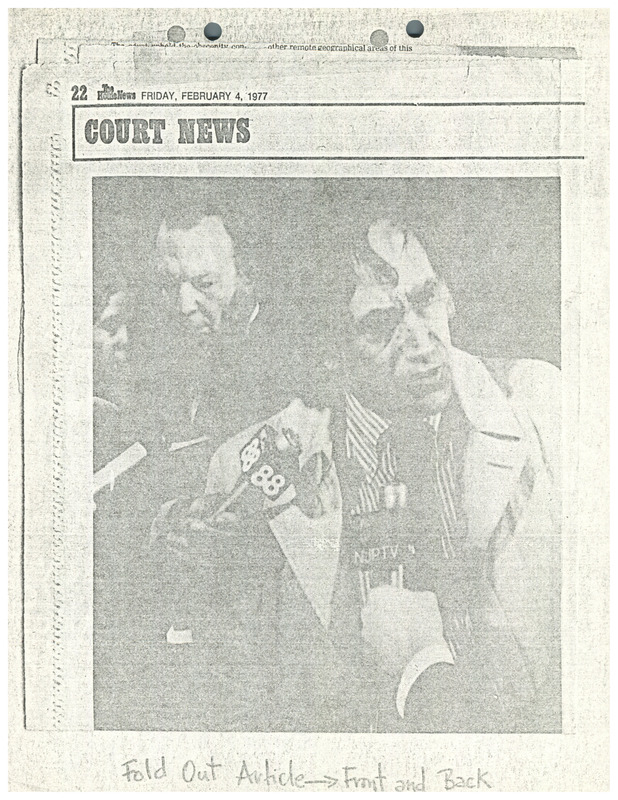
A cover photograph from the Court News Section of the newspaper The Home News featuring members of the defense team for Assata Shakur (JoAnne Chesimard) who was on trial for the 1973 killing of a state trooper. Shakur was convicted in 1977 of killing the state trooper during a shootout, escaped prison in 1979, and is still wanted by the FBI.
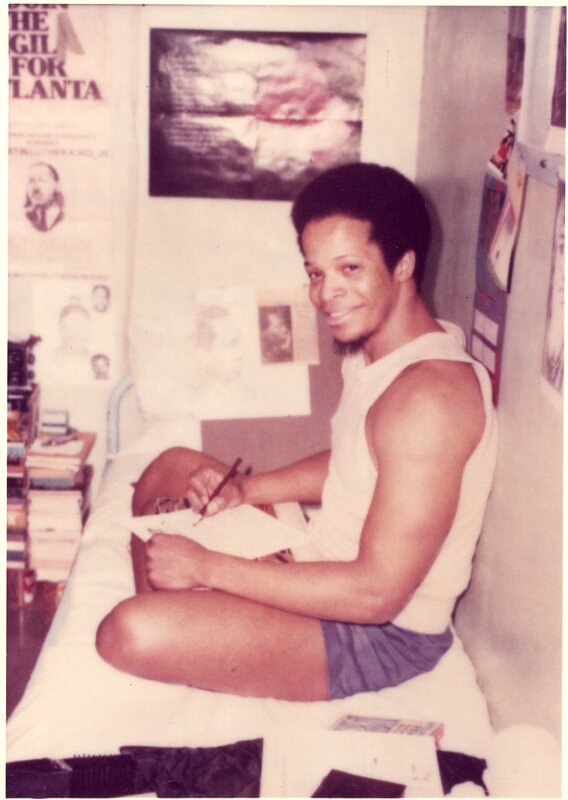
Ashanti Alston, a Black Liberation Army (BLA) member who was imprisoned for 11 years for a robbery to raise money for the BLA, says that he is getting big and his beard is too. He mentions his attempt to draw Nina Simone and says that the photo is two years old. The note is dated September 17th with no year listed.
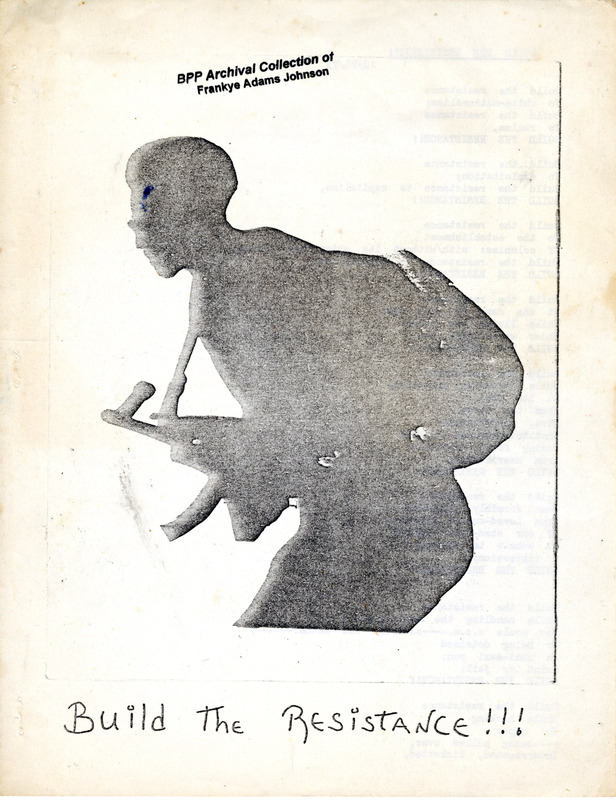
A poem by Ndugu Al-Jamil titled “Build the Resistance!!!” The cover page features the silhouette of an armed man appearing ready for combat. The poem is a call to arms for revolutionaries that outlines the problems facing the community such as police brutality, taxes, eviction, health care, education, and more.
An original poem by Malika Majid (Frankye Adams-Johnson) titled “A Poem for You.” In the poem, she reflects on the idea of resistance. The bottom of the page says “Lest We Forget: Poetry. From The Veterans For Whom Memories Are Precious Sources of Inspiration.”
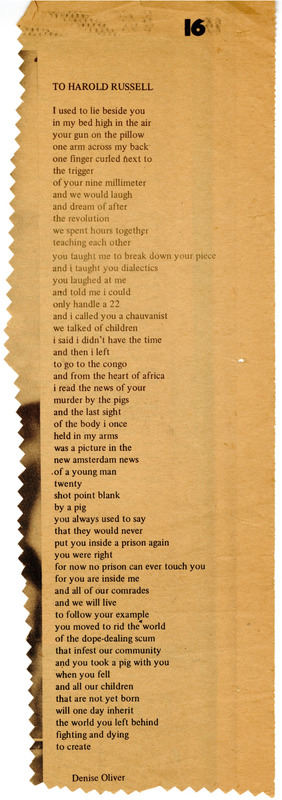
A poem written by Denise Oliver to Harold Russell after his death from a shootout with the Harlem police in April 1971. Harold Russell was a Black Liberation Army (BLA) member and one of many members who lost their lives in police killings.
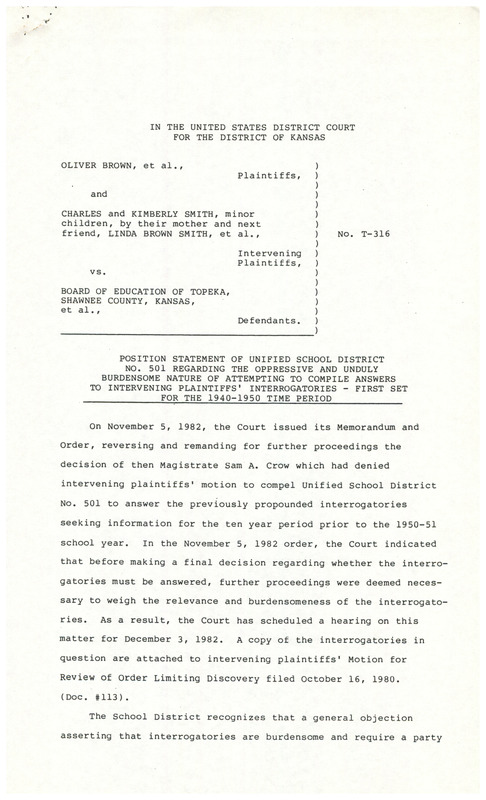
Case Data and Exhibits for Brown III, a relitigation of Brown v. Topeka Board of Education (1954) that corrected resegregation issues caused by open enrollment school choice in 1992. In this position statement, the defense argues that certain requests for documents from the plaintiff team are “unduly burdensome” because of time constraints.
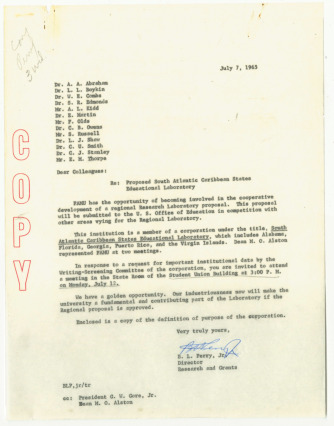
A series of letters between then Director of Research and Grants, B. L. Perry, Jr., and several colleagues, including President Gore, and proposal materials. FAMU collaborated with deans of universities based in Puerto Rico, the Virgin Islands, and the Southeastern region to create a research laboratory funded by the U.S. Office of Education.
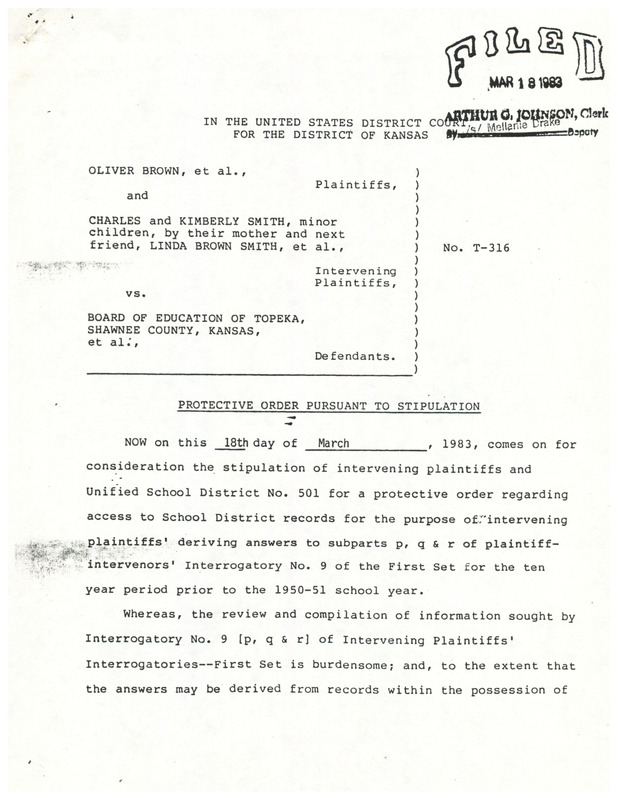
Case Data and Exhibits for Brown III, a relitigation of Brown v. Topeka Board of Education (1954) that corrected resegregation issues caused by open enrollment school choice in 1992. This court order places limitations on some of the documents requested by the defense due to redundancy and personal information that is included in some records.
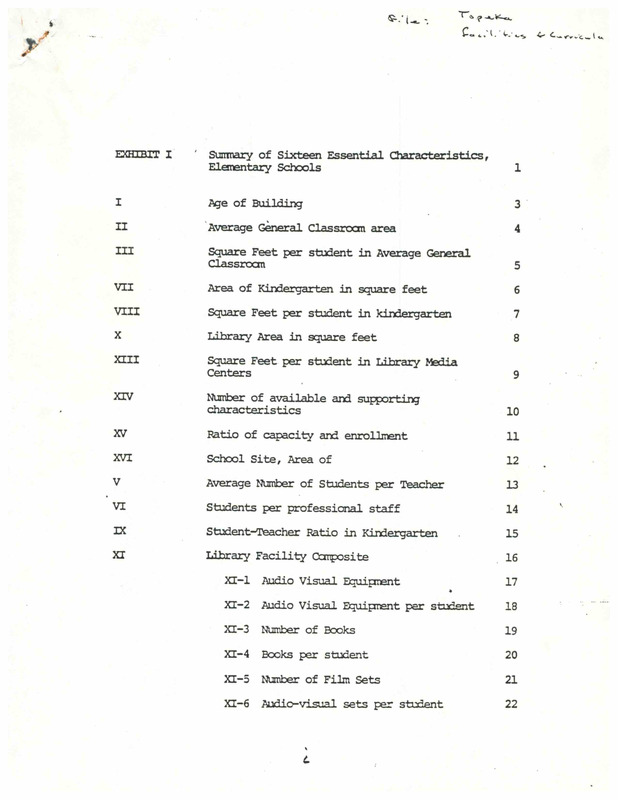
Case Data and Exhibits for Brown III, a relitigation of Brown v. Topeka Board of Education (1954) that corrected resegregation issues caused by open enrollment school choice in 1992. The report breaks down a study of all facilities, infrastructure, materials, and teaching resources for Topeka Public School for the history of the district.
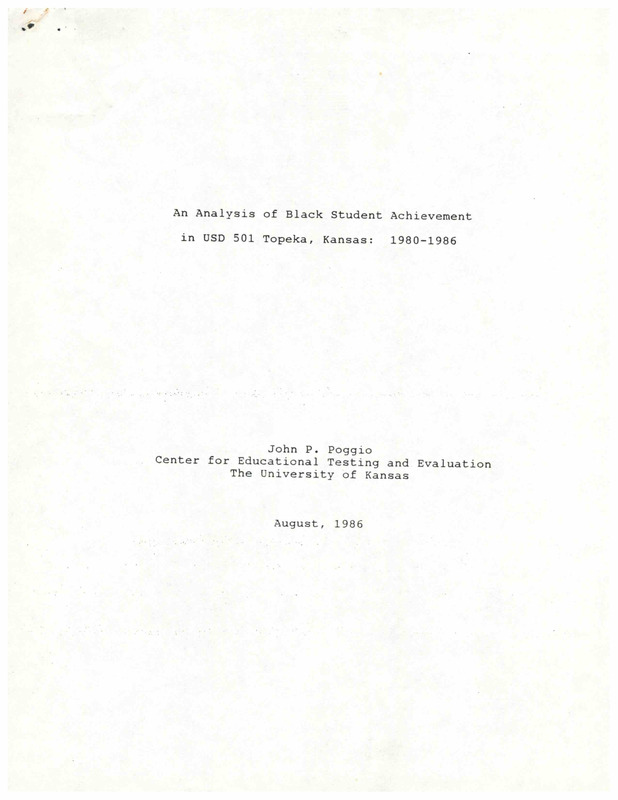
Case Data and Exhibits for Brown III, a relitigation of Brown v. Topeka Board of Education (1954) that corrected resegregation issues caused by open enrollment school choice in 1992. A report analyzing Black student achievement in Topeka, Kansas, schools from 1980-1986 that found the racial composition of schools had no effect on student learning.
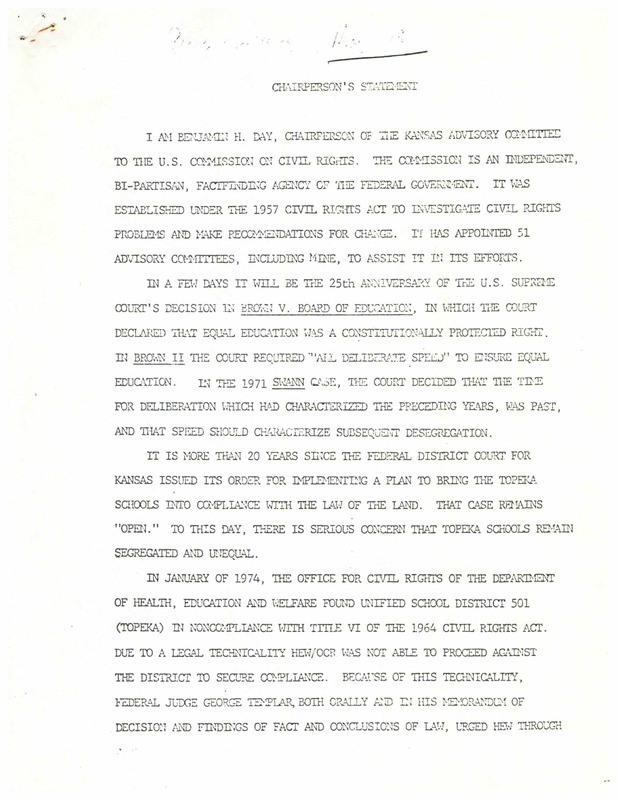
Case Data and Exhibits for Brown III, a relitigation of Brown v. Topeka Board of Education (1954) that corrected resegregation issues caused by open enrollment school choice in 1992. The report encourages the U.S. Justice Department and United States Department of Health, Education, and Welfare to conduct an investigation into Topeka Schools.
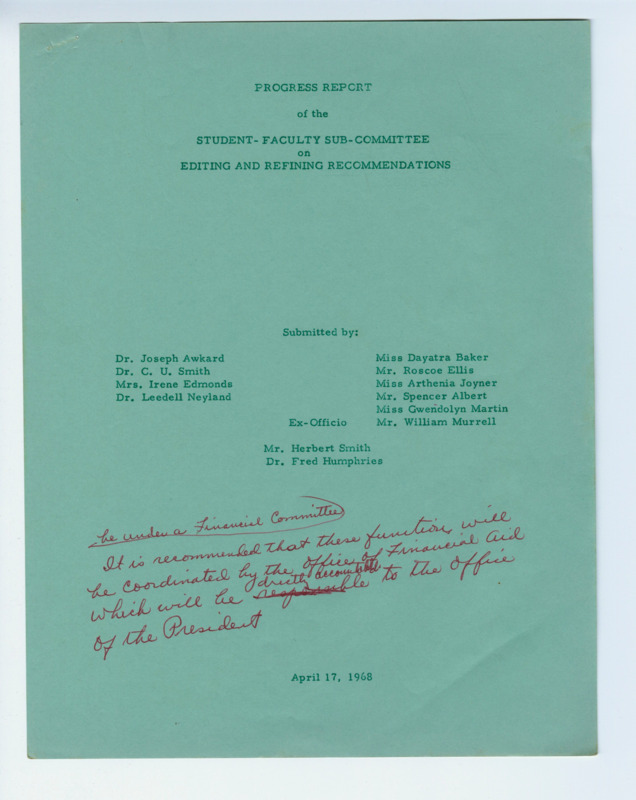
A progress report outlines the revisions and enhancements made to the recommendations from the Student-Faculty Subcommittee emphasizing the adjustments for clarity, impact, and alignment with the committee's objectives, paving the way for final approval and successful implementation.
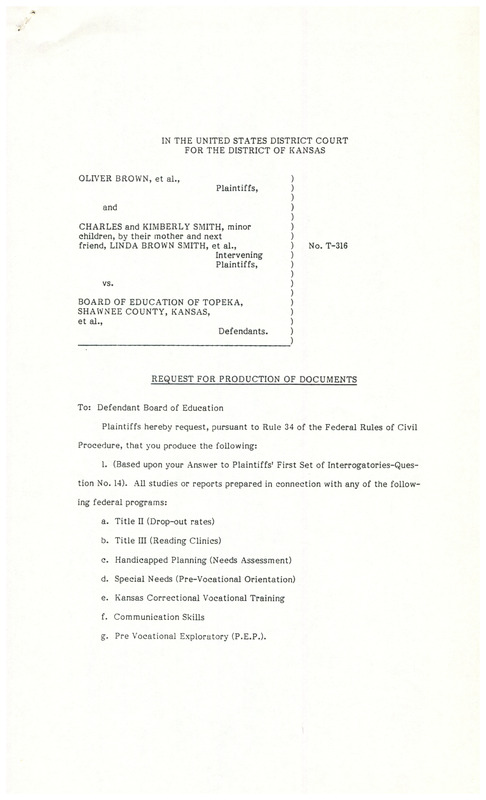
Case Data and Exhibits for Brown III, a relitigation of Brown v. Topeka Board of Education (1954) that corrected resegregation issues caused by open enrollment school choice in 1992. A list of documents the plaintiff attorneys request to be produced for evidence by the defense team.
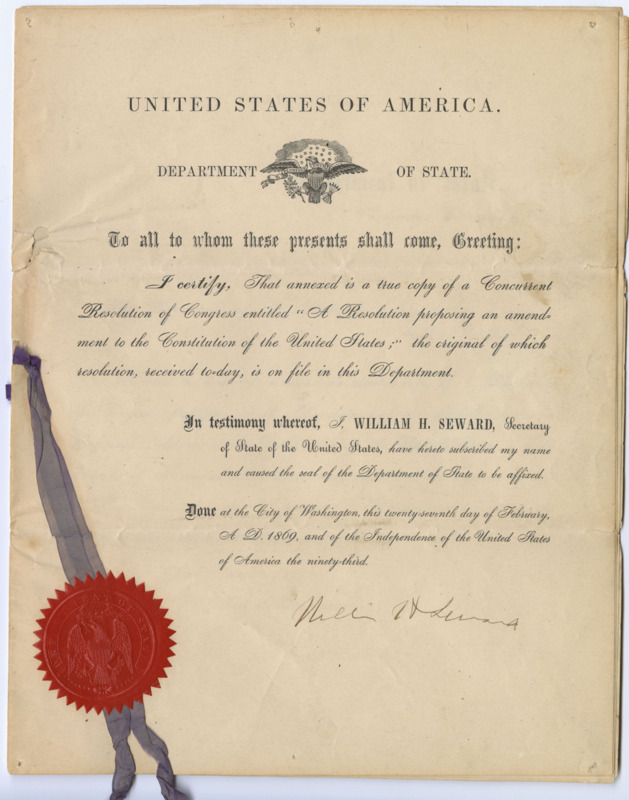
A letter from William H. Seward, Secretary of State, presents a resolution proposing an amendment to the U.S. Constitution to extend voting rights to people of color. The letter includes excerpts from the Governor of Tallahassee and references Article XV, advocating for equal voting rights for all citizens.
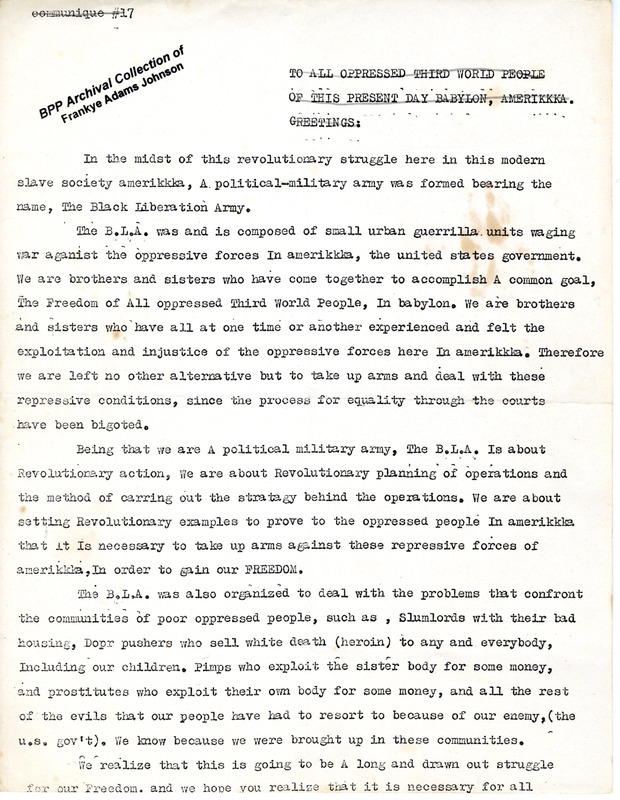
A rough draft of greetings to be given to people attending a Black Liberation Army (BLA) rally, with edits by an unknown person. The greetings outline the history and tenets of the BLA. “Communique #17” and “To All Oppressed Third World People of This Present Day Babylon, Amerikka. Greetings” on the top of page 1 were both crossed out.
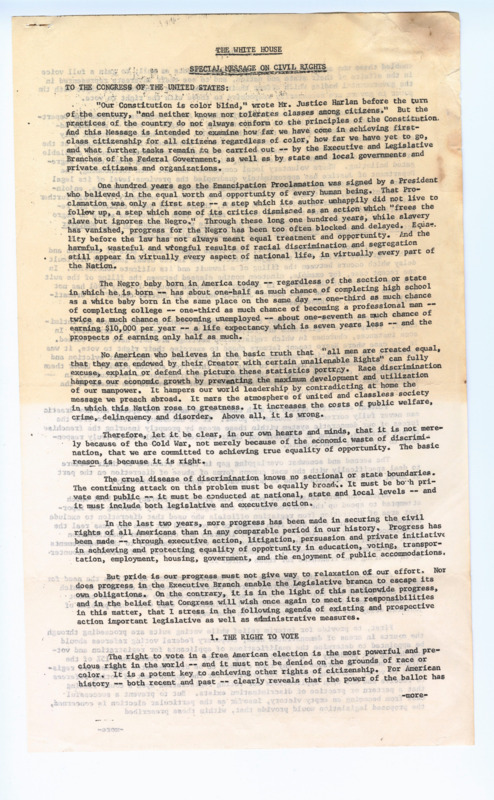
Under President Gore's administration, a White House message tackled harmful statistical stereotypes and societal biases. It condemned discrimination, emphasized voting and education rights, and advocated for the extension and expansion of the Commission on Civil Rights to promote equality and protect civil liberties for all.
Report on a telephone survey conducted with 400 Topekans selected randomly from the phone directory, conducted by Central Surveys Inc. of Shenandoah, Iowa. In general, the respondents believed the schools were performing well, but they also recognized patterns of segregation with the schools.
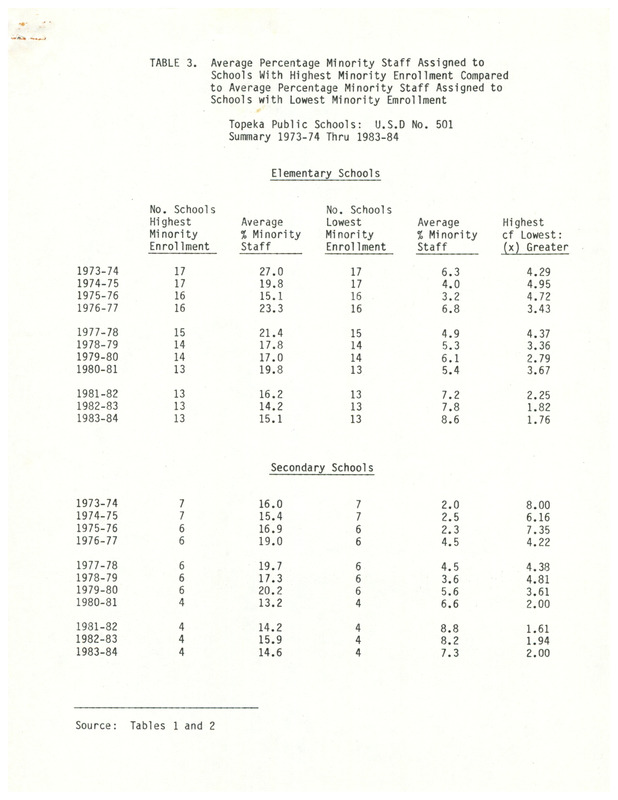
Case Data and Exhibits for Brown III, a relitigation of Brown v. Topeka Board of Education (1954) that corrected resegregation issues caused by open enrollment school choice in 1992. Charts comparing percentages of minority staff assigned to schools with highest minority enrollment to schools with the lowest in Topeka Schools from 1973 to 1984.
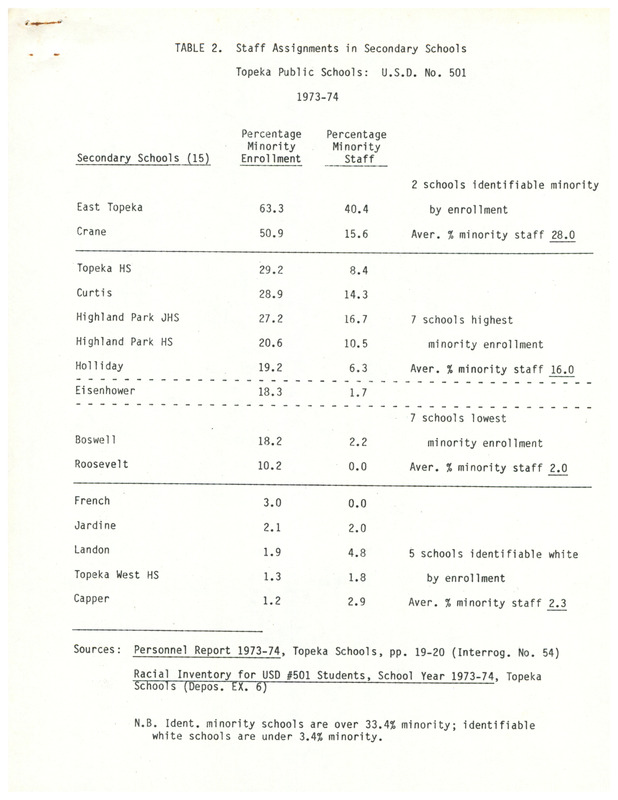
Case Data and Exhibits for Brown III, a relitigation of Brown v. Topeka Board of Education (1954) that corrected resegregation issues caused by open enrollment school choice in 1992. Charts comparing percentages of minority and white enrollment to minority and white staff members in Topeka, Kansas, schools from the 1973 to 1984 school years.
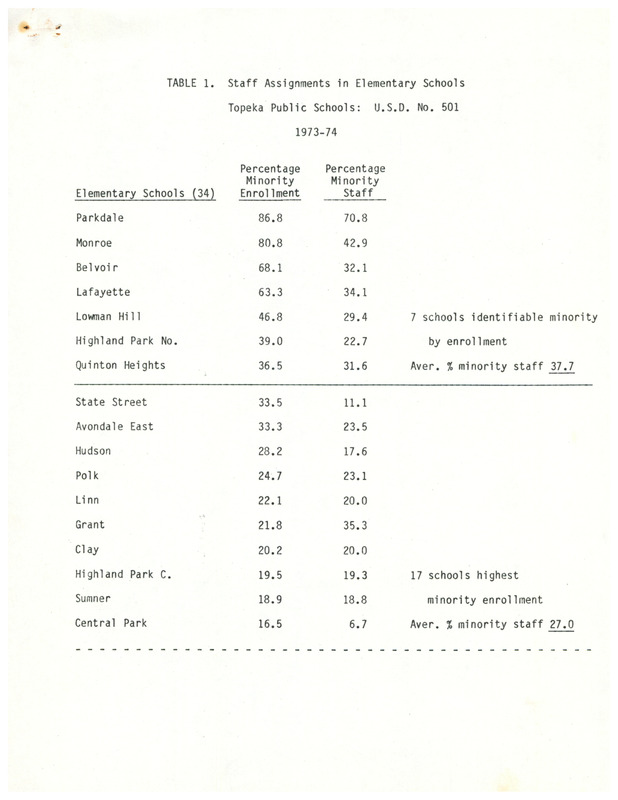
Case Data and Exhibits for Brown III, a relitigation of Brown v. Topeka Board of Education (1954) that corrected resegregation issues caused by open enrollment school choice in 1992. Charts comparing percentages of minority students to minority staff members in Topeka, Kansas, schools from the 1973 to 1984 school years.
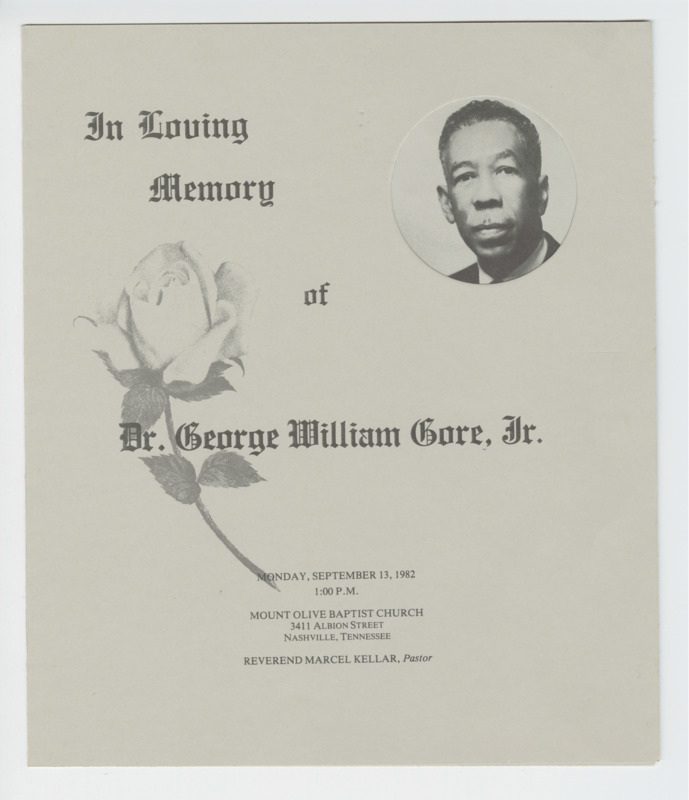
An obituary honoring President Gore, a visionary leader of FAMC and FAMU, pays tribute to his lifelong dedication to education and service. In loving memory, his funeral was held in Nashville, Tennessee in 1982, celebrating his legacy and the profound impact he left on both the university and community.