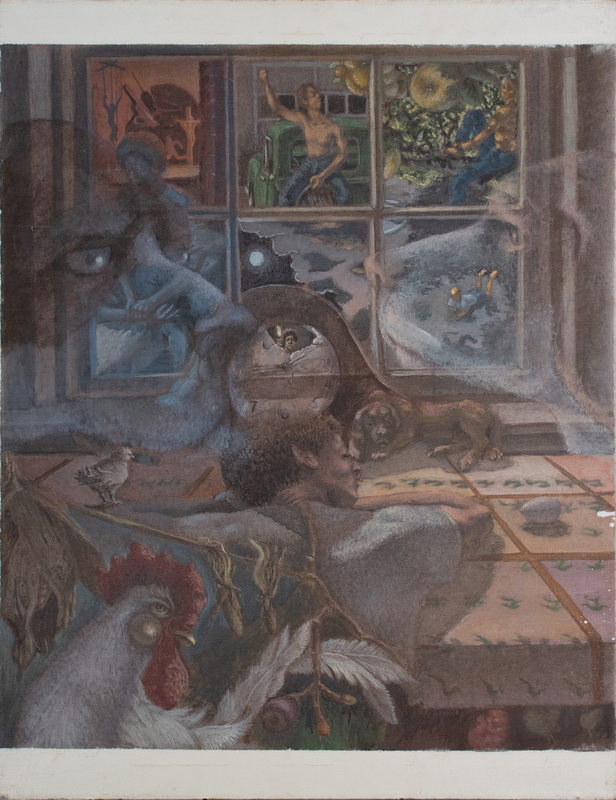
Samples' painting is a study of his mural created in Hannah Hall. The design unfolds like a dream, with each panel above the central figure (the artist himself), who is asleep on a table, revealing a constellation of scenes from the artists’ youth. Lower window panels evoke a harmonious existence with nature and animals, while upper panels reveal struggles with racism in the South and his mother’s death. The shadowy dogs along the sides of the study were not included in the final mural.
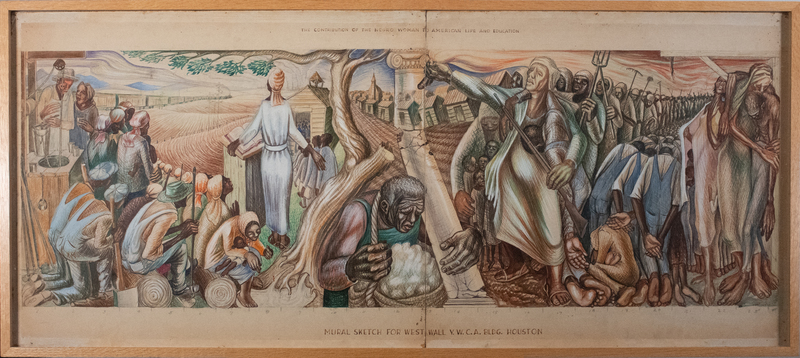
Biggers created this sketch while working on his mural, “The Contributions of the Negro Woman to American Life and Education,” for the Blue Triangle Branch of the YWCA. This mural was the culmination of his research for his doctoral dissertation at Penn State University. It features Harriet Tubman and Sojourner Truth leading enslaved people to freedom and educating African Americans, respectively.
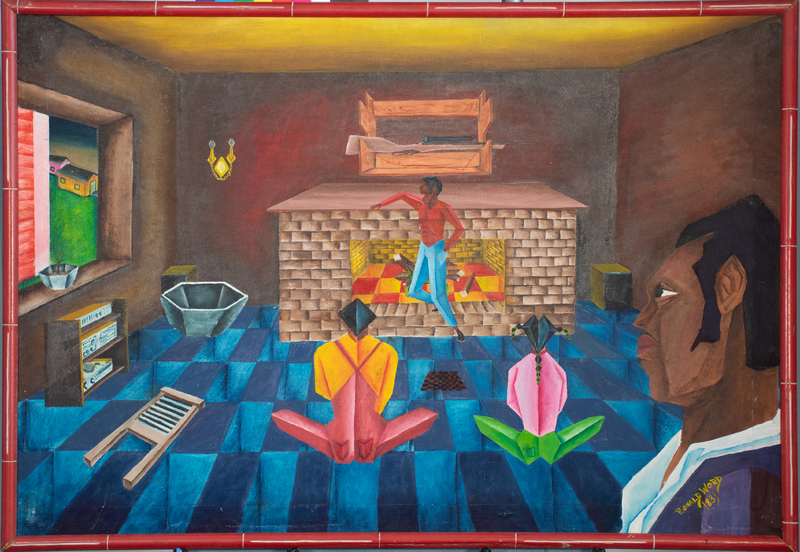
Word’s painting is a partial pre-study of his Hannah Hall mural. The painting, featuring a family in a small room with a fireplace, washboard, mounted gun, and radio, is done in a geometric style frequently seen in the art of Biggers’ students from the late 1970s and early 1980s. Word’s full mural design includes adjacent panels depicting a church, an abstract figure with a bubble-like head, and an homage to the Wizard of Oz.
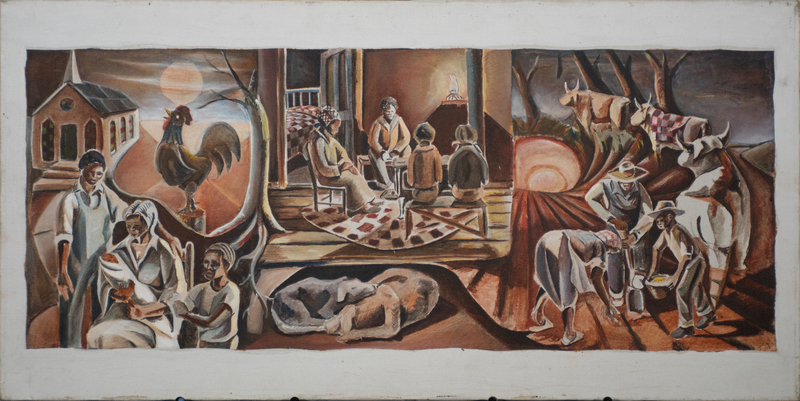
Williams’ painting is a pre-study for his mural. Across three scenes, the artist portrays birth, family home life, and farm work. This triptych style of composition appears frequently in the murals painted by students of Dr. John T. Biggers. The checkerboard motif that Williams uses in each panel is also drawn from Biggers’ teaching. Although Texas Southern is an urban university, many students hail from rural areas in Texas and these themes of country life appear repeatedly in student murals.
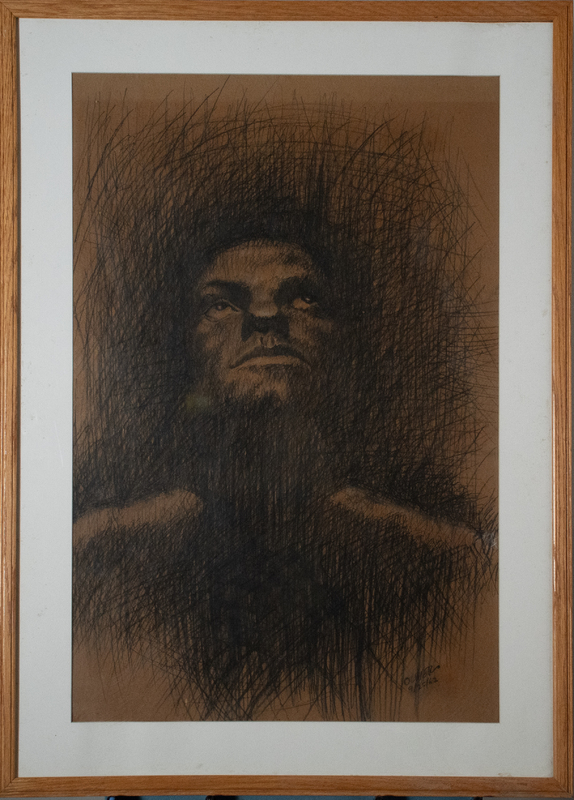
Oliver’s drawing is of a man looking upwards. This is a pre-sketch for a mural in Hannah Hall, which has a matching version with a woman and child. Oliver would find small spaces between other students’ murals and fill in the gaps with his own compositions. As a result, Oliver painted 6 murals in the building; no other student artist painted more than 2.
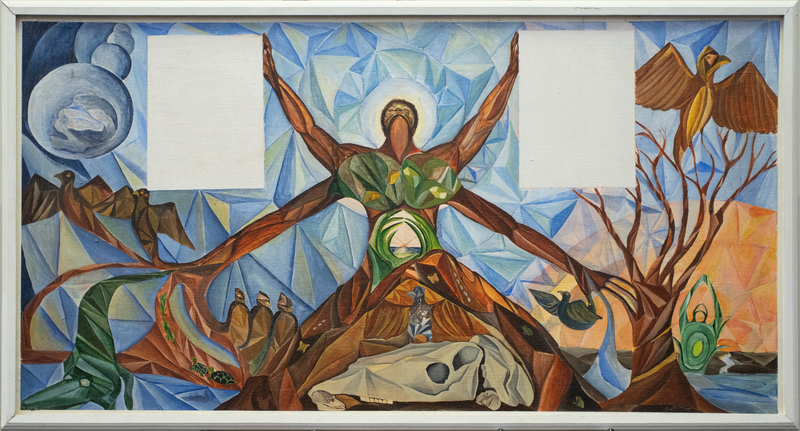
Sampson’s mural study depicts Mother Nature surrounded by birds, turtles, trees, fossils, and an expansive blue sky. This piece is painted in a geometric style that appears frequently in the work of students of Dr. John T. Biggers during the mid to late 1970s. Apart from some minor changes, Sampson’s final mural replicates the design in this earlier draft.
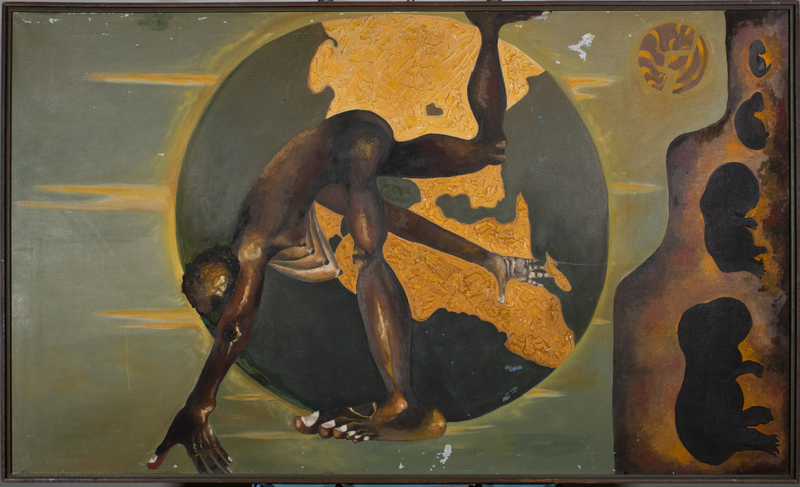
Tinker’s painting is a study of a section of her Hannah Hall mural. It depicts a naked woman bending over in front of a large globe. On the right side, the progression of human development, from embryo to fetus, is depicted. The final version of the mural features all of the pictured elements, but aligned differently and complemented by many additional images.
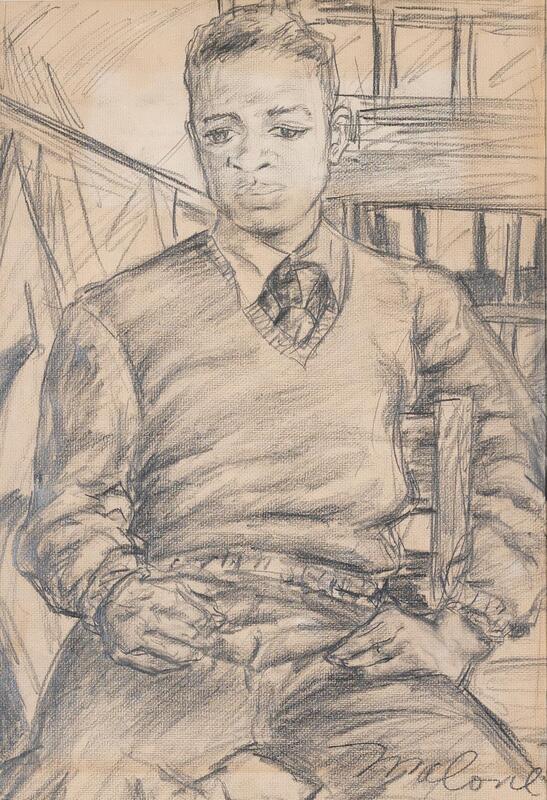
James H. Malone was a graphic artist, cartoonist, writer, and painter from Winterville, GA. My Classmate is a portrait drawing of a young Black boy in a school uniform. He sits in a chair with his hands on his lap, looking at the bottom left corner.
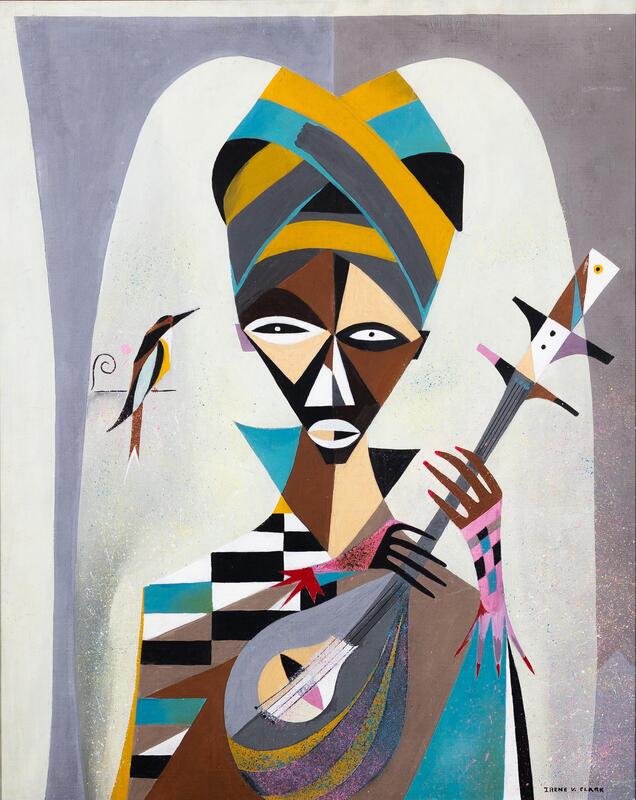
Irene V. Clark was a diasporic folklore artist from Washington, D.C. My Great, Great, Great, Great Grandfather's Cousin is a cubist portrait of a Black string musician wearing a cape and turban. Clark creates a symmetrical arch framing the subject and a perched hummingbird.
Samples’ mural unfolds like a dream, with each panel above the sleeping artist revealing a constellation of scenes from the artist’s youth. Lower window panels evoke a harmonious existence with nature and animals, while upper panels reveal struggles with racism in the South and his mother’s death.
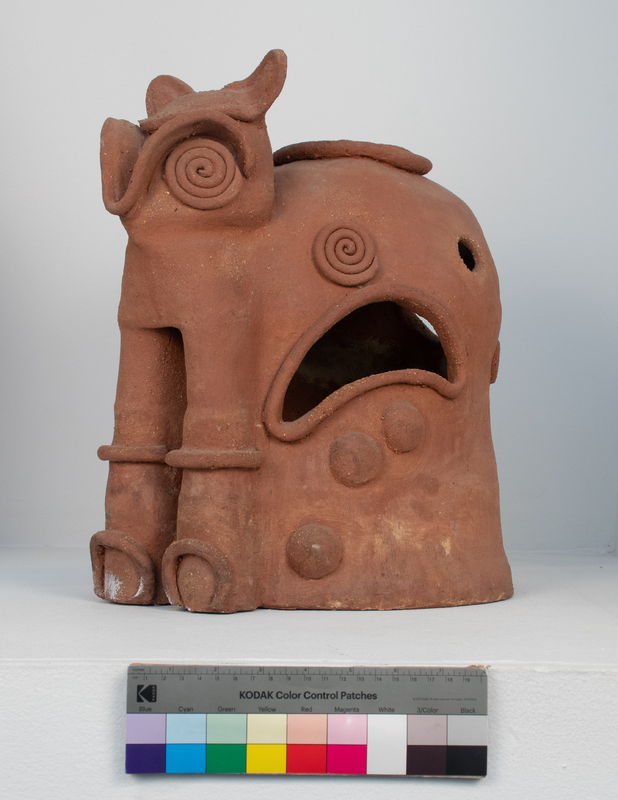
This terracotta features a snail-like creature with long legs, adorned with spiraled embellishments for the eyes and outer shell. The spiral motifs are placed in a symmetrical pattern on both sides of this sculpture. The clay is mixed with grog to create a better texture and prevent the terracotta from shrinking when fired.
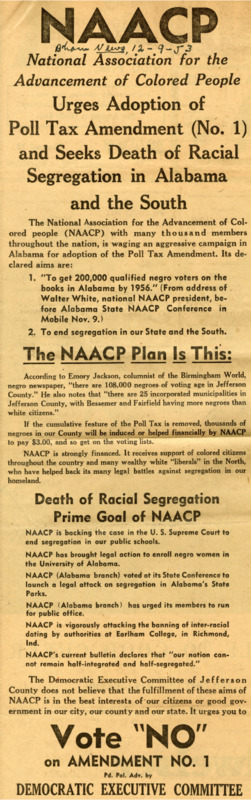
A document expressing the NAACP’s desires for the adoption of an amendment that will end poll tax not just within Macon County, AL but the entire state of Alabama.
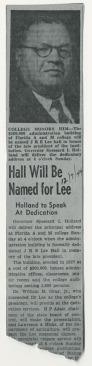
One of the most prominent symbols of Florida A&M includes Lee Hall, north of the Eternal Flame, which sits squarely in the middle of the campus quad. This newspaper clipping describes the $300,000 administrative building and how its namesake, former FAMU president J. R. E. Lee.
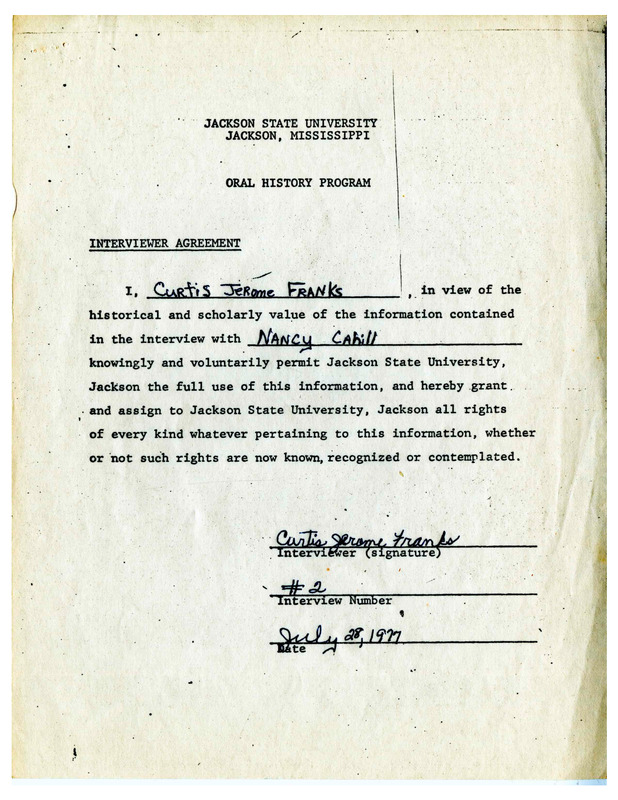
Nancy Cahill moved from Washington D.C., with her parents in 1948 when she was six years old and had lived in Clinton most of her life. In the interview she talks about her family's history in Clinton, MS, dating back to the 19th century; the town's rapid growth; her education; how Clinton compares and contrasts with Jackson; and racism in Clinton.
Nancy Stewart worked in the central office of the Child Development Group of Mississippi (CDGM) in Jackson, Mississippi, from 1967 until 1970. She talks about growing up during segregation in Gulfport, Mississippi, and the views that many people had about Head Start serving Black children. Interview is incomplete. Recording cuts short at the end.
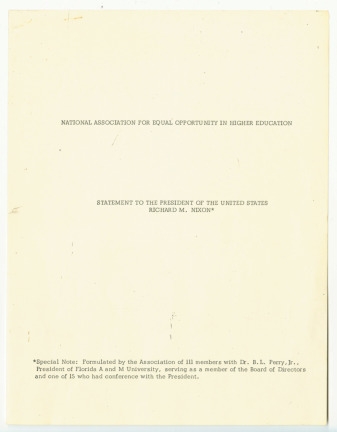
This statement to the President of the United States, Richard M. Nixon, was created by the association of 111 members with Florida A&M President Dr. Benjamin L. Perry, Jr., serving as a member of the Board of Directors and one of 15 members who had a conference with the former. It discusses equal opportunity and race relations in education.
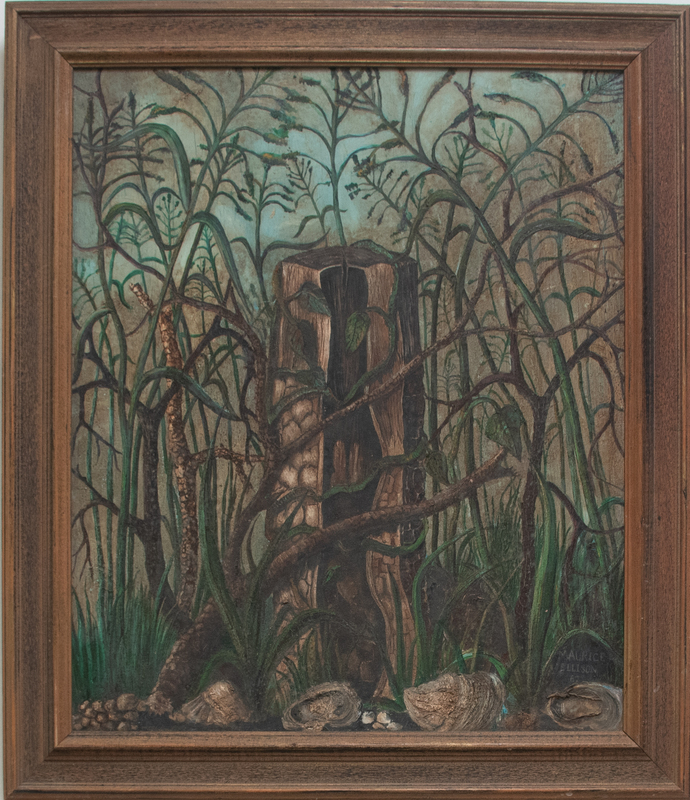
Ellison's painting is a nature scene featuring a bisected tree stump, with untamed growth all around it. At the bottom of the painting, there are several seashells, which the artist enhanced with raised, textural elements. Ellison graduated from Texas Southern University in 1972.
Dr. Eddie Jordan, Sr. was a Southern artist from Wichita Falls, TX. Negro Girl Skipping Rope depicts a young Black girl in the process of playing jump rope. The rope is positioned over her head as she prepares to hop over the rope with one leg lifted.
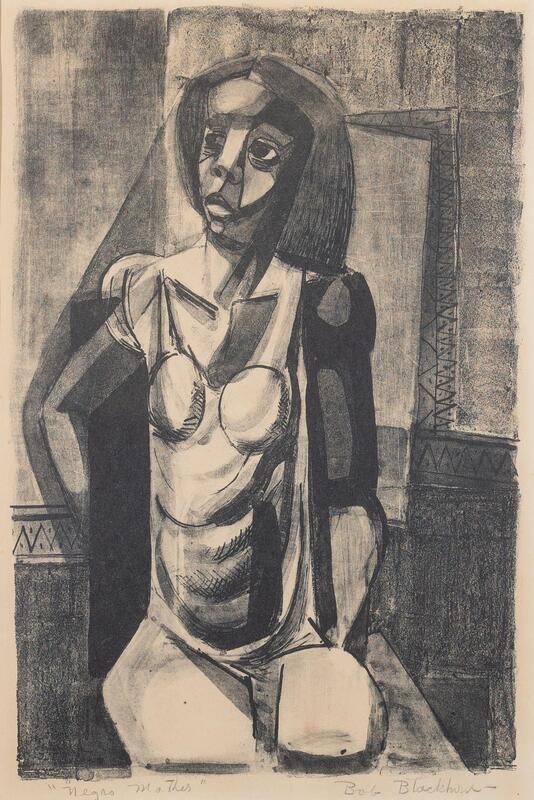
Robert Blackburn was a notable printmaker from Summit, NJ who grew up in Harlem, NY. Negro Mother depicts a Black woman with a sorrowful expression. Balckburn uses geometric shapes to emphasize her features adn the details of the background.
Elizabeth Catlett was an artist and educator from Washington, D.C., who repatriated to Mexico. Negro Woman is a wooden sculpture of a Black woman. Catlett crafts the woman with an intense stare through careful sculpting and inlaid onyx eyes.
Elizabeth Catlett was an artist and educator from Washington, D.C., who was repatriated to Mexico. Negro Woman is a print depicting a dark-skinned woman looking off into the distance. The piece is in Black and white, aside from her brown face. The woman is wearing a jacket pinned at the collar, an undershirt, and a straw hat.
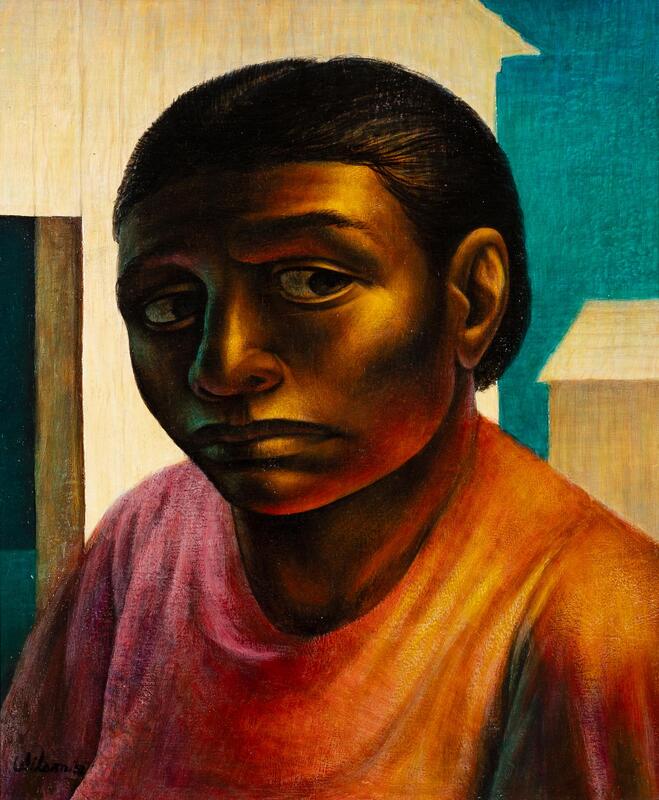
John Woodrow Wilson was a sculptor, painter, printmaker, and educator from Roxbury, MA. Negro Woman depicts a Black woman looking toward the distance from the side of her eyes. She is standing outside in a peach-colored shirt with the sun reflecting off of her face. Behind her are large buildings and a dark blue sky.
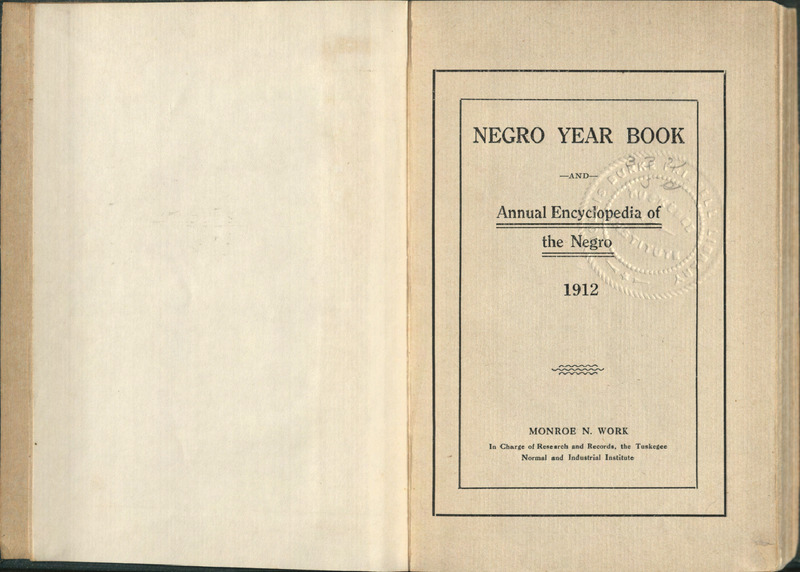
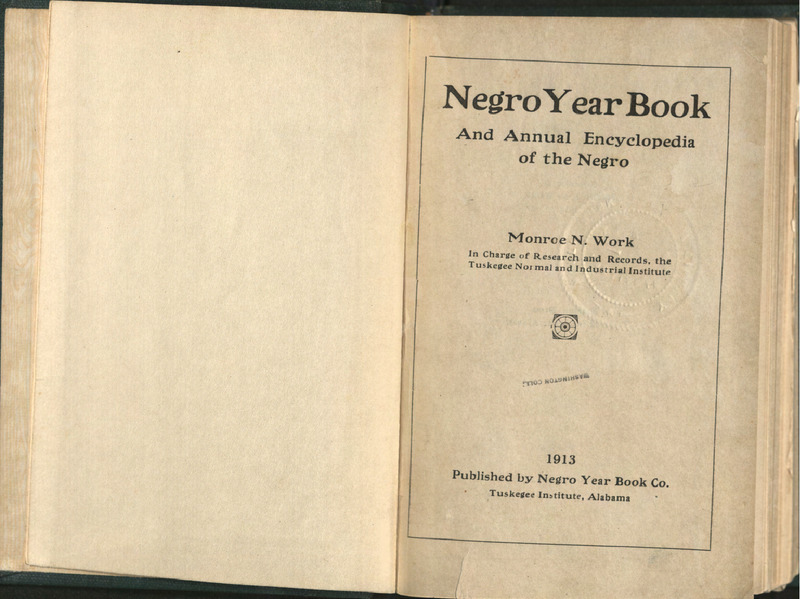
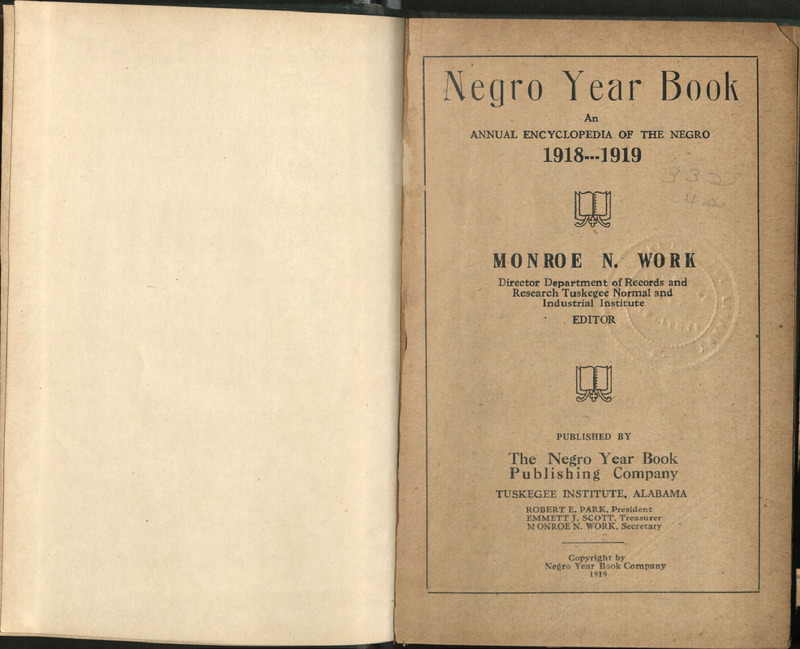
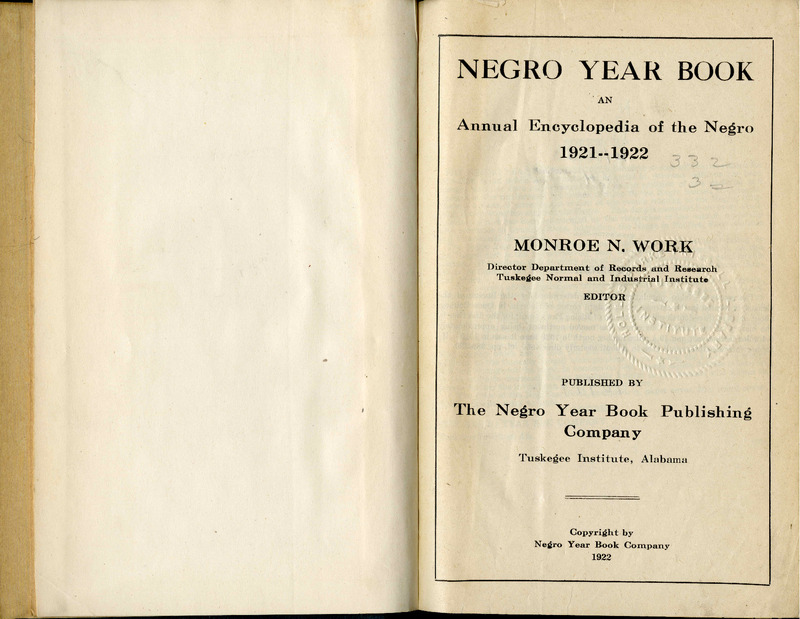
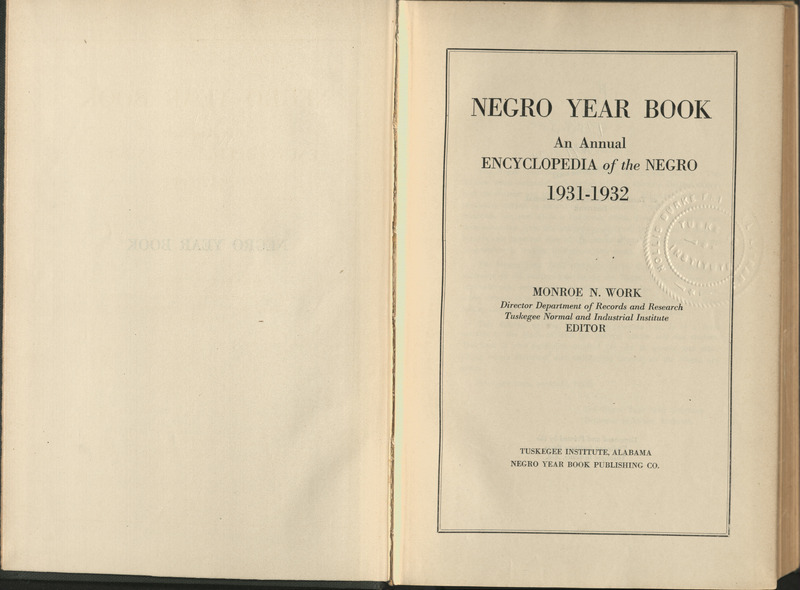
The Negro Yearbooks was an annual encyclopedia of the Negro published at Tuskegee University from 1912-1952. This chapter describes the history of slavery, abolition and freedom in the United States from 1645 to 1865.
The Negro Yearbook was an annual encyclopedia of the Negro published at Tuskegee University from 1912-1952. This chapter details the civil and political status of the Negro before 1865 to the early twentieth century.
The Negro Yearbook was an annual encyclopedia about African Americans, published at Tuskegee University from 1912 to 1952. This chapter focuses on the future of African American music.
The Negro Yearbook was an annual encyclopedia about African Americans, published at Tuskegee University from 1912 to 1952. This chapter details the growth of African American businesses since 1865.
The Negro Yearbook was an annual encyclopedia about African Americans, published at Tuskegee University from 1912 to 1952. This chapter details African Americans in politics since the end of the Civil War.
The Negro Yearbook was an annual encyclopedia of the negro published at Tuskegee University from 1912-1952. This chapter describes the importance of church to the African American community.
The Negro Yearbook was an annual encyclopedia about African Americans, published at Tuskegee University from 1912 to 1952. This chapter contains information on health and housing for African Americans.