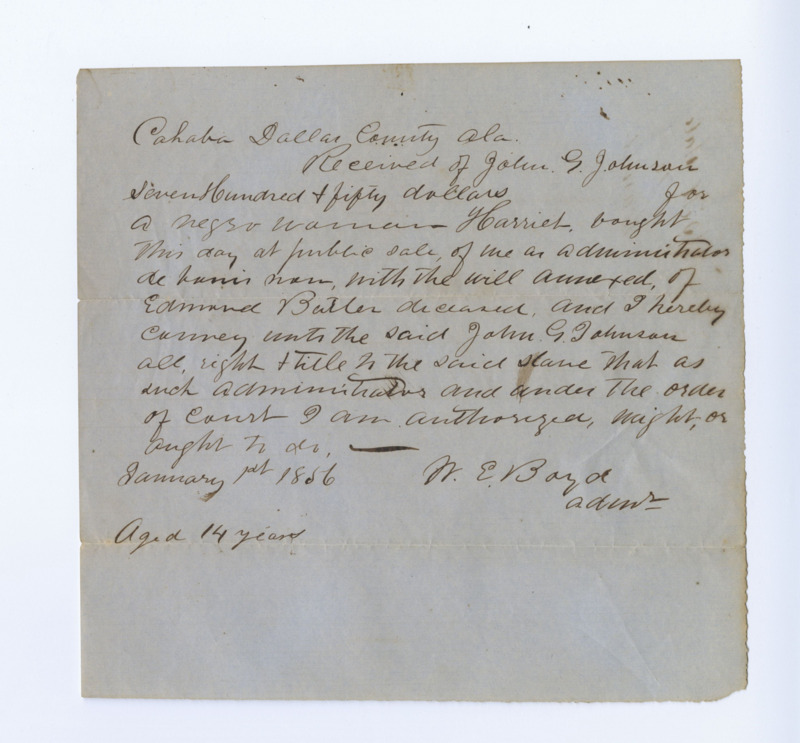
A rare 1856 letter from W. E. Boyd to John G. Johnson regarding the seven hundred and fifty dollar ($750) purchase of a fourteen-year-old negro girl named Harriet.
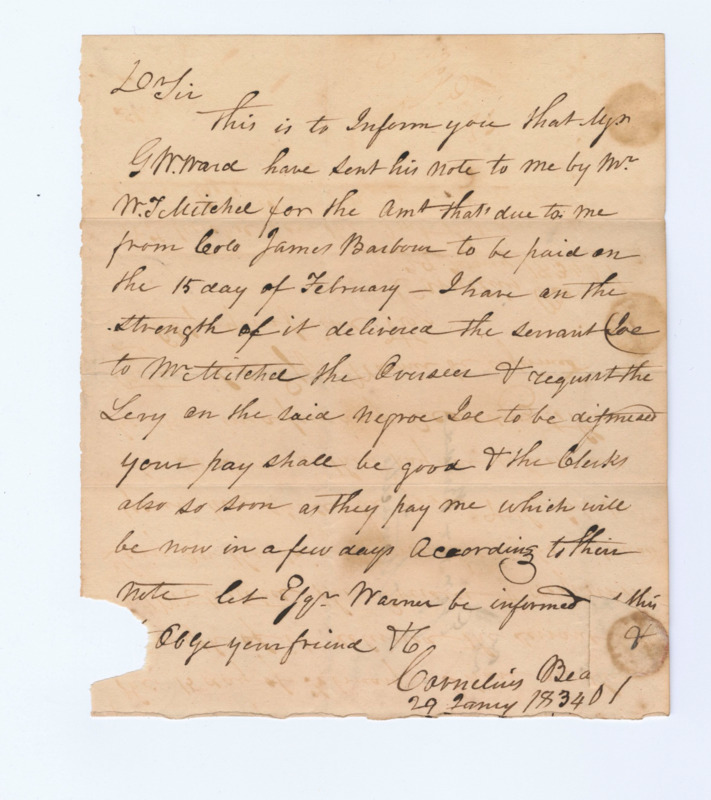
This rare slavery document is a letter from 1834 between W. Ward and Cornelius Beazley regarding the debt due in return for the lending of their slaves' labor.
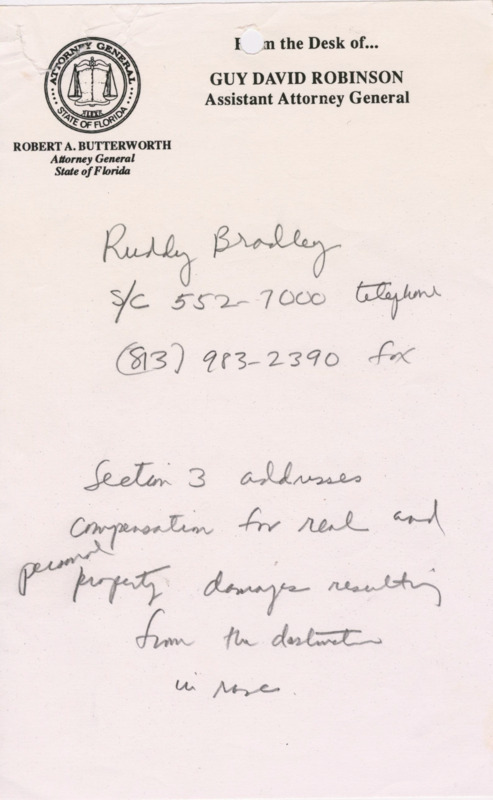
Legislative acts in Florida addressing the Rosewood Massacre and setting the legal framework for compensation and historical investigation. These acts were designed to ensure the state recognized the tragedy, supported the documentation of its impact, and provided a pathway for descendants to seek justice and reparations.
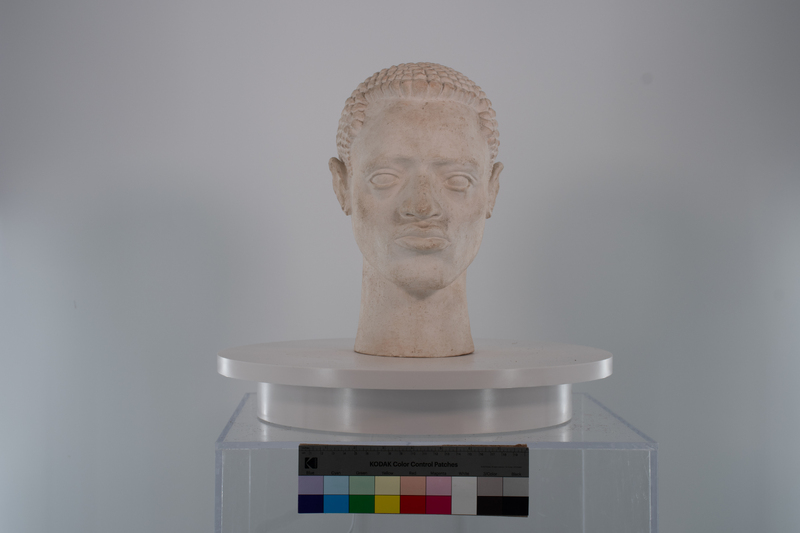
Leon Renfro’s bust is unique within the Texas Southern sculpture collection. It is one of only two busts made from a white plaster (as opposed to the standard terracotta material). The sculpture is also rather bare, lacking the intricate embellishments and ornamentation that are typical of the work of Carroll Harris Simms’ students.
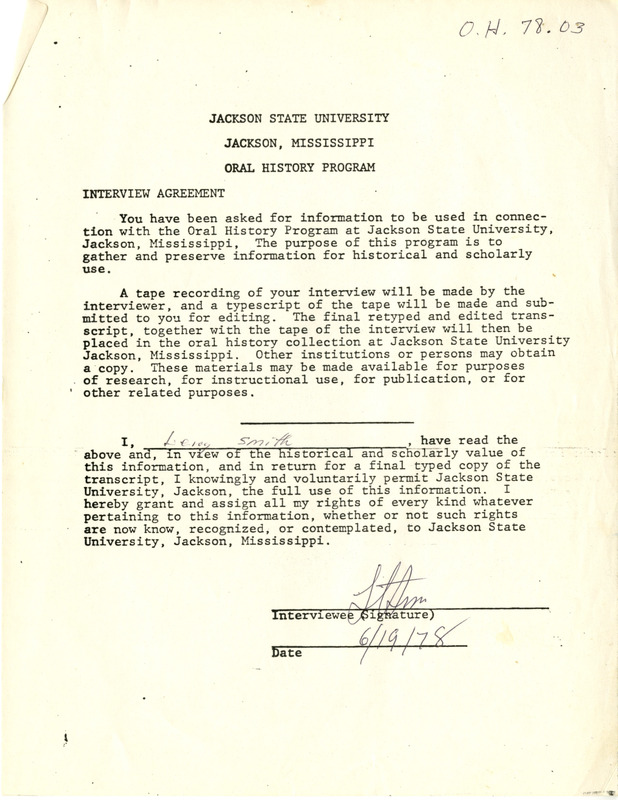
Leroy Smith was born in Jackson in 1918 and lived in Jackson his entire life. He attended Smith Robertson School until 6th grade and talks about his time there. He discusses the nightlife in the district beginning in the 1930s, including a number of restaurants, ballrooms, limited options to watch movies, and the red light district.
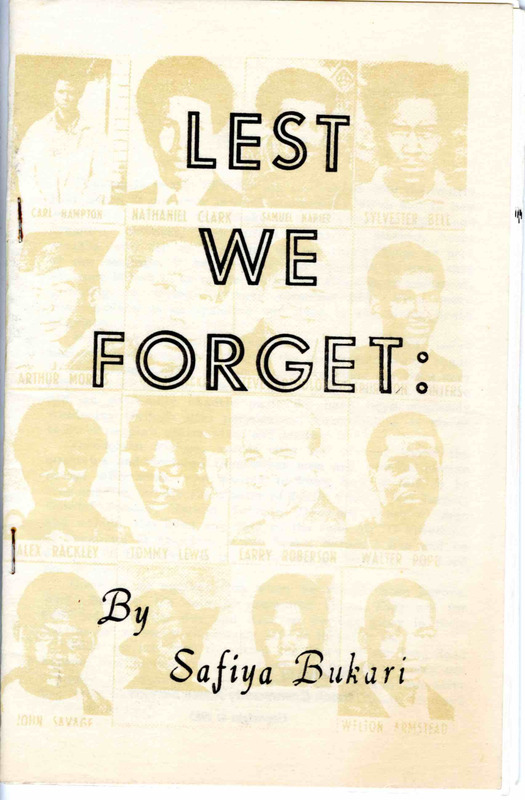
A booklet written by Bernice Jones (aka Safiya Bukhari), who was a Black Panther Party member and vice president of the Republic of New Afrika. The booklet lists members of the Black Panther Party who were killed between 1966 and 1981. There is also a memorial write up and poem in the conclusion.
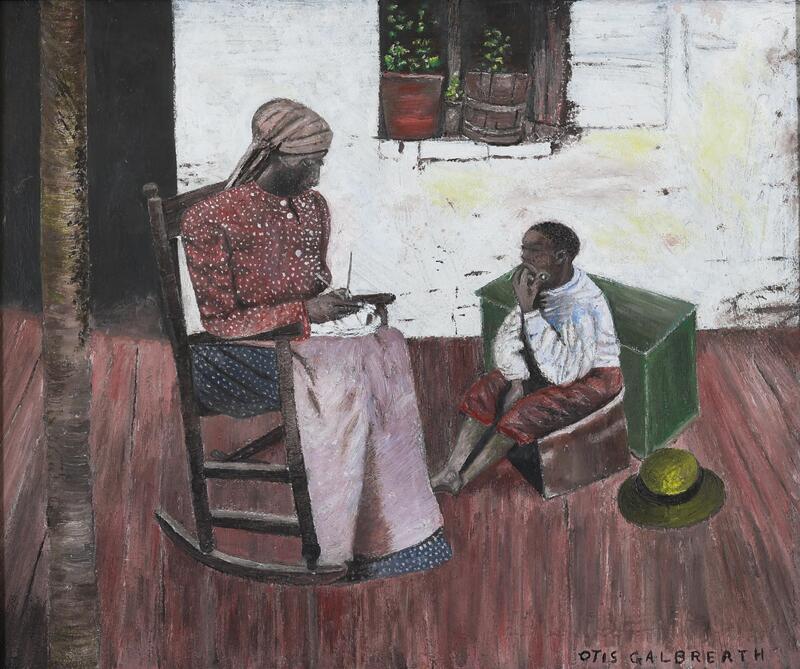
Otis Galbreath was an artist from Jackson, MI. Let By-Gones be By-Gones shows a woman and a young boy sitting down in a room with wooden floors and plant barrels behind them. The woman sits in a rocking chair looking down to knit, while the boy sits across from her with a hand in his mouth. A green hat sits beside him.
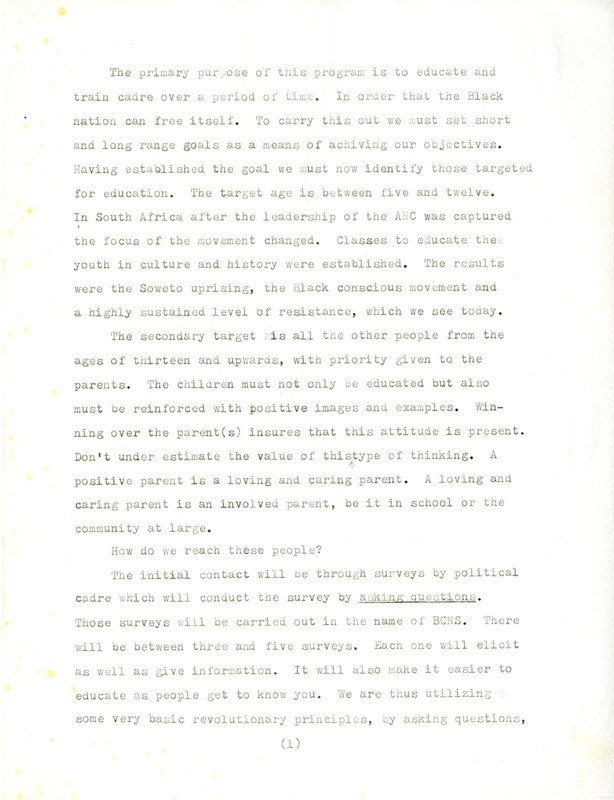
In this letter, Frankye Adams-Johnson (Malika)’s husband, Nuh Abdul Qaiyum, who is imprisoned, outlines a training and education program for Black liberation. He outlines the goals and priorities of the Black Panther Party moving forward and the means required. Instead of the usual militant rhetoric, he takes a social approach to the Revolution.
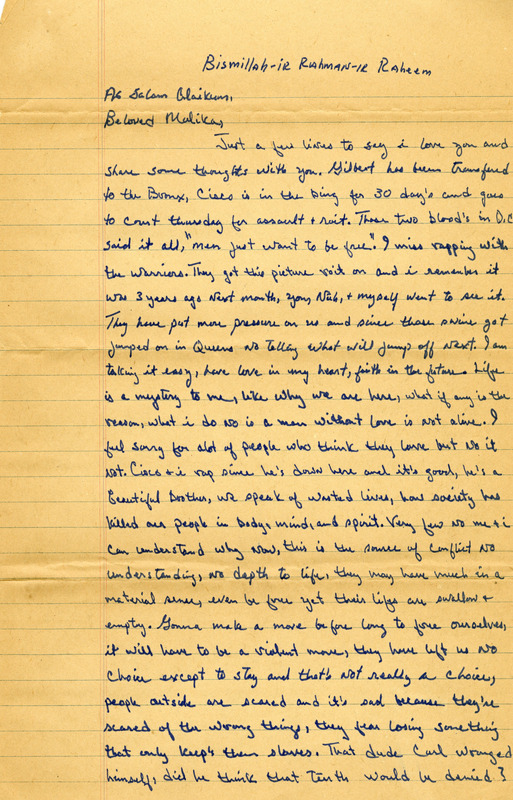
A letter from Nuh Abdul Qaiyum, who is imprisoned, to his wife Frankye Adams-Johnson (Malika). He sends the family his love and shares his thoughts on life in prison and conflict within the Black community and the Black Panther Party. He asks her about her upcoming birth and offers guidance and advice. He also includes multiple poems.
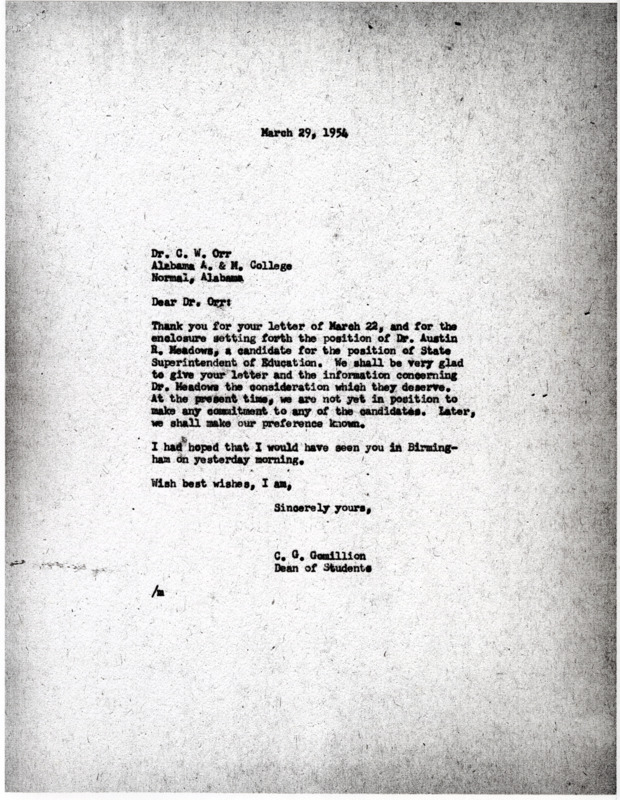
A letter written by Charles G. Gomillion to Dr. C.W. Orr concerning Dr. Austin R. Meadows consideration for the Superintendent of Education of Macon County, AL.
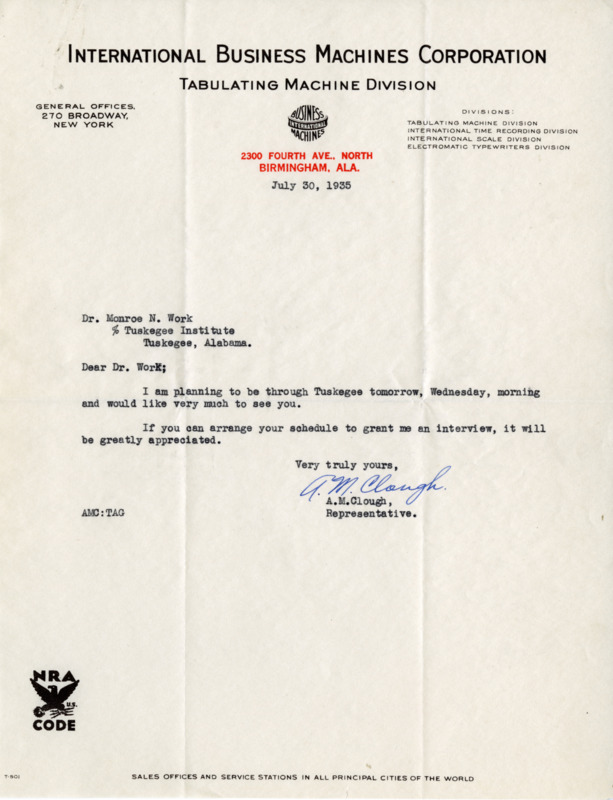
Letter from A. M. Clough requesting an interview with Monroe N. Work for the following day, Wednesday. Printed on "International Business Machines Corporation, Tabulating Machine Division" stationery.
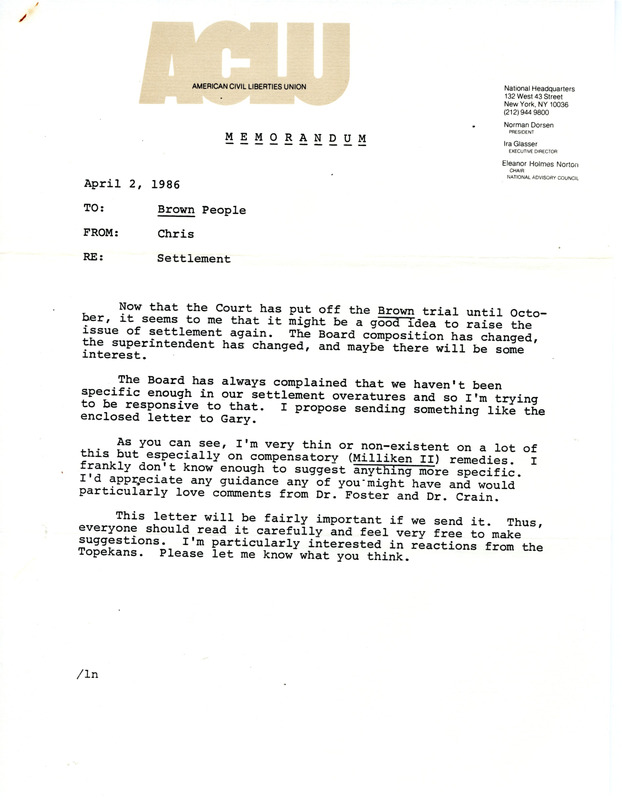
ACLU Attorney Chris Hansen writes to the members of the Brown Counsel team to inquire about their thoughts on a possible settlement. Attached is the court document containing the order of activities for the case between May and September 1986.
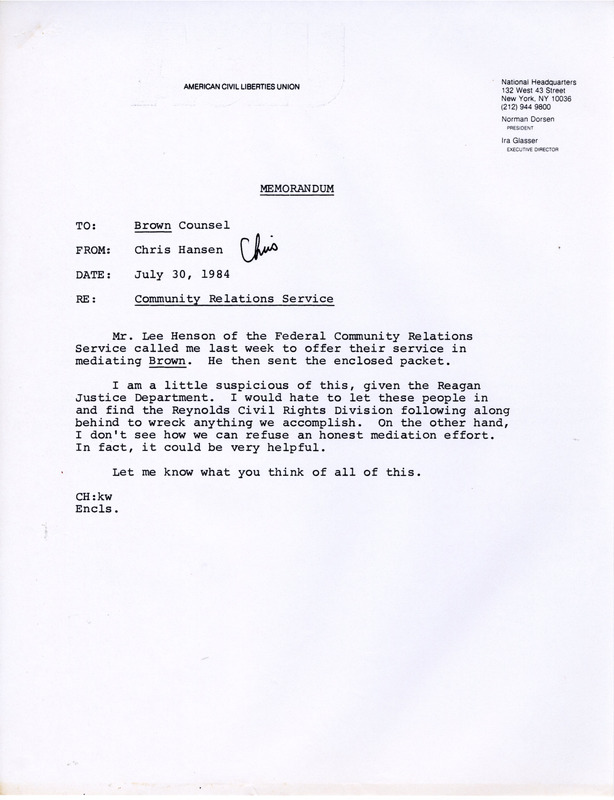
ACLU Attorney Chris Hansen writes to the members of the Brown III Counsel team to inform them that Lee Henson of the Federal Community Relations Service has offered their service in the case. Mr. Hansen is suspicious of this because of his opinion of the Justice Department under then-president Ronald Reagan.
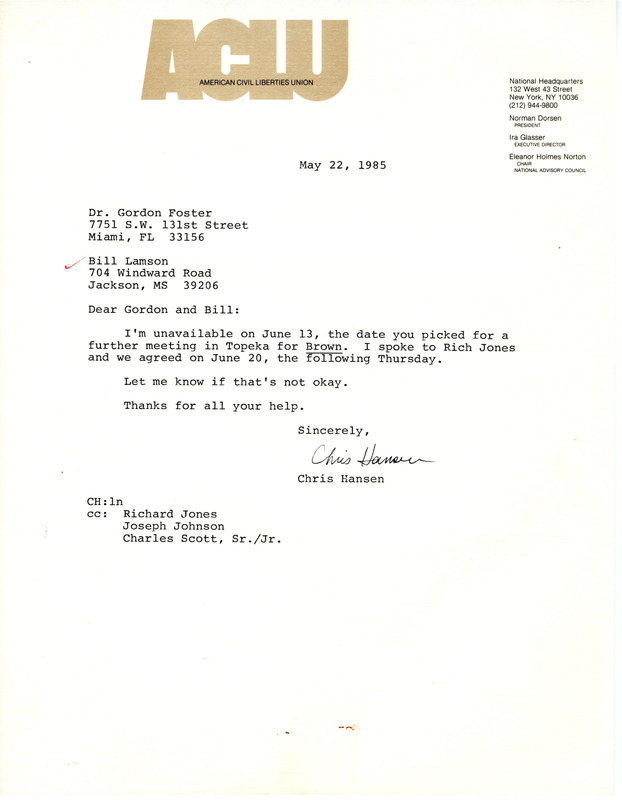
ACLU Attorney Chris Hansen writes to Dr. Gordon Foster and William Lamson to inform them that he is unavailable for the requested meeting date of June 13th, 1985, but can meet on June 20th instead. Dr. Foster and Lamson were to meet with the plaintiff team about their roles as expert witnesses in the Brown III case.
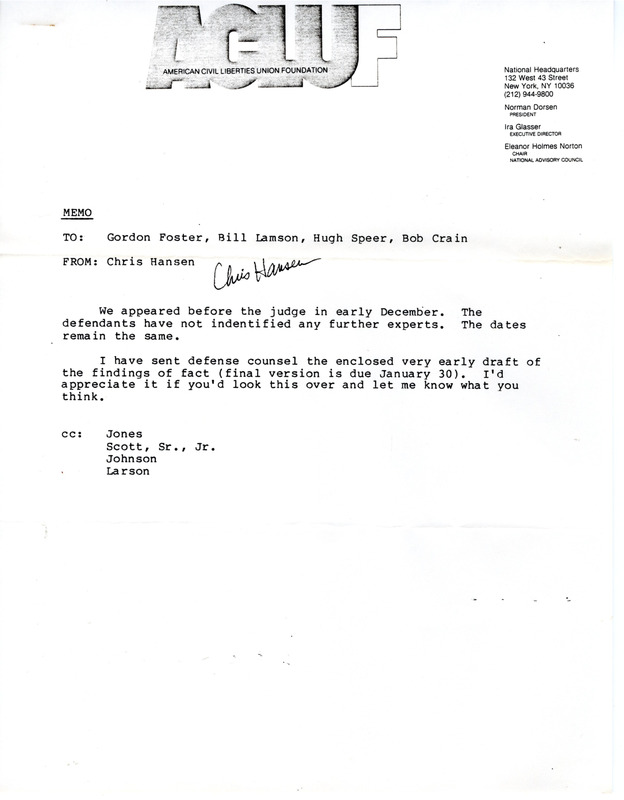
ACLU Attorney Chris Hansen writes to plaintiff expert witnesses Dr. Gordon Foster, William Lamson, Hugh Spear, and Bob Crain to inform them that dates and witness lists did not change after his appearance before the judge in early December. Attached is an early draft of findings of facts that he has shared with the defense.
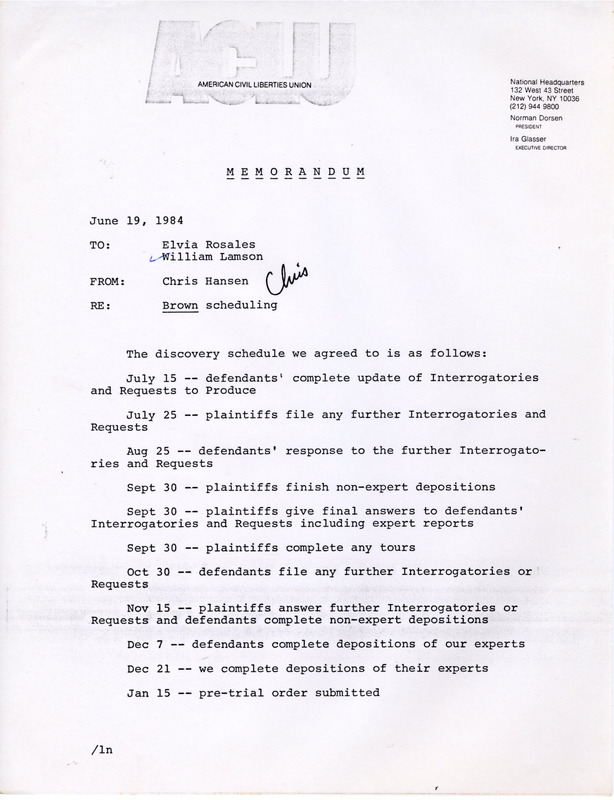
ACLU Attorney Chris Hansen writes to Elvia Rosales Arriola of the ACLU and William Lamson to outline the discovery schedule for the Brown III case. The schedule runs from July 15, 1984 to January 15, 1985 and includes depositions, due dates for interrogatories, tours of sites, and pre-trial orders.
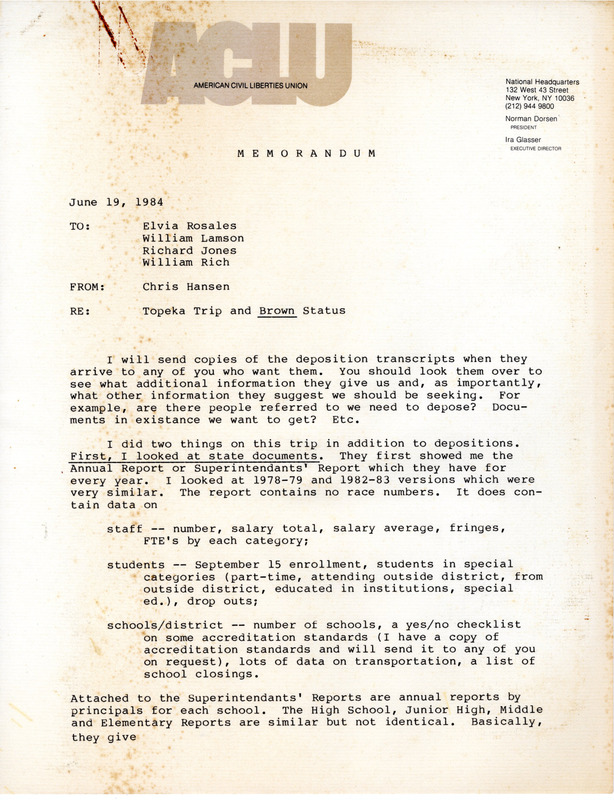
ACLU Attorney Chris Hansen writes to Elvia Rosales Arriola of the ACLU, William Lamson, Attorney Richard Jones, and Attorney William Rich to send an update on the round of depositions he completed. He also attached superintendent's and principal's annual reports for each school that he obtained on his recent trip to Topeka.
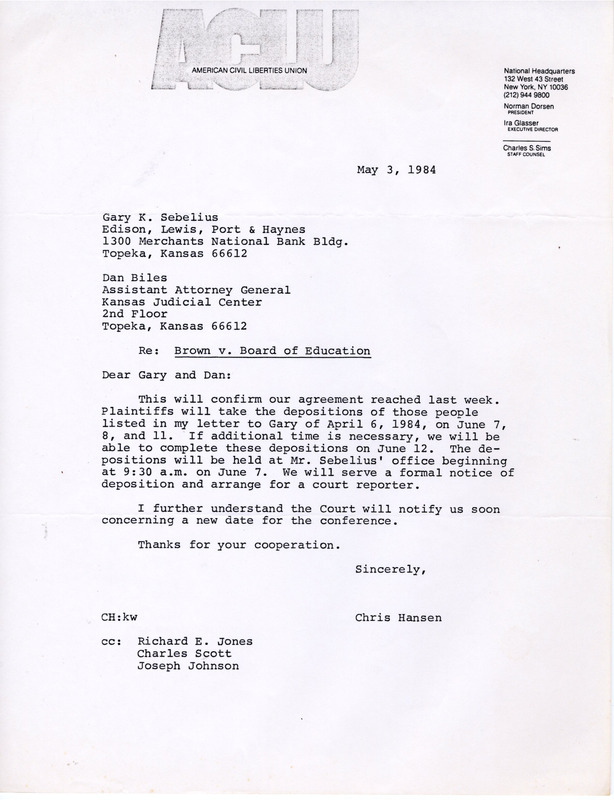
This letter from ACLU Attorney Chris Hansen to lead defense Attorney Gary K. Sebelius and Kansas Assistant Attorney General Dan Biles confirms deposition dates for June 7, 8, and 11, 1984, with a completion date of June 12. Hansen notes that formal notice of deposition will be served and a court reporter will be in the depositions.
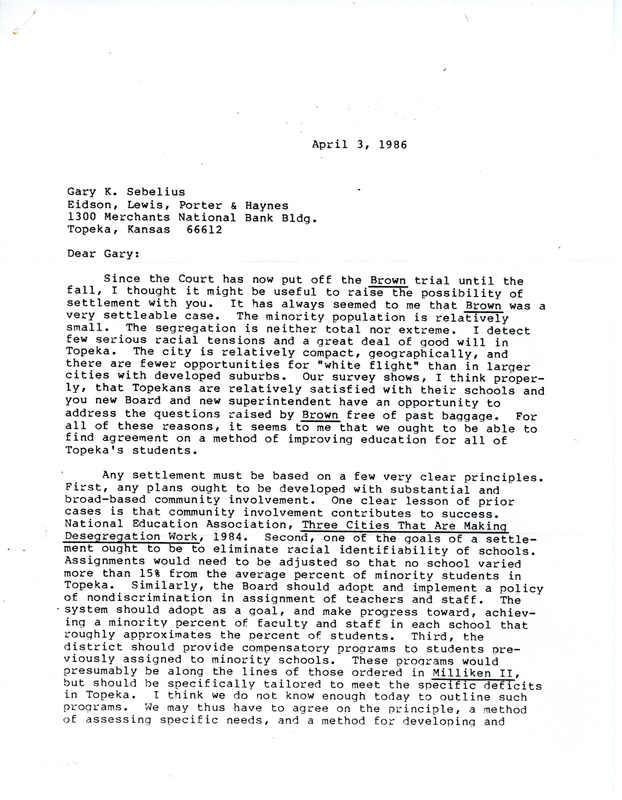
ACLU Attorney Chris Hansen writes to Lead Defense Attorney K. Gary Sebelius to outline a possible settlement for the case since the court has again pushed the date of the trial back. Mr. Hansen lists the principles on which a settlement would have to be based, including community involvement in any plans for the district.
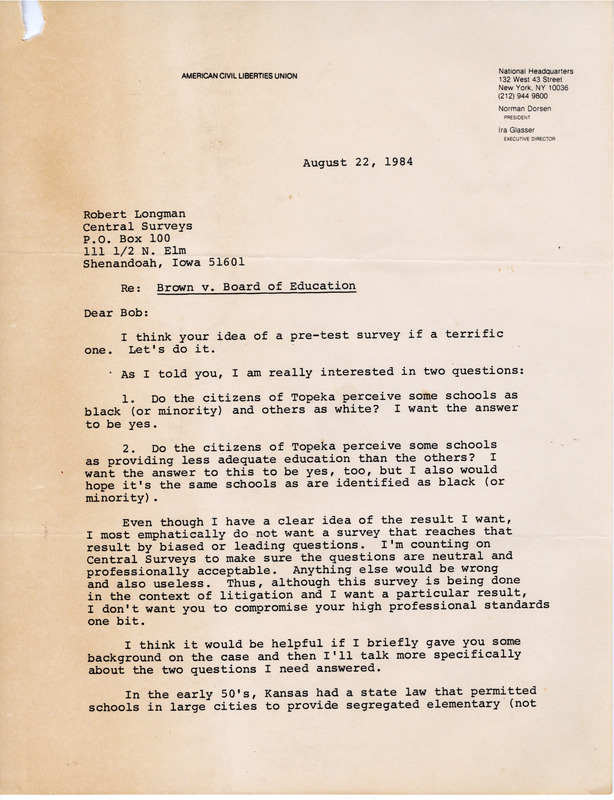
ACLU Attorney Chris Hansen writes to Robert Longman of Central Surveys Inc. to confirm a pre-test survey. Mr. Hansen gives background on the case and talks more specifically about the two questions he wants answered in the survey about Topeka residents' perception of whether schools are white or Black and if some schools are less adequate.
ACLU Attorney Chris Hansen sends William Lamson the order of activities for the case between December 1985 and March 1986. Also attached is the designation of fact witnesses by individually-named defendants associated with the State Board of Education.
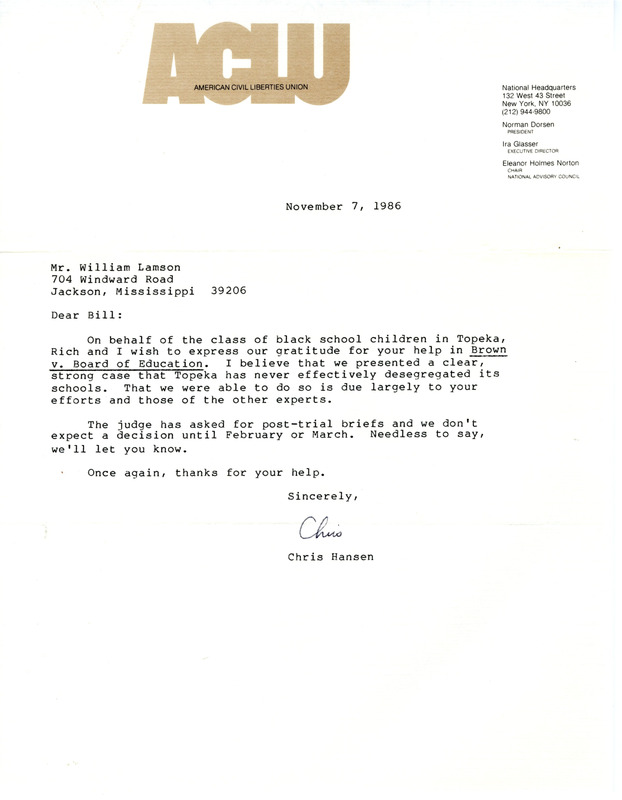
ACLU Attorney Chris Hansen writes to William Lamson to express his gratitude for working on the case. Hansen thanks Lamson on behalf of the class of Black school children in Topeka and writes that he feels the team presented a strong case that Topeka schools have never been fully desegregated and he expects a ruling sometime in early 1985.
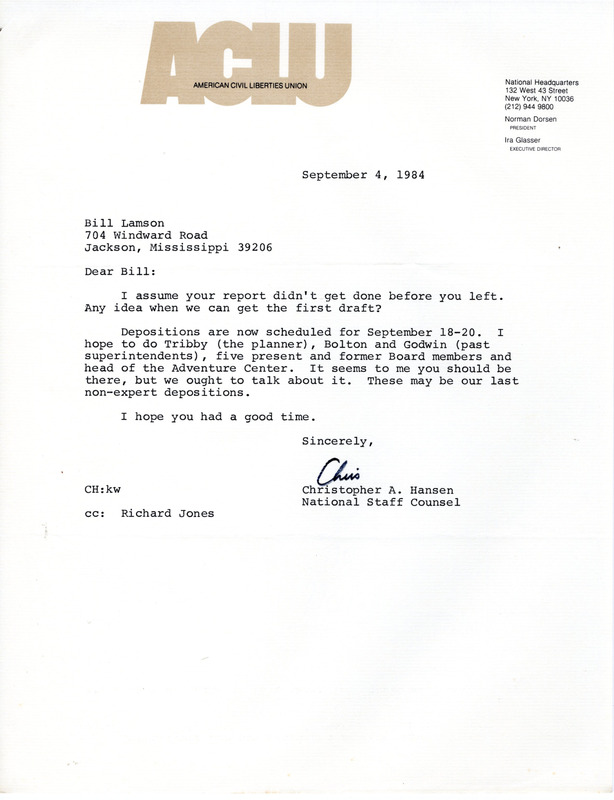
ACLU Attorney Chris Hansen writes to William Lamson requesting a first draft of a report and to alert him that depositions are now scheduled for September 18-20, 1984. Hansen writes that Lamson should be present at this round of depositions and they will discuss the matter further.
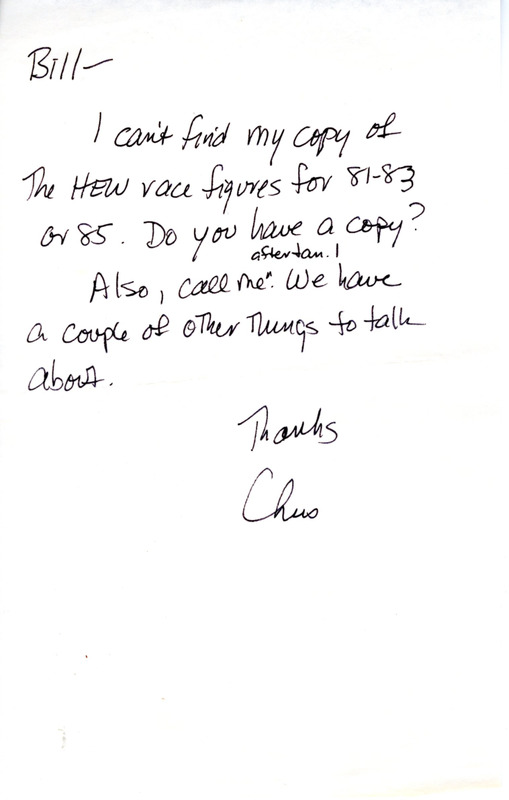
Handwritten letter from ACLU Attorney Chris Hansen to William Lamson asking Lamson if he has copies of the United States Department of Health, Education, and Welfare (HEW) race figures for 1981-1983 and 1985.
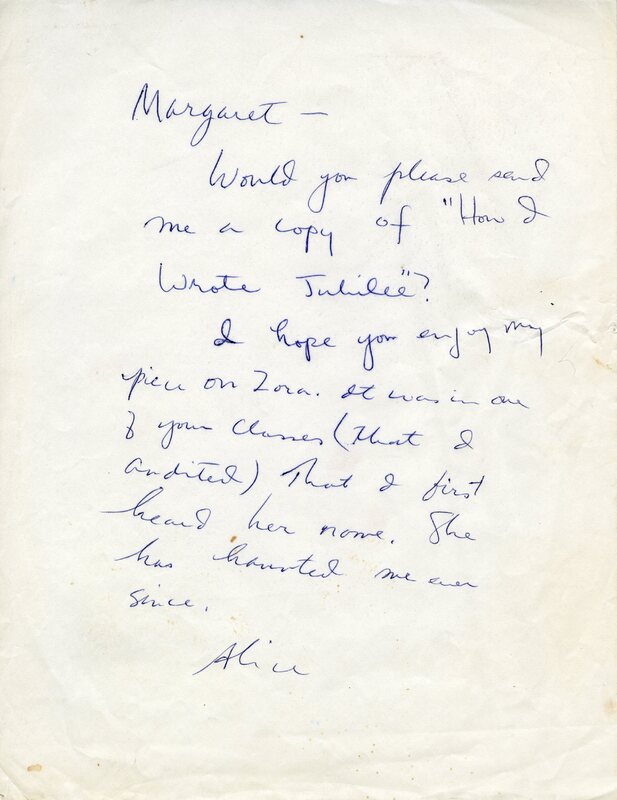
Renowned writer and activist Alice Walker was a dear friend of Margaret Walker. In this letter, Alice Walker asks Margaret Walker for a copy of “How I Wrote Jubilee.” Alice Walker also mentions a new piece she has about Zora Neal Hurston and that she first heard of her in one of Margaret Walker’s classes she was auditing.
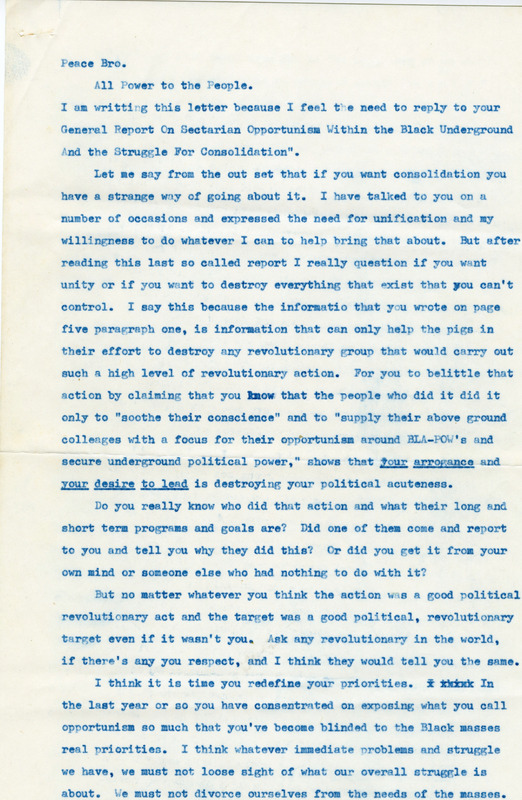
A letter from an unknown sender to an unknown recipient. The letter is written in response to a "General Report on Sectarian Opportunism Within the Black Underground and the Struggle for Consolidation." The sender is very critical of the report writer’s opinions on how to attain consolidation and unity in the movement for Black liberation.
Ashanti Alston, a Black Liberation Army (BLA) member who was imprisoned for 11 years for a robbery, writes about his plans to retrieve Frankye Adams-Johnson (Malika)’s art materials from her property. He tells her that he plans to be out by September and to take care of himself. The letter is dated July 16th with no year specified.
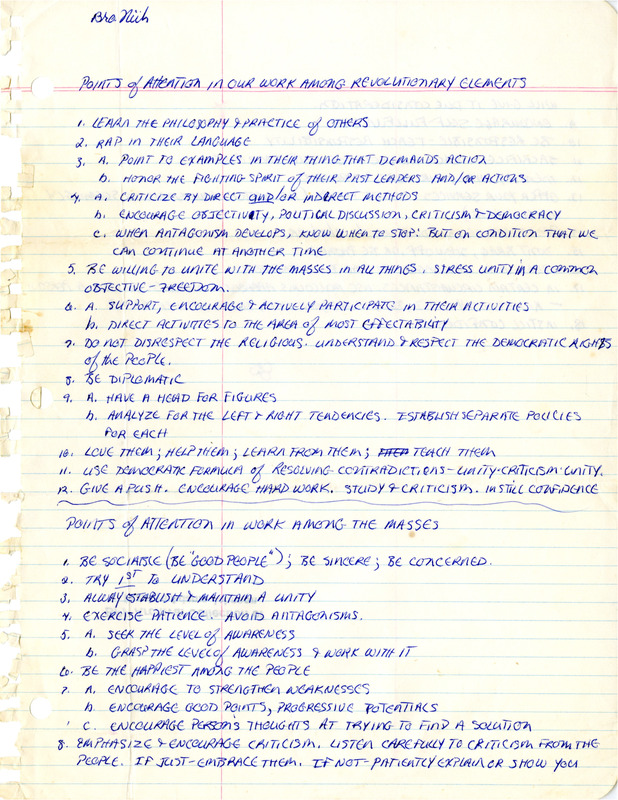
A letter from Ashanti Alston, a Black Liberation Army (BLA) member who was imprisoned for 11 years for a robbery to raise money for the BLA, to Nuh Abdul Qaiyum. The letter includes 2 lists: "Points of Attention In Our World Among Revolutionary Elements" and "Points of Attention in Work Among the Masses"
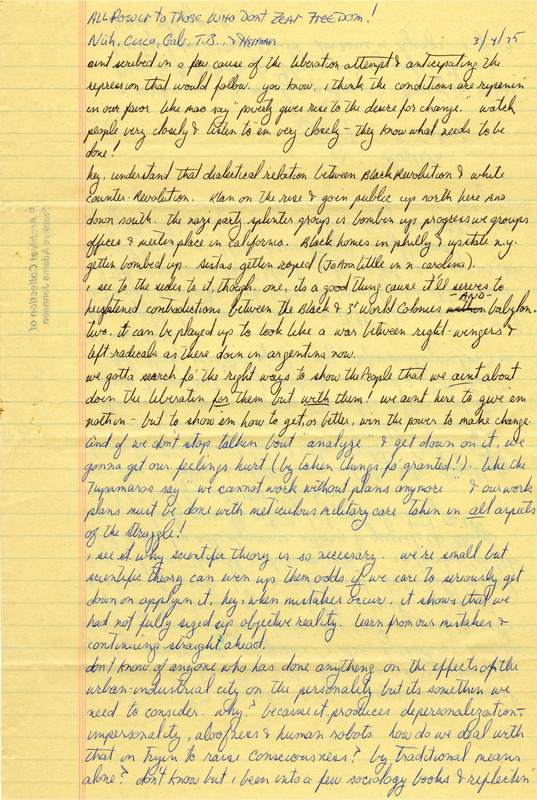
Ashanti Alston, a Black Liberation Army (BLA) member who was imprisoned for 11 years for a robbery to raise money for the BLA, writes to three fellow imprisoned revolutionaries. He writes about the psychology of the fight for Black liberation and the ways in which their organization should fight for the people.