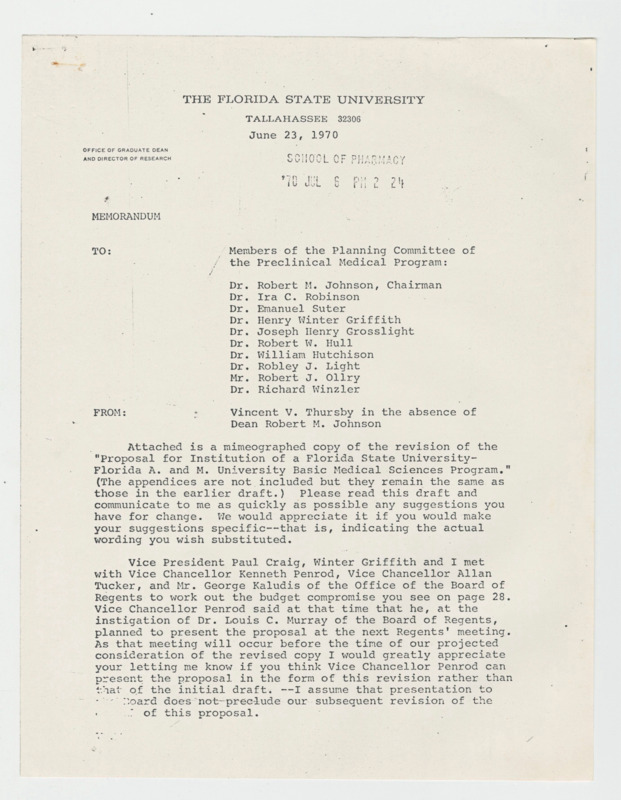
This document is a revised, detailed abstract of the “Proposal for Institution of a Florida State University- Florida A&M University Basic Medical Sciences Program,” sent to members of the Planning Committee of the Preclinical Medical Program. It detailed the addition of a joint medical program between FAMU and FSU.
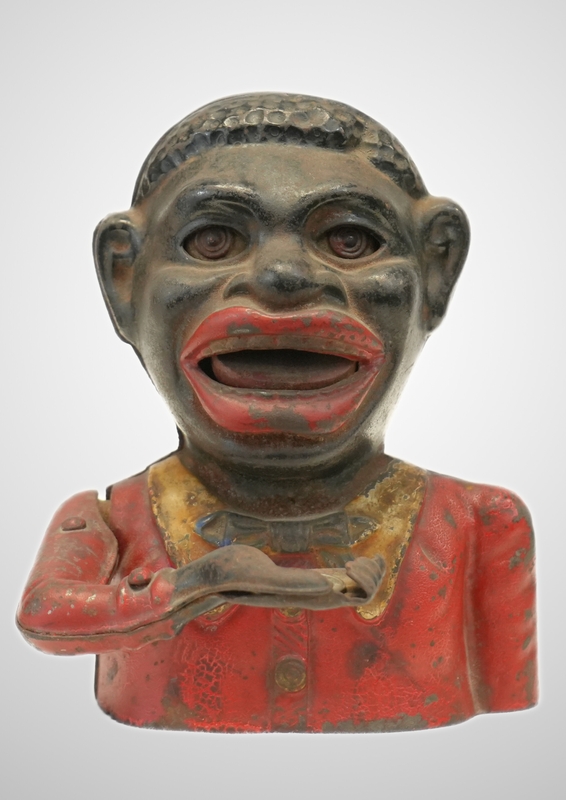
The red and yellow vintage Jolly Negro bank features a caricature of a smiling Black man, embodying the racially insensitive stereotypes prevalent in early 20th-century America. Designed as a coin bank, it reflects the era's problematic representation of African Americans in popular culture.
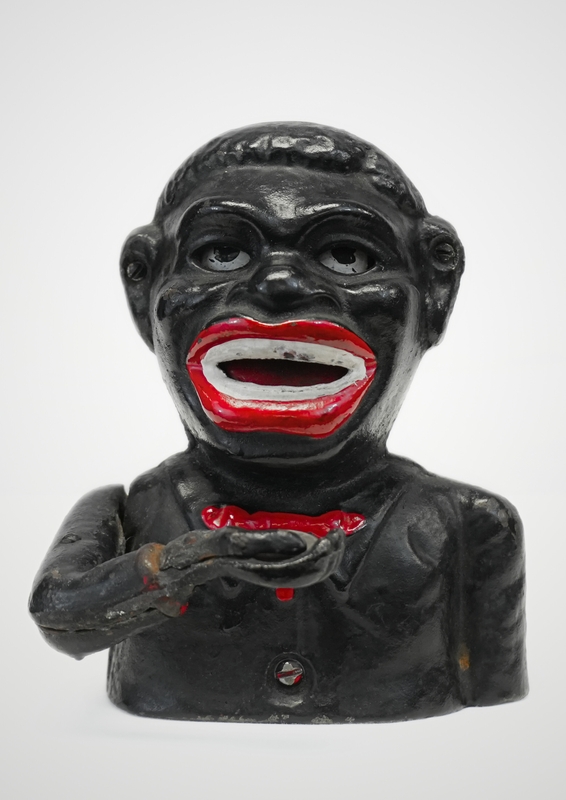
The vintage black and red Jolly Negro bank depicts a smiling Black figure, exemplifying the racially insensitive stereotypes common in early 20th-century America. This ceramic bank was designed to encourage saving while reflecting a troubling portrayal of African Americans in popular culture.
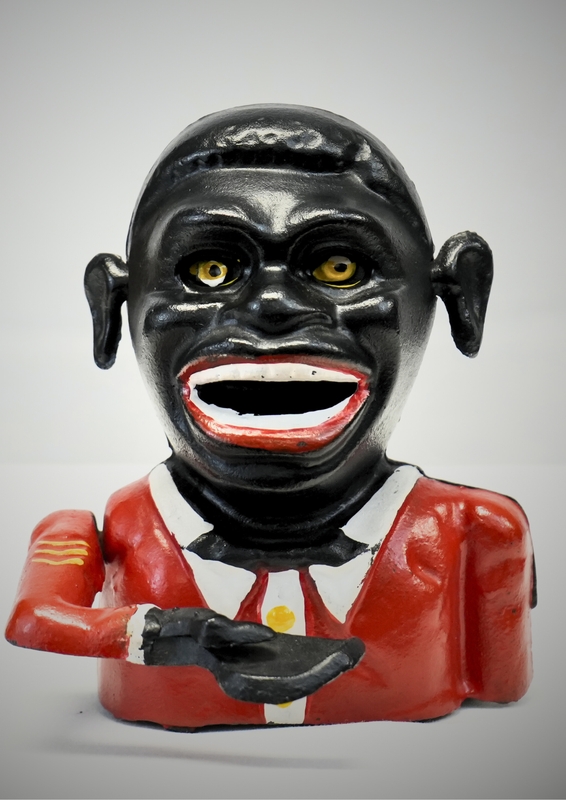
The vintage red and white Jolly Negro bank features a cheerful caricature of a Black man, reflecting the racial stereotypes common in early 20th-century American culture. This coin bank, characterized by its bright colors and playful design, embodies the problematic portrayals of African Americans during that time
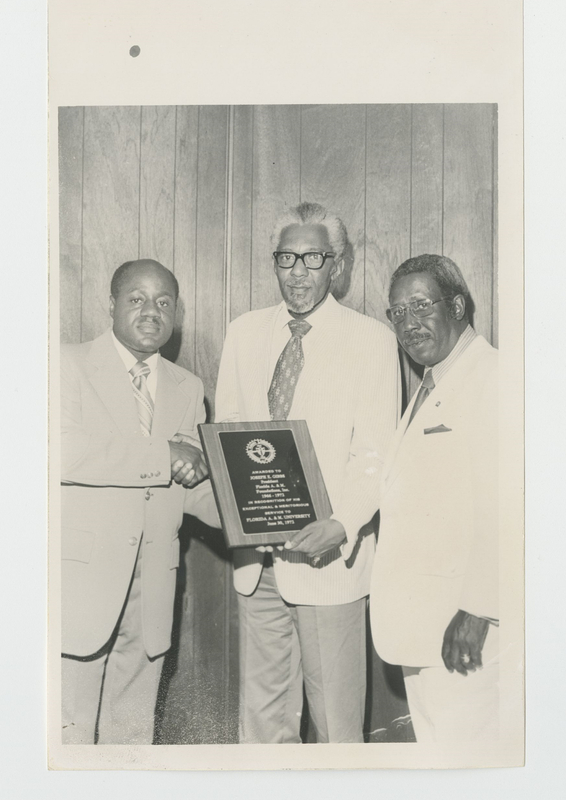
This photograph depicts two unidentified men with Joseph E. Gibbs, a faculty member at Florida A&M University’s original College of Law, World War II veteran, and YMCA executive director. The Florida A&M Foundation awarded Gibbs a plaque on June 30, 1972, for “His Exceptional & Meritorious Service to Florida A. & M. University.”
Josephine Tibbs was born in Jackson and moved to the Farish Street District in 1910. Mrs. Tibbs talks about her early school days at Smith Robertson School and her religious activities. She also talks about some of the businesses in the district and some of the Black doctors who practiced on Farish Street.
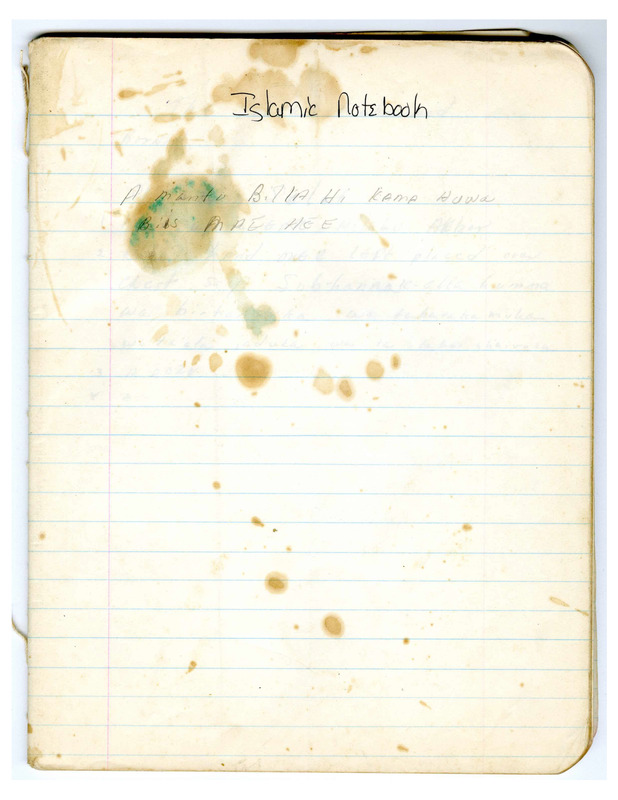
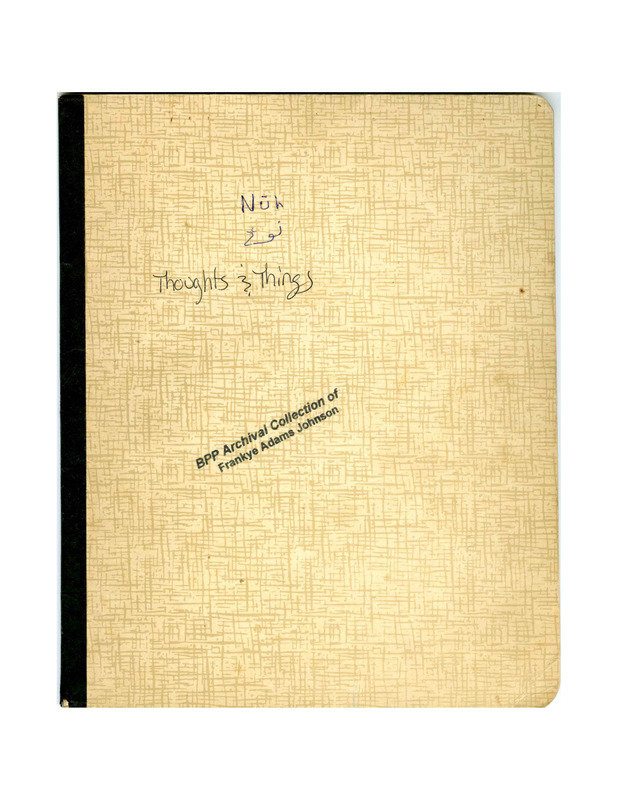
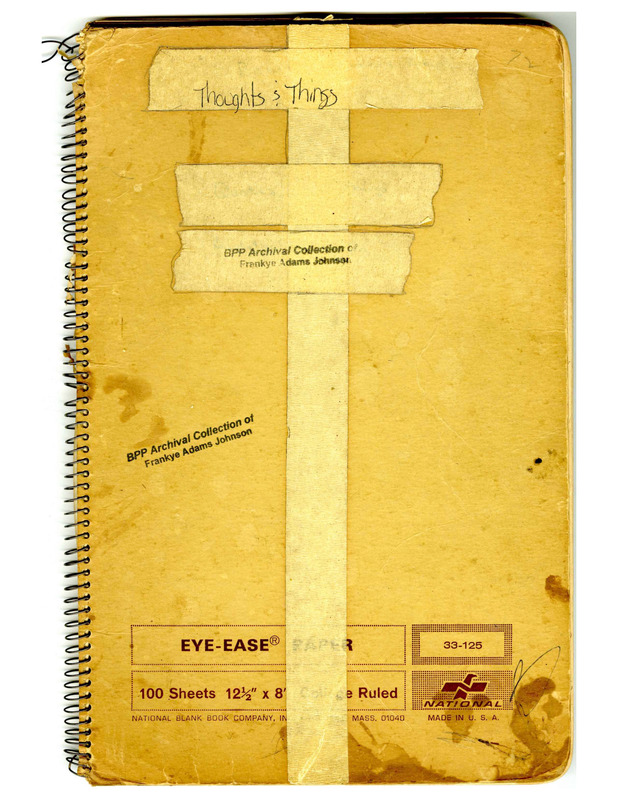
A journal written by former Black Panther Party member and former Jackson State University professor Frankye Adams-Johnson (Malika) on unknown dates. Items in the journal include: prayers; writing in Arabic and lists of Islamic terms; rough draft of a resume for a prospective job in Philadelphia, PA; a poem; and a note to her imprisoned husband.
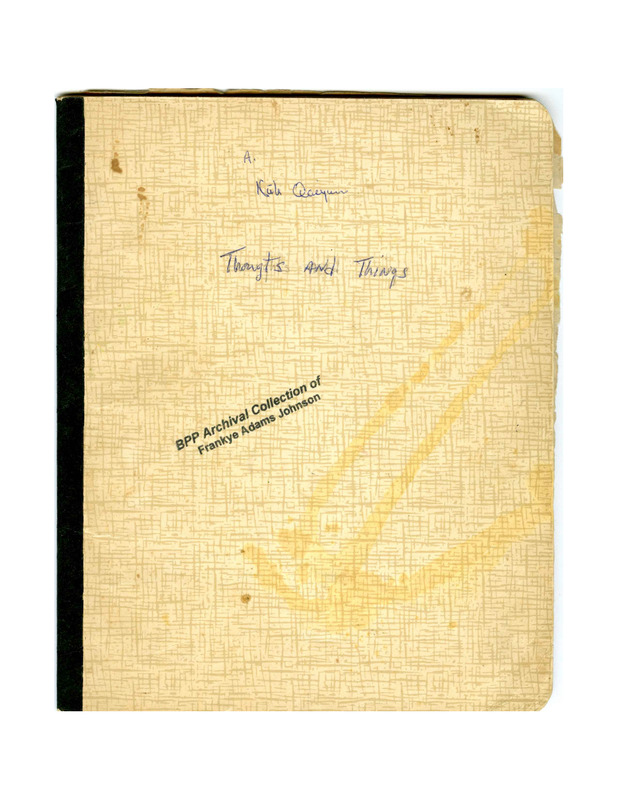
A journal written by Frankye Adam-Johnson (Malika)’s husband, Nuh Abdul Qaiyum, during unknown dates. Nuh Abdul Qaiyum was a former member of the Black Panther Party and Black Liberation Army and was imprisoned in 1975. He writes about a variety of topics, including daily rituals; religions; languages and alphabets; and politics and philosophy.
A journal written by Frankye Adam-Johnson (Malika)’s husband, former member of the Black Panther Party and Black Liberation Army Nuh Abdul Qaiyum, from 1975-1977 while imprisoned. Most of the pages are original poetry. He also copied some poems and songs by other writers. There are also several pages of Suras and other verses from the Quran.
A journal written by Nuh Abdul Qaiyum while imprisoned and later by Frankye Adams-Johnson (Malika), both former members of the Black Panther Party and the Black Liberation Army. Washington wrote poetry and essays and thoughts on philosophy and religion. Frankye Adams-Johnson (Malika) wrote poetry; drafts of letters; and meeting agendas.
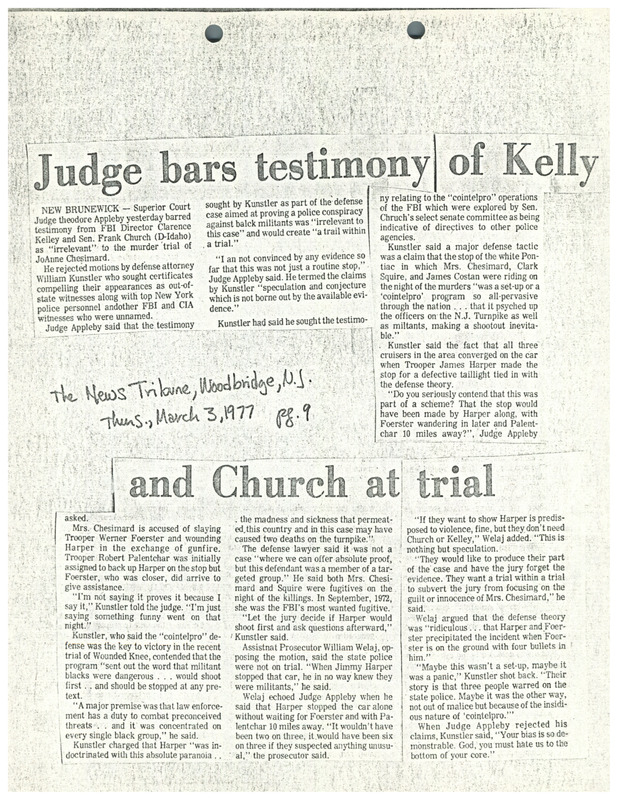
Newspaper article from The News Tribune about Superior Court Judge Theodore Appleby barring the testimony of an FBI agent and senator. Chief defense attorney William Kunstler wanted to use the testimony to establish a police conspiracy against Black militants in the trial of Assata Shakur (JoAnne Chesimard) for the 1973 killing of a state trooper.
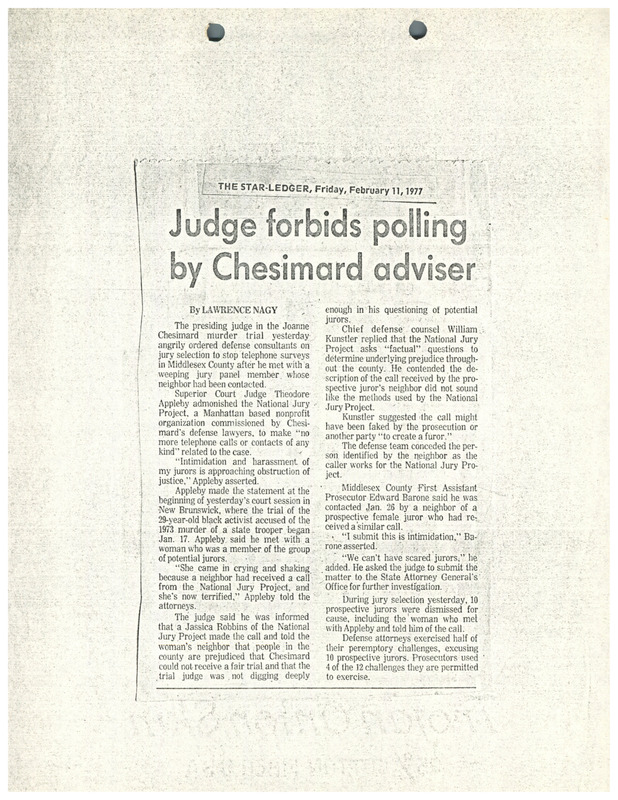
A newspaper article from The Star Ledger about Superior Court Judge Theodore Appleby ordering defense consultants, the National Jury Project, to stop making calls and contact related to the trial of Assata Shakur (JoAnne Chesimard) for the 1973 killing of a state trooper. Appleby said that the calls were approaching obstruction of justice.
Judge Houston Patton started with Child Development Group of Mississippi (CDGM) in 1965 as a Head Start administrator for Hinds, Madison, and Rankin counties in Mississippi. After attending law school, he worked from 1972 until 1979 with Head Start Legal Services in Jackson. He talks about these jobs including meetings, budgets, and personnel.
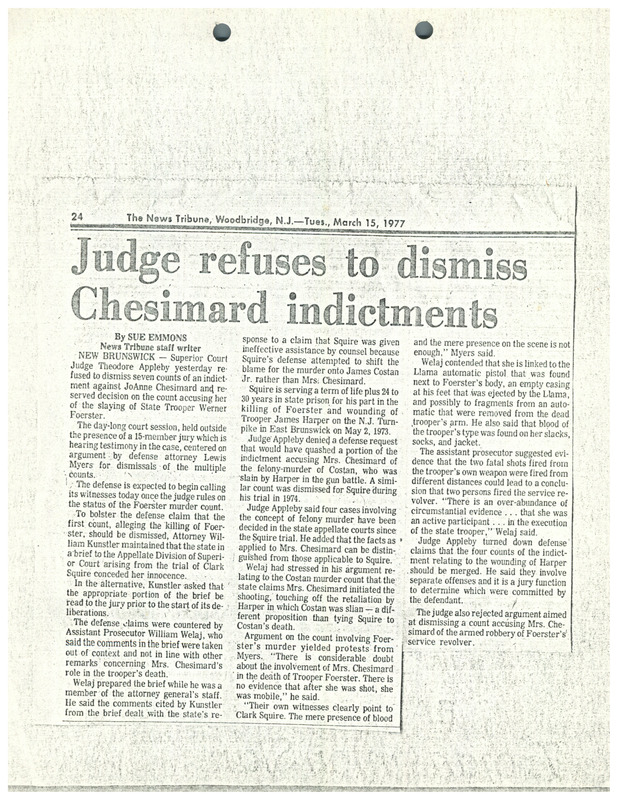
A newspaper article from The News Tribune about a day long juryless court session where defense lawyers made numerous motions to dismiss the indictments against Assata Shakur (JoAnne Chesimard) who was on trial for the 1973 killing of a state trooper. The judge rejected these motions and the attorneys are scheduled to call witnesses that day.
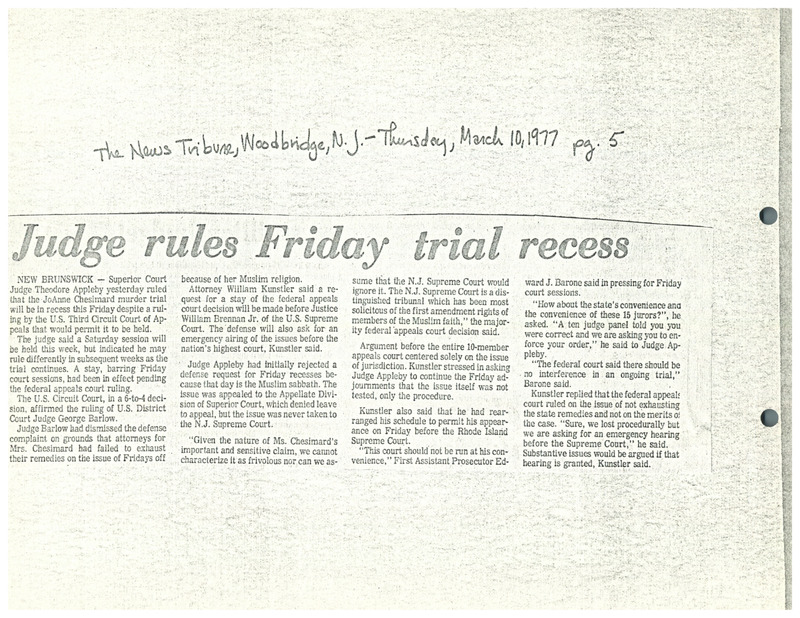
An article from The News Tribune about the question of Friday recesses asked for by the defense because of the Muslim faith of Assata Shakur (JoAnne Chesimard), who was on trial for the 1973 killing of a state trooper. The question has been a feature of the trial and the defense, prosecution, and judge continue to argue over it.
Lloyd’s scene closely focuses on three faces wracked with strong feelings. In the foreground, an angry man reaches out, while the middle figure turns completely inward, and the far right figure is deep in thought. These emotions are heightened by the dark hues in the composition.
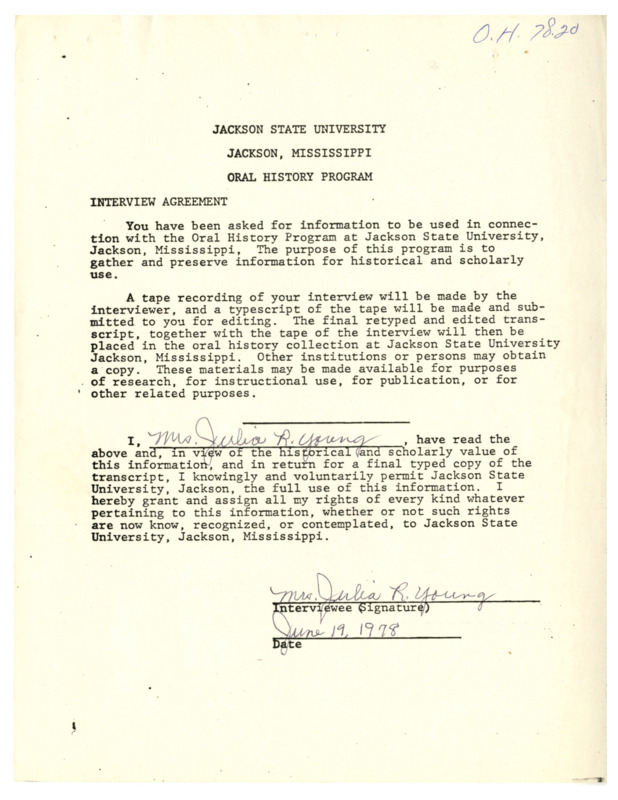
Ms. Young worked at Smith Robertson School as a teacher and secretary for the principal from 1951 until the school’s closing in 1971. She talks about her time at the Smith Robertson School as a secretary and teacher and discusses how the property around the school had a negative effect on it.
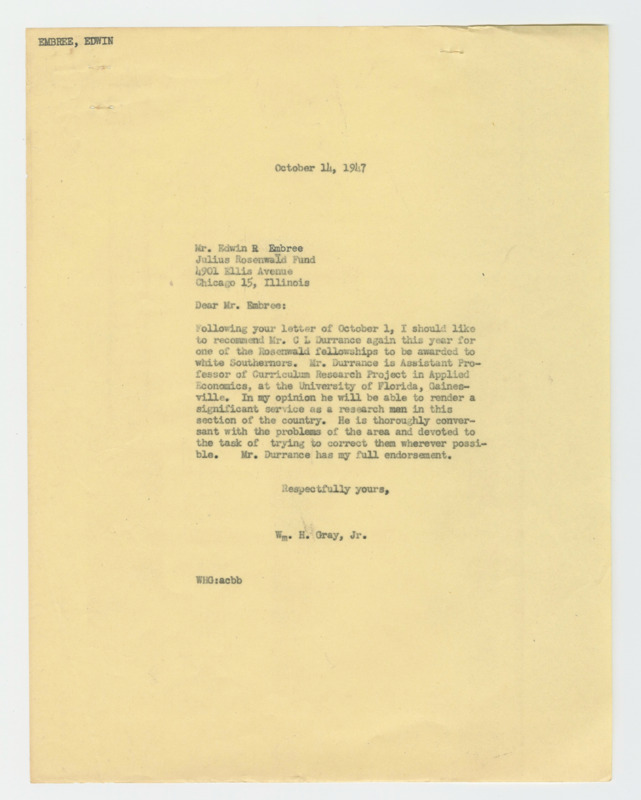
Julius Rosenwald was the part-owner of Sears, Roebuck and Company and the creator of the Rosenwald Fund, which donated millions in matching funds for vocational and technical education specifically for Negroes or white Southerners specialized to the South. Under William H. Gray, Jr.’s leadership. Florida A&M received scholarships from them.
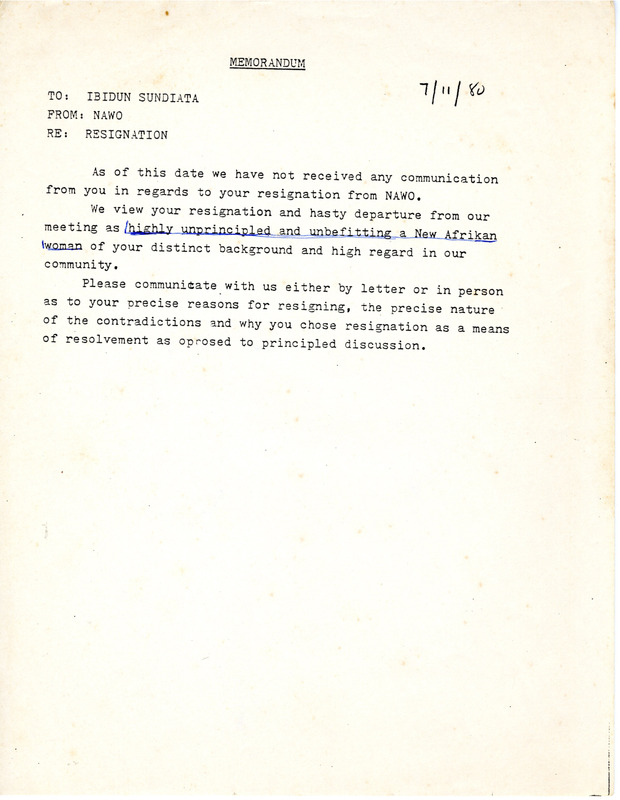
A letter from New Afrikan Women’s Organization (NAWO) leadership to Ibidun Sundiata (aka Dorothy Morrow) inquiring about her sudden resignation from the organization. Ibidun Sundiata was a well-respected and regarded activist and the members of the NAWO want clarification on why she resigned without a conversation with the group.
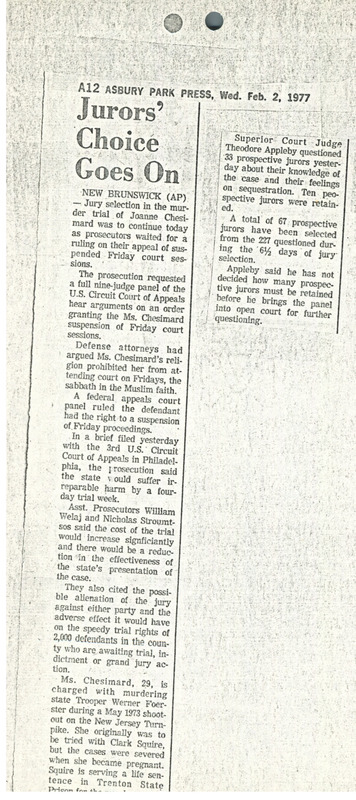
An article from the Asbury Park Press about the trial of Assata Shakur (JoAnne Chesimard) for the 1973 killing of a state trooper. Jury selection continued as prosecutors awaited ruling on their appeal of suspended court sessions, granted by a federal appeals court panel in respect to the defendant's Muslim faith.
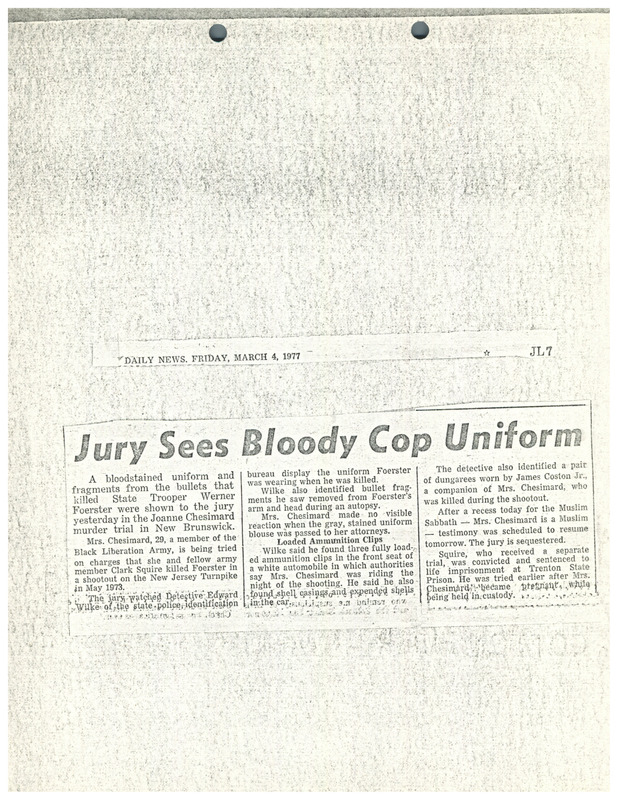
A newspaper article from The Daily News about items entered into evidence by the prosecution in the Assata Shakur (JoAnne Chesimard) trial for the 1973 killing of a state trooper. The slain trooper’s bloodied uniform shirt was submitted into evidence, as well as bullet fragments pulled from the body, and empty shell casings.
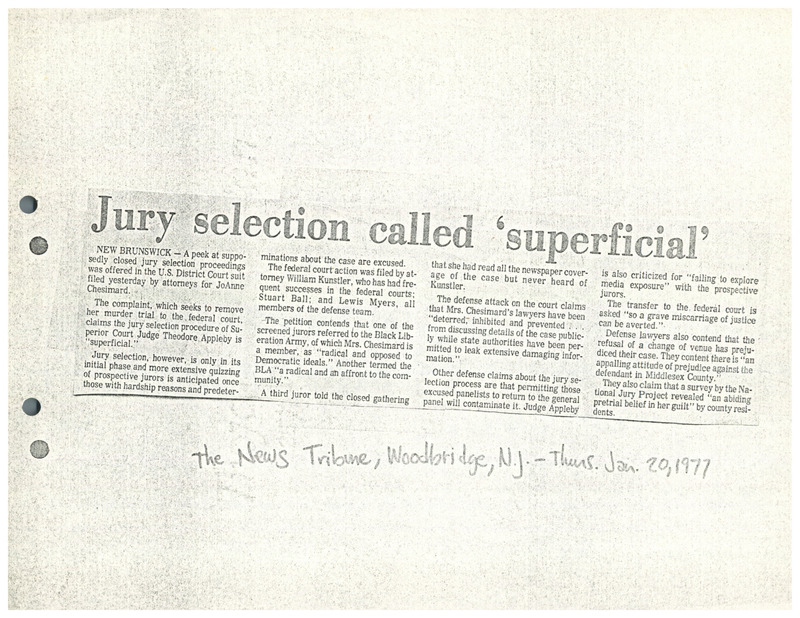
A newspaper article from The News Tribune about defense attorneys for Assata Shakur (JoAnne Chesimard), who was on trial for the 1973 killing of a state trooper, filing a complaint claiming that the jury selection in her murder trial is biased toward the prosecution. Shakur was convicted in 1977 of the killing and escaped prison in 1979.
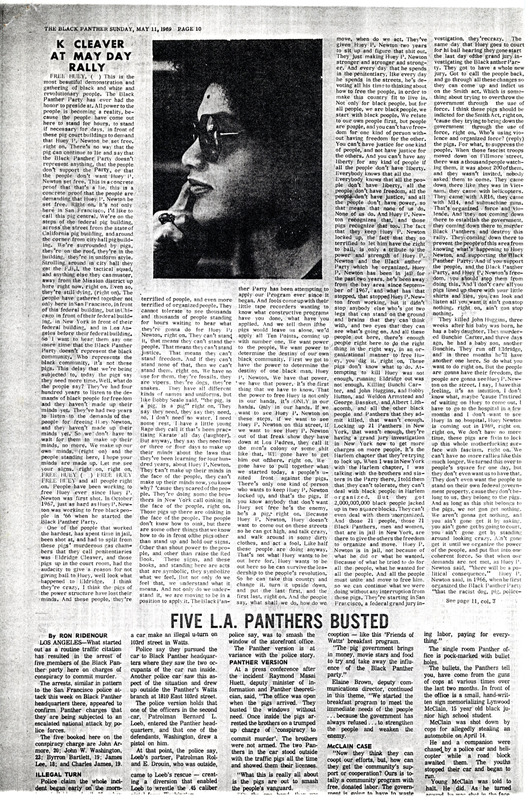
A newspaper article from The Black Panther. It is a transcript of Kathleen Cleaver's speech at May Day (International Workers Day) on May 1, 1969 in San Francisco, California. Cleaver’s speech, like many of the speeches given that day, centered on the calls to Free Huey Newton from his arrest on murder charges on October 28, 1967.
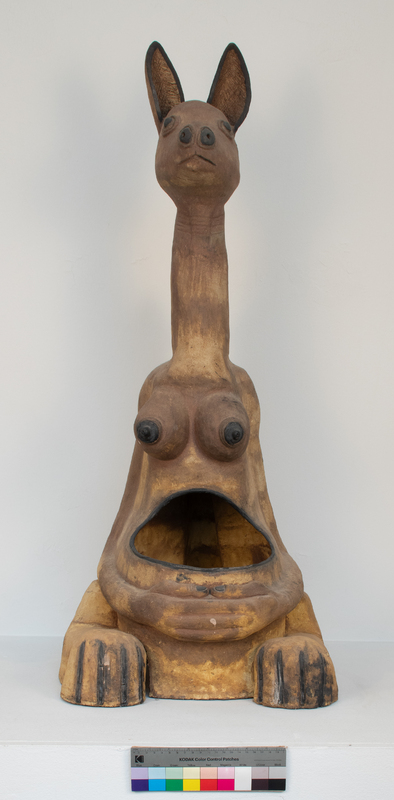
Moses Adams Jr.'s sculpture depicts a kangaroo mother with human-like hands and breasts. The clasped hands under the open pouch signify protection. Detailed, oversized hands are characteristic of the work of John Biggers and his students. Additionally, mothers of various forms and species are a common subject of the student terracottas from Texas Southern University.
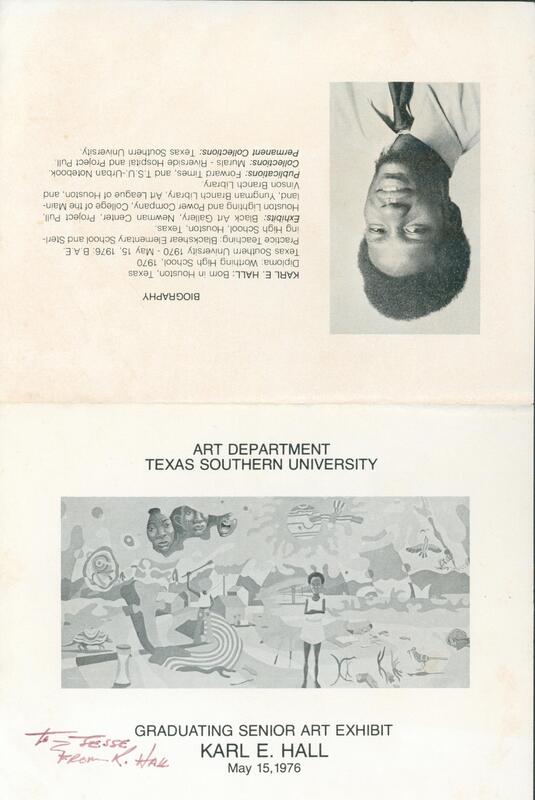
This is a brochure for Hall’s senior art exhibition. The culmination of the Texas Southern art curriculum is a senior exhibition where students showcase artwork created over the course of their undergraduate studies. The brochure features a photo of Hall, a brief biography, a catalog of the artwork featured in the exhibition, and a photo of one of his paintings. It is inscribed with a note from Hall.
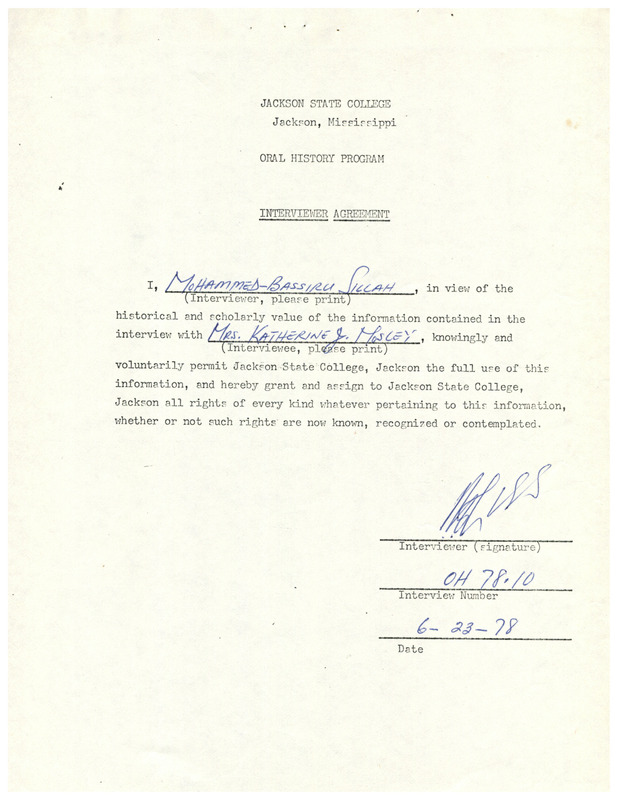
Katherine Mosley moved to the Farish Street District in 1949. She recounts her time as a young person in the district, specifically the entertainment she enjoyed. Ms. Mosley also goes into detail about the decline of the district and lack of Black businesses and she gives her opinions about urban renewal on Farish Street.
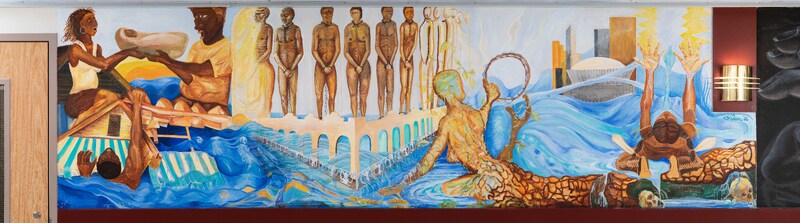
A native of New Orleans, Green transferred to TSU’s art program following Hurricane Katrina. His mural ties different aspects of New Orleans history and culture together through floodwaters. Enslaved ancestors stand at auction, and the city skyline, including the Superdome, is featured prominently.
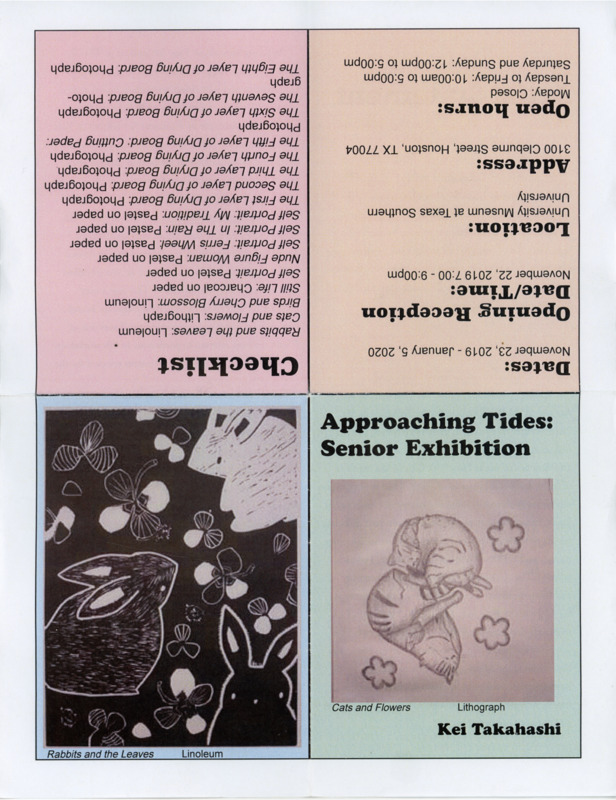
This is a brochure for Takahashi’s senior art exhibition. The culmination of the Texas Southern art curriculum is a senior exhibition where students showcase artwork created over the course of their undergraduate studies. The brochure features a brief biography, an artistic philosophy, a catalog of the artwork featured in the exhibition, exhibition viewing information, and three photos of her artwork.
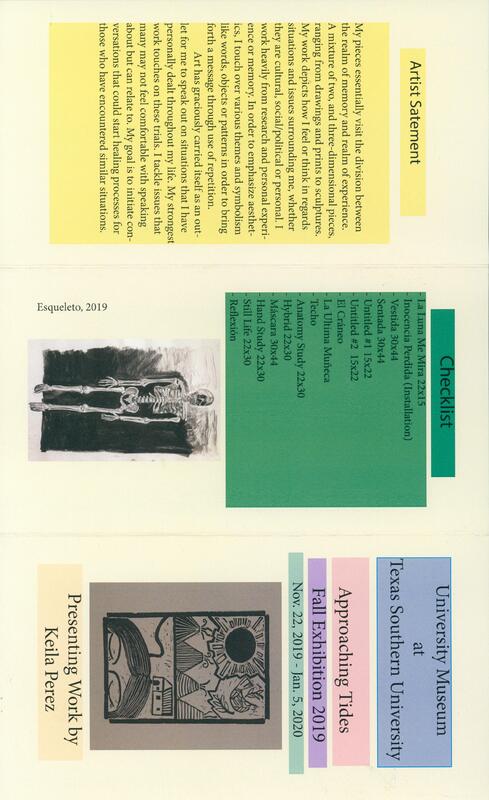
This is a brochure for Perez’s senior art exhibition. The culmination of the Texas Southern art curriculum is a senior exhibition where students showcase artwork created over the course of their undergraduate studies. The brochure features a brief biography, a photograph of the artist, an artistic philosophy, a catalog of the artwork featured in the exhibition, and five photos of her artwork.