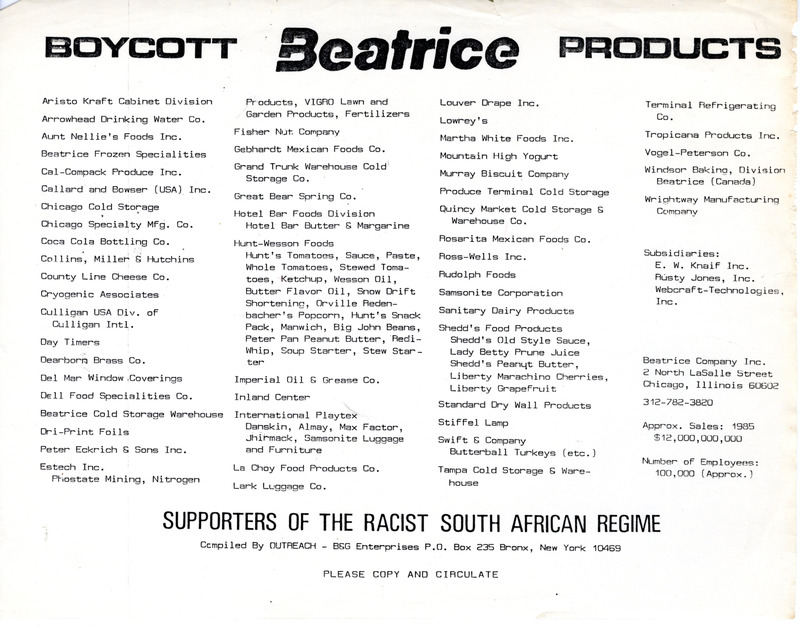
A flier listing the different companies that fall under the ownership of business conglomerate Beatrice. The memo suggests that people boycott these companies because of South Africa’s institutionalized system of racial segregation that lasted from 1948 until the early 1990s, known as apartheid.
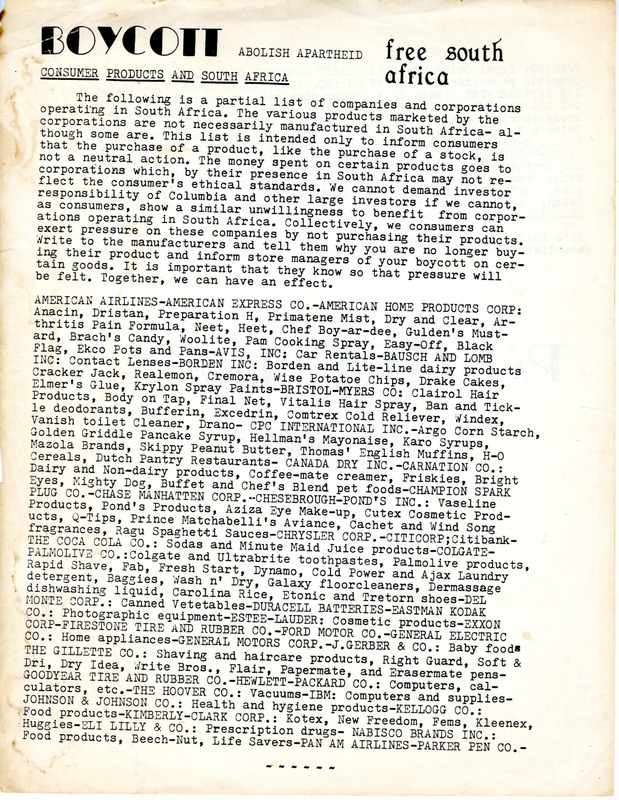
A list of companies doing business in South Africa. The memo suggests that people boycott these companies because of apartheid, South Africa’s institutionalized system of racial segregation that lasted from 1948 until the early 1990s. The memo also suggests for people to write to the companies and speak to store managers about the boycott.
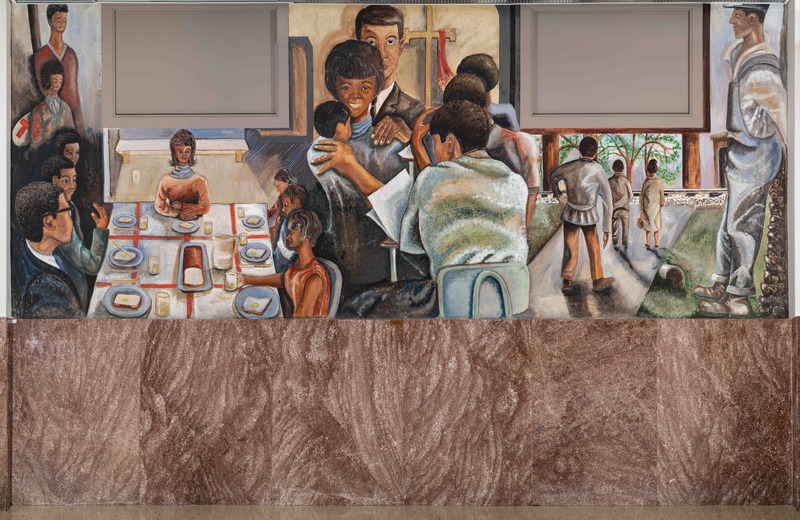
Mass depicts scenes of family life, including a gathering at the dinner table and church services. The laborer at the far right suggests the role of physical work in sustaining the Black family. As in other murals, architectural elements from Hannah Hall are incorporated in this mural.
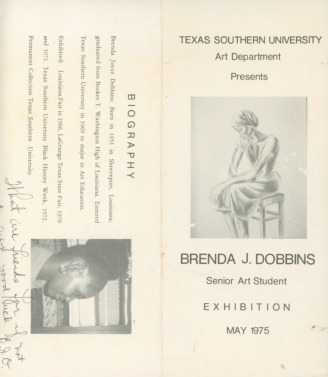
This is a brochure for Dobbins’ senior art exhibition. The culmination of the Texas Southern art curriculum is a senior exhibition where students showcase artwork created over the course of their undergraduate studies. The brochure features a photo of Dobbins, a brief biography, a catalog of the artwork featured in the exhibition, and a photo of one of her drawings. It is inscribed with a note from Dobbins.
In this interview, former Texas Southern art student Brenda Mackey Lang discusses her time as an art student (1967-73) and as an artist later on. At TSU, Lang learned from Dr. John T. Biggers and Professor Carroll Harris Simms, met Maya Angelou, and protested with Mickey Leland.
Case Data and Exhibits for Brown III, a relitigation of Brown v. Topeka Board of Education (1954) that corrected resegregation issues caused by open enrollment school choice in 1992. This brief to the U.S. Court of Appeals argues that Former Kansas Governor John Carlin did not have the power to affect desegregation and should not be a defendant.
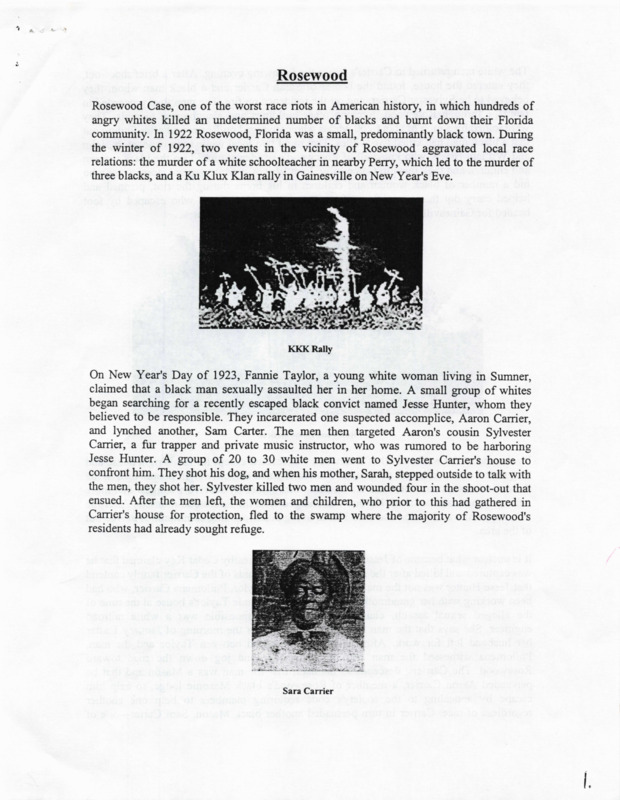
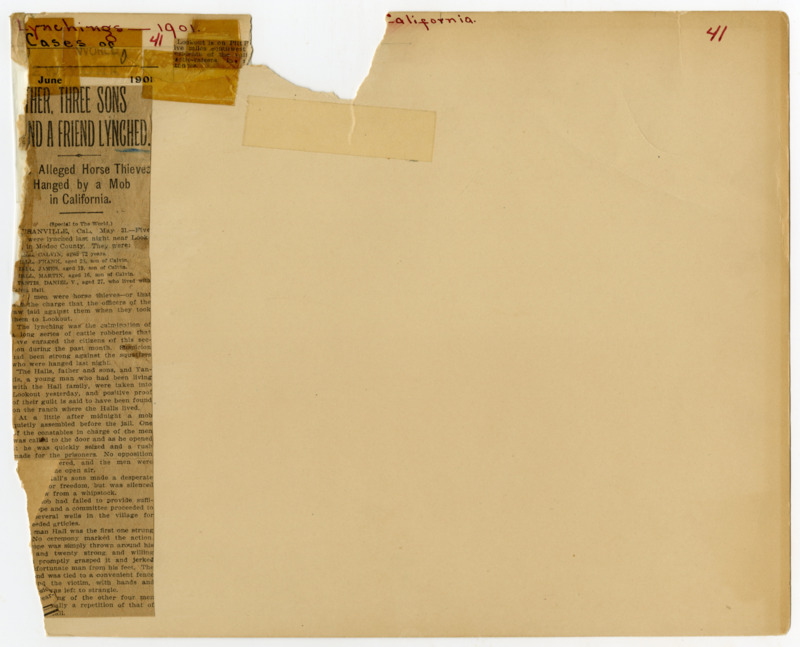
This abstract provides a brief account of the Rosewood Case, a horrific 1923 race riot caused by aggravated racial relations from the winter of 1922. A white woman’s claim of rape set off a group of white men to begin shooting people who they believed were connected to the assault, all residents of a small, thriving predominantly Black town.
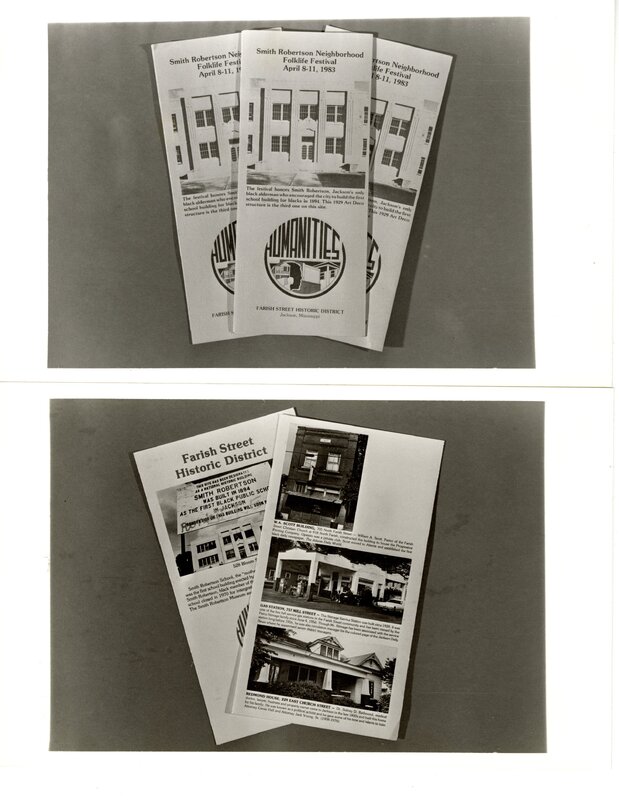
Two photographs of brochures for the Smith Robertson Neighborhood Folklife Festival, April 9-11, 1983. The festival was a one-time grant sponsored event held on the grounds of the Smith Robertson Museum to celebrate the rich history and culture of the Farish Street Historic District.
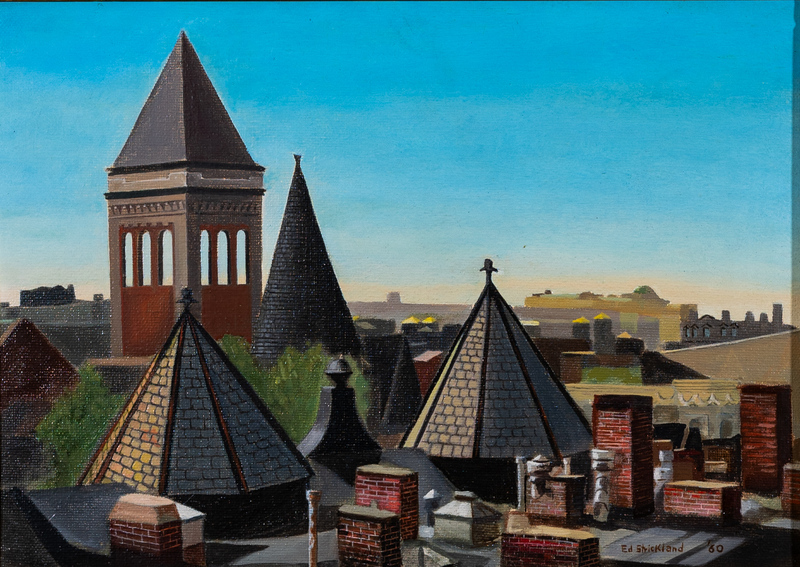
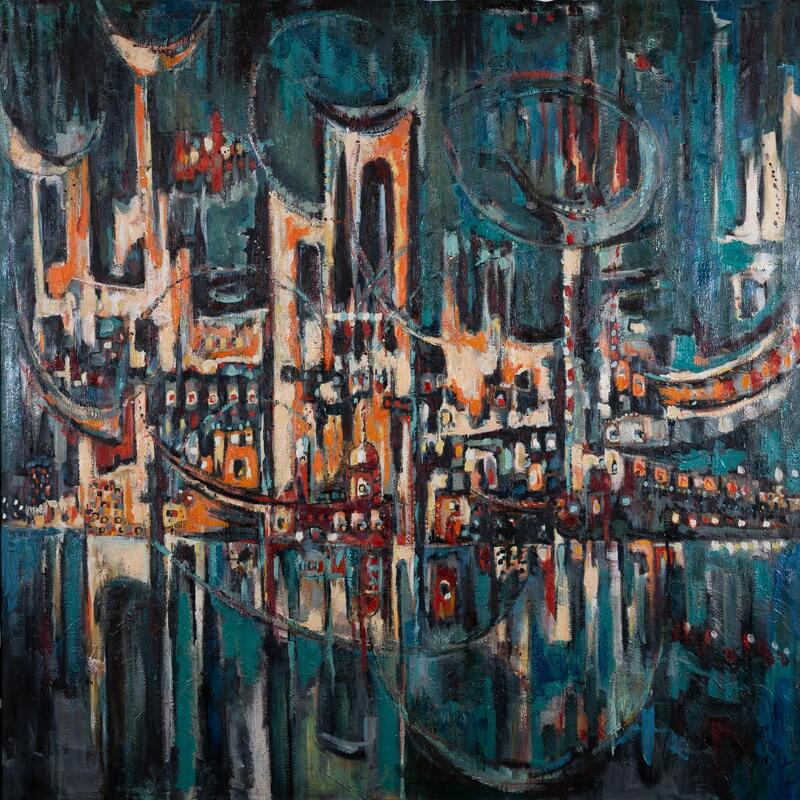
Edward Strickland was an artist, educator, and writer who lived in New York City. "Brooklyn View" depicts the rooftop perspective of a neighborhood in Brooklyn, NY. Several buildings with chimneys and spires are in the foreground, and the cityscape continues in the background.
Gregory L. Ridley, Jr. was an artist from Smyrna, TN. "Brooklyn View" is a painting of the nightlife in Brooklyn, New York City during the 60’s. Story top buildings, trains, and street lights painted in layers of red, teal, orange, and black reflect a busy scenery on an open body of water below.
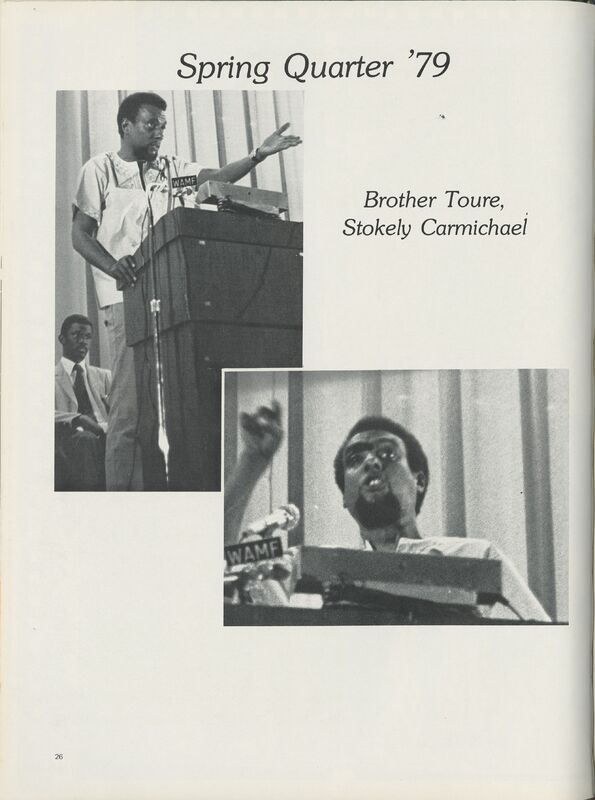
These images are from the spring of 1979 when Kwame Ture, formerly known as Stokely Carmichael, visited Florida A&M University to speak to students. Ture was a field organizer with the Student Nonviolent Coordinating Committee (SNCC) and coined the “Black Power” slogan, making him a key figure during the Civil Rights Movement.
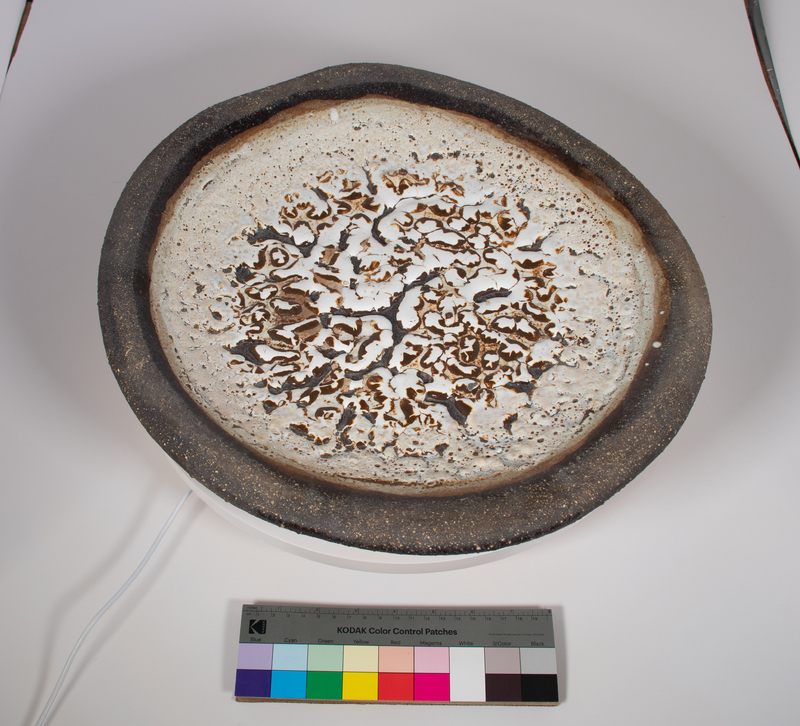
This large ceramic plate created by Carroll Harris Simms features multiple textures, including a bubbling glaze covering most of the top of the piece. Simms worked alongside Dr. John T. Biggers to build Texas Southern's art department from the ground up. Simms' decorative artworks remain in high demand by collectors.
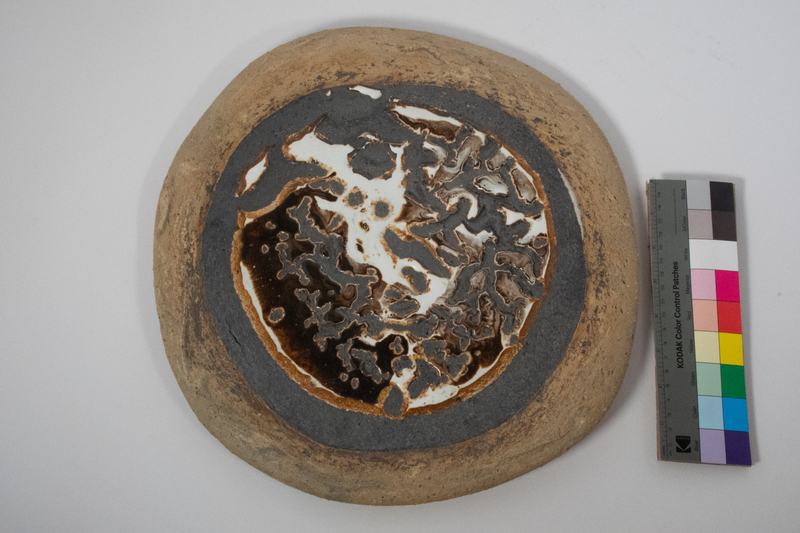
This large, brown ceramic plate created by Carroll Harris Simms features multiple textures, including a bubbling glaze covering most of the top of the piece. Simms worked alongside Dr. John T. Biggers to build Texas Southern's art department from the ground up. Simms' decorative artworks remain in high demand by collectors.
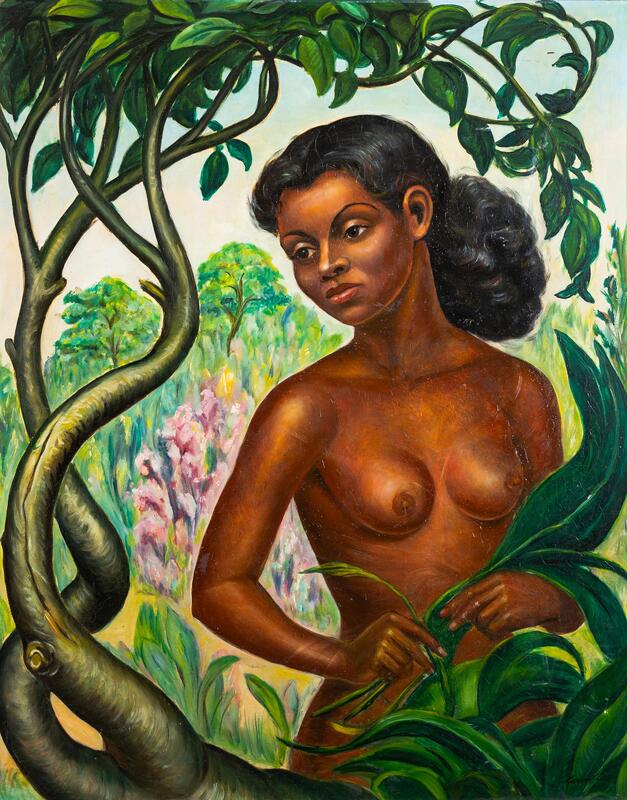
Samuel Albert Countee was a New Negro movement painter and sculptor from Marshall, TX. "Brown Girl" depicts a nude Black woman in nature. She has a thoughtful expression as she touches the branches that obscure her groin. In the background is a garden scene of pink flowers and lush trees.
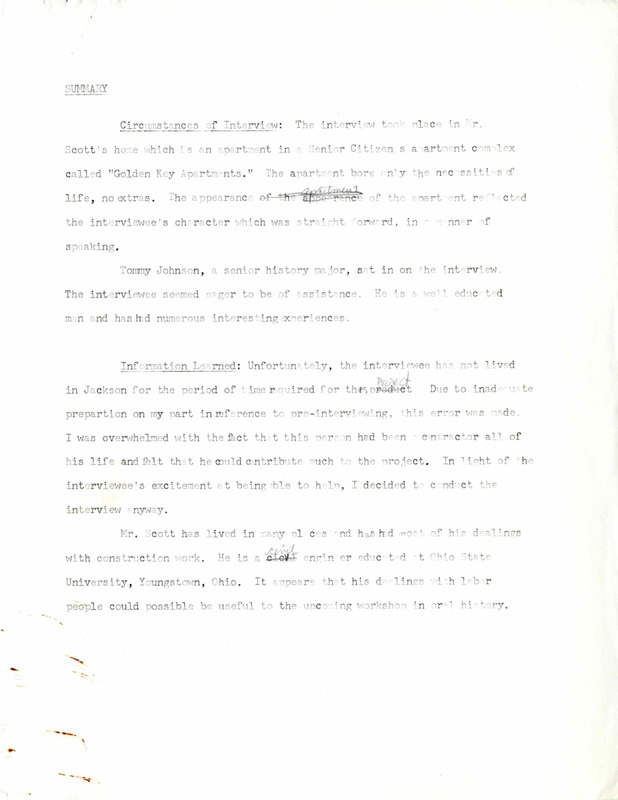
Brown Scott was born in 1912 and came to Jackson in 1951. He recalls the "Good Old Days" as a comparison between the past and present: they were good in the sense that people enjoyed them at the time, but what is good now is quite different. He discusses racial issues he faced in Jackson and being in Europe in the Army for World War II.
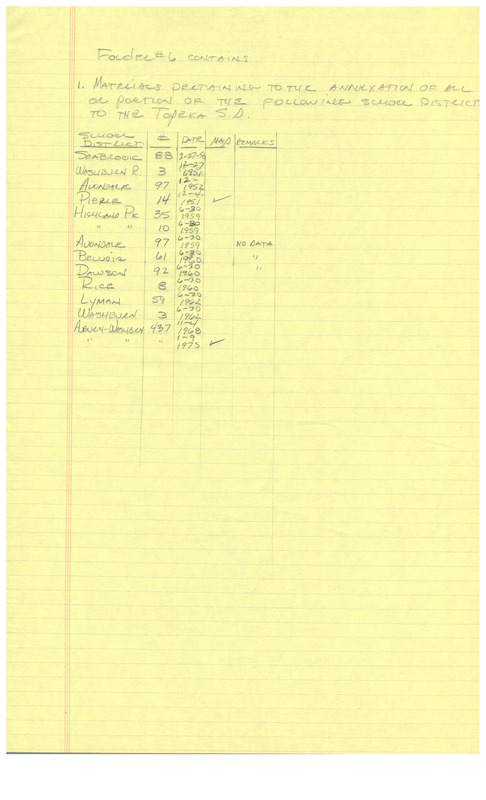
Case Data and Exhibits for Brown III, a relitigation of Brown v. Topeka Board of Education (1954) that corrected resegregation issues caused by open enrollment school choice in 1992. List of analysis materials used by William Lamson in his expert testimony preparation for the Brown v. Topeka III litigation.
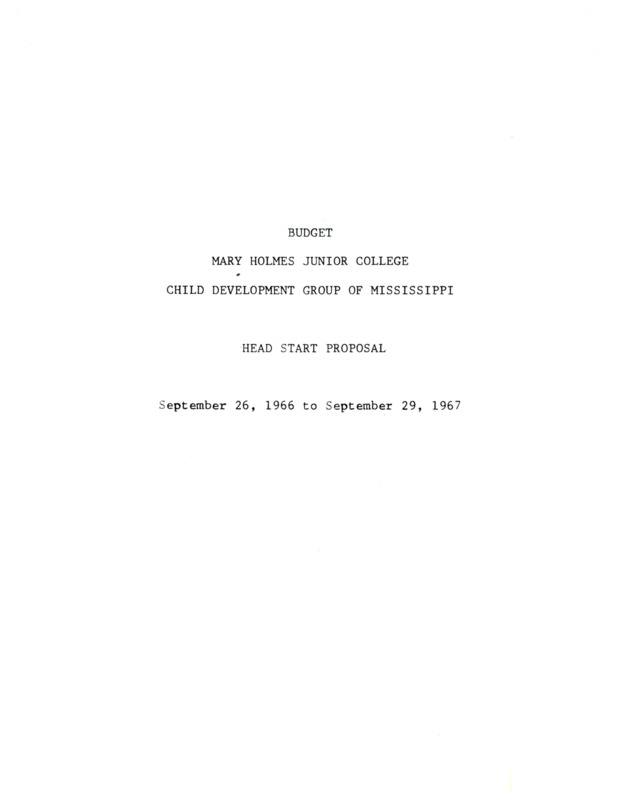
The estimated budget for funding Head Start in Mississippi from September 26, 1966, to September 29, 1967, the first year of Head Start operating in Mississippi. This budget proposal covered 13,500 Mississippi children in 170 centers across 37 counties. It also funded 20 administrative areas with staff and a central office in Jackson, Mississippi.
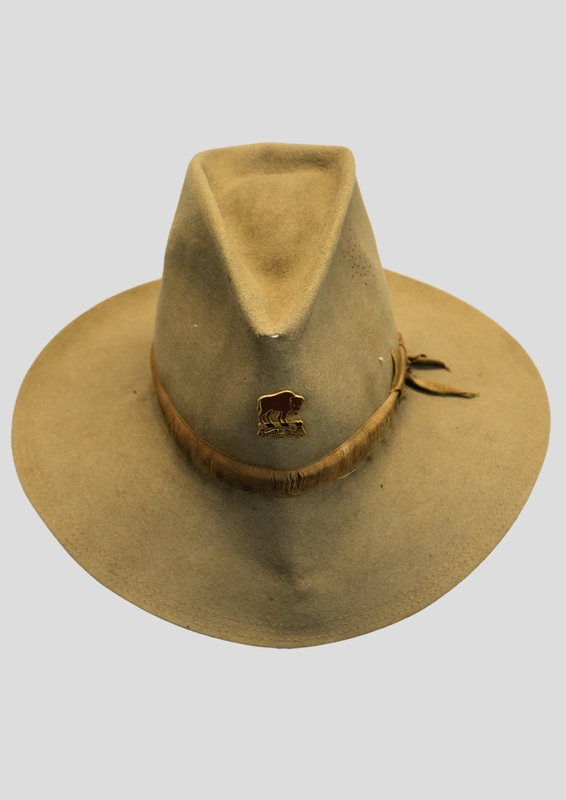
The Buffalo Soldier Stratton hat is a distinctive military headgear associated with the African American cavalry regiments known as Buffalo Soldiers, and belonged to Benjamin French. Crafted from durable materials, it features a wide brim and a high crown, symbolizing pride and resilience.
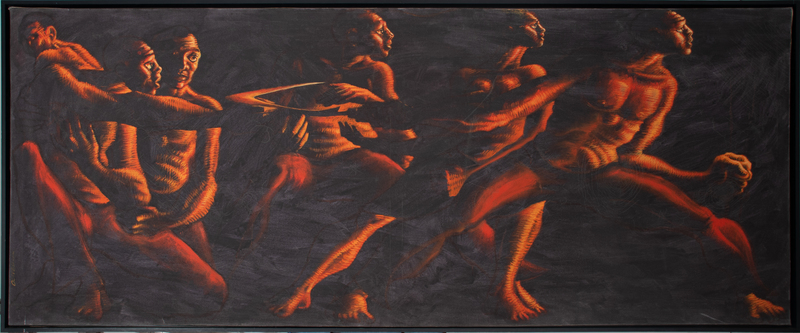
Oliver's painting shows a group of shirtless men looking towards an unseen figure or force. The painting makes heavy use of crosshatching and red and black hues. The composition bears significant resemblance to Oliver's mural Fire Fighters, which can be seen in the 1978 book, Black Art in Houston: The Texas Southern University Experience.
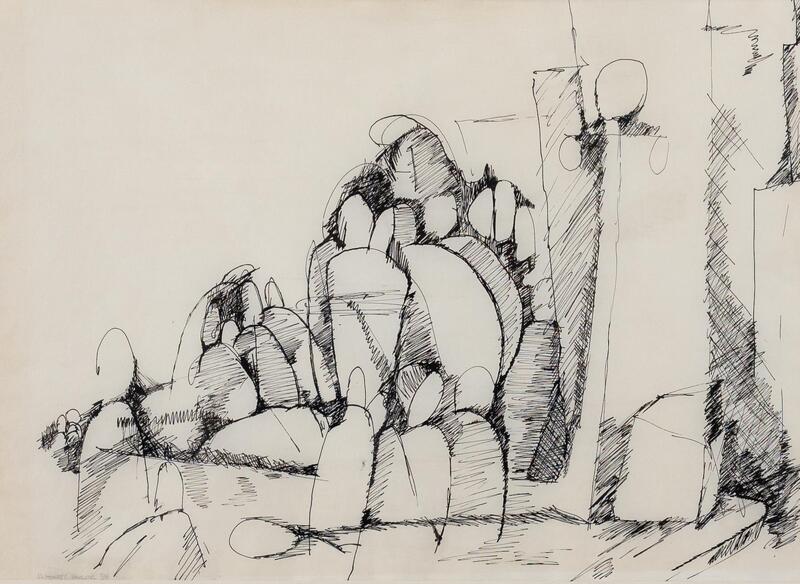
Hubert C. Taylor was an architect and artist from Kilmarnock, VA. "Bus Stop" is a non-finito depiction of a bus stop. The piece displays a sign pole with indistinct shapes and shadows surrounding it.
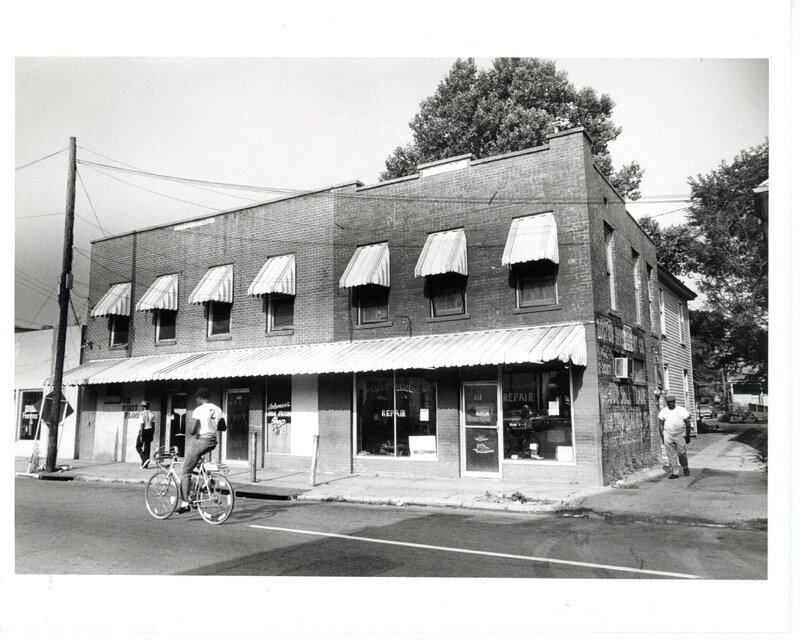
A front-view photograph of businesses on N. Farish Street in the Farish Street Historic District. At the time of the photograph, the businesses were closed and the building was in disrepair.
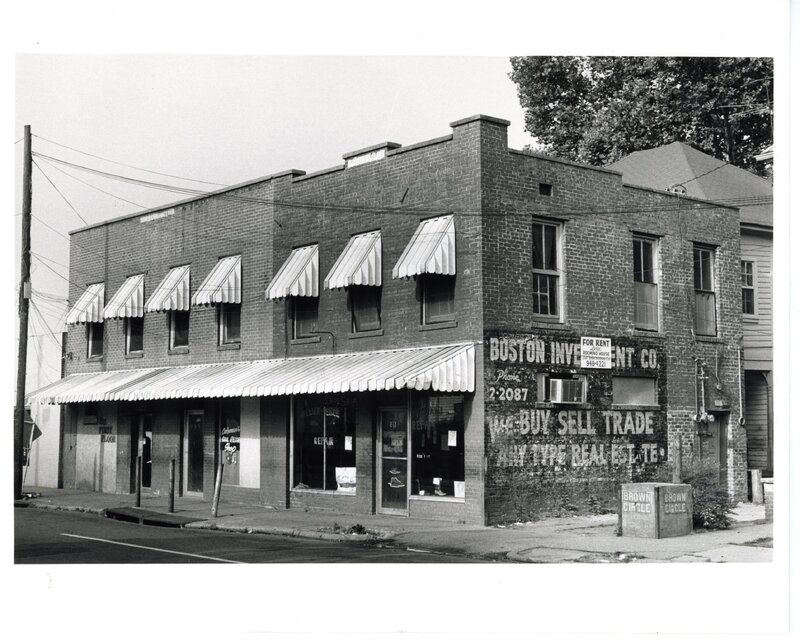
A side-view photograph of businesses on N. Farish Street in the Farish Street Historic District. At the time of the photograph, the businesses were closed and the building was in disrepair.
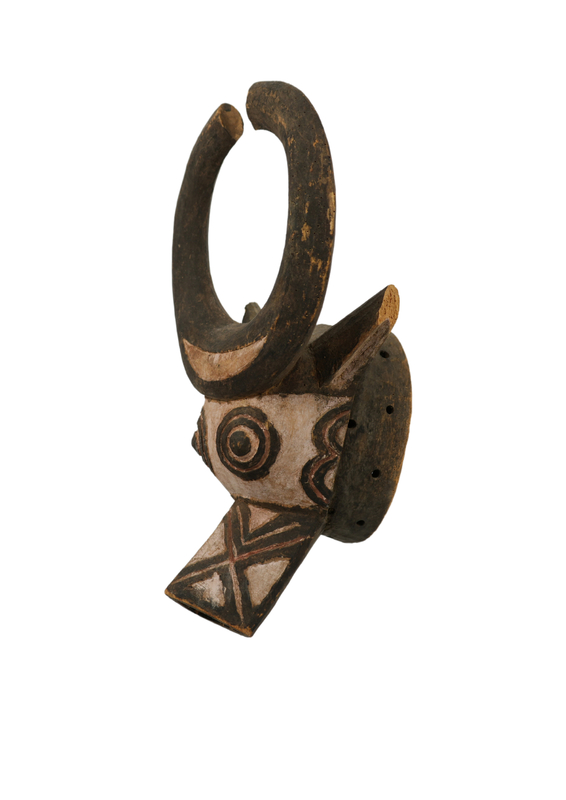
This rare mask could belong to the Gurunsi, Boba, or Bwa ethnic groups in Burkina Faso, one of the oldest agricultural groups in that region. They believed in strictly preserving the spirits, which brought balance to a world humans disturb. Each mask is unique, channeling these spirits for performances, celebrations, and harvest rituals.
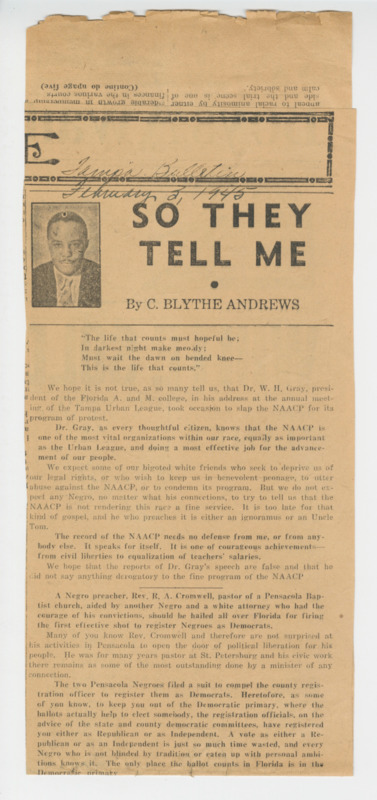
Mr. Blythe Andrews criticized President W. H. Gray's speech at the Tampa Urban League, claiming he undermined the NAACP’s work. Andrews condemned the bigotry of "white friends" and urged Black people to match their white counterparts politically, citing a lawsuit of two Pensacola Negroes falsely registered as Democrats.
Hubbard’s senior notebook includes his written philosophy of art, photographs of the artist’s works and his process, and a copy of his senior exhibition brochure. As a part of the Texas Southern art curriculum under Dr. John T. Biggers and Professor Carroll Harris Simms, students would create these notebooks to explain their artistry and showcase the works they created as students.
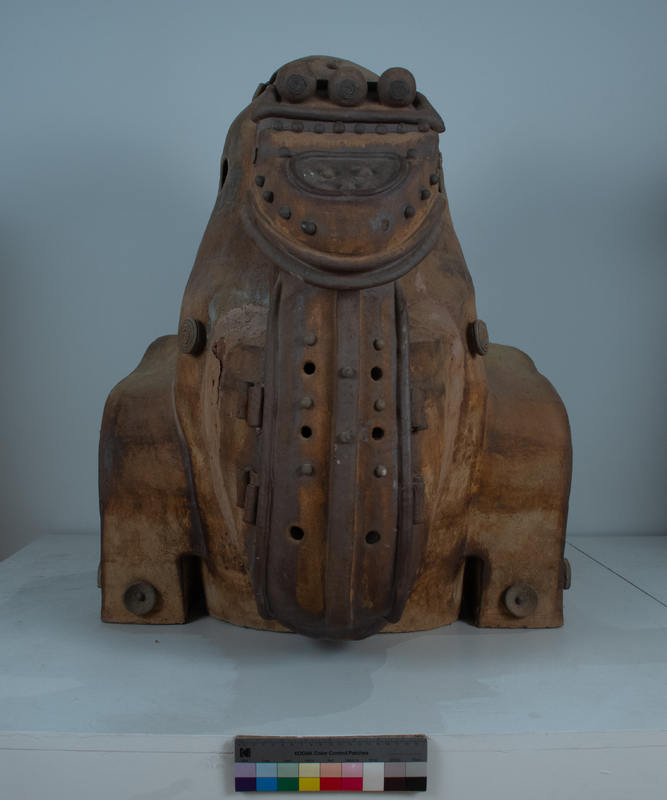
Settles, a student of Carroll Harris Simms, created the sculpture “Camel” in 1978. The creation of a large terracotta sculpture was a part of each art student's curriculum. The design features include a huge hump and embellishments, including spirals, on the exterior. Sculptures lacking sufficient ornamentation were often not retained for the collection.
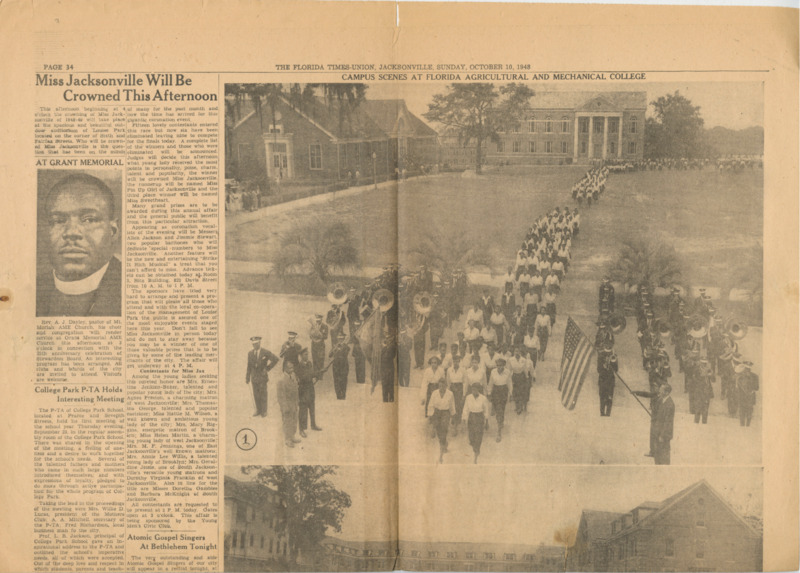
The Florida Times Union captured the lively campus atmosphere at FAMC, highlighting the 75-member band led by W. P. Foster and the newly constructed Coleman Library, honoring Samuel H. Coleman. The article also detailed the costs of Diamond Hall, the dining hall, McQuinn Hall, and the infirmary.
Case Data and Exhibits for Brown III, a relitigation of Brown v. Topeka Board of Education (1954) that corrected resegregation issues caused by open enrollment school choice in 1992. An April 1976 report by Ted Clark that explains the facilities improvements for Topeka Public Schools that were prioritized and funded in 1975 and 1976.