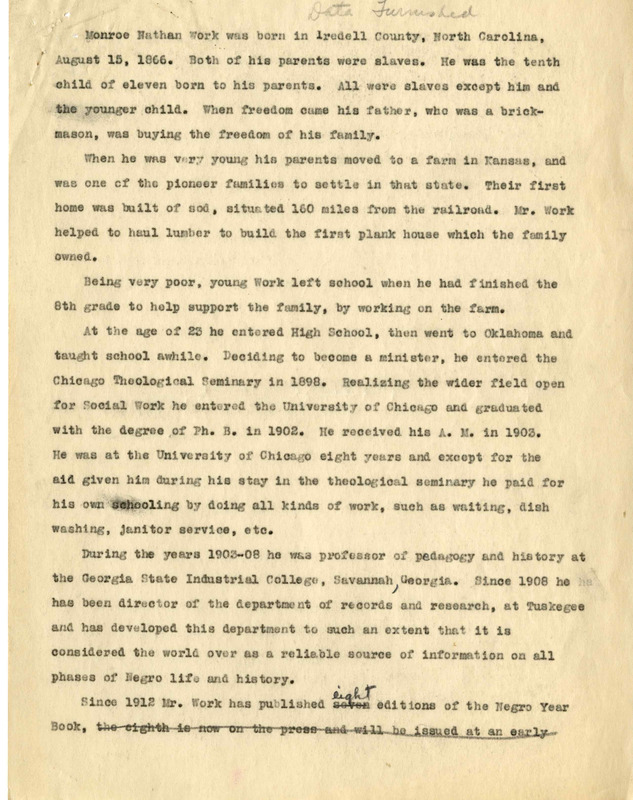
Seven pages of typed biographical information on Monroe N. Work, with many edits written in pencil. Undated, but latest date listed is 1932. "For Miss [Jessie] Parkhurst" is written on one page.
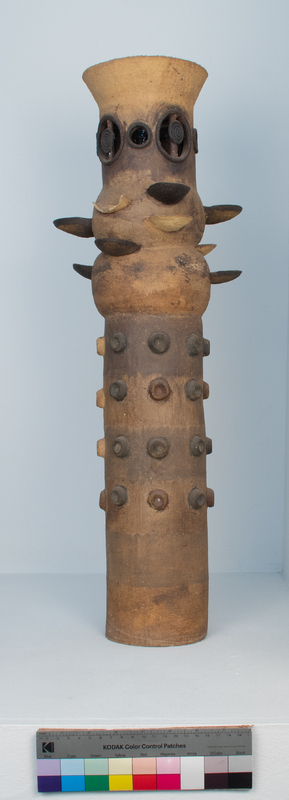
Elizabeth Montgomery Shelton’s terracotta is made up of a variety of colored clays with embellishments that have been painted using black and tan slips. The top half includes layers of plates extending out from the surface, while the bottom half is evenly decorated with pressed circular clay. The structure perhaps mimics an instrument or a bird feeder.
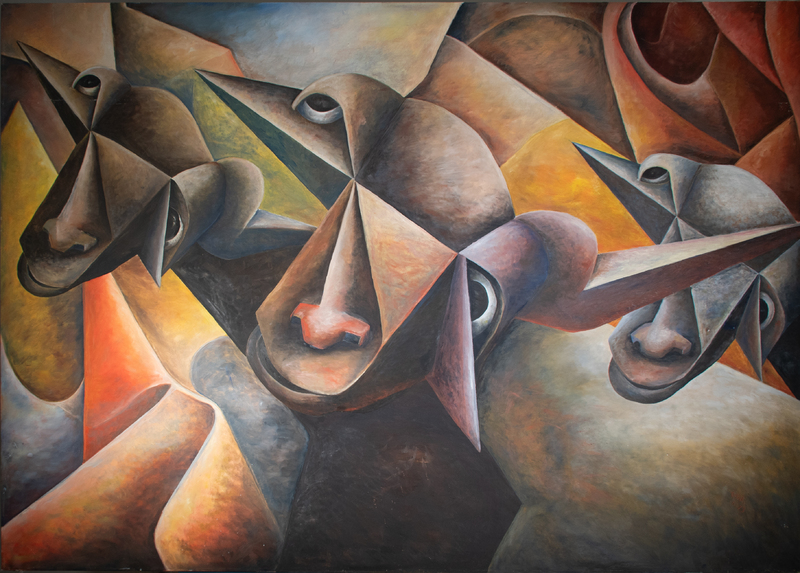
This abstract work features three distorted cows’ faces that seem to be staring upwards and at the viewer, against a colorful triangular background. Vital was an art student at Texas Southern and later went on to become a faculty member in the art department. Many works in the school’s collection, particularly from the 1970s, use cubist styles.
White square button for the Birmingham, Alabama, 1963 Foot Soldiers Reunion. There is also text on the button that says: "Inspired by what we did for ourselves-and the world." The 1963 Foot Soldiers were children marchers in Birmingham who encountered police resistance in the form of water hoses, attack dogs, and arrests.
Burley’s vibrant mural explores cycles of life and focuses on women. The left conveys night and includes a female constellation. The right shows daytime, with plants and animals. A rainbow runs across, signifying unity. The large, detailed hand is a frequent motif in the art of Biggers’ students.
A birthday card from Ashanti Alston, a Black Liberation Army (BLA) member who was imprisoned for 11 years for a robbery to raise money for the BLA, to Frankye Adams-Johnson (Malika). Ashanti Alston wishes her a happy birthday and gives her an update on her birthday gift.
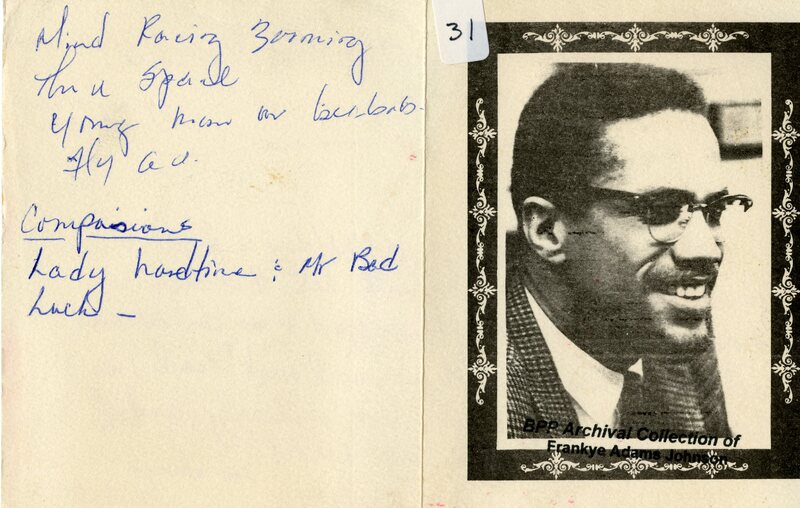
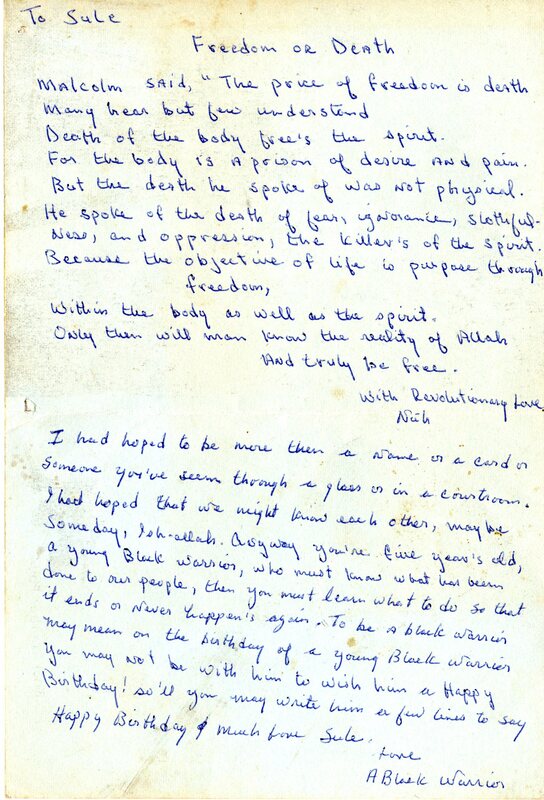
A birthday card from Nuh Abdul Qaiyum, who is imprisoned, to Sule for his 5th birthday. A photo of Malcolm X is on the cover. Nuh Abdul Qaiyum quotes Malcolm X and explains the importance of letting go of fear, ignorance, and oppression. He expresses disappointment that he is not free to wish Sule, “young Black warrior,” a happy birthday in person.
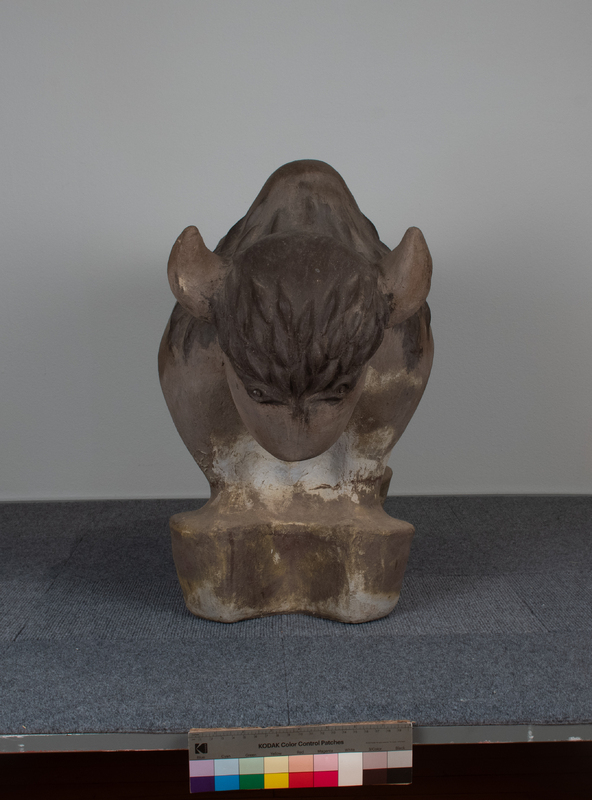
Erma Gordon’s “Bison” sculpture includes two-toned clay with a smooth finish on the body. The hair of the bison is carefully sculpted on the top of its body, lending a realistic, soft texture. The artist depicted herself creating this sculpture in her Hannah Hall mural. Wildlife are frequent subjects of TSU student terracottas.
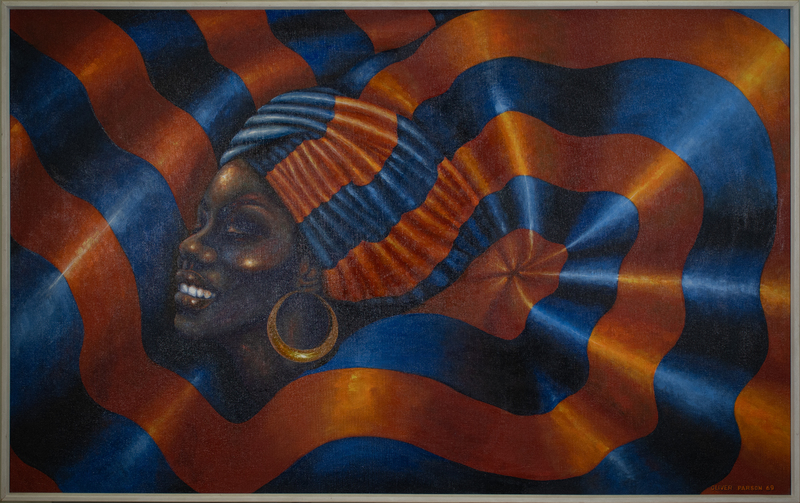
This radiant work by Oliver Parson engulfs the viewer in the spiraling flow of a smiling woman's silky headwrap. The headwrap is a fashionable method of hair protection and expression of identity that is shared among women across the African diaspora.
Charles Clinton Spaulding, born in 1874, rose from a farm boy in North Carolina to leading the largest black insurance company, the North Carolina Mutual and Provident Association.
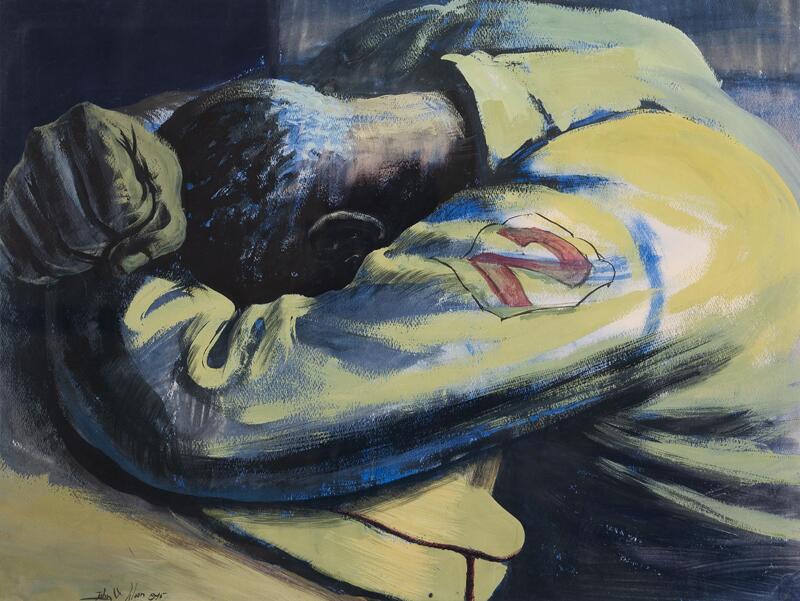
John Woodrow Wilson was a famous painter known for his creative portraits and stylistic approach to social justice. "Black Despair" shows a Black man in a state of anguish with his arms crossed over his head, facing downward, loooking into his lap, resting his body on a table or desk. His right fist sits above his head, and he is wearing a military uniform.
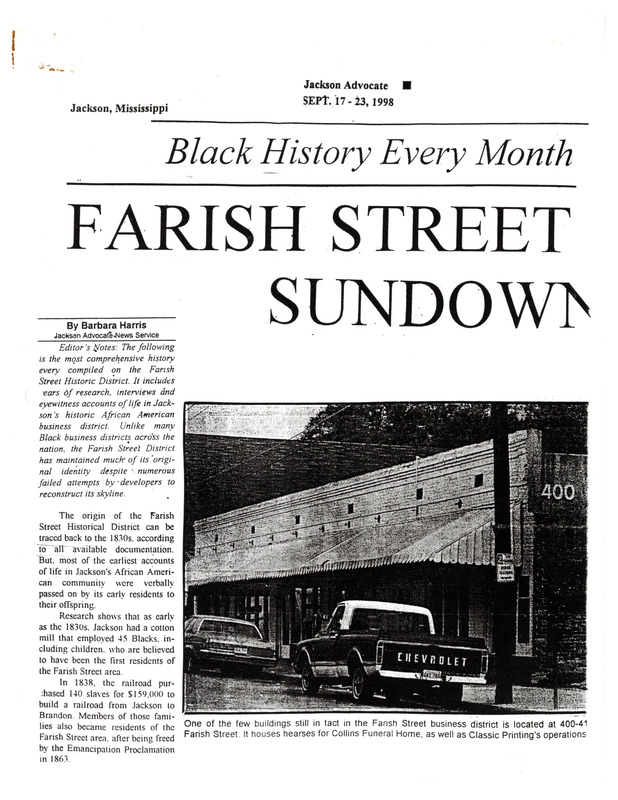
A newspaper article from the Jackson Advocate about the history of the Farish Street Historic District. Some research for the article comes from Jackson State's Farish Street Oral History Collection.
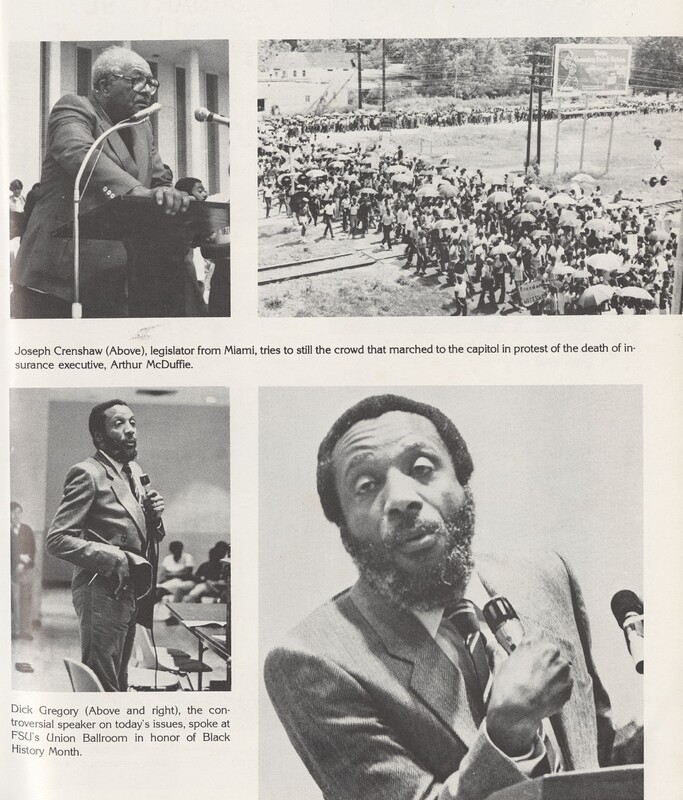
This two-page spread comes from the 1981 Rattler Yearbook and features images from Black History Month events at both Florida A&M University and Florida State University. Prominent figures like Dr. Larry Rivers, Joseph “Joe” Lang Kershaw, and Dick Gregory were highlighted for significant events or visited the campuses’ to speak to students.
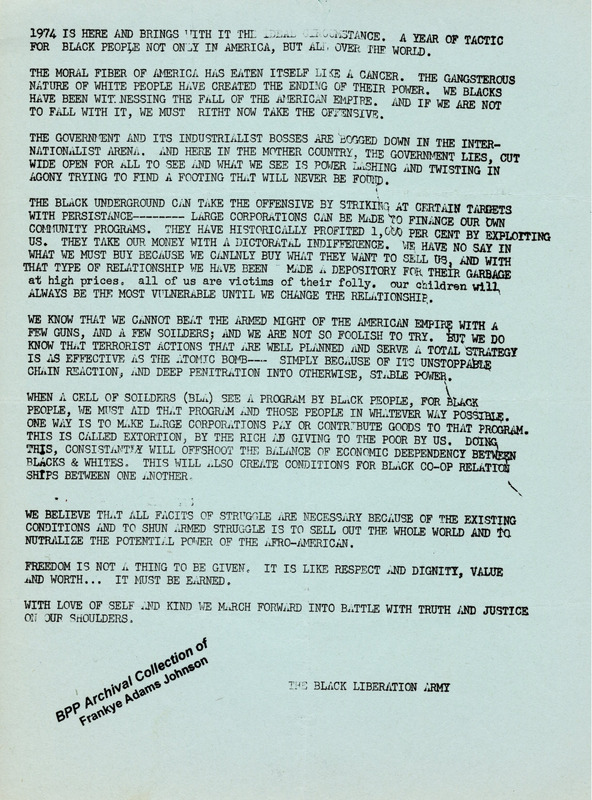
A directive from the Black Liberation Army (BLA) calling Black people in the United States to organize against the white power complex. The author writes that the end of the American empire is near and that the BLA will aid any programs that are for Black people, by Black people, including forcing corporations to contribute goods to the cause.
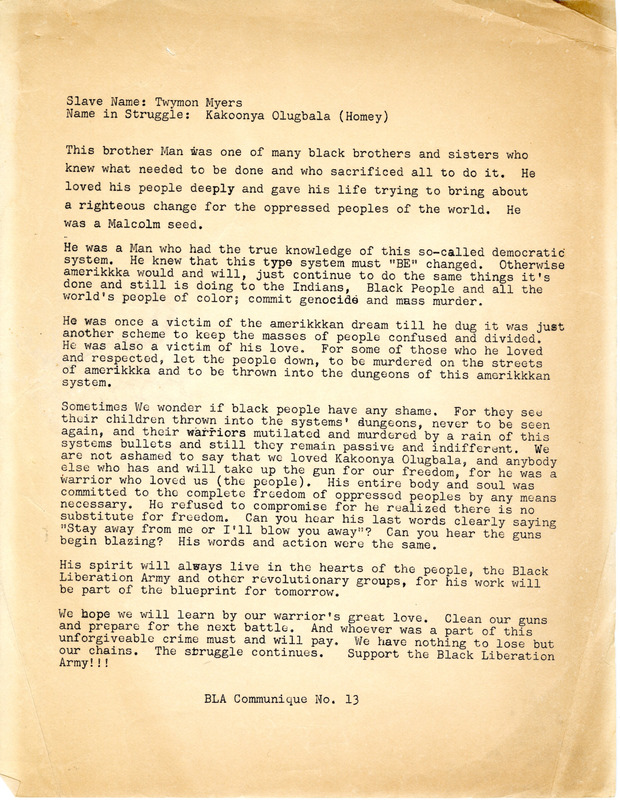
A memo from the Black Liberation Army (BLA) eulogizing Kakoonya Olugbala (Twymon Myers) who gave his life to the struggle against oppression. He was killed in a shootout with New York Police and FBI agents on November 14, 1973, after a long manhunt (he was on the FBI’s most wanted list) because of his involvement with previous police shootings.
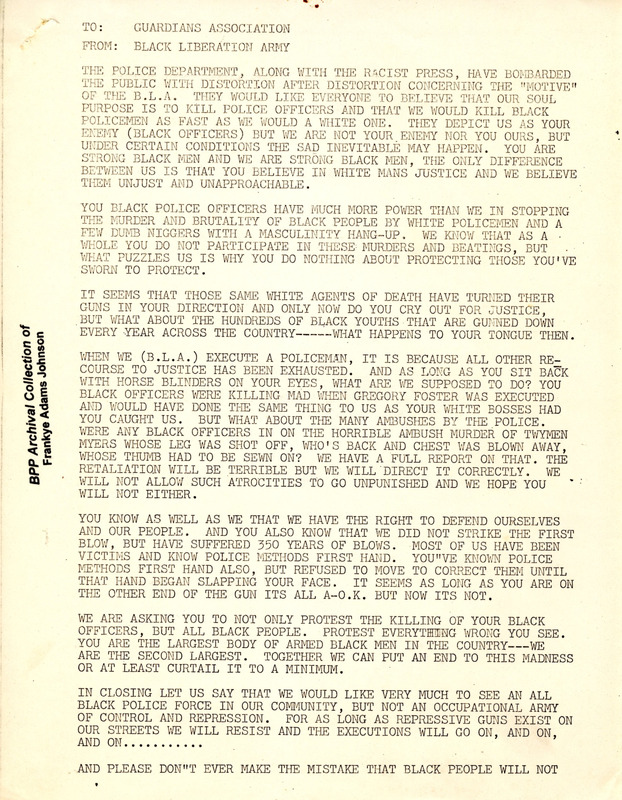
A memo from the Black Liberation Army (BLA) to the Guardians Association. The memo explains the BLA's stance on killing police and pleads with Black police officers to no longer side with their white counterparts. The Guardian’s Association is a fraternal organization primarily composed of Black law enforcement officers.
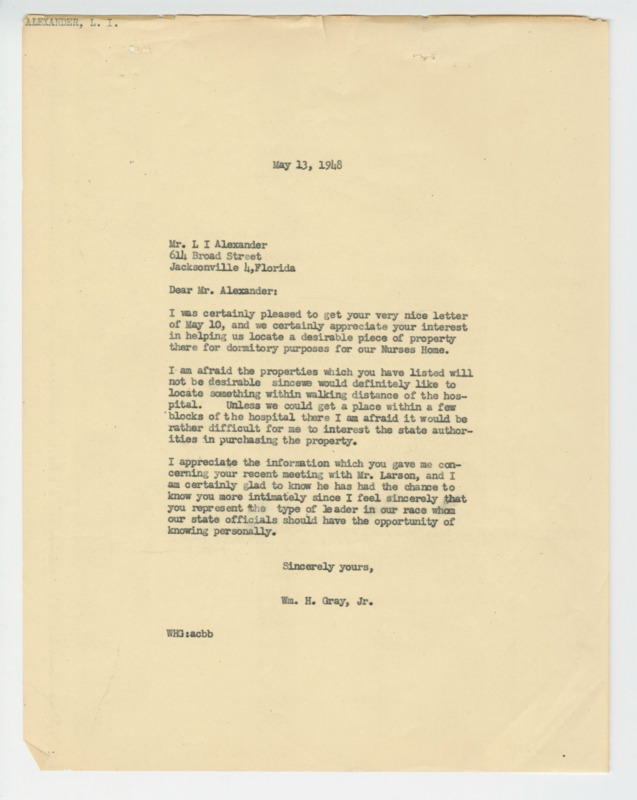
In a year of letters, L. I. Alexander and President W. H. Gray explored opportunities in insurance and real estate, amid decreasing college interest. Gray, seeing Alexander as a key leader, supported his initiative to acquire property and foster Black excellence in education and business.
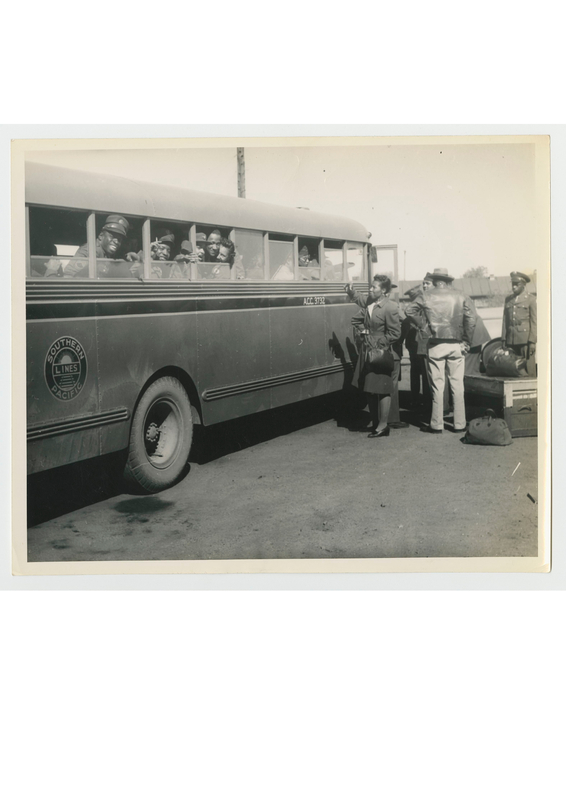
In this photograph, beaming Black soldiers smile and wave out the windows of a bus with the Southern Pacific Lines insignia on the side. Others stand around bags of luggage waiting to enter the transport. While Southern Pacific Lines was known as a locomotive company, this vehicle appeared to be a bus rather than a train car.
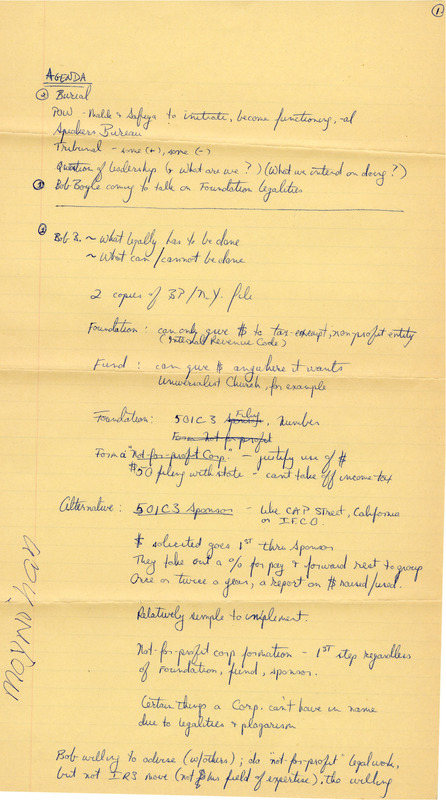
An agenda for a meeting of the Black Panther Foundation in 1987. The Black Panther Foundation discussed their leadership and a defined mission of the foundation. There is also a note about a meeting with Howard University about establishing a Black Panther Party archive.
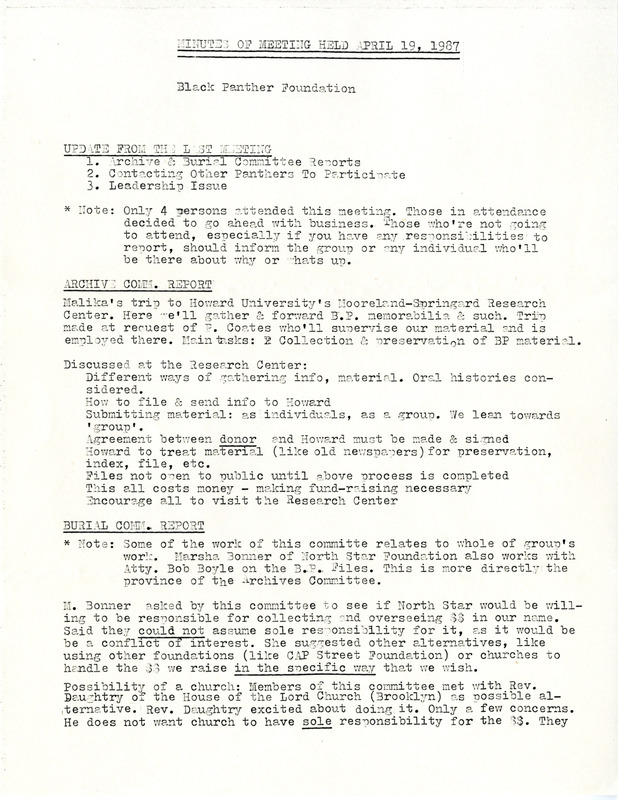
Minutes from a meeting of the Black Panther Foundation on April 19, 1987. Low attendance at the last meeting was briefly mentioned before a meeting regarding Howard University's Black Panther archive was discussed. Members discussed the burial committee, money, reaching out to new members, and the foundation’s responsibility.
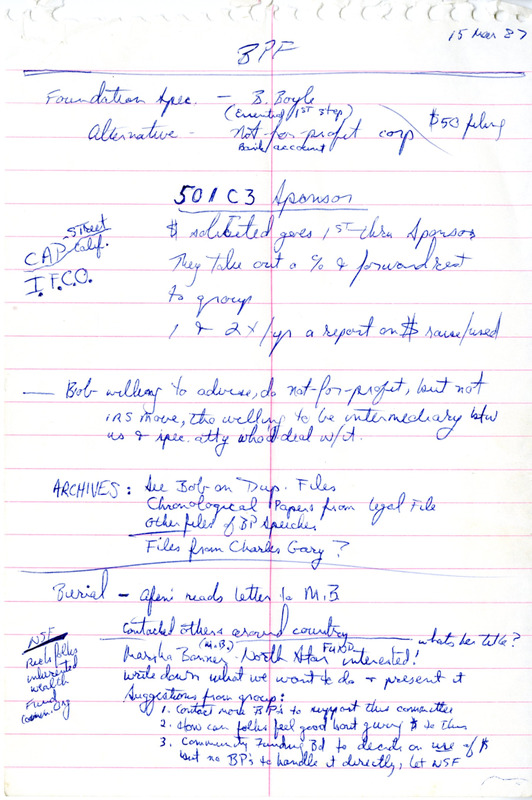
Handwritten notes of minutes from a March 17, 1987 meeting of the Black Panther Foundation. The meeting covered such topics as sponsors for the foundation, archives, burial, prisoners of war, speakers bureau, leadership, and criticisms.
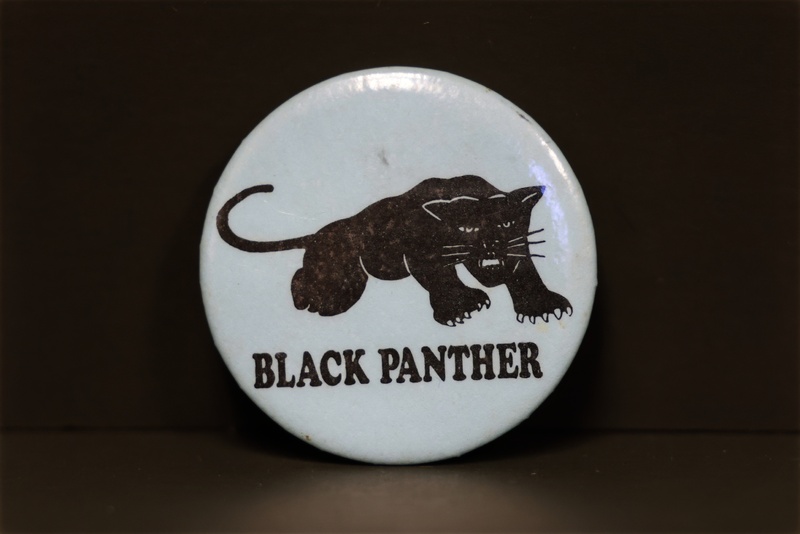
A blue button with the Black Panther logo and text that says “Black Panther.” The Black Panther Party for Self Defense was founded in 1966 by Bobby Seale and Huey P. Newton in Oakland, California. Rooted in Black Power and Marxist-Leninist ideologies, the Black Panther Party would soon spread with branches all over the United States.
A proposed budget and income statement prepared for the Black Panther Newspaper Committee. The budget totals $221,750 and covers everything needed to operate the paper for a year: salaries, equipment and supplies, communication, printing, travel expenses, attorney and accountant fees, and office rental.
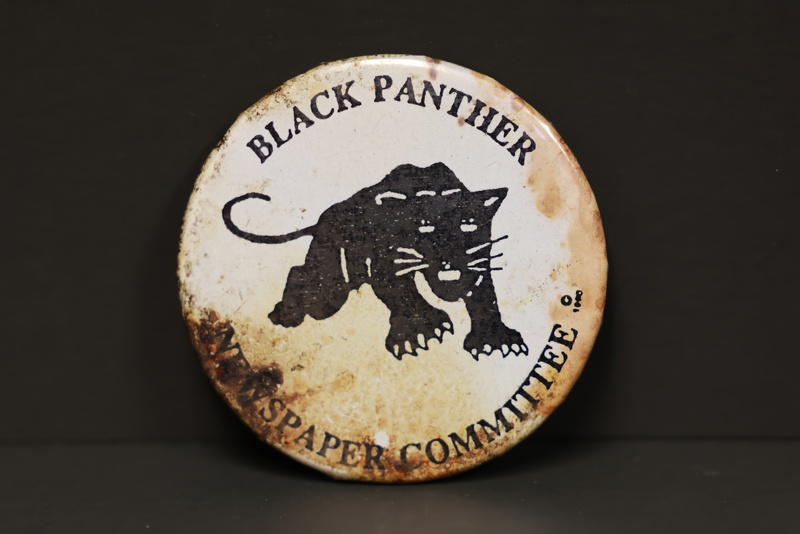
A white button with a picture of the Black Panther Party logo. The text says "Black Panther Newspaper Committee." The Black Panther newspaper began as a 4 page newsletter in 1967 by Black Panther Party founders Huey P. Newton and Bobby Seale. The paper went on to express the party’s core ideologies to a large national and international readership.
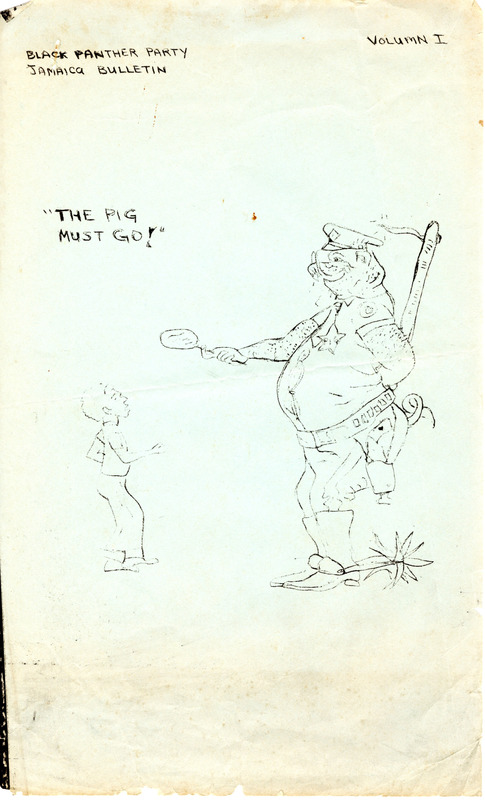
Volume 1 of The Black Panther Party Jamaica Bulletin from Jamaica Queens, NY, February 28, 1969. Included in the bulletin are a political cartoon titled "The Pig Must Go"; an article titled "Panthers Harassed by F.B.I."; and an abridged version of Black Panther Party Ten Point Program.
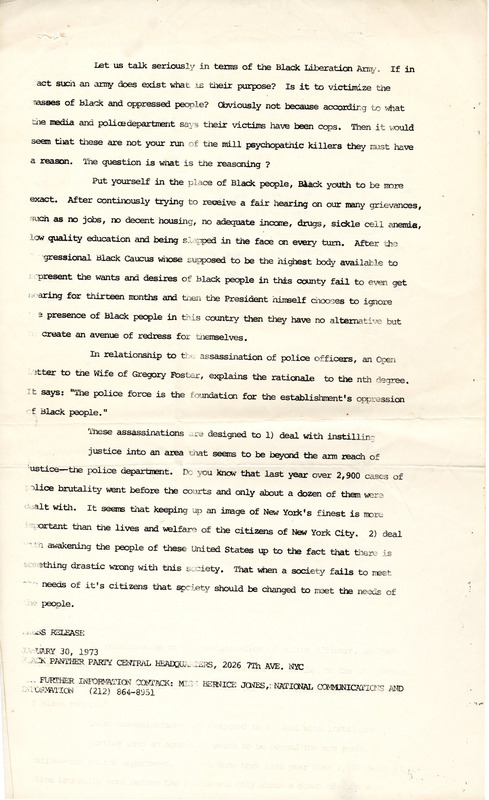
A press release from the Black Panther Party Central Headquarters in New York City about recent acts of police brutality and the response of the Black Liberation Army (BLA). The author writes that the recent assassinations of New York police officers is a direct response to the amount of police brutality that goes unnoticed and unpunished.
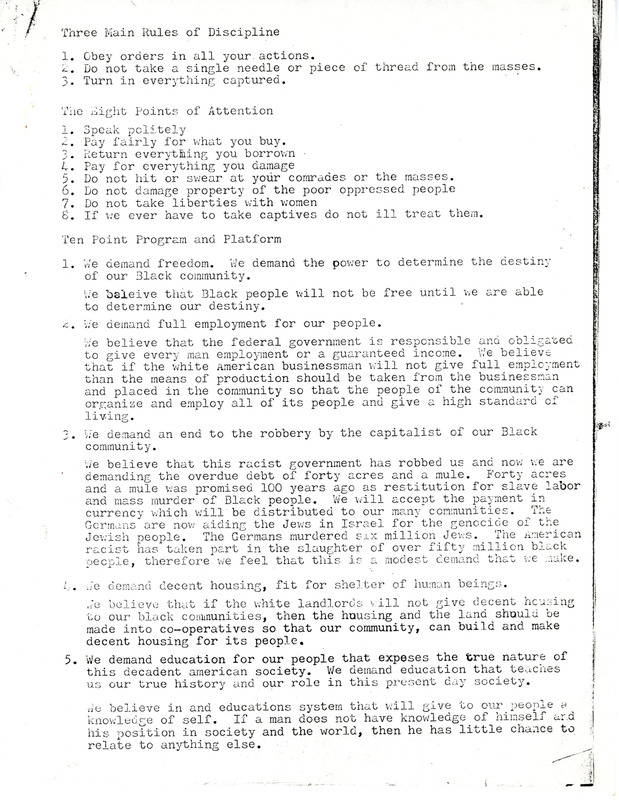
A three page handout given to members of the Black Panther Party. The sections are: Three Main Rules of Discipline; The Eight Points of Attention; Ten Point Program and Platform; and Rules of the Black Panther Party.
A newspaper article from The Black Panther. This is a transcript of the address Roberta Alexander gave at the Black Panthers’ United Front Against Fascism (UFAF) conference in August of 1969 in Oakland, California. Alexander, a Black Panther Party member, talks about the role of women in the party and in the larger struggle against oppression.
John Woodrow Wilson was a famous painter known for his creative portraits and stylistic approach to social justice. "Black Despair" shows a Black man in a state of anguish with his arms crossed over his head, facing downward, loooking into his lap, resting his body on a table or desk. His right fist sits above his head, and he is wearing a military uniform.