This collection highlights the Black Liberation Army (BLA), an underground Marxist-Leninist organization that operated in the United States from 1970-1981. BLA was primarily made up of former Black Panthers and Republic of New Afrika members. The organization's goal was to “take up arms for the liberation and self-determination of Black people in the United States” and they openly declared war on the United States government. Former Black Panther Party member and Jackson State University professor Frankye Adams-Johnson’s Black Panther Party Collection includes many items associated with the BLA such as newspaper clippings, BLA newsletters, drafts of speeches, position papers, and more. These materials offer a rare glimpse into the inner workings of this underground organization.
Curated By
Garrad Lee
Contributing Institution
Jackson State University
About This Record
The HCAC public history focused digital archive cataloging is an ongoing process, and we may update this record as we conduct additional research and review. We welcome your comments and feedback if you have more information to share about an item featured on the site, please contact us at: HCAC-DigiTeam@si.edu
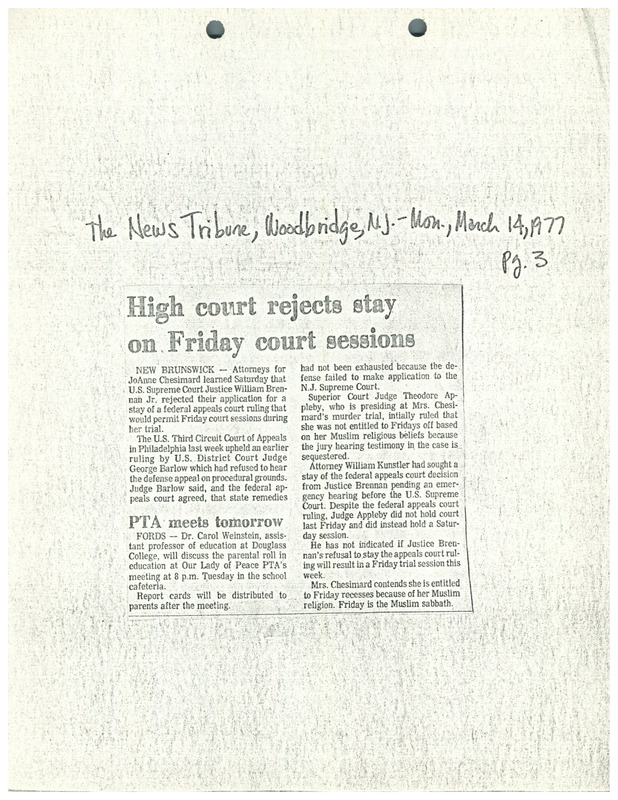
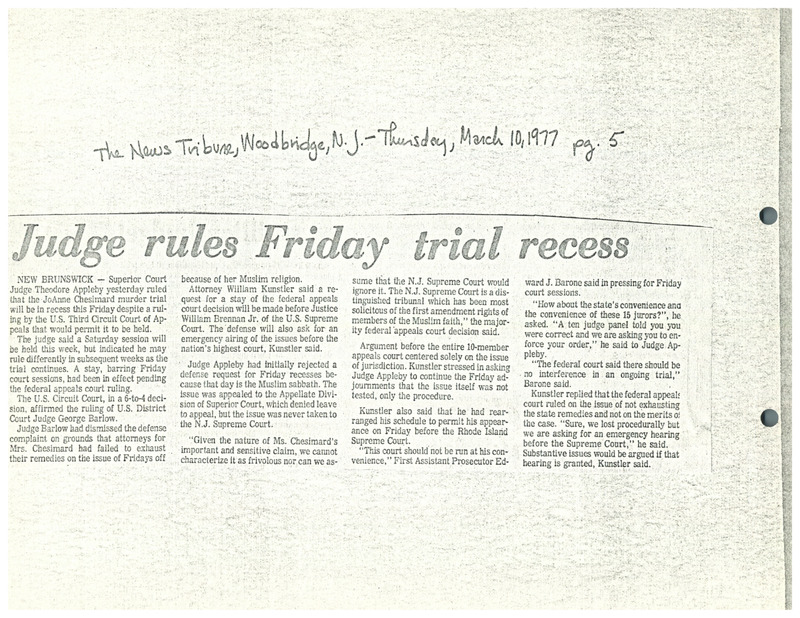
A newspaper article from The News Tribune about the question of Friday recesses asked for by the defense because of the Muslim faith of Assata Shakur (JoAnne Chesimard), who was on trial for the 1973 killing of a state trooper. The question has been a feature of the trial and the defense, prosecution, and judge continue to argue over it.
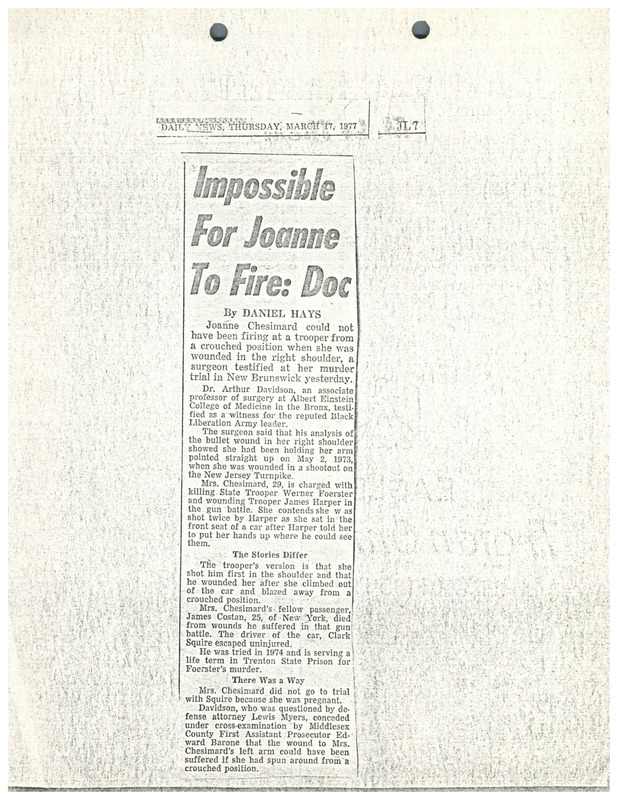
A newspaper article from Daily News about the testimony of defense witness Dr. Arthur Davidson during the trial of Assata Shakur (JoAnne Chesimard) for the 1973 killing of a state trooper. He testified that the wound in her right shoulder showed that she was holding her right arm pointed straight when she was wounded in the shootout.
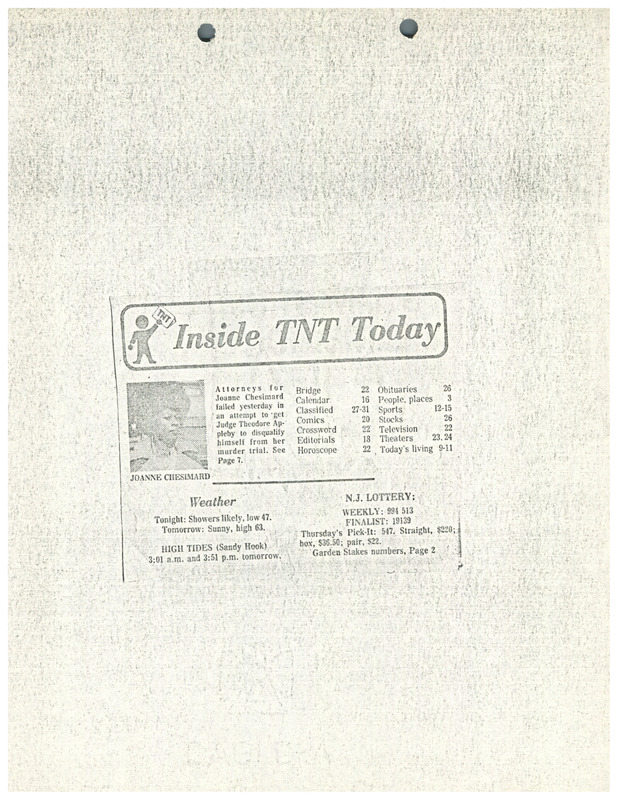
A news blurb from The News Tribune about the failure of defense attorneys to have Judge Theodore Appleby disqualify Assata Shakur (JoAnne Chesimard) from her murder trial for the 1973 killing of a state trooper. Shakur was convicted in 1977 of the killing and escaped prison in 1979.
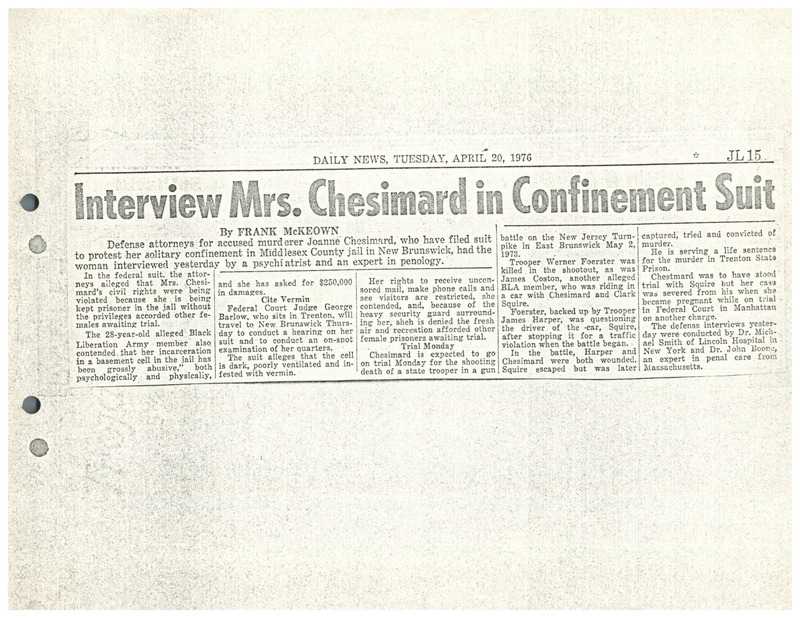
A newspaper article from The Daily News about Assata Shakur (JoAnne Chesimard) being in New Jersey to stand trial for the May 1973 killing of a state trooper and the federal suit her attorneys filed for alleged horrible living conditions and violation of civil rights. Shakur was convicted in 1977 of the killing and escaped prison in 1979.
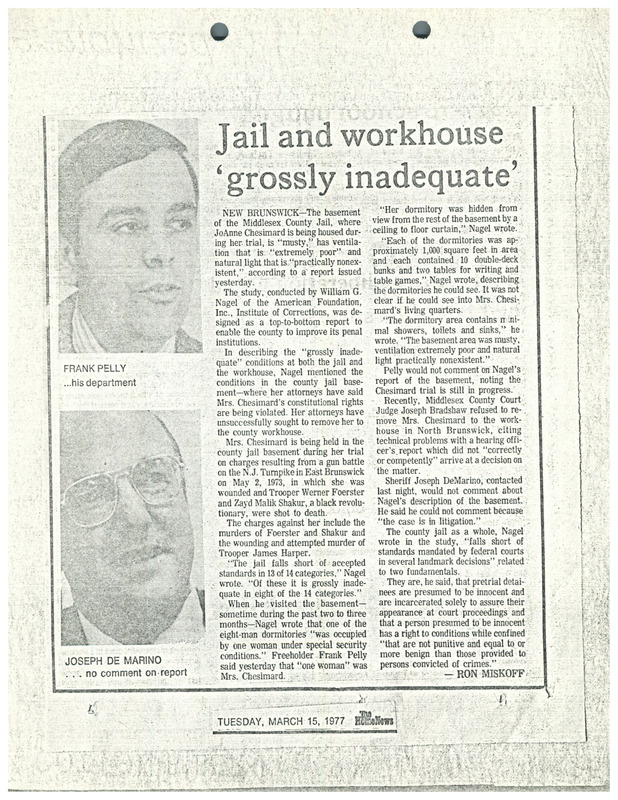
A newspaper article from The Home News about a 133 page report from American Foundation, Inc., Institute of Corrections that finds the conditions of Middlesex County Jail, specifically the basement where Assata Shakur (JoAnne Chesimard) is being held while on trial for the 1973 killing of a state trooper, to be "grossly inadequate."
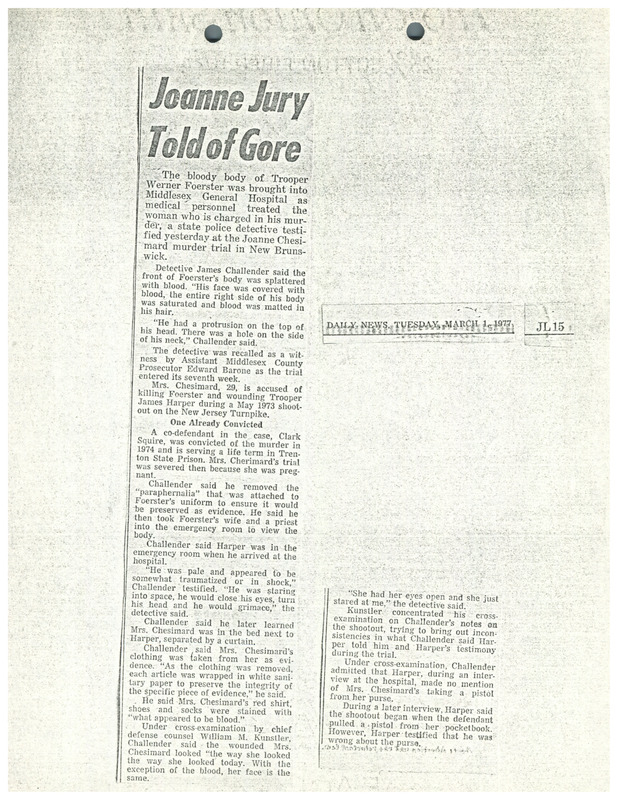
A newspaper article from the Daily News about the testimony of State Police Detective James Challender describing what he saw at the emergency room where Assata Shakur (JoAnne Chesimard) and wounded state trooper Werner Foerster were taken after he was fatally shot. Shakur was on trial for the 1973 murder of Foerster.
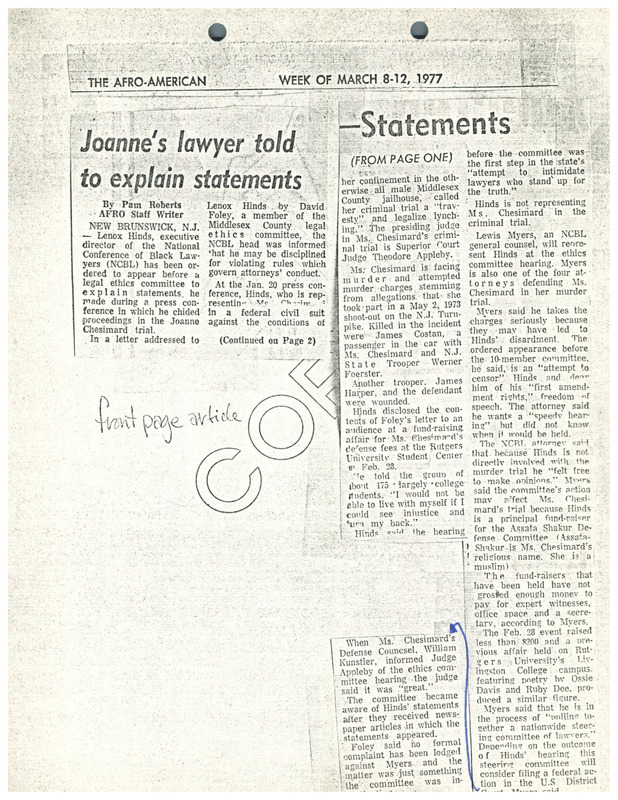
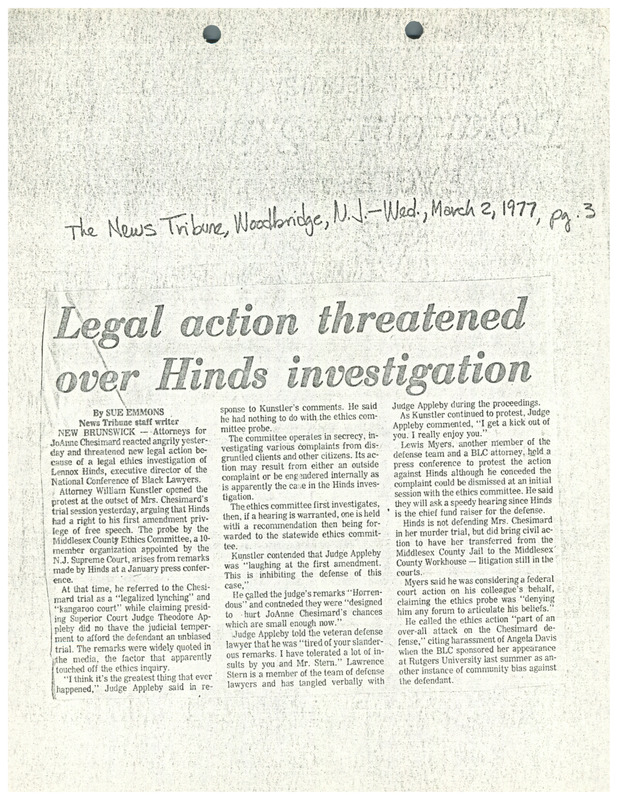
A newspaper article from The Afro-American about Lennox Hinds, president of the National Conference of Black Lawyers, speaking out against his critics for his support of Assata Shakur (JoAnne Chesimard), who was on trial for the 1973 killing of a state trooper, after being cited by The Ethics Committee of the Middlesex County Bar Association.
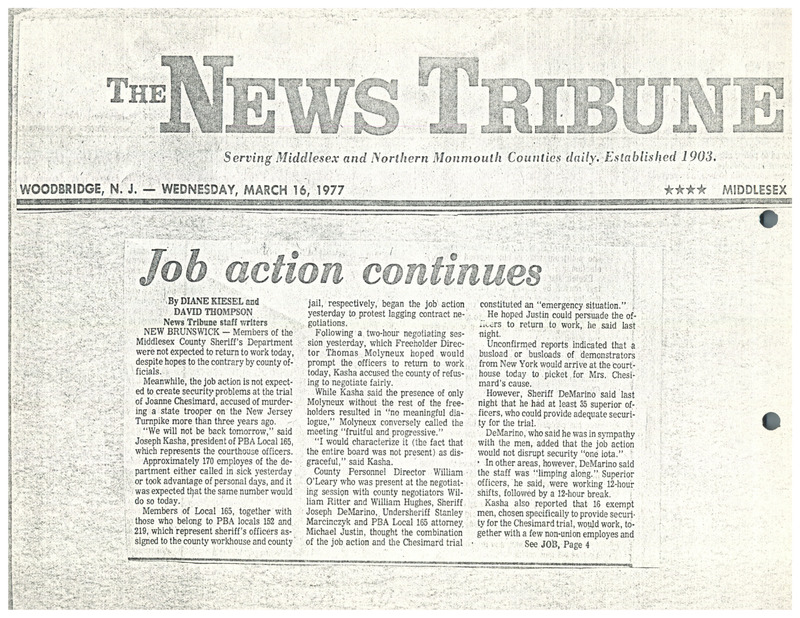
A newspaper article from The News Tribune about no-work action taken by around 170 employees of the Middlesex County Sheriff's Department over lagging contract negotiations. The missing officers are not expected to cause security issues at the Assata Shakur (JoAnne Chesimard) trial for the 1973 killing of a state trooper.
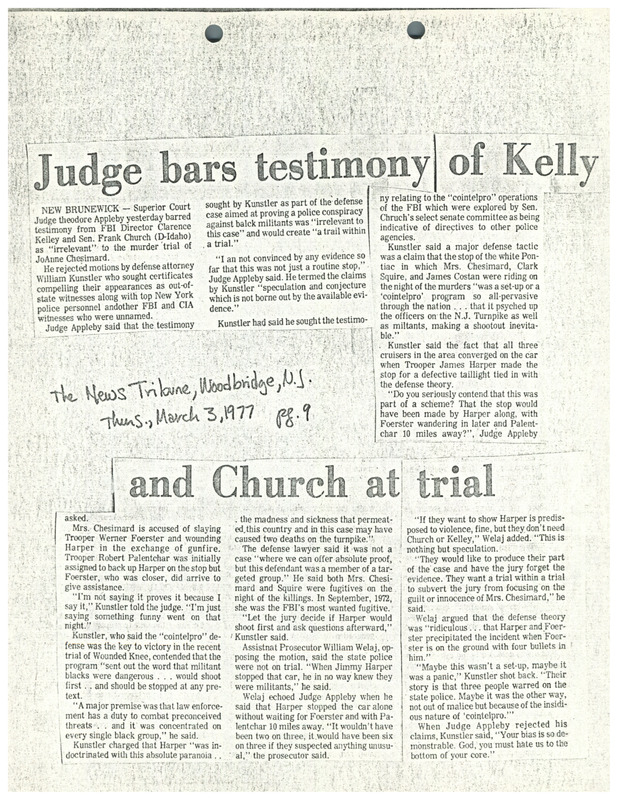
Newspaper article from The News Tribune about Superior Court Judge Theodore Appleby barring the testimony of an FBI agent and senator. Chief defense attorney William Kunstler wanted to use the testimony to establish a police conspiracy against Black militants in the trial of Assata Shakur (JoAnne Chesimard) for the 1973 killing of a state trooper.
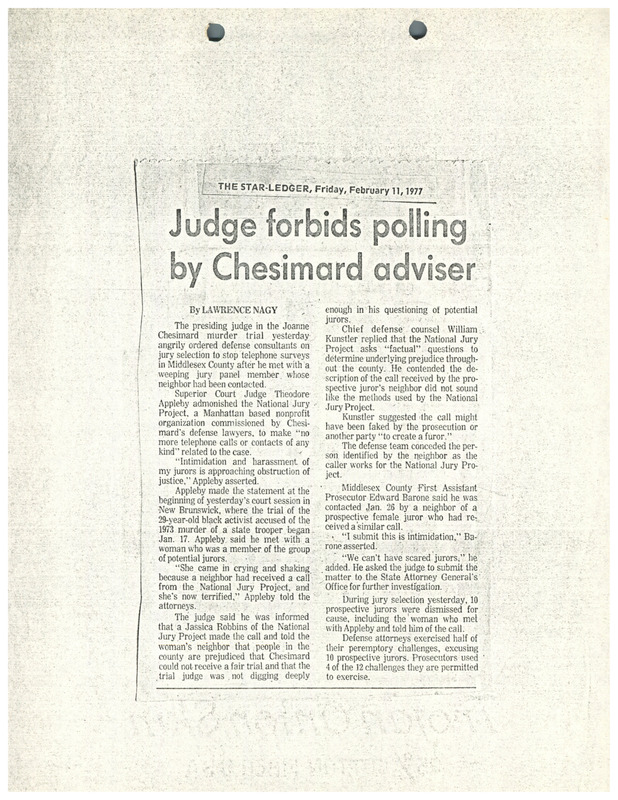
A newspaper article from The Star Ledger about Superior Court Judge Theodore Appleby ordering defense consultants, the National Jury Project, to stop making calls and contact related to the trial of Assata Shakur (JoAnne Chesimard) for the 1973 killing of a state trooper. Appleby said that the calls were approaching obstruction of justice.
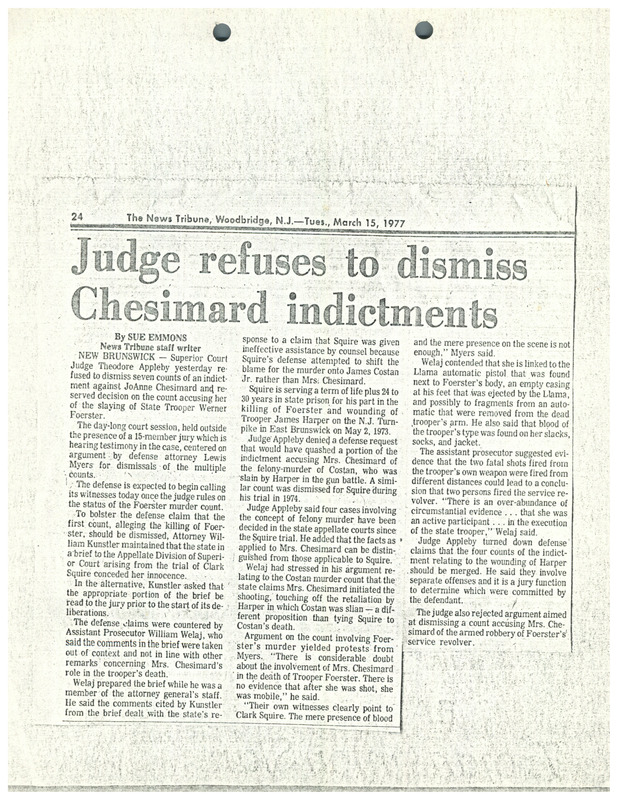
A newspaper article from The News Tribune about a day long juryless court session where defense lawyers made numerous motions to dismiss the indictments against Assata Shakur (JoAnne Chesimard) who was on trial for the 1973 killing of a state trooper. The judge rejected these motions and the attorneys are scheduled to call witnesses that day.
An article from The News Tribune about the question of Friday recesses asked for by the defense because of the Muslim faith of Assata Shakur (JoAnne Chesimard), who was on trial for the 1973 killing of a state trooper. The question has been a feature of the trial and the defense, prosecution, and judge continue to argue over it.
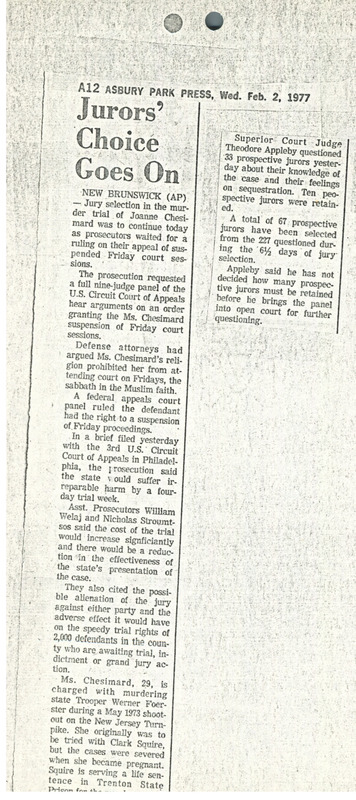
An article from the Asbury Park Press about the trial of Assata Shakur (JoAnne Chesimard) for the 1973 killing of a state trooper. Jury selection continued as prosecutors awaited ruling on their appeal of suspended court sessions, granted by a federal appeals court panel in respect to the defendant's Muslim faith.
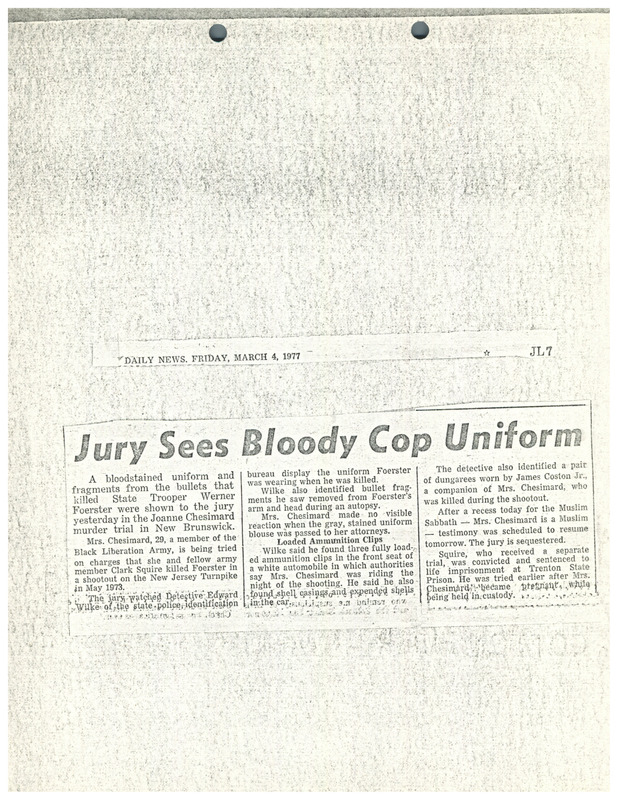
A newspaper article from The Daily News about items entered into evidence by the prosecution in the Assata Shakur (JoAnne Chesimard) trial for the 1973 killing of a state trooper. The slain trooper’s bloodied uniform shirt was submitted into evidence, as well as bullet fragments pulled from the body, and empty shell casings.
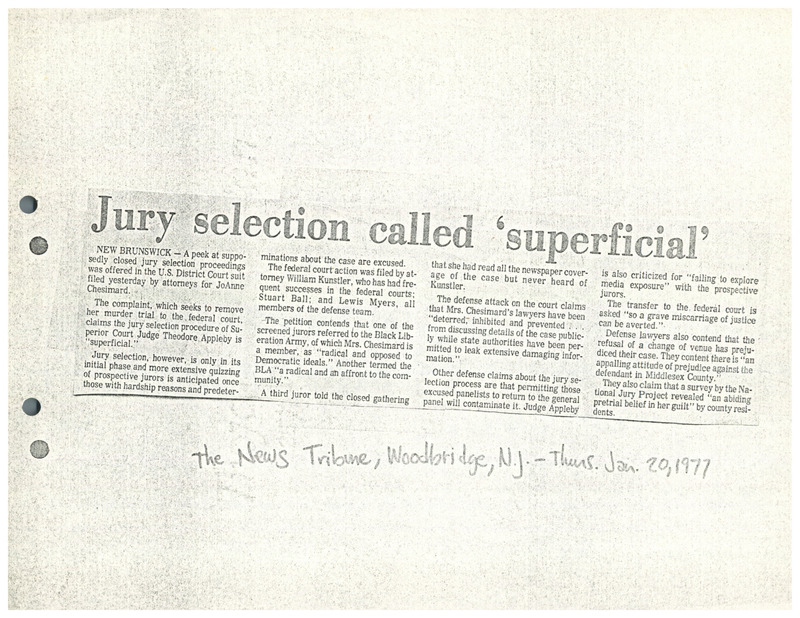
A newspaper article from The News Tribune about defense attorneys for Assata Shakur (JoAnne Chesimard), who was on trial for the 1973 killing of a state trooper, filing a complaint claiming that the jury selection in her murder trial is biased toward the prosecution. Shakur was convicted in 1977 of the killing and escaped prison in 1979.
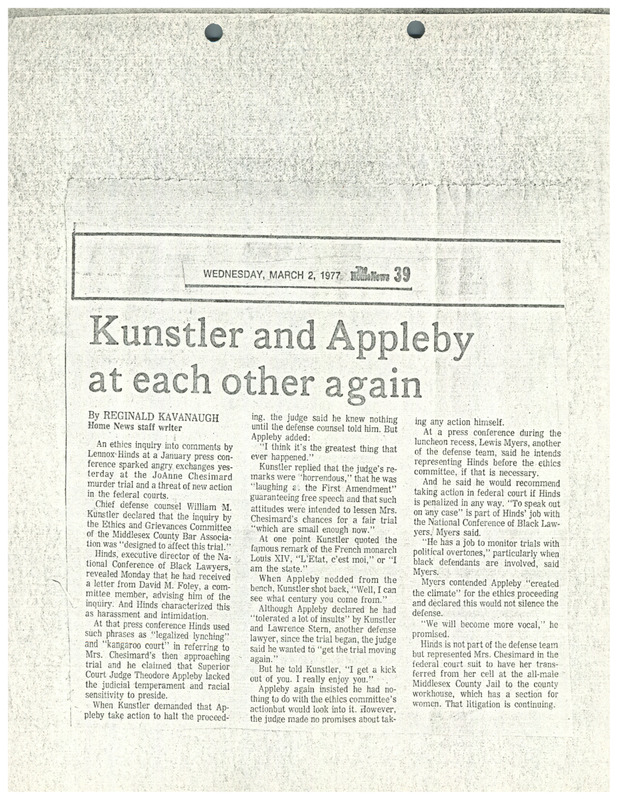
A newspaper article from The Home News about arguing between chief defense counsel William Kunstler and Superior Court Judge Theodore Appleby in the trial of Assata Shakur (JoAnne Chesimard) for the 1973 killing of a state trooper. The argument centered on a citation given to Lennox Hinds, president of the National Conference of Black Lawyers.
A newspaper article from The News Tribune about Lennox Hinds, president of the National Conference of Black Lawyers, being cited by The Ethics Committee of the Middlesex County Bar Association. Chief defense counsel William Kunstler, representing Assata Shakur (JoAnne Chesimard) in her trial for the 1973 killing of a state trooper, protested it.
Ashanti Alston, a Black Liberation Army (BLA) member who was imprisoned for 11 years for a robbery, writes about his plans to retrieve Frankye Adams-Johnson (Malika)’s art materials from her property. He tells her that he plans to be out by September and to take care of himself. The letter is dated July 16th with no year specified.
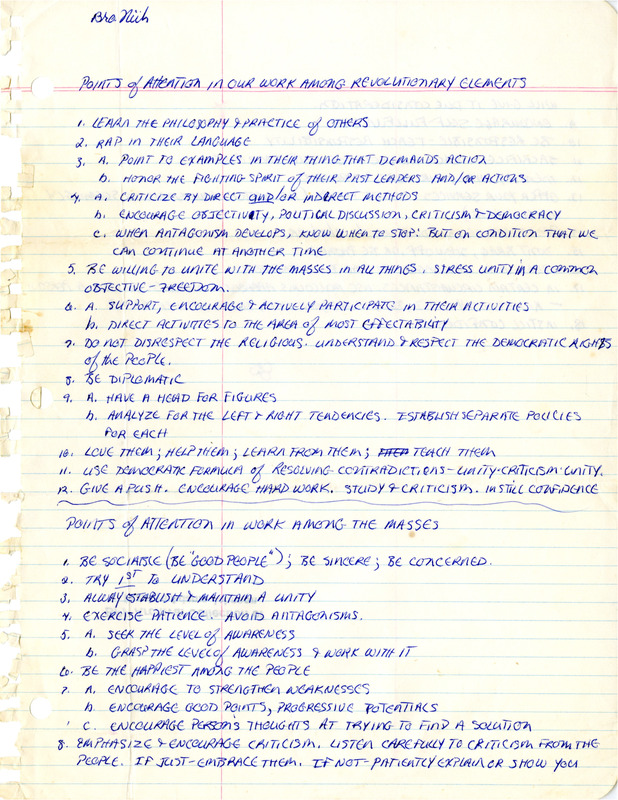
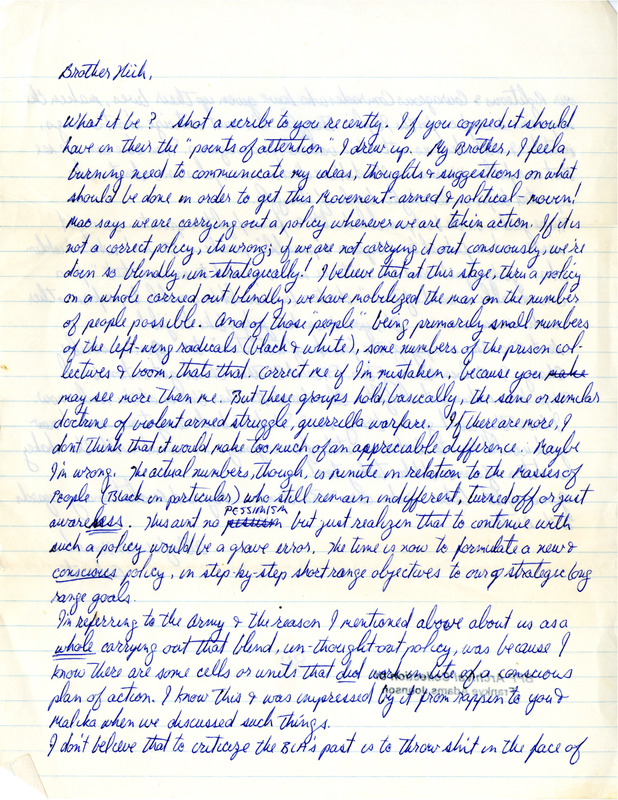
A letter from Ashanti Alston, a Black Liberation Army (BLA) member who was imprisoned for 11 years for a robbery to raise money for the BLA, to Nuh Abdul Qaiyum. The letter includes 2 lists: "Points of Attention In Our World Among Revolutionary Elements" and "Points of Attention in Work Among the Masses"
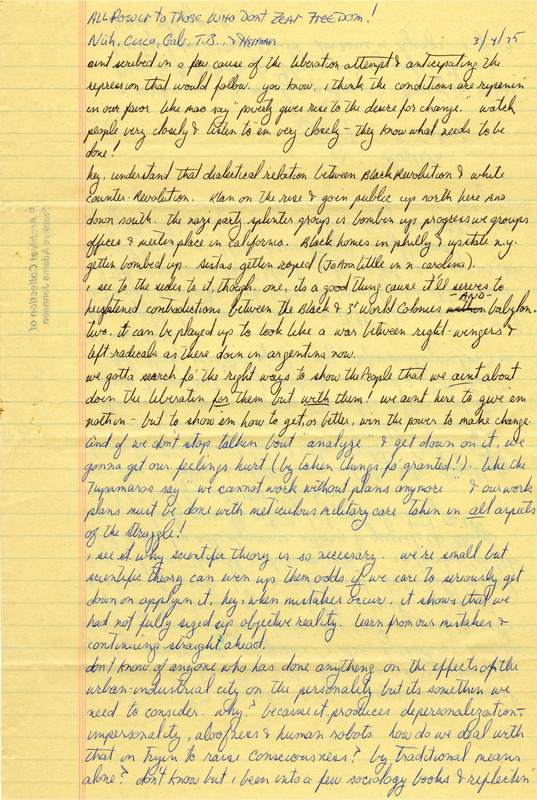
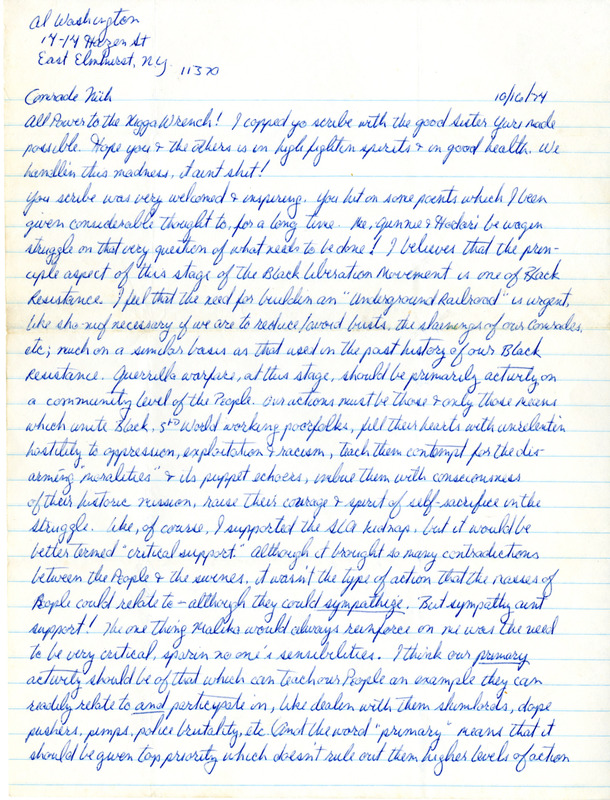
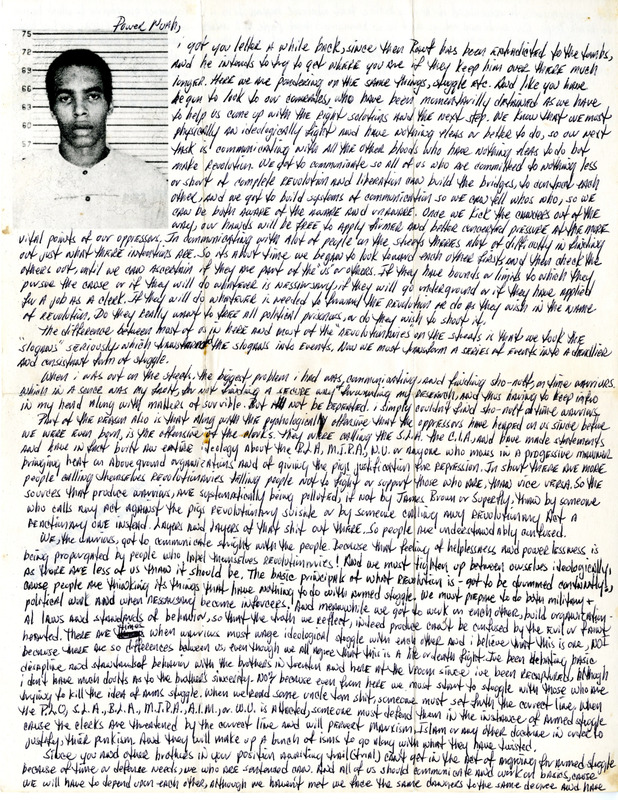
Ashanti Alston, a Black Liberation Army (BLA) member who was imprisoned for 11 years for a robbery to raise money for the BLA, writes to three fellow imprisoned revolutionaries. He writes about the psychology of the fight for Black liberation and the ways in which their organization should fight for the people.
A letter from Ashanti Alston, a Black Liberation Army (BLA) member who was imprisoned for 11 years for a robbery to raise money for the BLA. He explores the mistakes of the BLA and writes about the principles of the new movement. He gives an update of his prison sentence of 25 years.
Ashanti Alston, a Black Liberation Army (BLA) member who was imprisoned for 11 years for a robbery to raise money for the BLA, writes to Nuh Abdul Qaiyum, asking which methods should be used to communicate with the people and the best actions to take that will instill unity in the community. He also writes about his court proceedings.
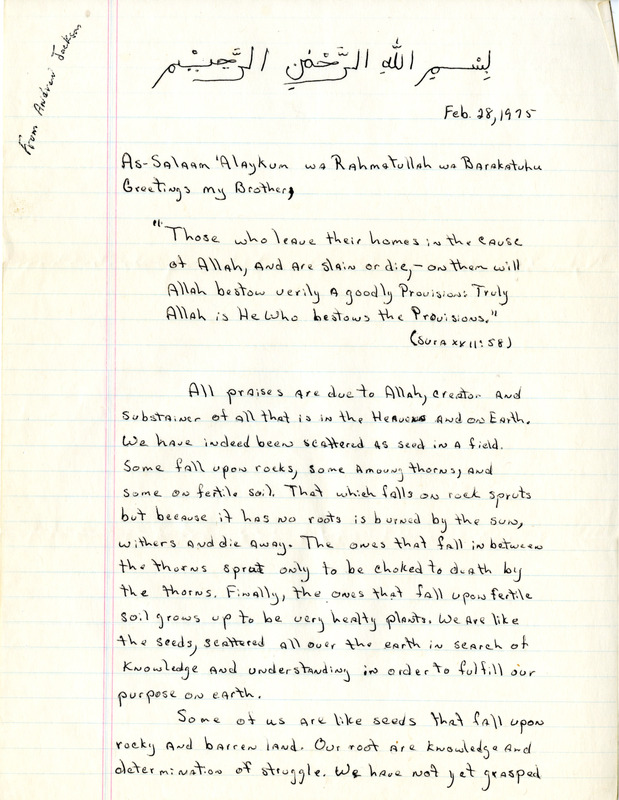
Bashir Abdul Lugman AS-Sabur writes to a fellow imprisoned person. He compares the Black Panther Party to scattered seeds that can't grow. He mentions the need for their forces to be reunited and how the recipient's religious rights are being violated through the denial of the ability to perform the Muslim practice of Jumma services in prison.
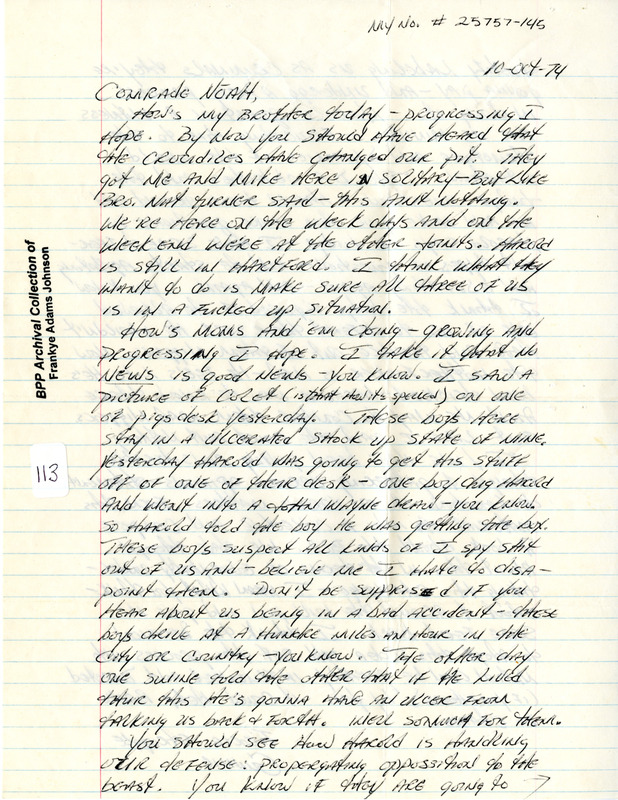
Gunnie James Haskins, a Black Liberation Army (BLA) member who was imprisoned for a robbery to raise money for the BLA, is writing to update Nuh Abdul Qaiyum of his current condition and the treatment of the other prisoners. He tells him of their court proceedings and gives his idea for a collaborative book about the BLA.
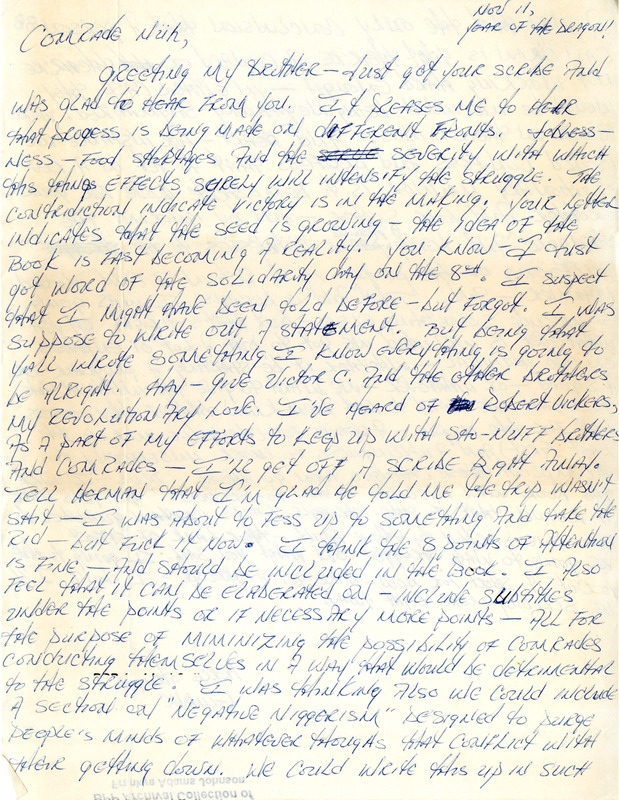
Gunnie James Haskins, a Black Liberation Army (BLA) member who was imprisoned for a robbery to raise money for the BLA, is writing to update Nuh Abdul Qaiyum to express happiness in the fact that their book is becoming a reality and the revolution is still happening in different ways.
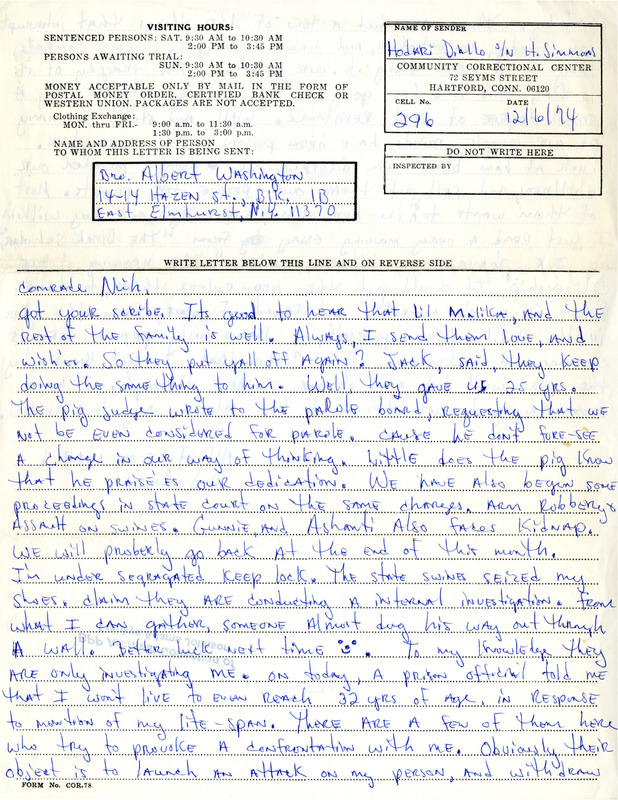
Harold Simmons (Hodari Diallo), a Black Liberation Army (BLA) member who was imprisoned for a robbery to raise money for the BLA, writes to Nuh Abdul Qaiyum to tell him he was sentenced to 25 years and is currently in segregated lockup, still being harassed by the police. He explores corruption in the community before mentioning an essay he read.
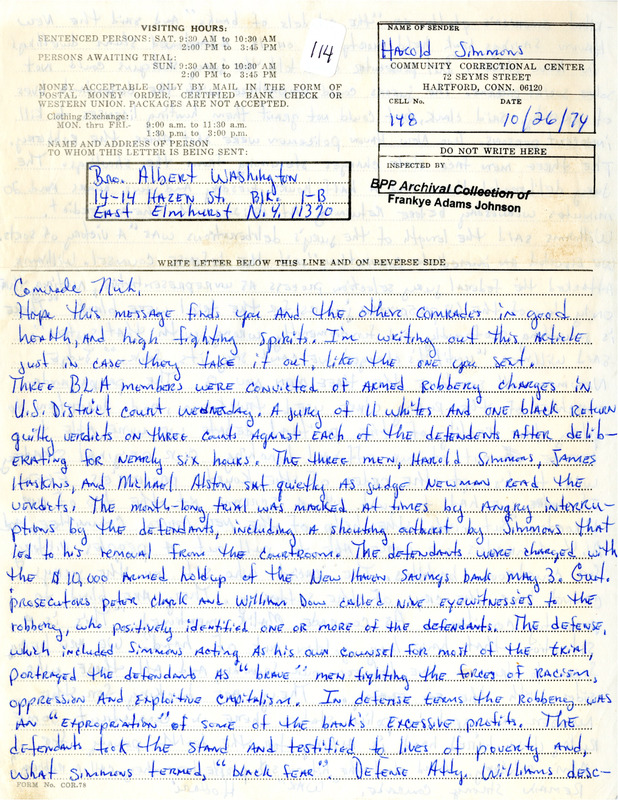
Harold Simmons (Hodari Diallo), a Black Liberation Army (BLA) member who was imprisoned for a robbery to raise money for the BLA, writes to Nuh Abdul Qaiyum. He copies an article detailing his and two other members' court proceedings. He explains their mission was to disrupt the court system, and believes they achieved a victory for the people.
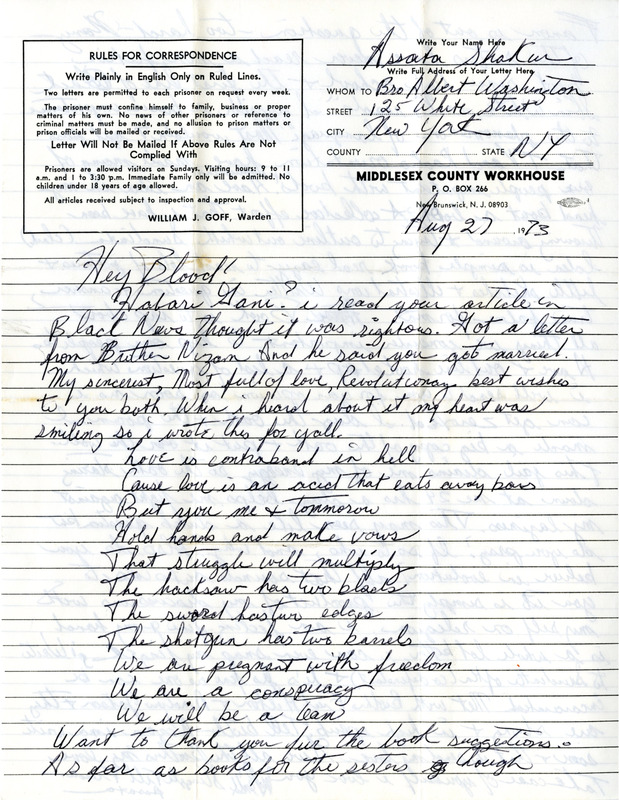
Written on Middlesex County Workhouse letterhead, where Joanne Chesimard (Assata Shakur) was being held in connection with a 1973 police shooting. She writes to Nuh Abdul Qaiyum that she heard about his marriage and wrote a love poem for them. She thanks him for his book suggestions and writes about the other prisoners attitudes’ toward books.
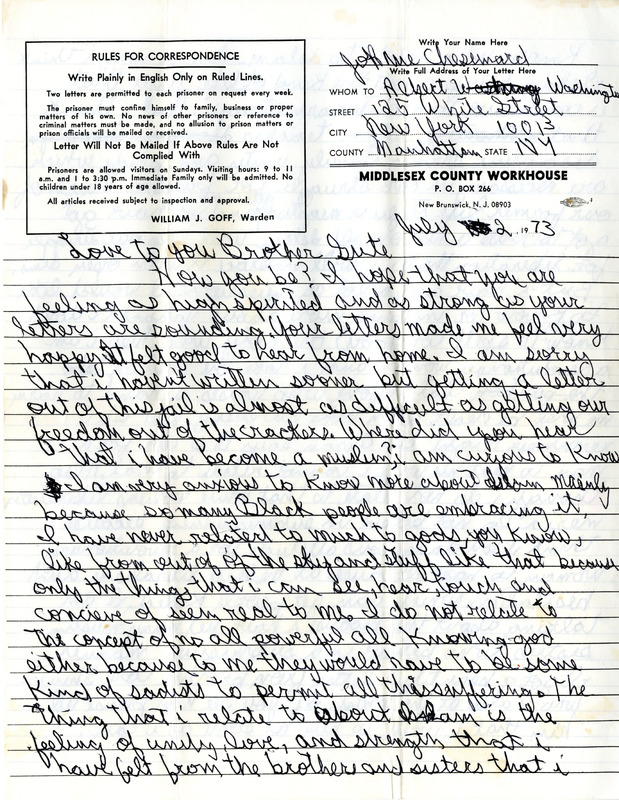
Written on Middlesex County Workhouse letterhead, where Joanne Chesimard (Assata Shakur) was being held in connection with a 1973 police shooting. She writes to Nuh Abdul Qaiyum in response to his letters and to catch up. She notes that she is hesitant toward religion, but believes Islam teaches the mental processes needed for revolution.
Kuwasi Balagoon (aka Donald Weems) was a Black Liberation Army Member (BLA) who was imprisoned in 1969. He writes to Nuh Abdul Qaiyum to detail the conscious change that the revolutionaries and prisoners need to undergo. He believes there are too many contradicting messages and they must maintain an organizational structure and single message.