This collection showcases the rich legacies of HBCUs through the medium of text. It includes both published and unpublished items such as reports, correspondence, legal documents, books, letters, essays, government publications, and journals.
Date Modified
2025-12-17
About This Record
The HCAC public history focused digital archive cataloging is an ongoing process, and we may update this record as we conduct additional research and review. We welcome your comments and feedback if you have more information to share about an item featured on the site, please contact us at: HCAC-DigiTeam@si.edu
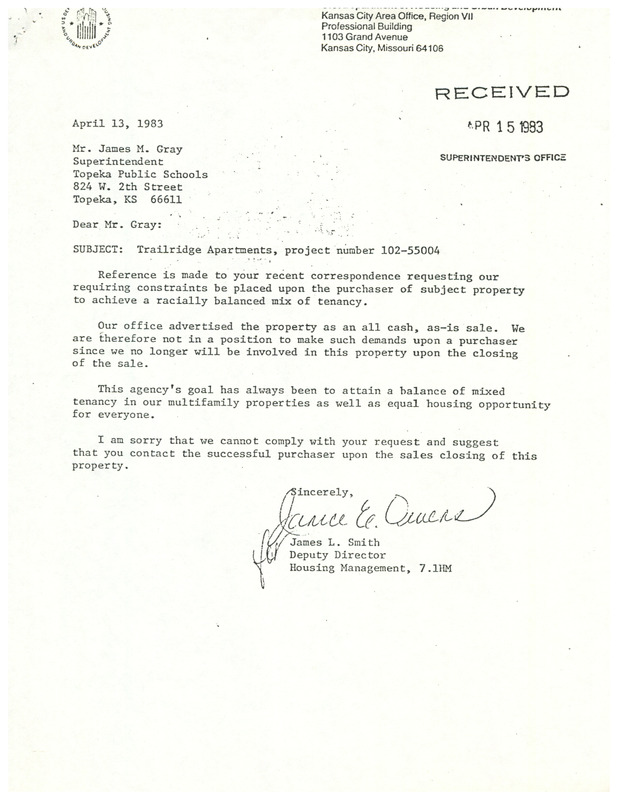
In this letter, Housing and Urban Development (HUD) Deputy Director Smith informs Superintendent of Topeka Public Schools James M. Gray that his department cannot make any demands upon a purchaser concerning racial balance since the all cash, as-is sale has been completed. Gray had earlier requested HUD assistance in the sale of a rental property.
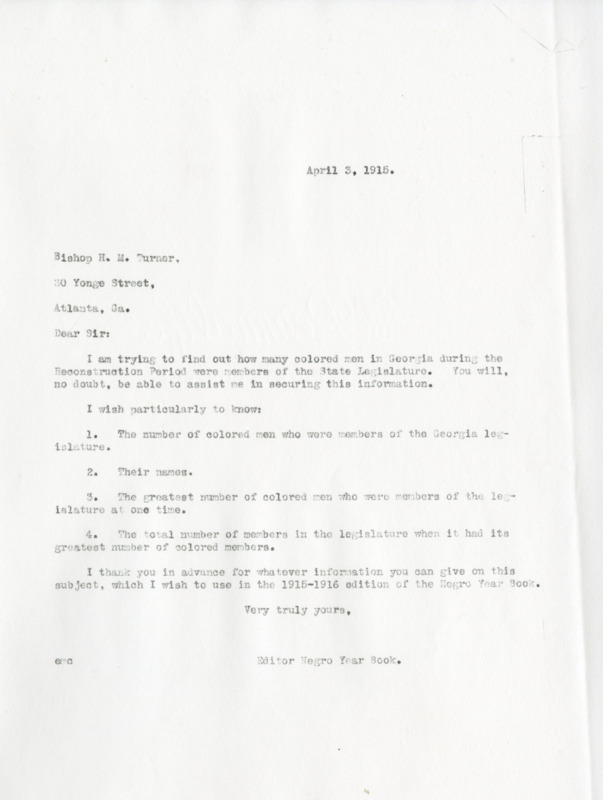
A one page letter from Dr. Work to Bishop Henry McNeal Turner rquesting information pertaining to the colored men who served in the Georgia legislature during Reconstruction.
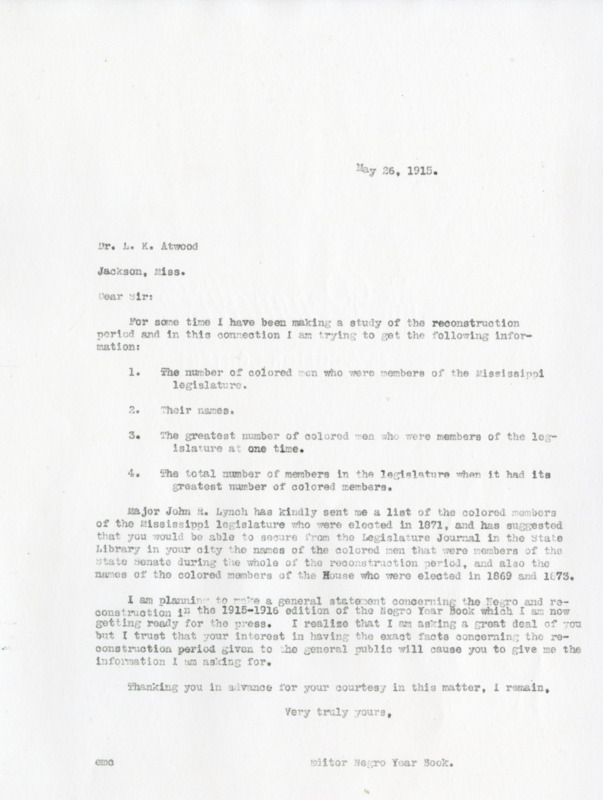
A one page letter from Dr. Work to Dr. L. K. Atwood rquesting information pertaining to the colored men who served in the Mississippi legislature during Reconstruction for the 1915-1916 Negro Yearbook.
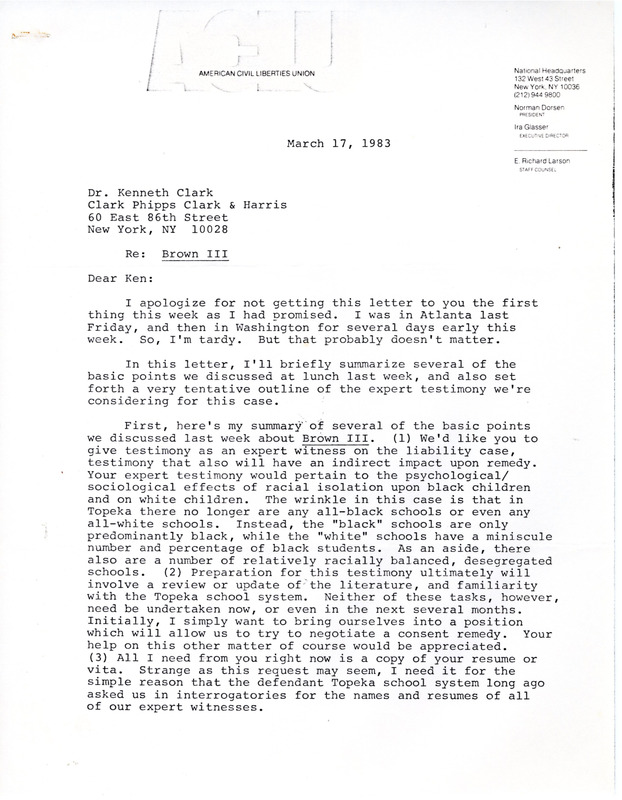
E. Richard Larson of the ACLU writes to Dr. Kenneth Clark of Clark, Phipps, Clark, & Harris to outline what the plaintiff team is looking for with Dr. Clark’s expert testimony in the Brown III case. They hope for Dr. Clark to speak to the psychological and sociological effects of racial isolation on students in segregated schools.
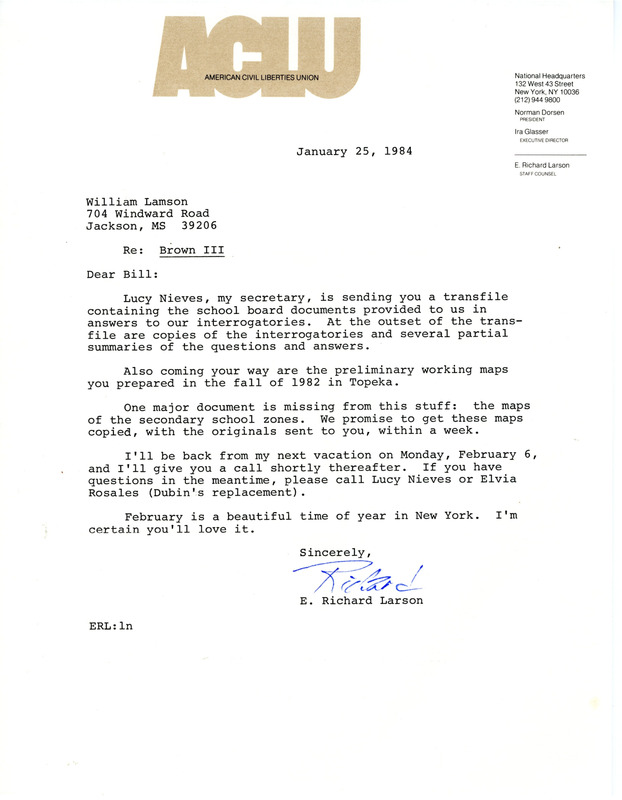
E. Richard Larson of the ACLU writes to William Lamson to inform him of some files and maps he is sending him including school board documents and preliminary working maps Lamson prepared in the Fall of 1982. Larson notes that the maps of Topeka secondary school zones are missing from these files and will be sent back at a later date.
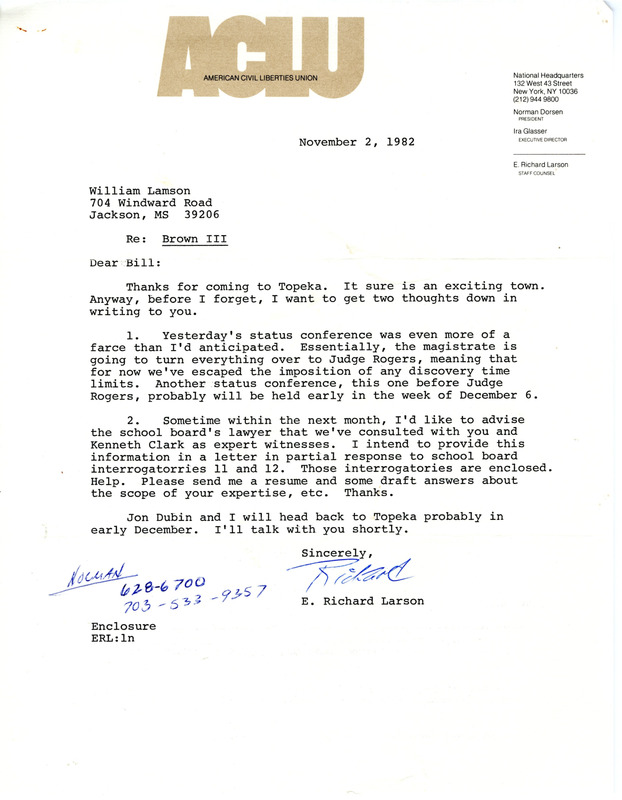
E. Richard Larson of the ACLU writes to William Lamson to thank him for coming to Topeka to work on the case. He also summarizes some of the things they talked about while there and asks Lamson to send over a resume and some information on his expertise in the matters involved with the case.
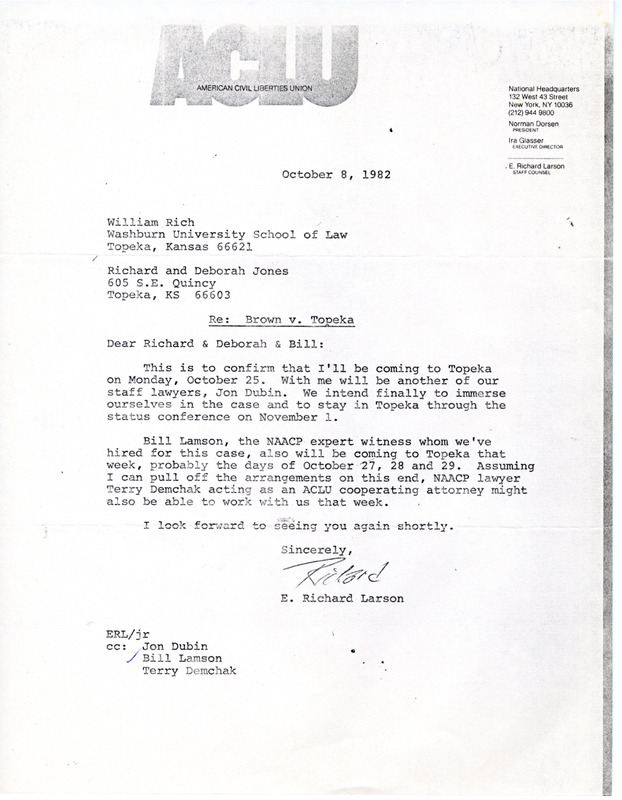
E. Richard Larson of the ACLU writes to William Rich of Washburn University School of Law (Topeka, Kansas), Attorney Richard Jones, and Deborah Jones to inform them that he will be in Topeka from October 25th through November 1st. Also, William Lamson will be coming to Topeka October 27th-29th and they intend to immerse themselves in the case.
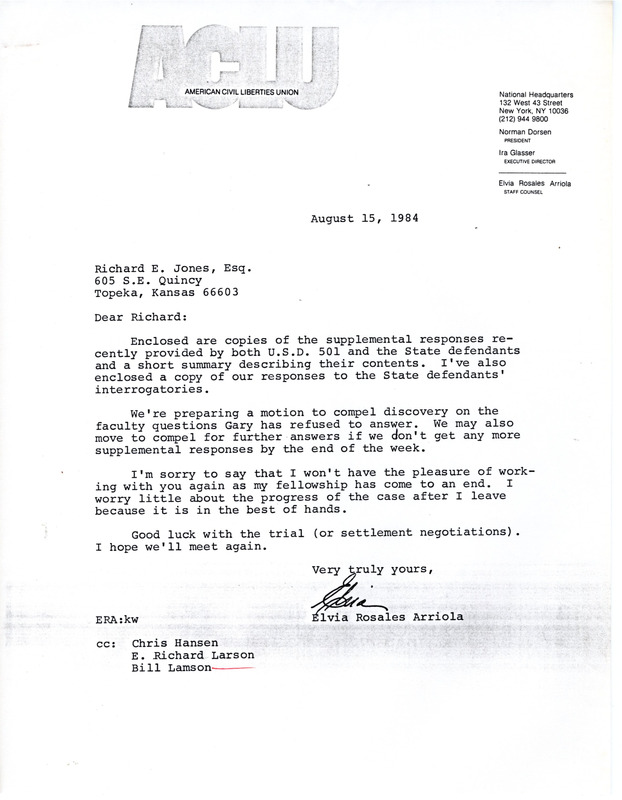
Elvia Rosales Arriola of the ACLU writes to Attorney Richard E. Jones to inform him that the ACLU is preparing a motion to compel discovery on questions a witness in the case refuses to answer. She also writes that her fellowship with the ACLU has come to end and will no longer be working on the case and knows the case is in good hands.
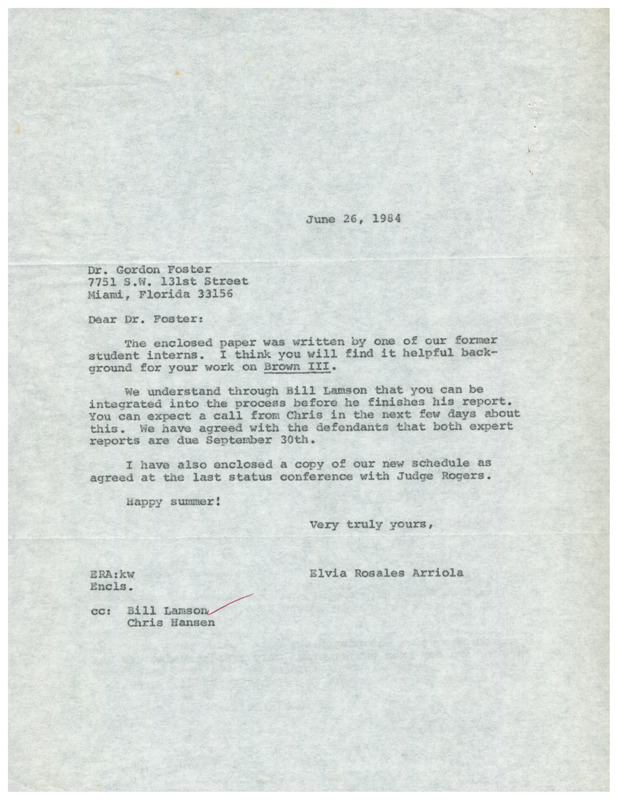
A cover letter for a student-intern written paper that Elvia Rosales Arriola of the ACLU believes will be helpful to Dr. Gordon Foster in the Brown III case. Chris Hansen of the ACLU and William Lamson are cc’d on the letter.
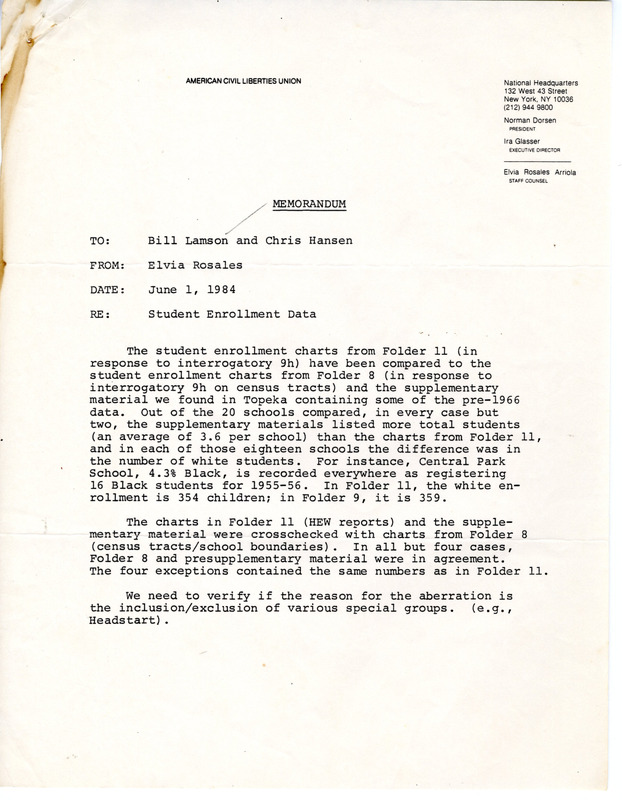
Elvia Rosales Arriola writes to William Lamson and ACLU Attorney Chris Hansen about discrepancies found in student enrollment number reports from different charts. A chart summarizing the discrepancies is included.
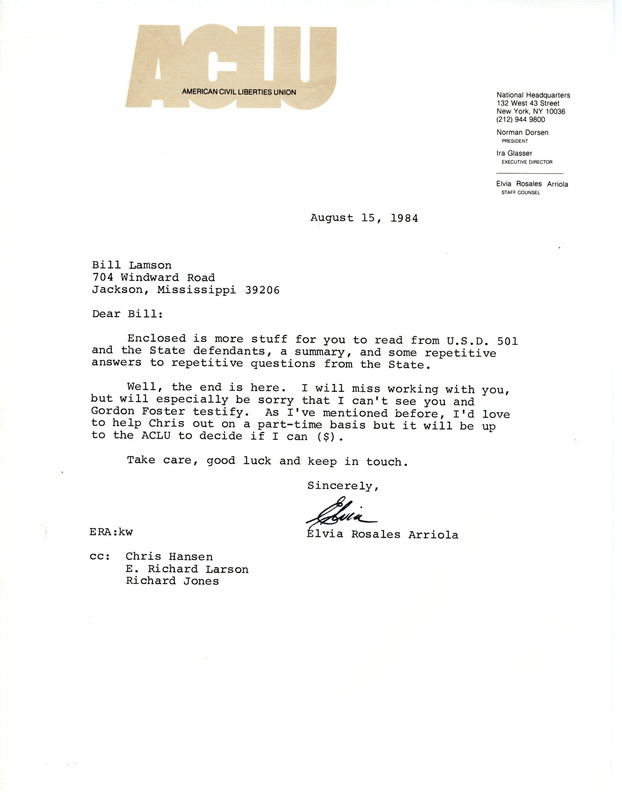
Elvia Rosales Arriola of the ACLU writes to William Lamson to inform him that her time working on the Brown III case has reached an end. She regrets that she won’t be able to see him testify in the case and hopes she can stay on at the ACLU part-time if the budget permits.
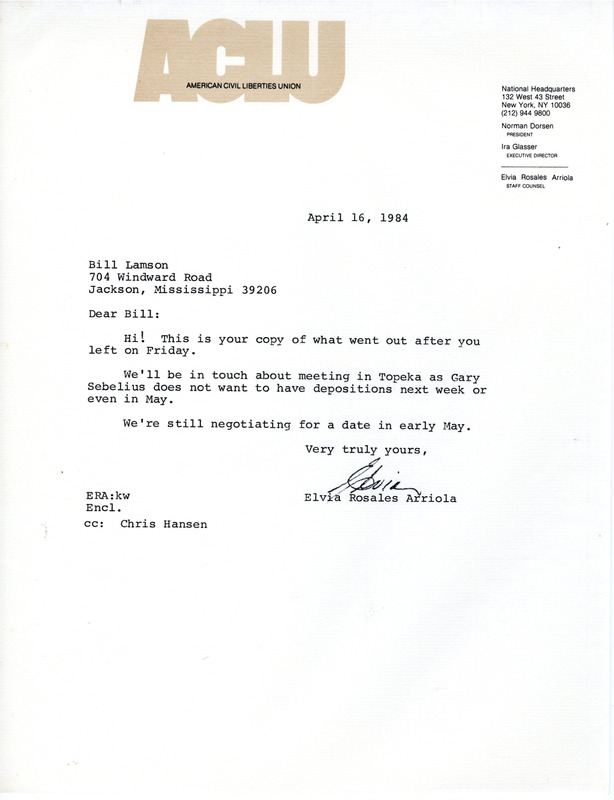
Elvia Rosales Arriola of the ACLU writes to William Lamson to update him on potential dates for depositions in May. She writes that lead defense attorney K. Gary Sebelius doesn’t want to hold depositions in May but the ACLU is trying to negotiate for an early May deposition date.
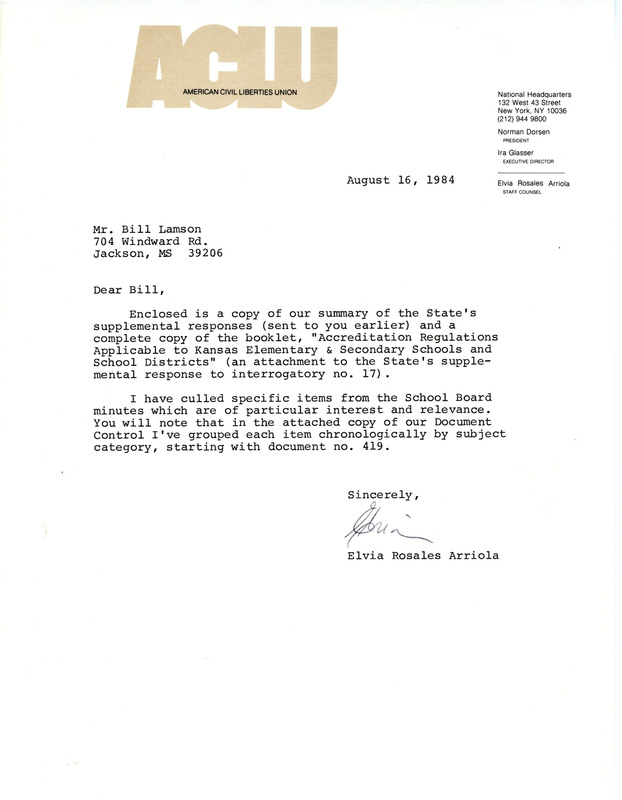
Letter from Elvia Rosales Arriola of the ACLU to William Lamson. Cover letter for a copy of the summary of the State of Topeka’s supplemental responses and a copy of the booklet "Accreditation Regulations Applicable to Kansas Elementary and Secondary Schools and School Districts."
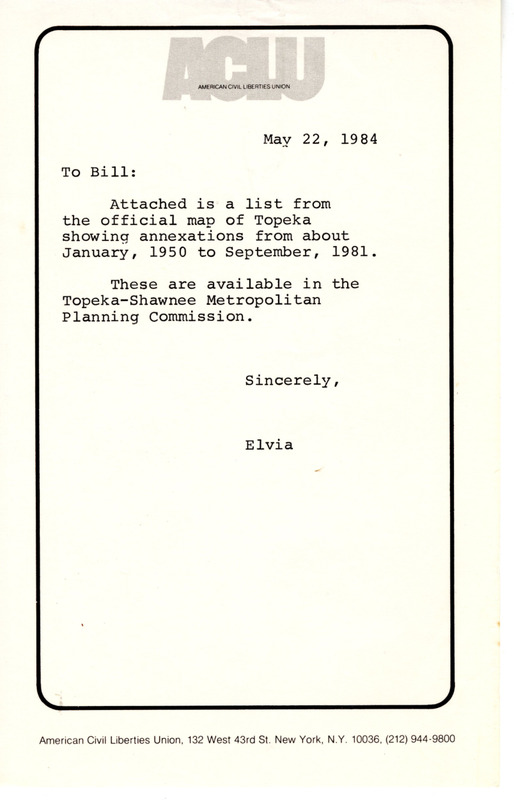
Letter from Elvia Rosales Arriola of the ACLU to William Lamson. Arriola informs Lamson that attached to the letter is a list from the official map of Topeka, Kansas, showing annexations from January 1950 to September 1981. She also indicates that maps are available in the Topeka-Shawnee Metropolitan Planning Commission.
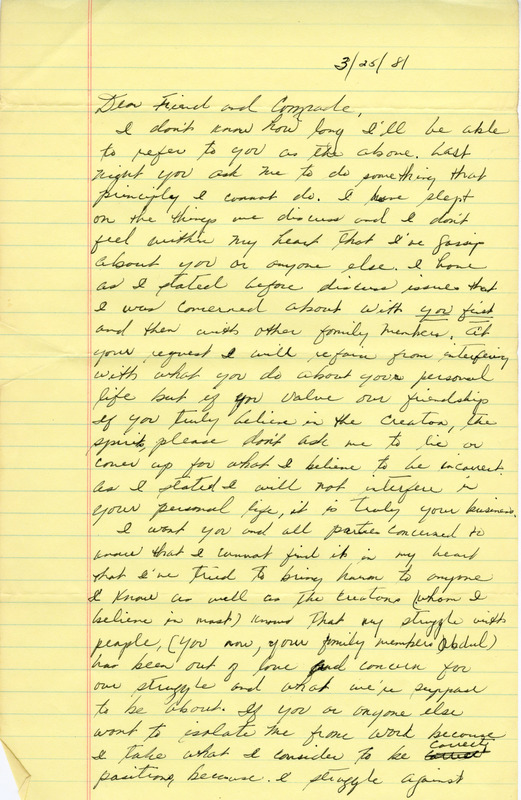
Frankye Adams-Johnson admonishes a fellow member of the Black Panther Party for requesting something dishonorable of her and says that she is always working against wrongdoing. She explains that she will not lose her sanity and that she cannot be bought.
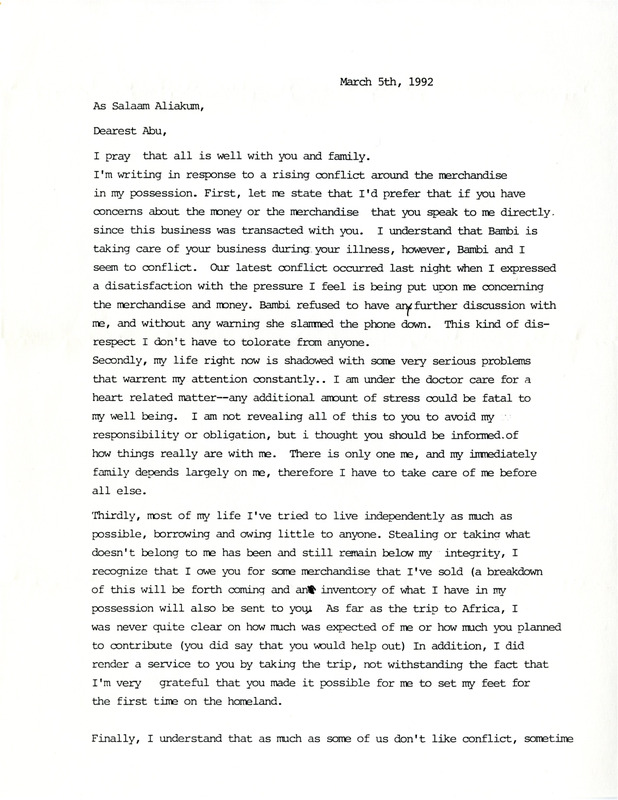
Frankye Adams-Johnson (Malika) writes to her business associate, Abu, regarding their current business arrangement, the conflict arising from it, and her overall health. She acknowledges that she owes him money for merchandise sold. She thanks Abu for the opportunity to visit Africa and adds a note about a $100 check sent with the letter.
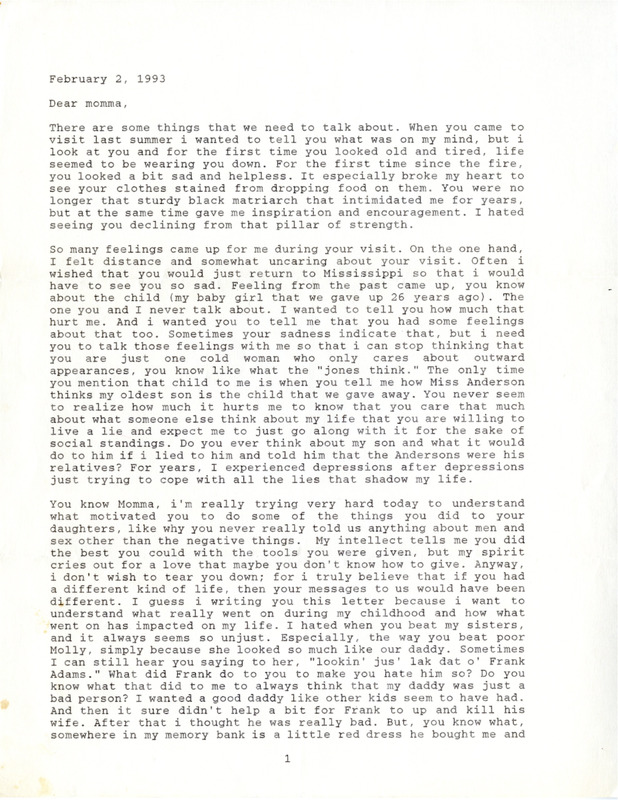
Frankye Adams-Johnson writes to her mother about her childhood, her mother's love, and the effect that it has had on her in life. She questions every event in her life. She is writing to make peace with her mother and everything that has happened.
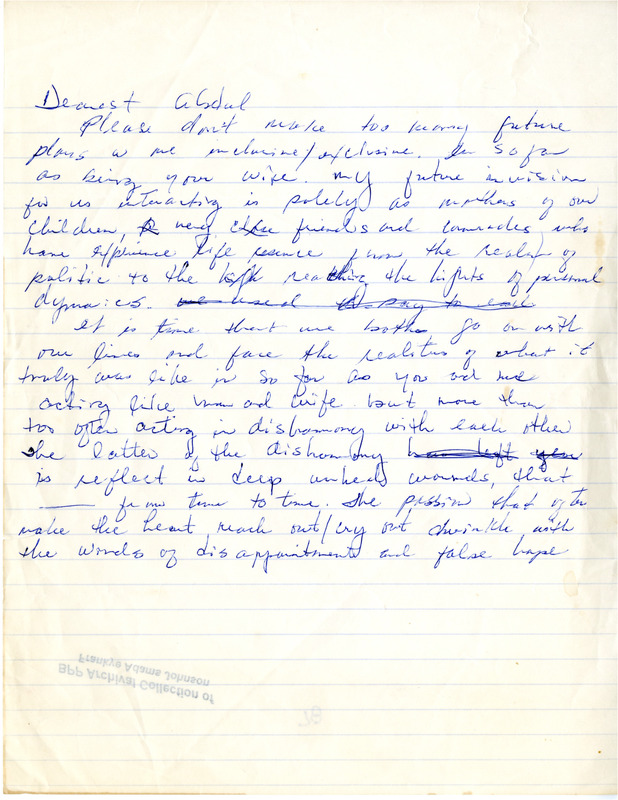
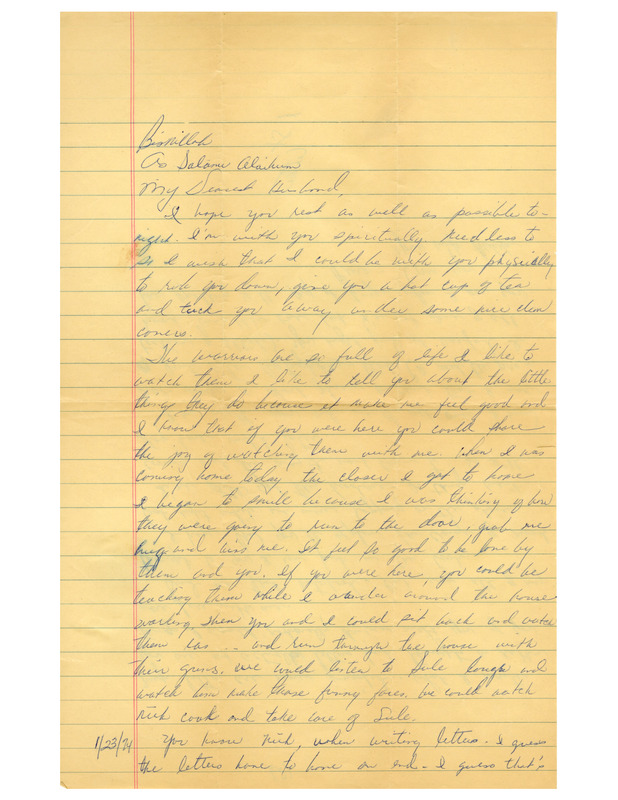
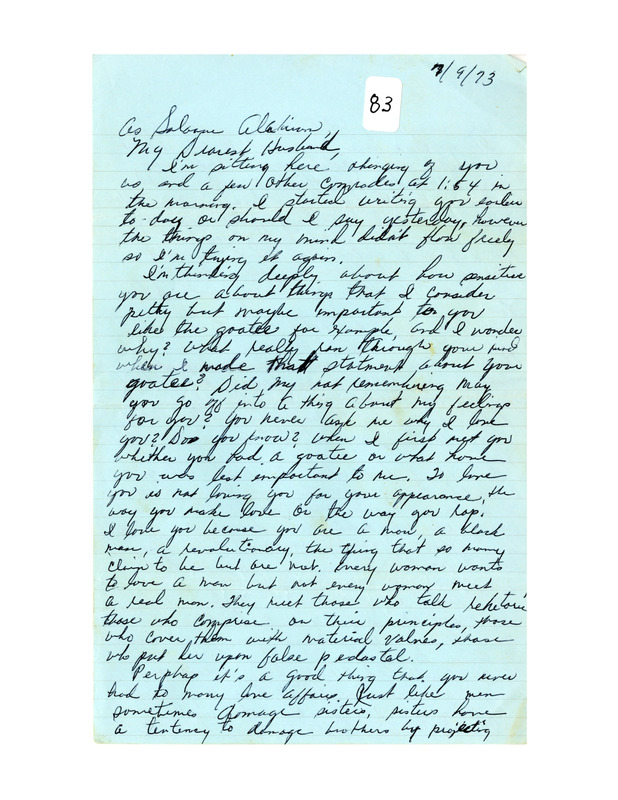
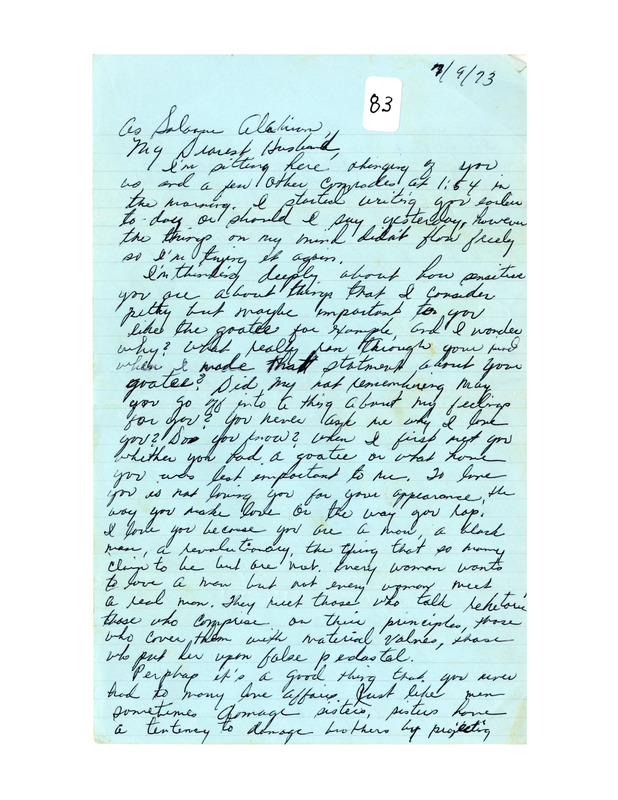
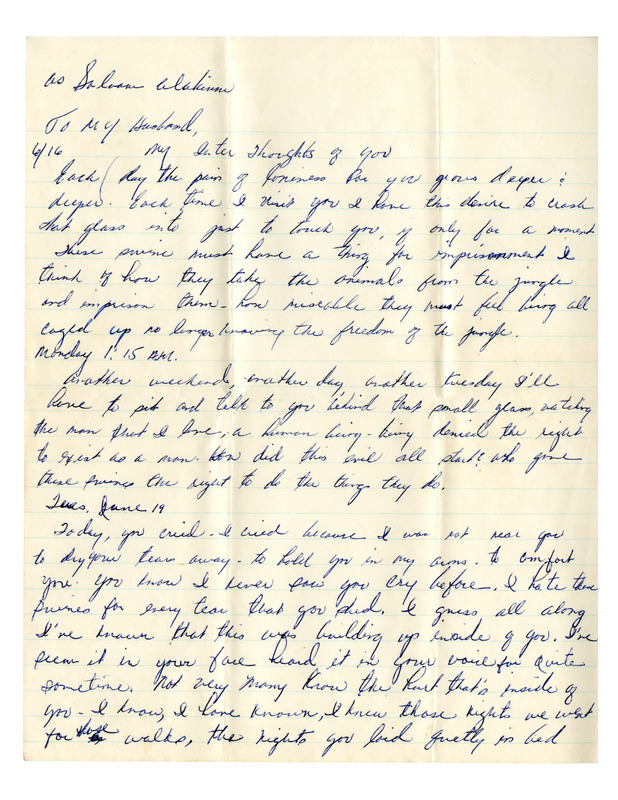
A letter from Frankye Adams-Johnson (Malika) to her husband, Nuh Abdul Qaiyum, who is imprisoned. She addresses their marriage and future together. She tells him not to plan ahead for their future and to face reality about what their relationship was. She doesn't want either of them to have false hope.
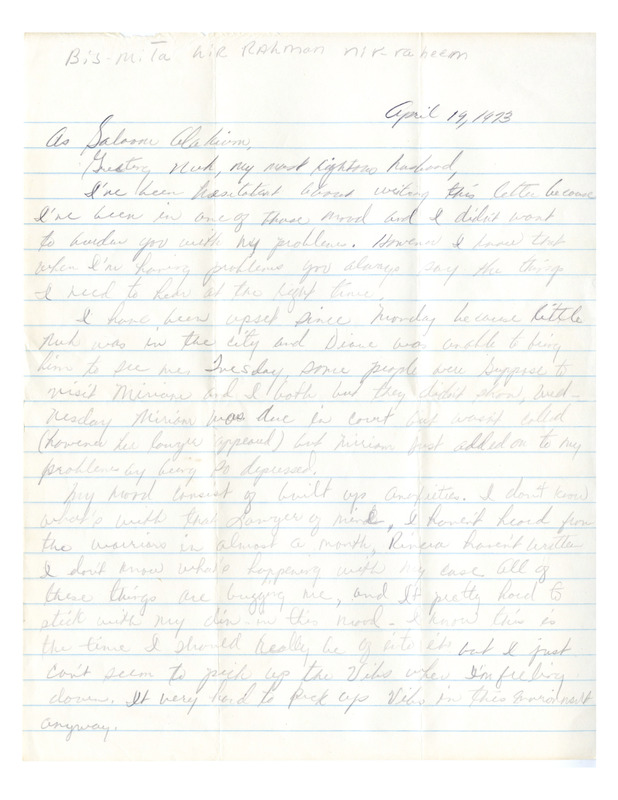
A letter from Frankye Adams-Johnson (Malika) to her husband, Nuh Abdul Qaiyum, who was sentenced to prison in 1975 for a 1971 Black Liberation Army (BLA) connected shooting of police officers in New York. She writes about her mental health and asks about his physical health.
A birthday card from Frankye Adams-Johnson (Malika) to her husband, Nuh Abdul Qaiyum, who was sentenced to prison in 1975 for a 1971 Black Liberation Army (BLA) connected shooting of police officers in New York. She makes note of his strong will to survive and fight against oppression. The card is dated February 28th with no year specified.
A letter from Frankye Adams-Johnson (Malika) to her husband, Nuh Abdul Qaiyum, who was sentenced to prison in 1975 for a 1971 Black Liberation Army (BLA) connected shooting of police officers in New York. She expresses her desire for a normal family life and writes about her mental health in the face of this test to their relationship.
A letter from Frankye Adams-Johnson (Malika) to her husband, Nuh Abdul Qaiyum, who was sentenced to prison in 1975 for a 1971 Black Liberation Army (BLA) connected shooting of police officers in New York. She expresses her deep love for him and her resentment at the police for not allowing them to be together. She also writes about her faith.
A letter from Frankye Adams-Johnson (Malika) to her husband, Nuh Abdul Qaiyum, who was sentenced to prison in 1975 for a 1971 Black Liberation Army (BLA) connected shooting of police officers in New York. She writes about the grief and pain they are feeling and she warns of their oppressors and their plans.
A letter from Frankye Adams-Johnson (Malika) to her husband, Nuh Abdul Qaiyum, who was sentenced to prison in 1975 for a 1971 Black Liberation Army (BLA) connected shooting of police officers in New York. She writes about her feelings and the effects their meetings at the prison are having on her.
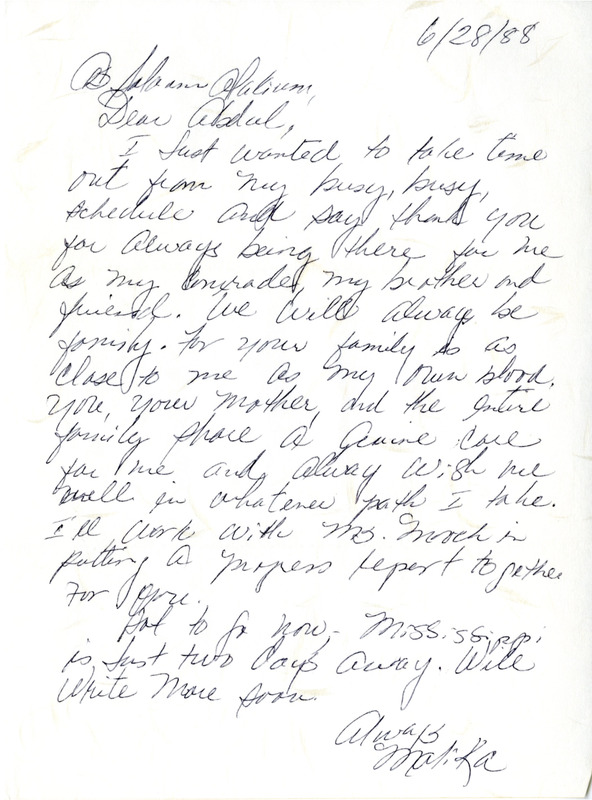
A letter from Frankye Adams-Johnson (Malika) to her husband, Nuh Abdul Qaiyum, who was sentenced to prison in 1975 for a 1971 Black Liberation Army (BLA) connected shooting of police officers in New York. She expresses her gratitude to him and his family for the love, support, and kindness they show her and updates him on her travel to Mississippi.
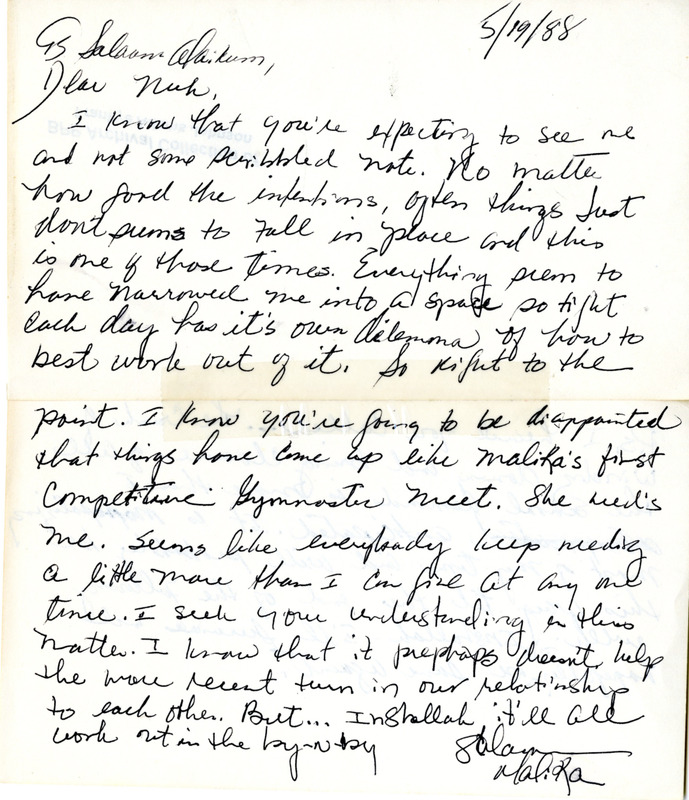
A letter from Frankye Adams-Johnson (Malika) to her husband, Nuh Abdul Qaiyum, who was sentenced to prison in 1975 for a 1971 Black Liberation Army (BLA) connected shooting of police officers in New York. She is apologizing to him for being too busy to visit him and acknowledges a change in their relationship.
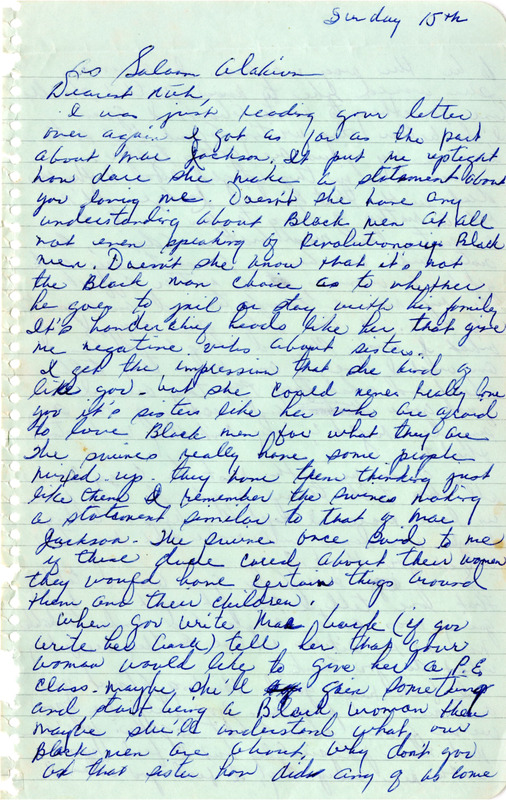
A letter from Frankye Adams-Johnson (Malika) to her husband, Nuh Abdul Qaiyum, who was sentenced to prison in 1975 for a 1971 Black Liberation Army (BLA) connected shooting of police officers in New York. She writes about their marriage and how much each of them has grown during their time apart. Letter is dated “Sunday the 15th.”
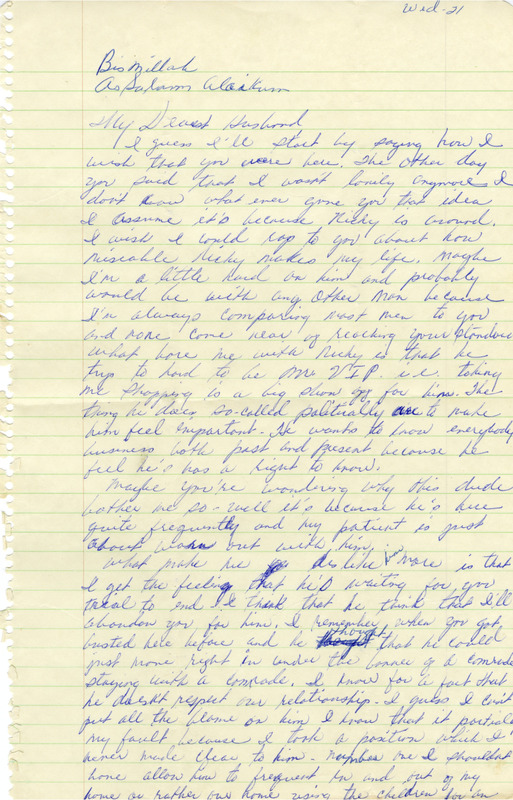
Frankye Adams-Johnson (Malika) writes to her imprisoned husband, Nuh Abdul Qaiyum. She writes about her loneliness, her upcoming trial, their family, and love. She mentions her growth away from fear, and the different legal battles she is fighting. The letter is dated November 21st and 23rd with no year specified.
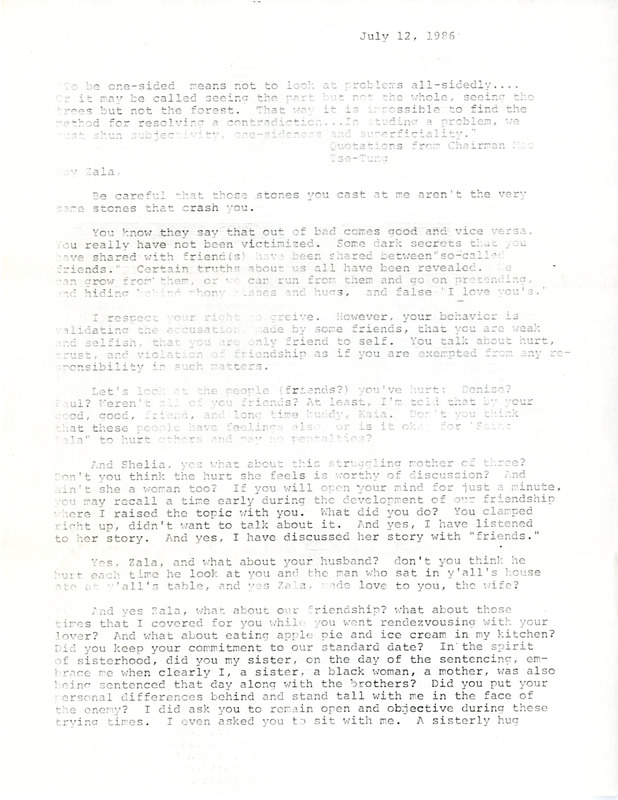
Frankye Adams-Johnson (Malika) writes to a fellow Black woman who is a member of the Black Panther Party. She discusses Zala's selfish behavior surrounding the recent sentencing of herself as well as the sentencing of Zala’s husband and its impact on everyone. She tells her that they must stay aware of their true enemy, and that is neither of them.
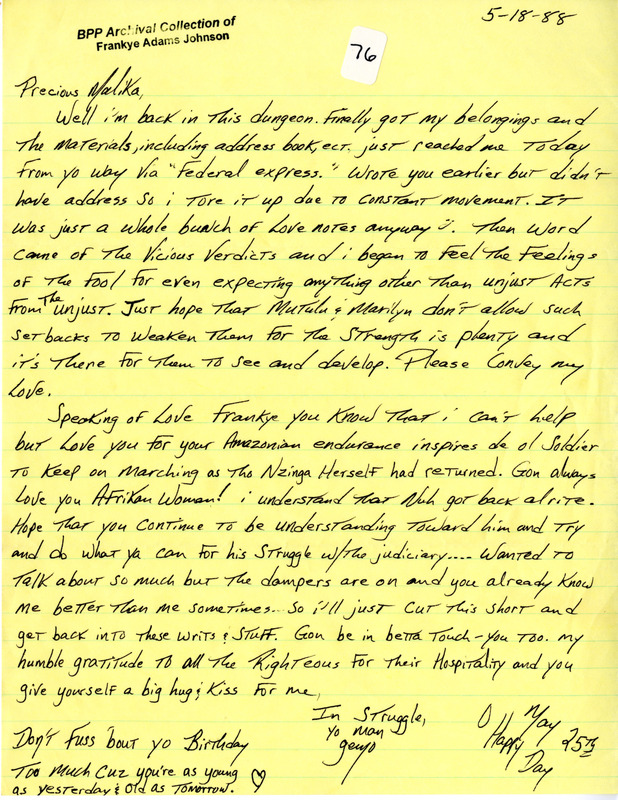
Geiyo, an imprisoned Black Panther Party member, updates Frankye Adams-Johnson (Malika) of his movement throughout the prison, saying he just arrived at his new location and received his belongings. He writes about his feelings surrounding the upcoming verdict of his trial and expresses his deep love for her for being the woman that she is.