Frankye Adams-Johnson Black Panther Party Collection
Title
Frankye Adams-Johnson Black Panther Party Collection
Date Modified
2025-12-12
Description
Frankye Adams-Johnson is a former English Professor at Jackson State University and former active member of the Black Panther Party for Self-Defense in New York City, where she served as an officer in the New York State Chapter. This collection, created or collected during her involvement in the Black Panther Party, consists of personal journal notebooks, correspondence, newspaper articles, fliers, meeting documents and her collection of political and movement buttons.
Curated By
Garrad Lee
Contributing Institution
Jackson State University
About This Record
The HCAC public history focused digital archive cataloging is an ongoing process, and we may update this record as we conduct additional research and review. We welcome your comments and feedback if you have more information to share about an item featured on the site, please contact us at: HCAC-DigiTeam@si.edu
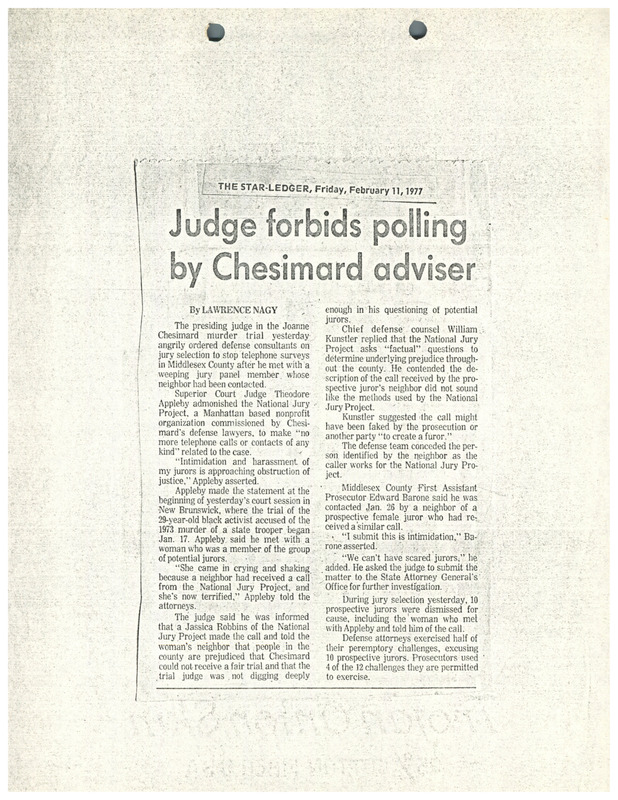
A newspaper article from The Star Ledger about Superior Court Judge Theodore Appleby ordering defense consultants, the National Jury Project, to stop making calls and contact related to the trial of Assata Shakur (JoAnne Chesimard) for the 1973 killing of a state trooper. Appleby said that the calls were approaching obstruction of justice.
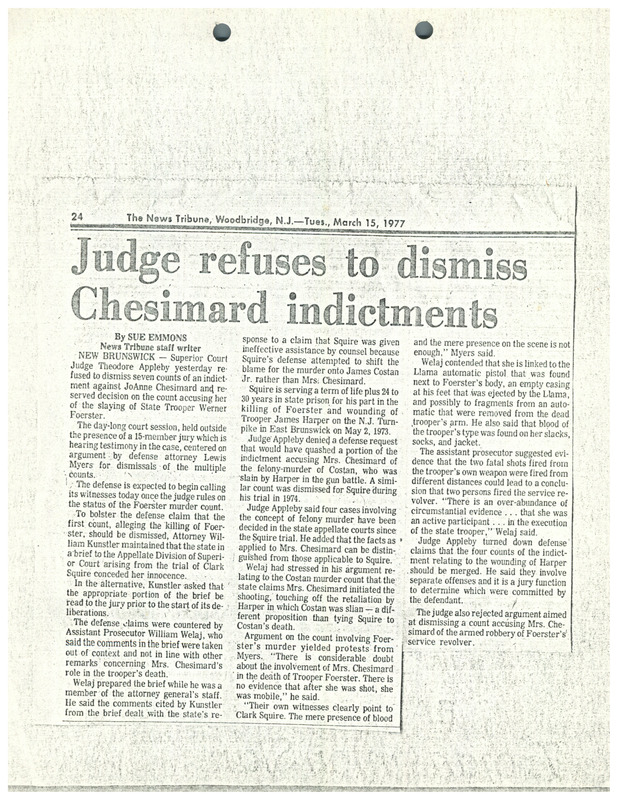
A newspaper article from The News Tribune about a day long juryless court session where defense lawyers made numerous motions to dismiss the indictments against Assata Shakur (JoAnne Chesimard) who was on trial for the 1973 killing of a state trooper. The judge rejected these motions and the attorneys are scheduled to call witnesses that day.
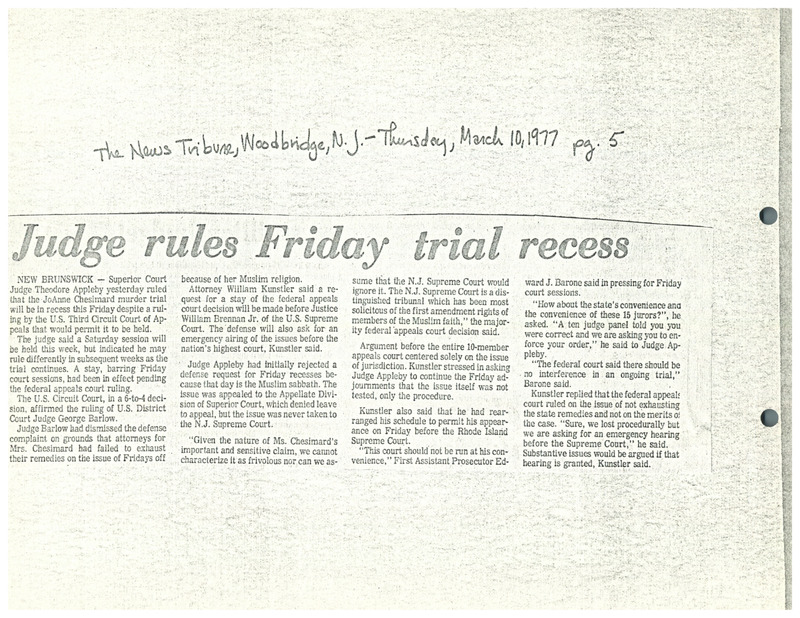
An article from The News Tribune about the question of Friday recesses asked for by the defense because of the Muslim faith of Assata Shakur (JoAnne Chesimard), who was on trial for the 1973 killing of a state trooper. The question has been a feature of the trial and the defense, prosecution, and judge continue to argue over it.
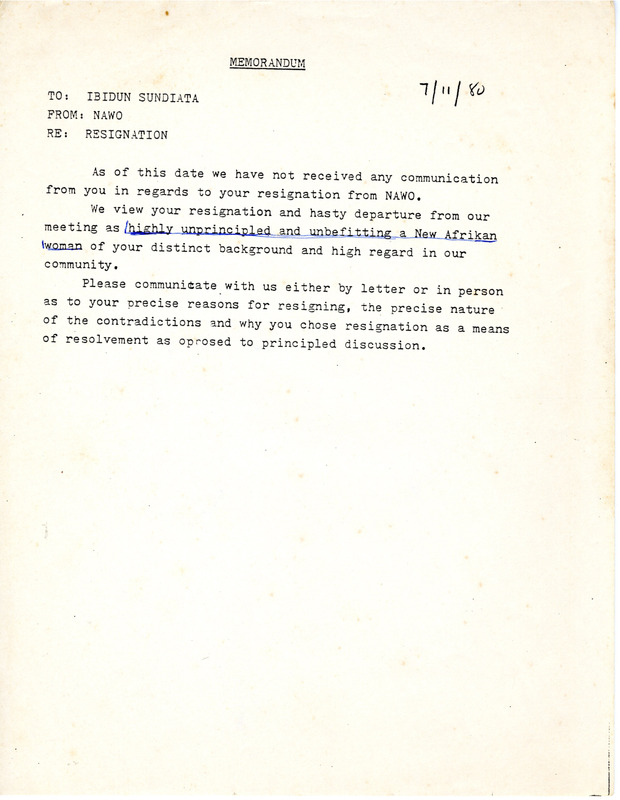
A letter from New Afrikan Women’s Organization (NAWO) leadership to Ibidun Sundiata (aka Dorothy Morrow) inquiring about her sudden resignation from the organization. Ibidun Sundiata was a well-respected and regarded activist and the members of the NAWO want clarification on why she resigned without a conversation with the group.
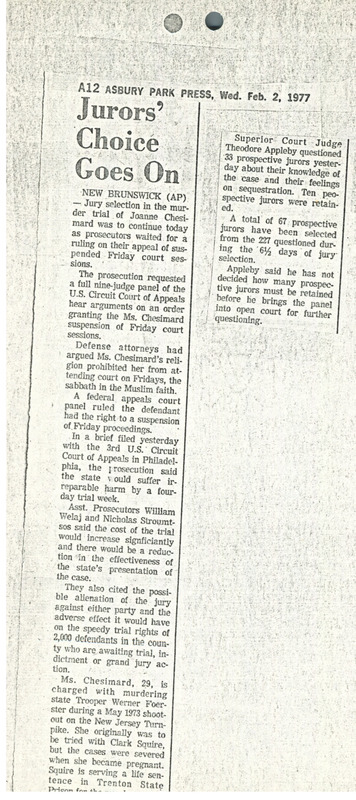
An article from the Asbury Park Press about the trial of Assata Shakur (JoAnne Chesimard) for the 1973 killing of a state trooper. Jury selection continued as prosecutors awaited ruling on their appeal of suspended court sessions, granted by a federal appeals court panel in respect to the defendant's Muslim faith.
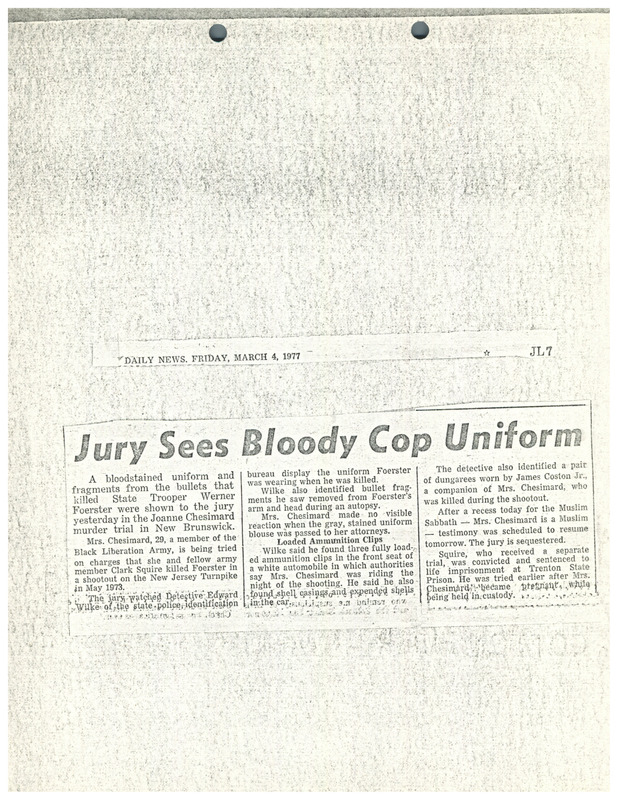
A newspaper article from The Daily News about items entered into evidence by the prosecution in the Assata Shakur (JoAnne Chesimard) trial for the 1973 killing of a state trooper. The slain trooper’s bloodied uniform shirt was submitted into evidence, as well as bullet fragments pulled from the body, and empty shell casings.
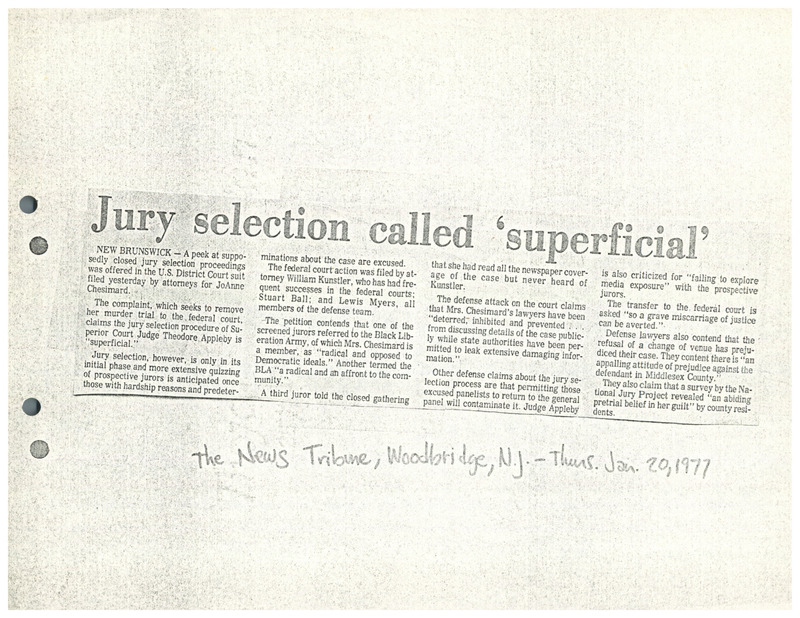
A newspaper article from The News Tribune about defense attorneys for Assata Shakur (JoAnne Chesimard), who was on trial for the 1973 killing of a state trooper, filing a complaint claiming that the jury selection in her murder trial is biased toward the prosecution. Shakur was convicted in 1977 of the killing and escaped prison in 1979.
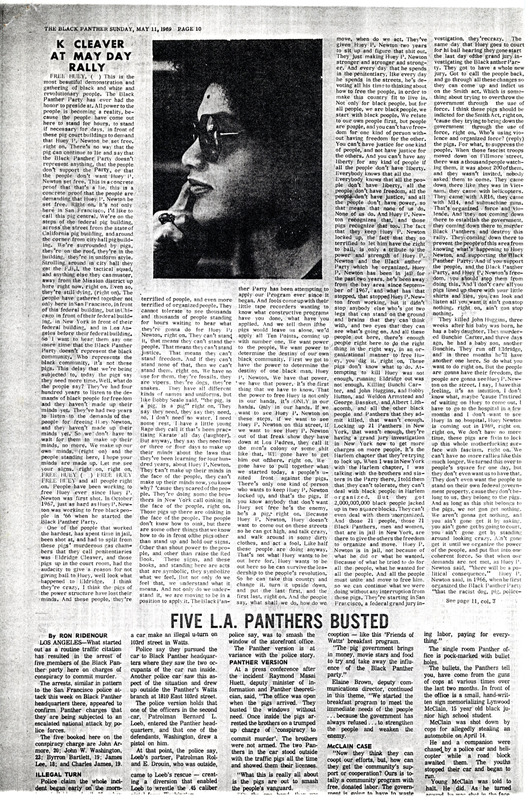
A newspaper article from The Black Panther. It is a transcript of Kathleen Cleaver's speech at May Day (International Workers Day) on May 1, 1969 in San Francisco, California. Cleaver’s speech, like many of the speeches given that day, centered on the calls to Free Huey Newton from his arrest on murder charges on October 28, 1967.
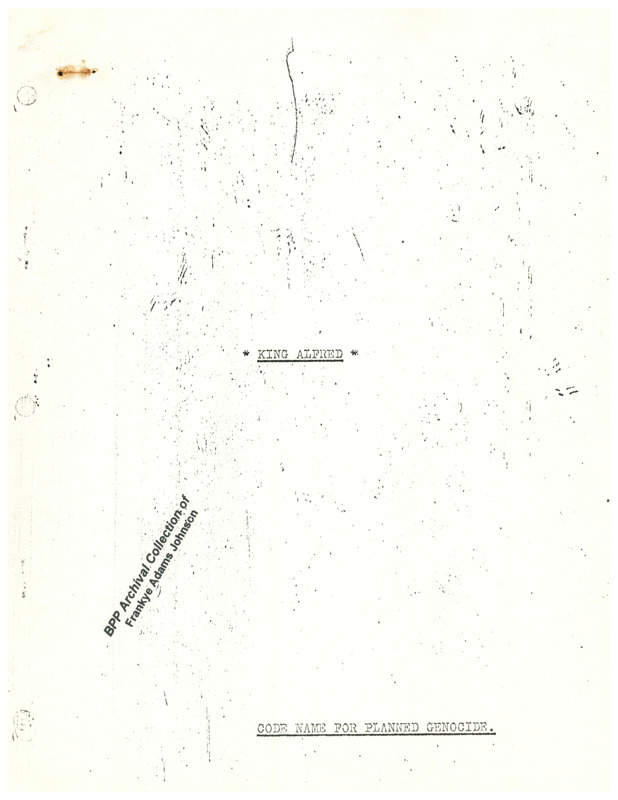
A copy of “The King Alfred Plan,” a fictional CIA-led scheme supporting an international effort to eliminate people of African descent, invented by author John A. Williams in his 1967 novel The Man Who Cried I Am. Copies of the plan circulated in Black communities during the late 1960s and early 1970s, with many people accepting it at face value.
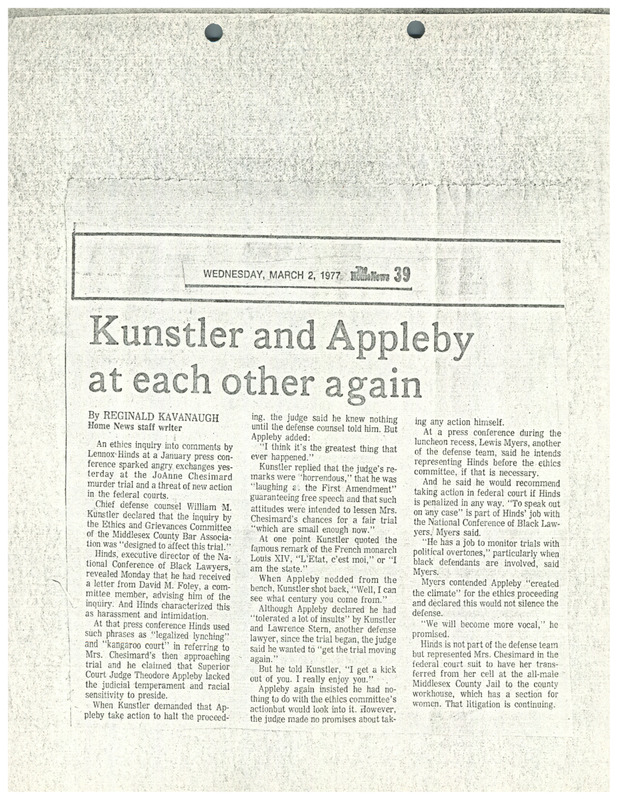
A newspaper article from The Home News about arguing between chief defense counsel William Kunstler and Superior Court Judge Theodore Appleby in the trial of Assata Shakur (JoAnne Chesimard) for the 1973 killing of a state trooper. The argument centered on a citation given to Lennox Hinds, president of the National Conference of Black Lawyers.
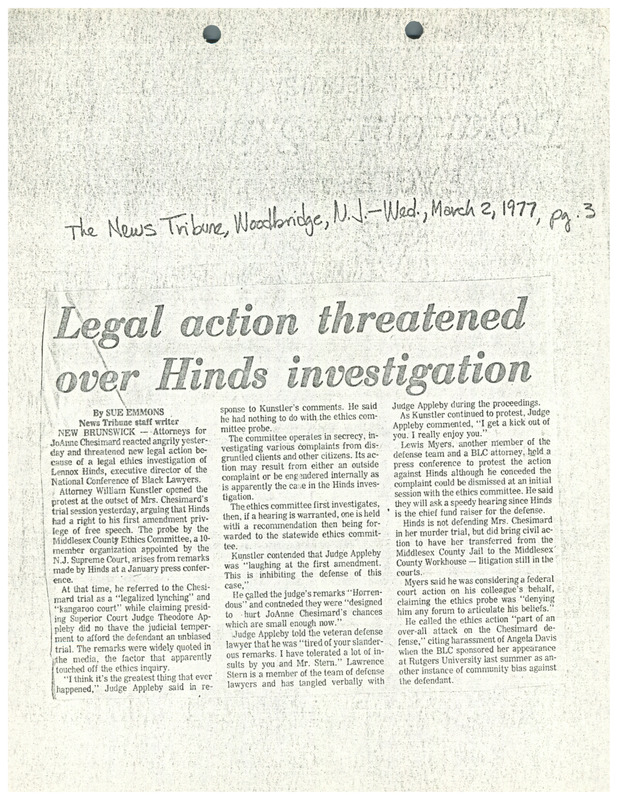
A newspaper article from The News Tribune about Lennox Hinds, president of the National Conference of Black Lawyers, being cited by The Ethics Committee of the Middlesex County Bar Association. Chief defense counsel William Kunstler, representing Assata Shakur (JoAnne Chesimard) in her trial for the 1973 killing of a state trooper, protested it.
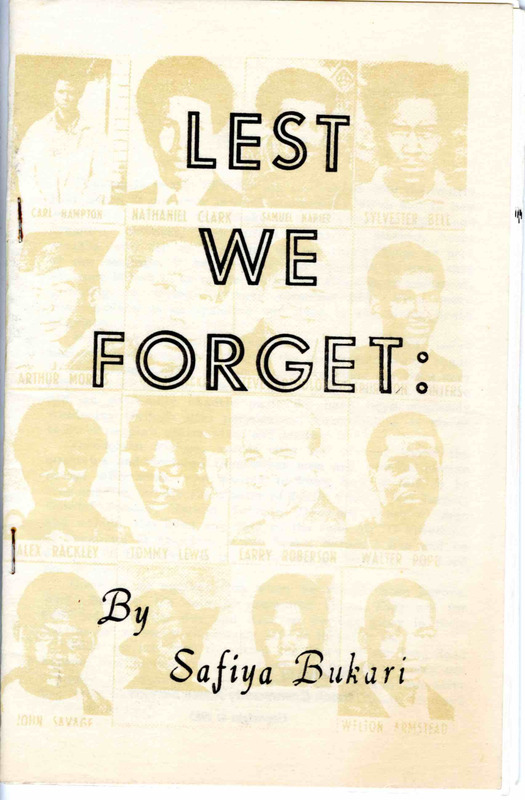
A booklet written by Bernice Jones (aka Safiya Bukhari), who was a Black Panther Party member and vice president of the Republic of New Afrika. The booklet lists members of the Black Panther Party who were killed between 1966 and 1981. There is also a memorial write up and poem in the conclusion.
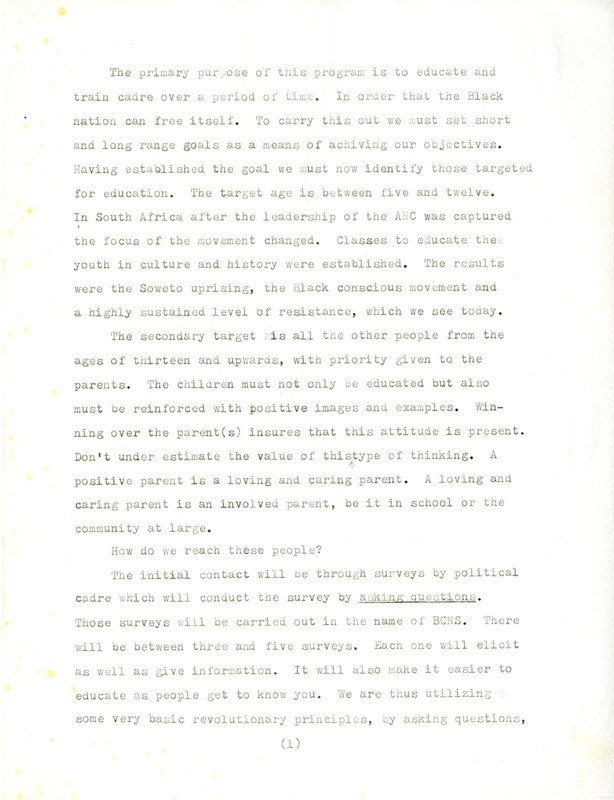
In this letter, Frankye Adams-Johnson (Malika)’s husband, Nuh Abdul Qaiyum, who is imprisoned, outlines a training and education program for Black liberation. He outlines the goals and priorities of the Black Panther Party moving forward and the means required. Instead of the usual militant rhetoric, he takes a social approach to the Revolution.
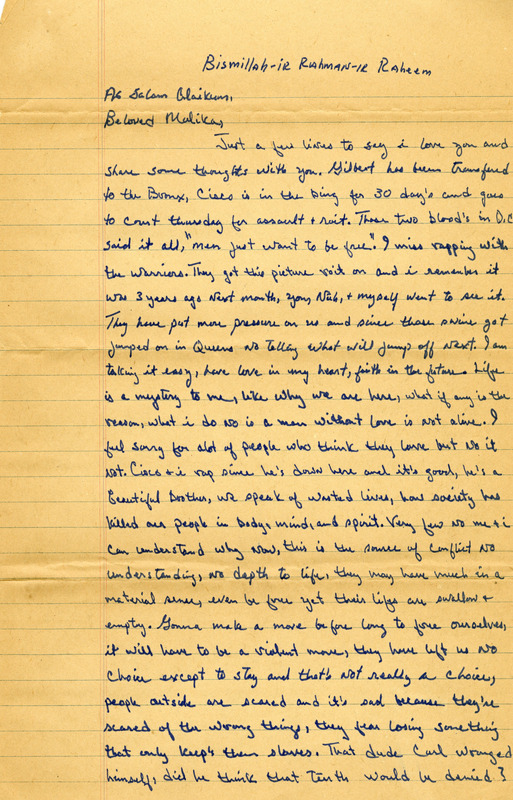
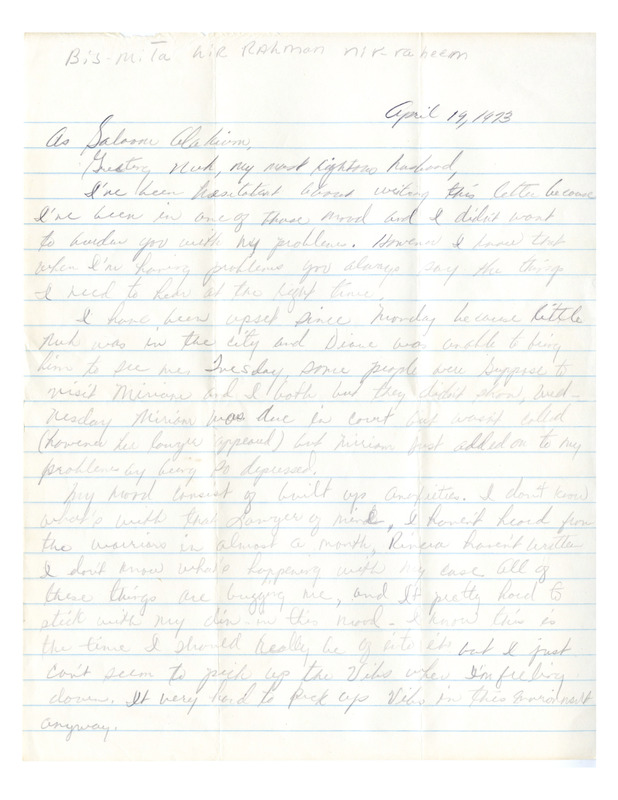
A letter from Nuh Abdul Qaiyum, who is imprisoned, to his wife Frankye Adams-Johnson (Malika). He sends the family his love and shares his thoughts on life in prison and conflict within the Black community and the Black Panther Party. He asks her about her upcoming birth and offers guidance and advice. He also includes multiple poems.
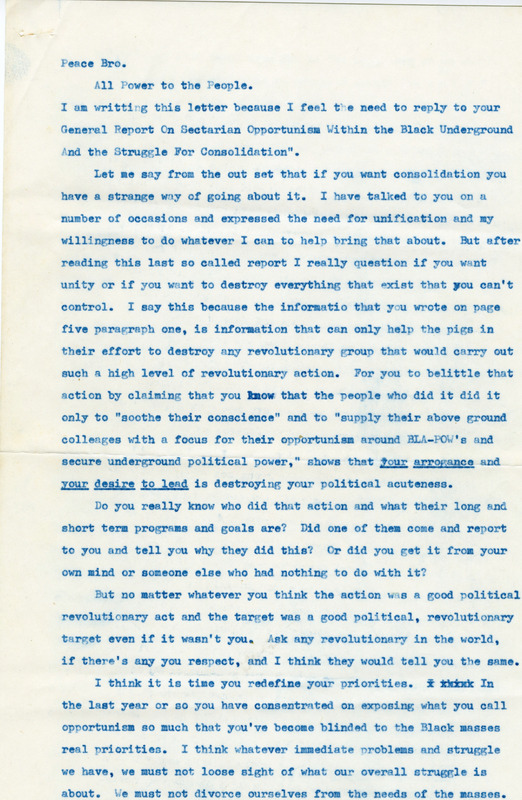
A letter from an unknown sender to an unknown recipient. The letter is written in response to a "General Report on Sectarian Opportunism Within the Black Underground and the Struggle for Consolidation." The sender is very critical of the report writer’s opinions on how to attain consolidation and unity in the movement for Black liberation.
Ashanti Alston, a Black Liberation Army (BLA) member who was imprisoned for 11 years for a robbery, writes about his plans to retrieve Frankye Adams-Johnson (Malika)’s art materials from her property. He tells her that he plans to be out by September and to take care of himself. The letter is dated July 16th with no year specified.
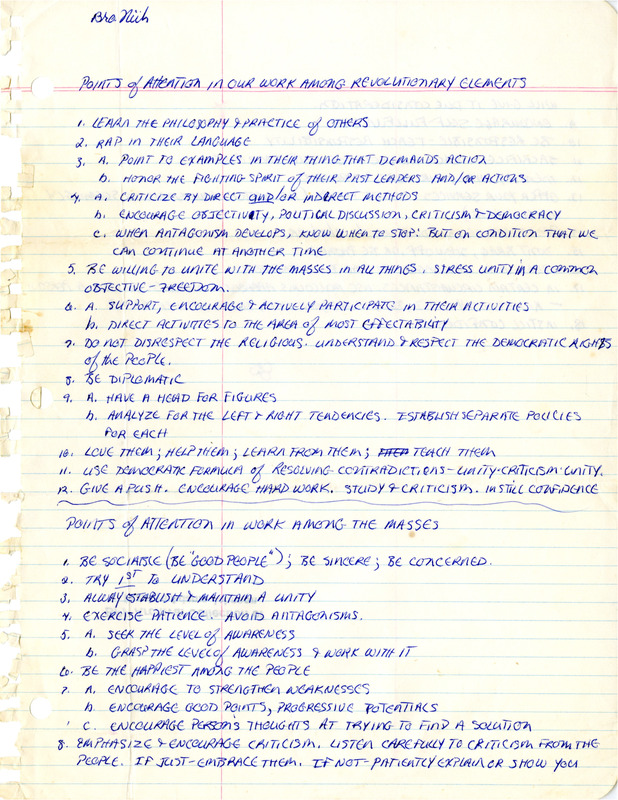
A letter from Ashanti Alston, a Black Liberation Army (BLA) member who was imprisoned for 11 years for a robbery to raise money for the BLA, to Nuh Abdul Qaiyum. The letter includes 2 lists: "Points of Attention In Our World Among Revolutionary Elements" and "Points of Attention in Work Among the Masses"
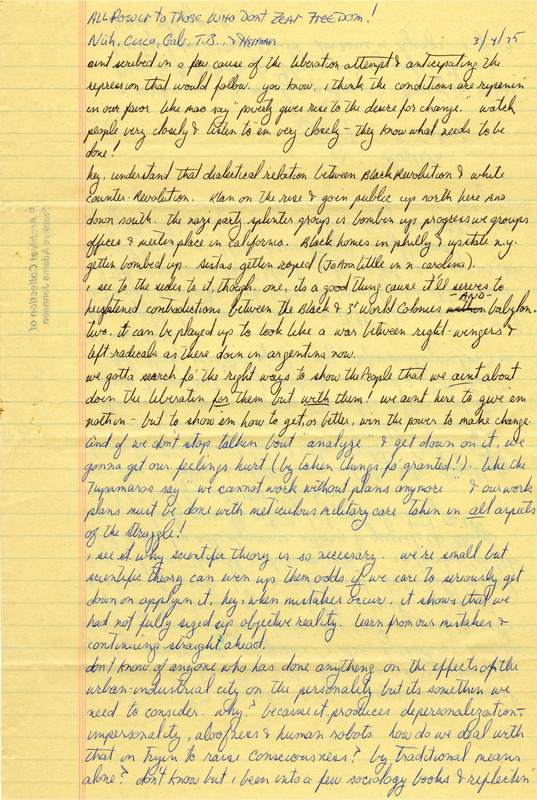
Ashanti Alston, a Black Liberation Army (BLA) member who was imprisoned for 11 years for a robbery to raise money for the BLA, writes to three fellow imprisoned revolutionaries. He writes about the psychology of the fight for Black liberation and the ways in which their organization should fight for the people.
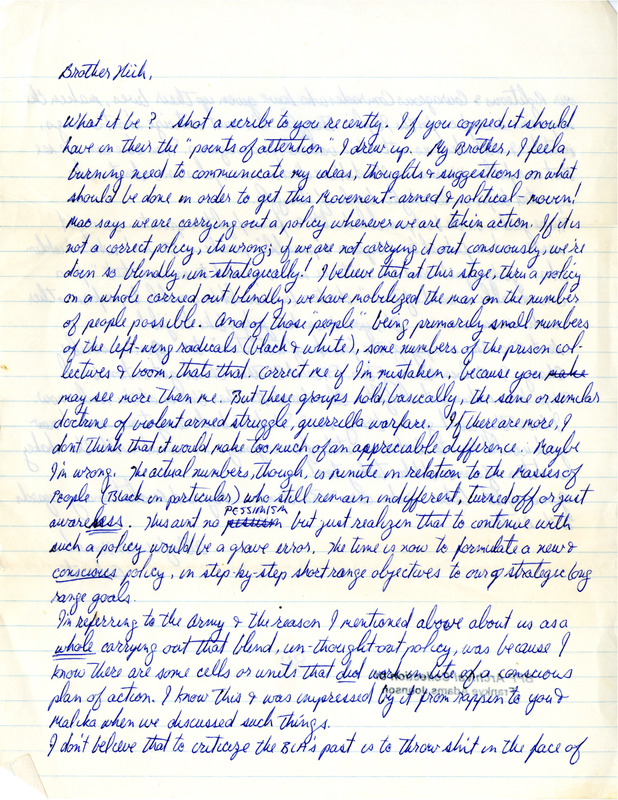
A letter from Ashanti Alston, a Black Liberation Army (BLA) member who was imprisoned for 11 years for a robbery to raise money for the BLA. He explores the mistakes of the BLA and writes about the principles of the new movement. He gives an update of his prison sentence of 25 years.
Ashanti Alston, a Black Liberation Army (BLA) member who was imprisoned for 11 years for a robbery to raise money for the BLA, writes to Nuh Abdul Qaiyum, asking which methods should be used to communicate with the people and the best actions to take that will instill unity in the community. He also writes about his court proceedings.
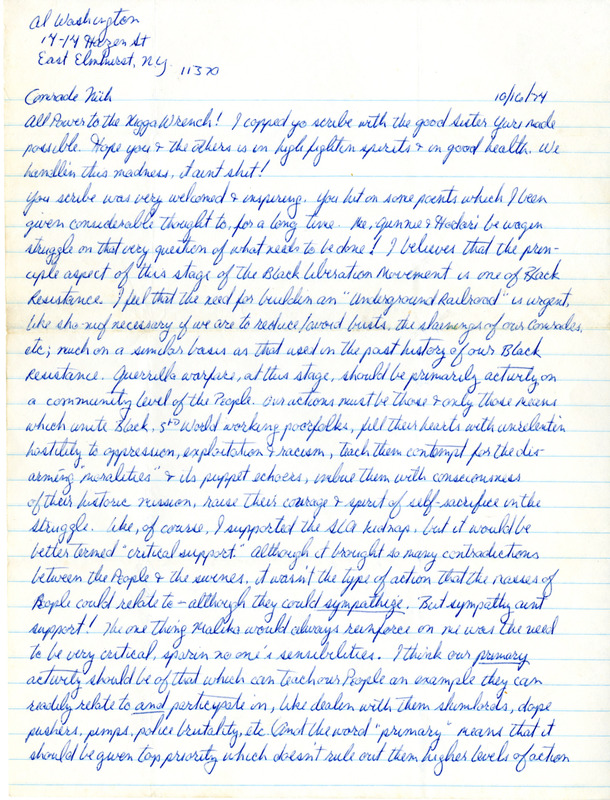
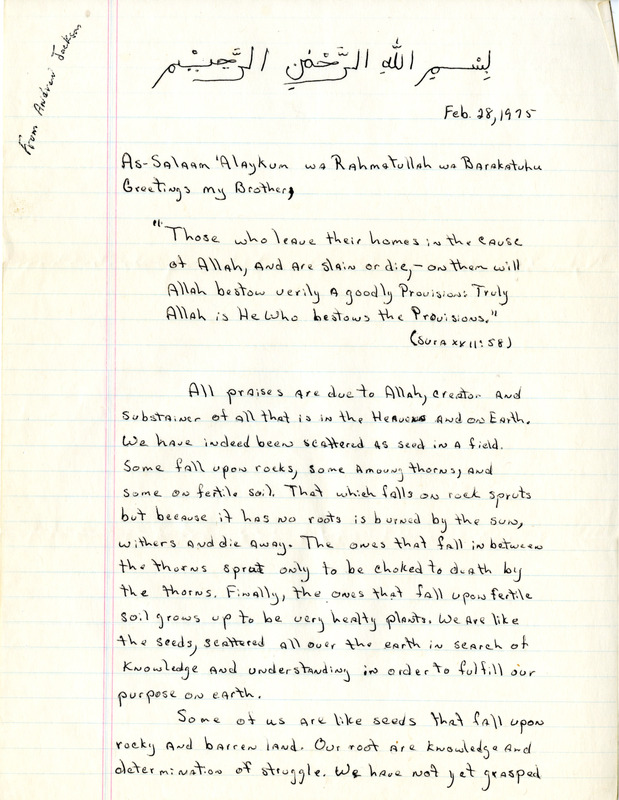
Bashir Abdul Lugman AS-Sabur writes to a fellow imprisoned person. He compares the Black Panther Party to scattered seeds that can't grow. He mentions the need for their forces to be reunited and how the recipient's religious rights are being violated through the denial of the ability to perform the Muslim practice of Jumma services in prison.
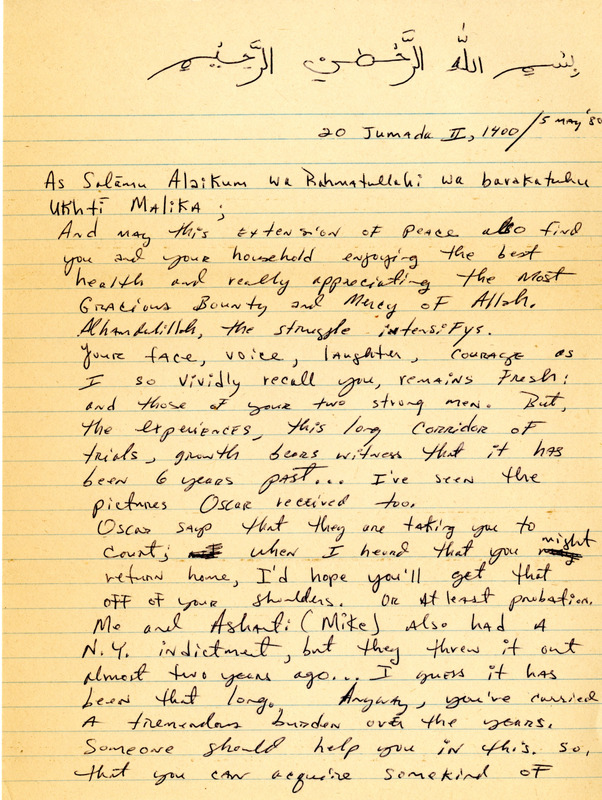
Walid, a fellow Black Panther Party and Black Liberation Army member, begins his letter to Frankye Adams-Johnson (Malika) by expressing his best wishes and remarks at how vividly he can remember her and her children. He focuses his attention on her trial, comparing it with his indictment that was dropped.
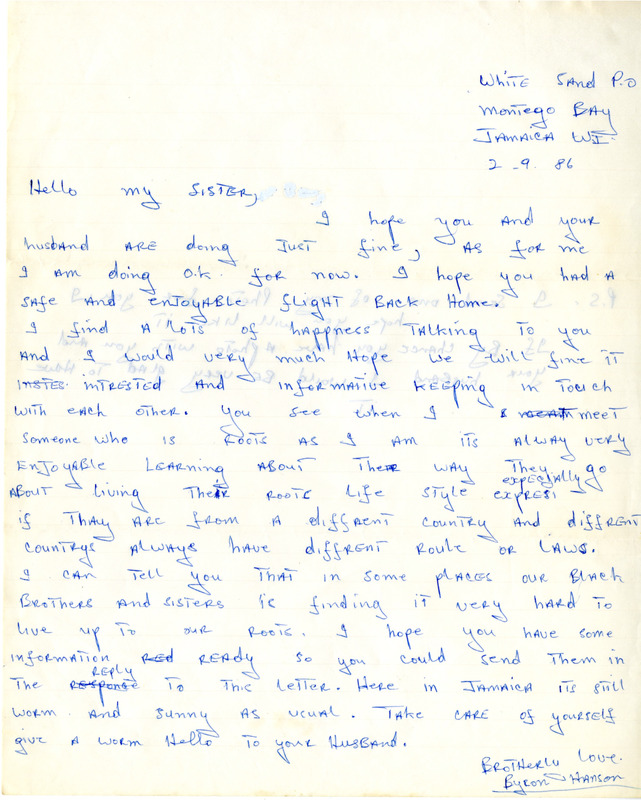
Byron Harrison, fellow Black Panther Party member, expresses to Frankye Adams-Johnson (Malika) the value he feels in communicating with someone like minded in the struggle. He asks her to send important information to other members of the Black Panther Party.
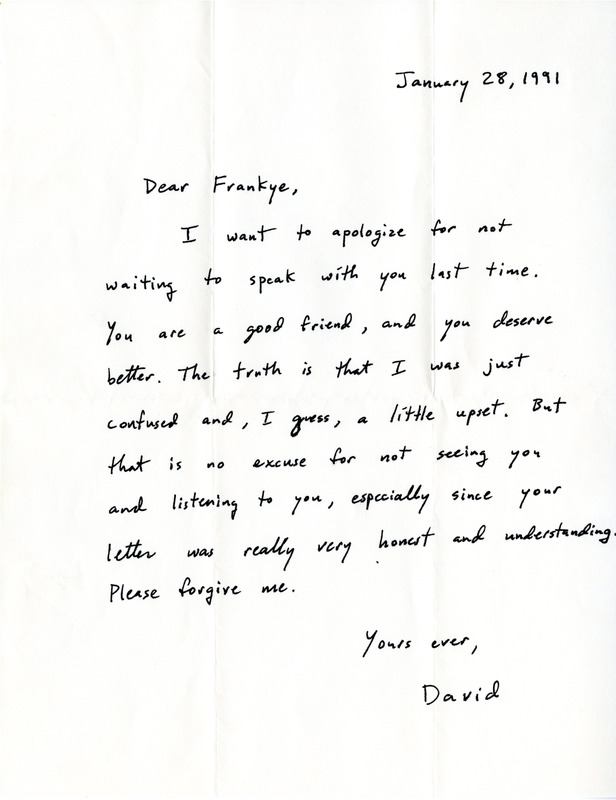
David writes to apologize to Frankye Adams-Johnson (Malika) for not being sensitive to her feelings and leaving before they could speak with one another the last time they saw each other.
A newspaper article from The Black Panther. This is the publication of a letter from Ericka Huggins to her late husband John Huggins (February 11, 1945-January 17, 1969) before he was killed in a gun battle in Los Angeles by rival Black Nationalist group the US organization. She writes that she believes they were destined to die for liberation.
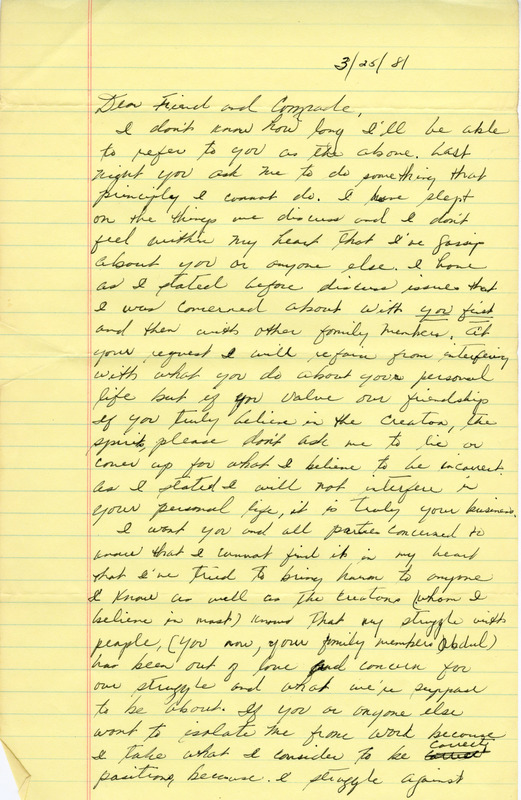
Frankye Adams-Johnson admonishes a fellow member of the Black Panther Party for requesting something dishonorable of her and says that she is always working against wrongdoing. She explains that she will not lose her sanity and that she cannot be bought.
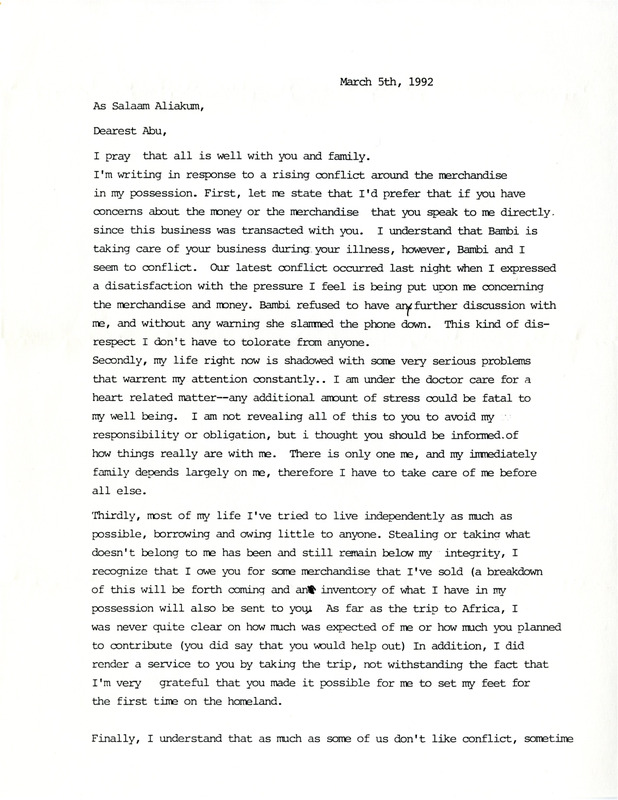
Frankye Adams-Johnson (Malika) writes to her business associate, Abu, regarding their current business arrangement, the conflict arising from it, and her overall health. She acknowledges that she owes him money for merchandise sold. She thanks Abu for the opportunity to visit Africa and adds a note about a $100 check sent with the letter.
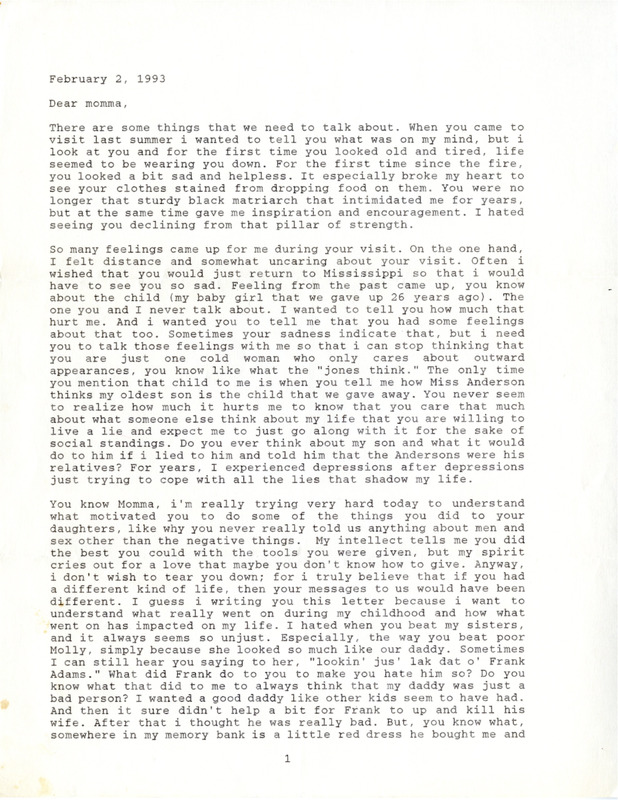
Frankye Adams-Johnson writes to her mother about her childhood, her mother's love, and the effect that it has had on her in life. She questions every event in her life. She is writing to make peace with her mother and everything that has happened.
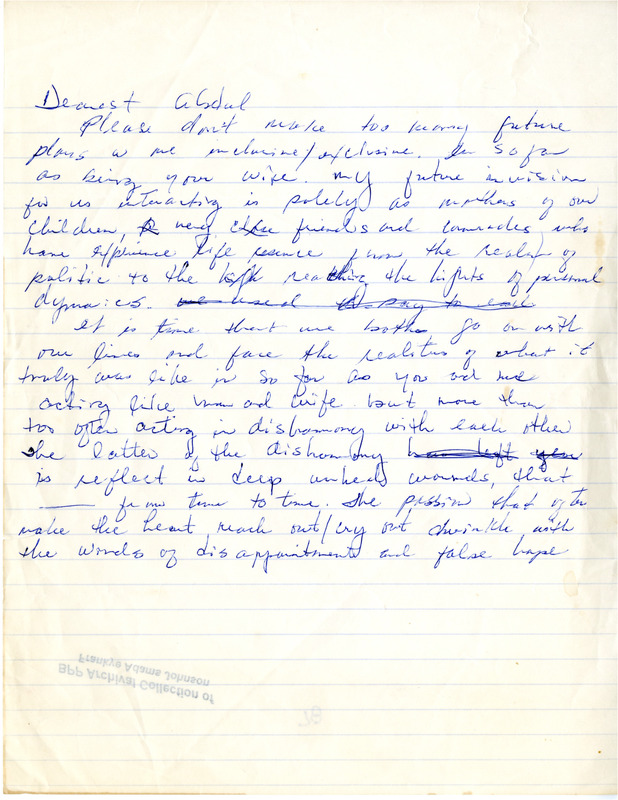
A letter from Frankye Adams-Johnson (Malika) to her husband, Nuh Abdul Qaiyum, who is imprisoned. She addresses their marriage and future together. She tells him not to plan ahead for their future and to face reality about what their relationship was. She doesn't want either of them to have false hope.
A letter from Frankye Adams-Johnson (Malika) to her husband, Nuh Abdul Qaiyum, who was sentenced to prison in 1975 for a 1971 Black Liberation Army (BLA) connected shooting of police officers in New York. She writes about her mental health and asks about his physical health.