Frankye Adams-Johnson Black Panther Party Collection
Title
Frankye Adams-Johnson Black Panther Party Collection
Date Modified
2025-12-12
Description
Frankye Adams-Johnson is a former English Professor at Jackson State University and former active member of the Black Panther Party for Self-Defense in New York City, where she served as an officer in the New York State Chapter. This collection, created or collected during her involvement in the Black Panther Party, consists of personal journal notebooks, correspondence, newspaper articles, fliers, meeting documents and her collection of political and movement buttons.
Curated By
Garrad Lee
Contributing Institution
Jackson State University
About This Record
The HCAC public history focused digital archive cataloging is an ongoing process, and we may update this record as we conduct additional research and review. We welcome your comments and feedback if you have more information to share about an item featured on the site, please contact us at: HCAC-DigiTeam@si.edu
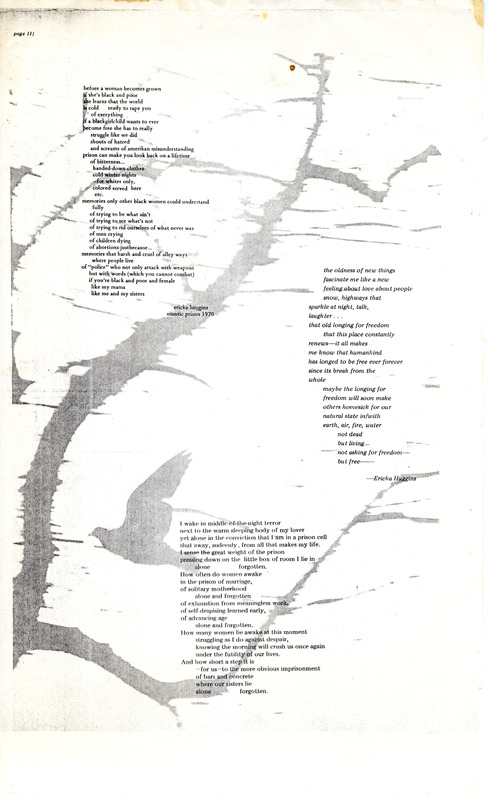
Three untitled poems written by Ericka Huggins. She signs first poem with her name and “Niantic Prison 1970” in reference to the York Correctional Institution in Connecticut. Each of the three poems makes reference to prison and themes of freedom and longing.
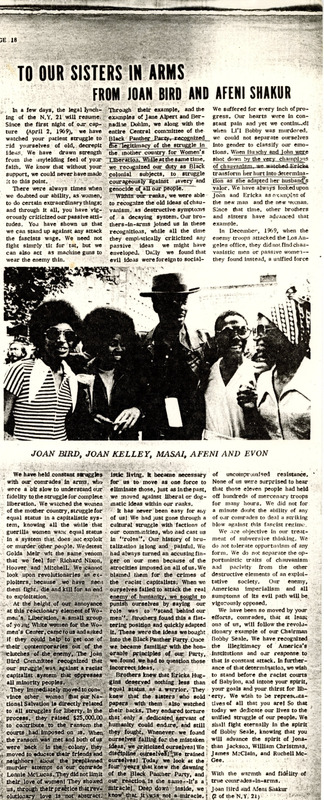
A newspaper article from The Black Panther detailing the importance of women in the Black Panther Party and calling on other women to find their strength to fight for liberation. The article was written by Joan Byrd and Afeni Shakur, two of the New York 21 who were arrested in 1969 for allegedly planning the bombing of buildings in New York City.
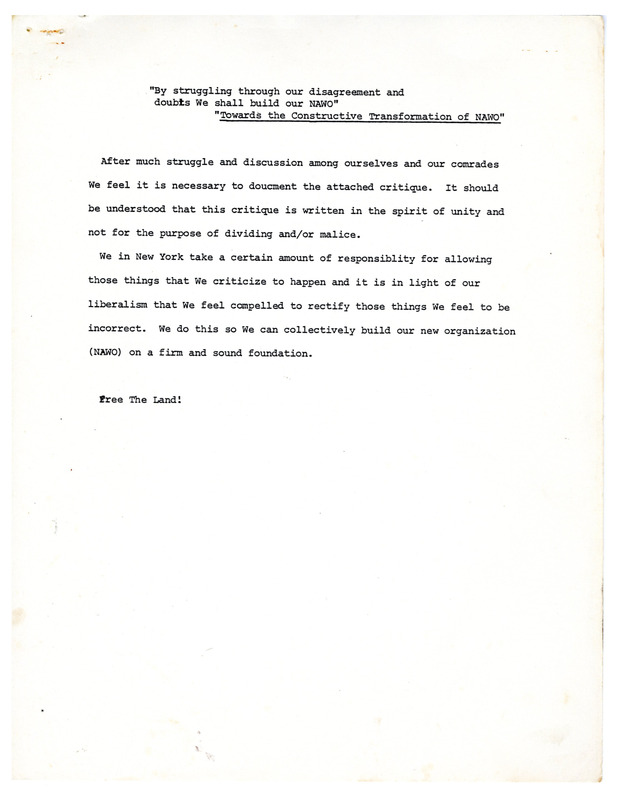
An essay that critiques certain aspects of the New Afrikan Women's Organization (NAWO). The author notes that "this critique is written in the spirit of unity and not for the purpose of dividing and/or malice."
A newspaper article from The News Tribune about multiple disruptions on March 2, 1977, in the trial of Assata Shakur (JoAnne Chesimard) for the 1973 killing of a state trooper. Several spectators were ejected from the court after Superior Court Judge Theodore Appleby accused the defense team of orchestrating outbursts during evidence submission.
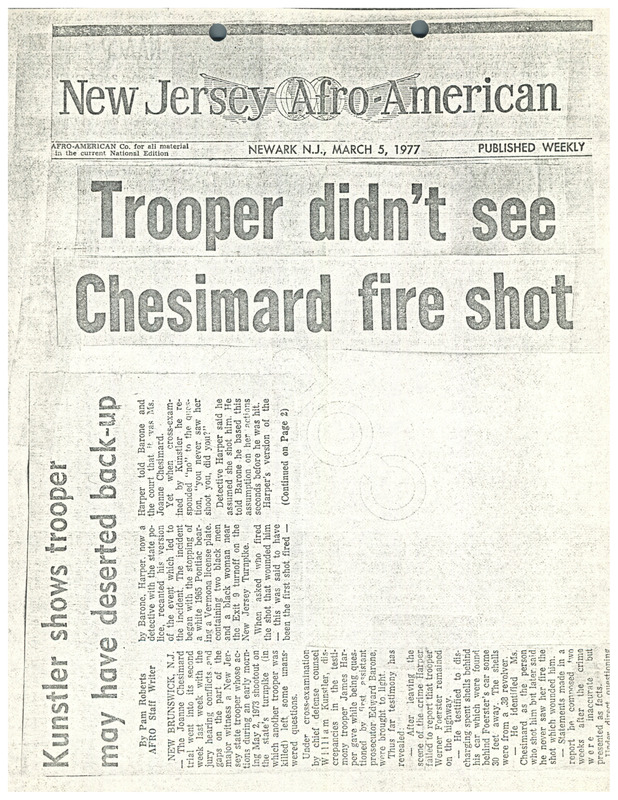
A newspaper from the New Jersey Afro-American about discrepancies in the testimony of trooper James Harper in the trial of Assata Shakur (JoAnne Chesimard) for the 1973 killing of a state trooper. In cross-examination, it was revealed that Harper had not seen Shakur fire the shot that had wounded him even though he had claimed that earlier.
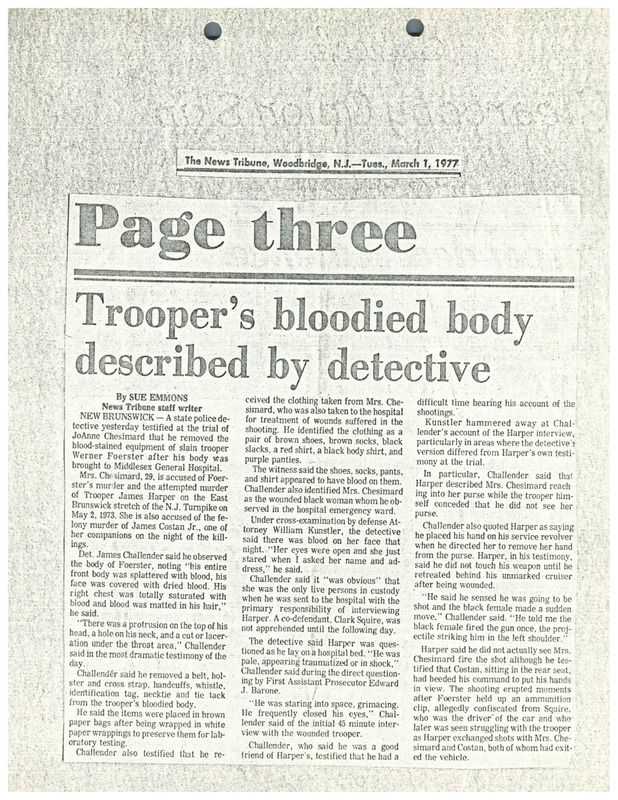
A newspaper article from The News Tribune about the testimony of State Police Detective James Challender describing what he saw at the emergency room where Assata Shakur (JoAnne Chesimard) and wounded state trooper Werner Foerster were taken after he was fatally shot. Shakur was on trial for the 1973 murder of Foerster.
A letter from Frankye Adams-Johnson (Malika) to her husband, Nuh Abdul Qaiyum, who has been imprisoned since 1975. She writes about their rare correspondence and lack of depth in conversation. She also writes about her faith and how Allah will continue to protect her and the children through hard times.
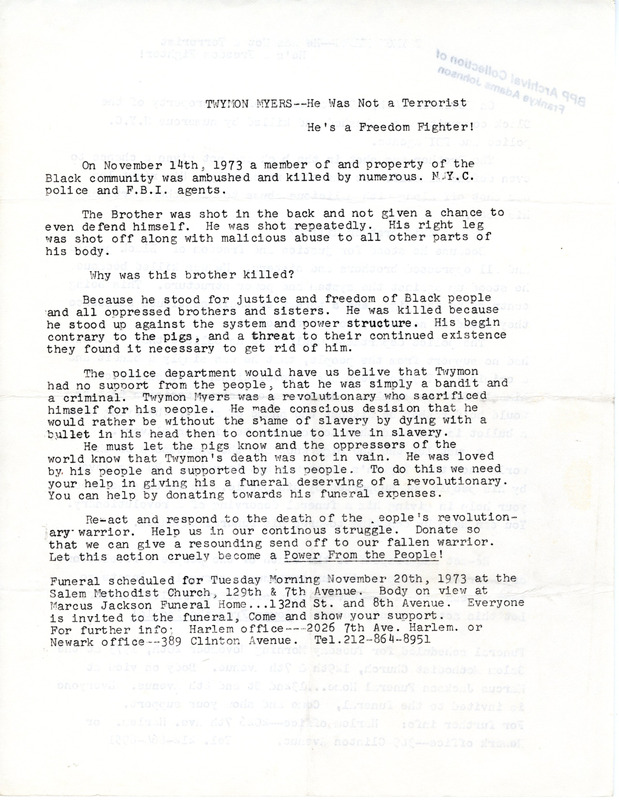
A memo calling for assistance with the funeral for Twymon Myers who was killed by New York City police officers and F.B.I. agents on November 14th, 1973. The unknown author asks the community for donations toward his funeral as a way to show the police that he was a beloved freedom fighter with the support of the people and not a criminal.
A letter from Nuh Abdul Qaiyum, who is imprisoned, to his wife Frankye Adams-Johnson (Malika). He details their love as it relates to their nature and their religion. He writes of their divine connection and compares their physical love to arena warfare. He compares her presence to an engraving on his brain.
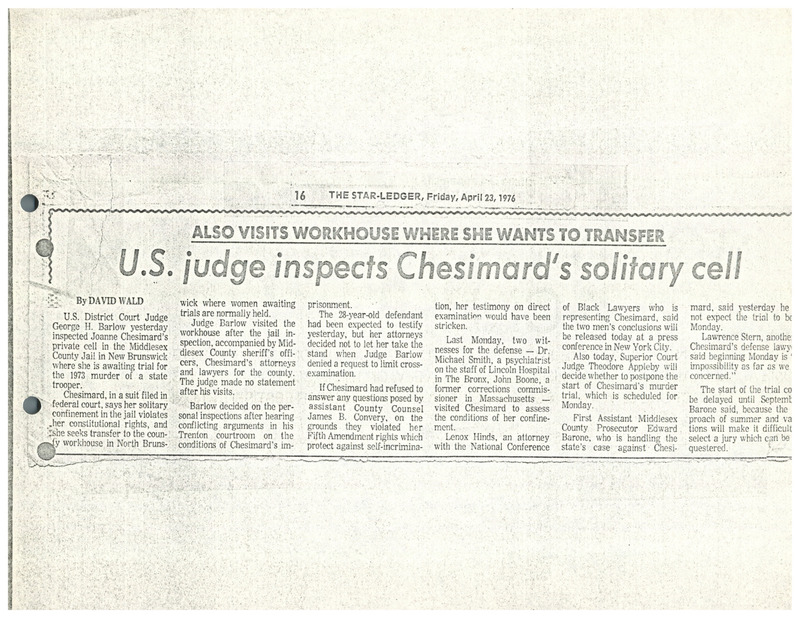
A newspaper article from The Star Ledger about District Court Judge George H. Barlow inspecting the cell where Assata Shakur (JoAnne Chesimard) is being held in Middlesex County to stand trial for the May 1973 killing of a state trooper. Shakur was convicted in 1977 of the killing and escaped prison in 1979.
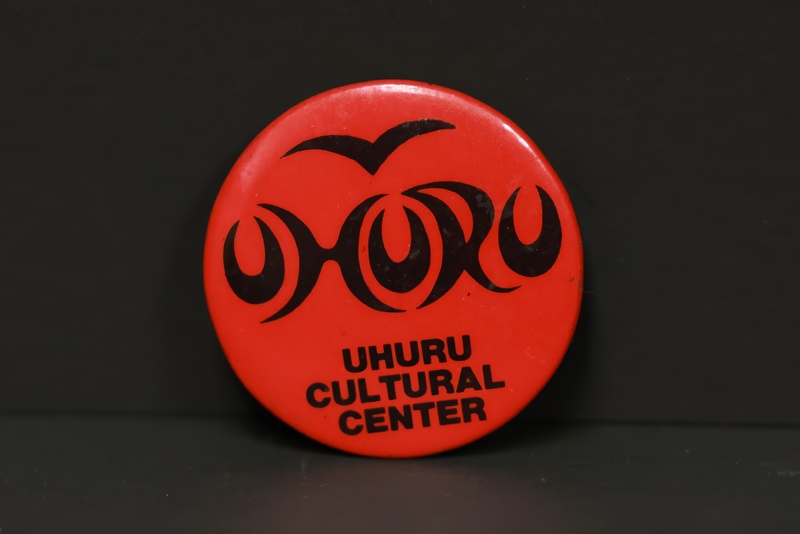
A red button with the logo for the Uhuru Cultural Center. The Uhuru Movement (from the Swahili word for "Freedom”) is an African Internationalist movement founded in 1972 by the African People's Socialist Party (APSP). Uhuru cultural centers and art centers were established around the country.
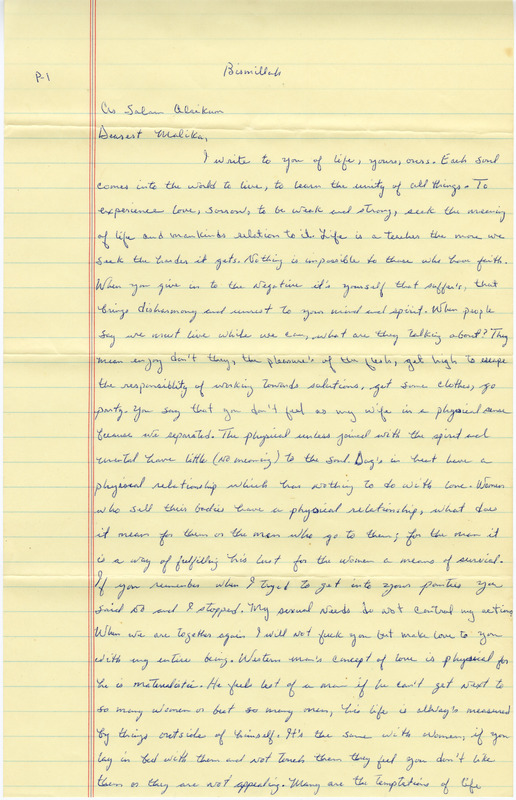
A letter from Nuh Abdul Qaiyum, who is imprisoned, to his wife Frankye Adams-Johnson (Malika). He writes about their spiritual union, its power, and giving into negativity in life and the world. He reassures her of their true love outside of the physical sense. He includes meditations for her to practice in the hopes that she will find peace.
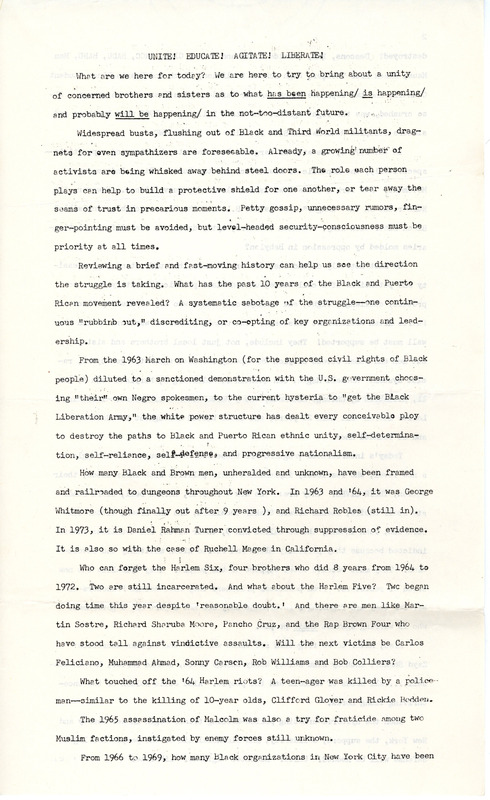
A call for support, solidarity, and financial aid for the legal defense of people on trial for police killings. The author writes that the incarcerations are part of a long-term strategy of the system to destroy the Black and Puerto Rican freedom movements and gives multiple examples of people and organizations that had been carried out on.
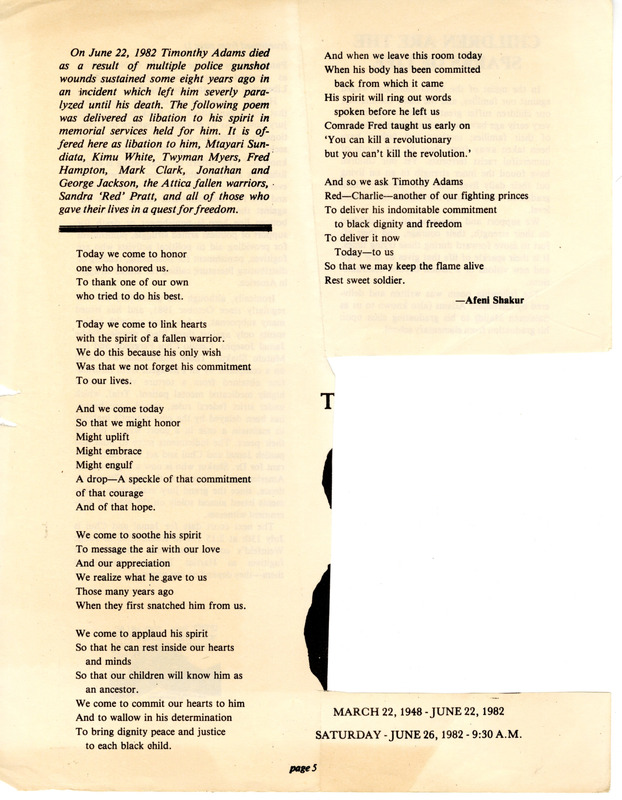
A poem written by former Black Panther Party Member Afeni Shakur after the death of Timothy Adams on June 22, 1982. His death came from complications from gunshot wounds he suffered 8 years prior at the hands of the police that left him paralyzed. The poem is offered as libation to him and several others who gave their lives for freedom.
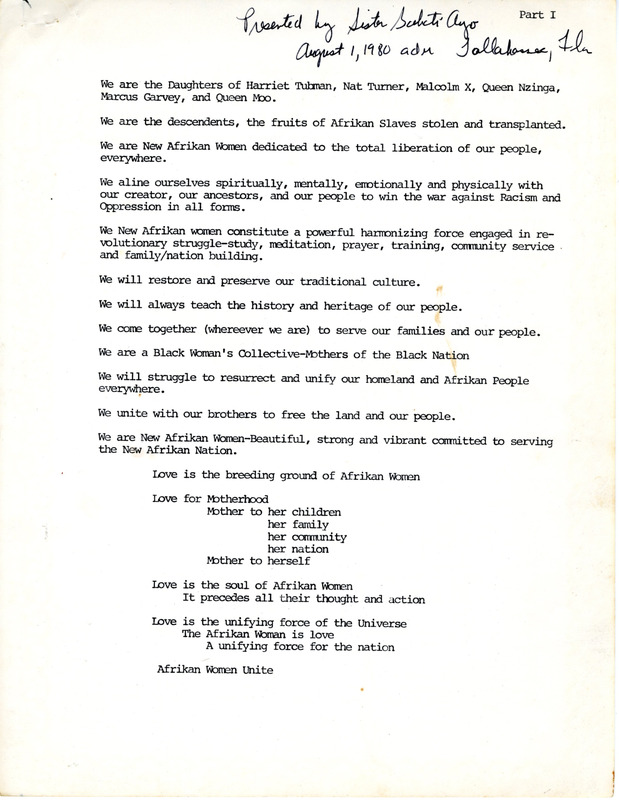
A speech about the role of Black women in the Republic of New Afrika. Sister Ayo writes that New Afrikan women are dedicated to the total liberation of their people and will also teach the history and heritage of their children to prepare them for self rule. The Republic of New Afrika was founded in 1968 and popularized by black militant groups.
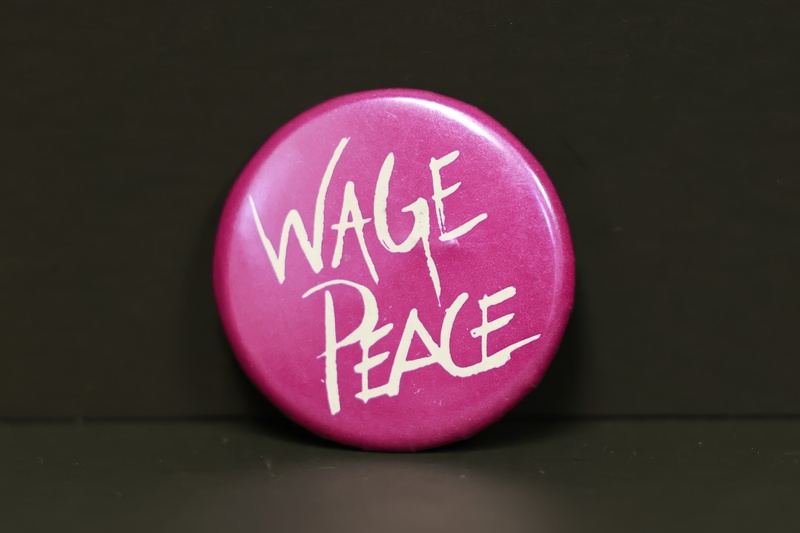
A purple button with text that says "Wage Peace." The phrase was popularized in a speech given by President Dwight D. Eisenhower in 1953 during the Cold War. “Wage Peace” went on to be a rally cry for the anti-war and peace movements, especially during the Vietnam War.
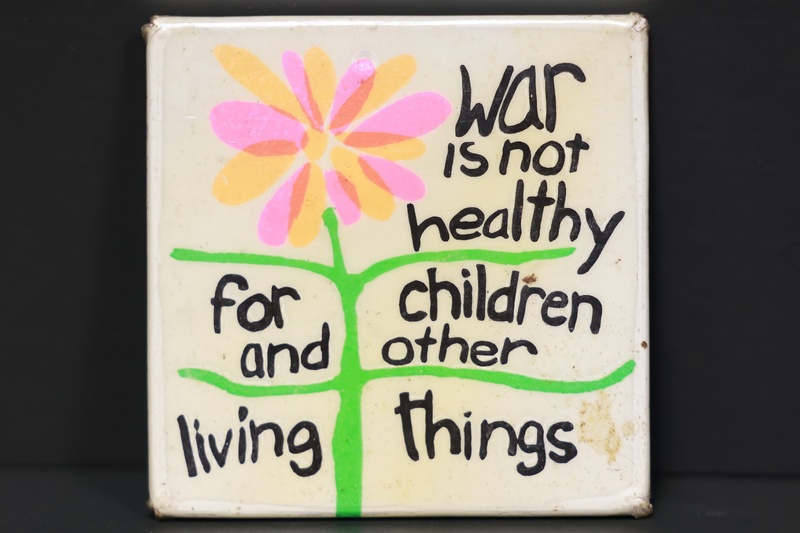
A white square button with a drawing of a flower. The text says: "War is not healthy for children and other living things." The button uses the poster design created by Chicago, Illinois, artist Lorraine Schneider in 1966. The design and slogan became an enduring symbol of the peace movement starting in 1967 with the Vietnam War.
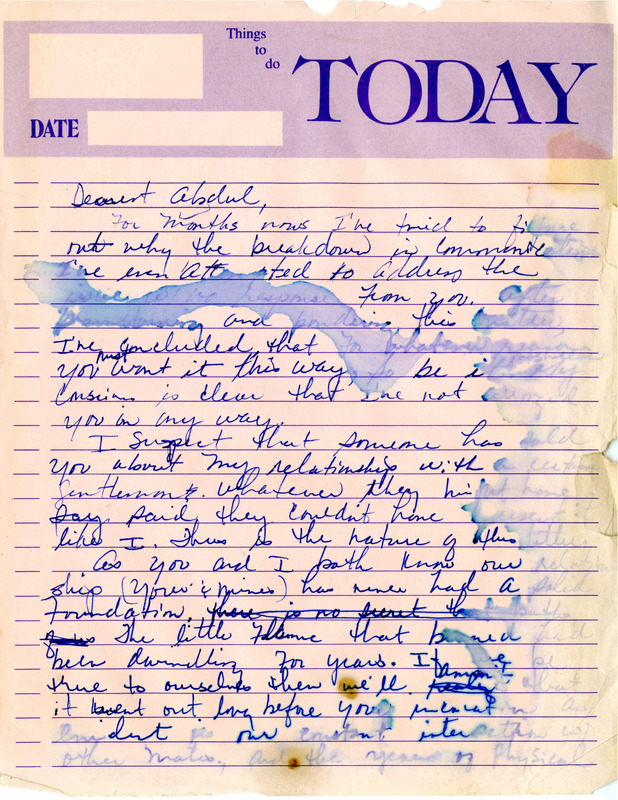
A letter from Frankye Adams-Johnson (Malika) to her husband, Nuh Abdul Qaiyum, who was imprisoned. She is upset about their breakdown in communication. She concludes that he wants it this way and goes on to explain that their "flame" has been dwindling for years. She changes the subject to explaining her teaching moment with a young man.
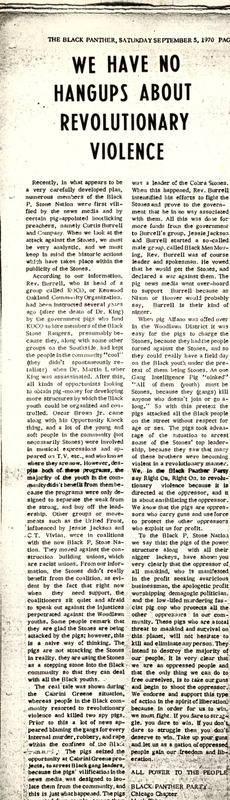
A newspaper article from The Black Panther by Moak Teba of the Chicago Black Panther Party. The article describes acts of violence against the people in Chicago and argues for taking that same violence to the oppressors. The story centers on the Panthers’ support of the Black P. Stone Nation, one of Chicago’s most notorious street gangs.
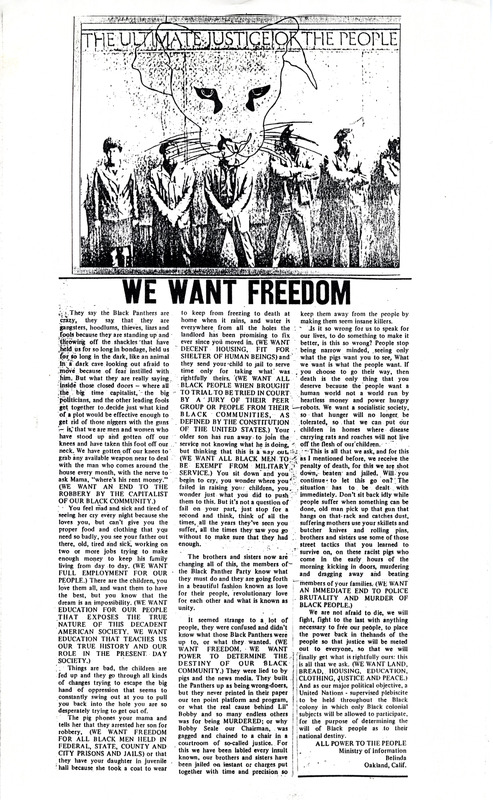
A newspaper article from The Black Panther (unknown date) explaining the Black Panther Party's Ten Point Program. The article is credited to the Ministry of Information, Belinda, Oakland, California. The author gives a detailed explanation of each of the points of the Ten Point Program that lies at the core of Black Panther ideology.
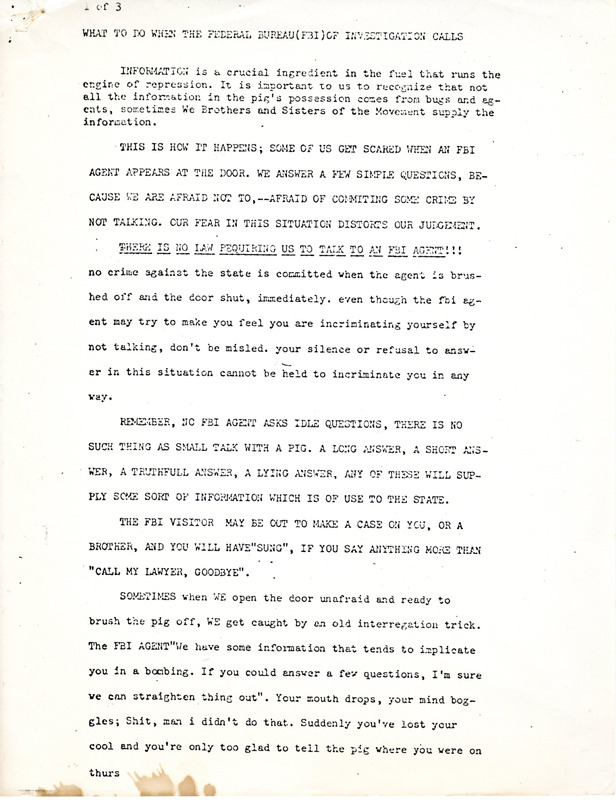
A memo describing one's rights when confronted by the Federal Bureau of Investigation (FBI). The memo states that FBI agents are always asking questions intentionally to incriminate the subject and therefore no one should ever speak with them without an attorney present, especially considering it is not against the law to not talk to an agent.
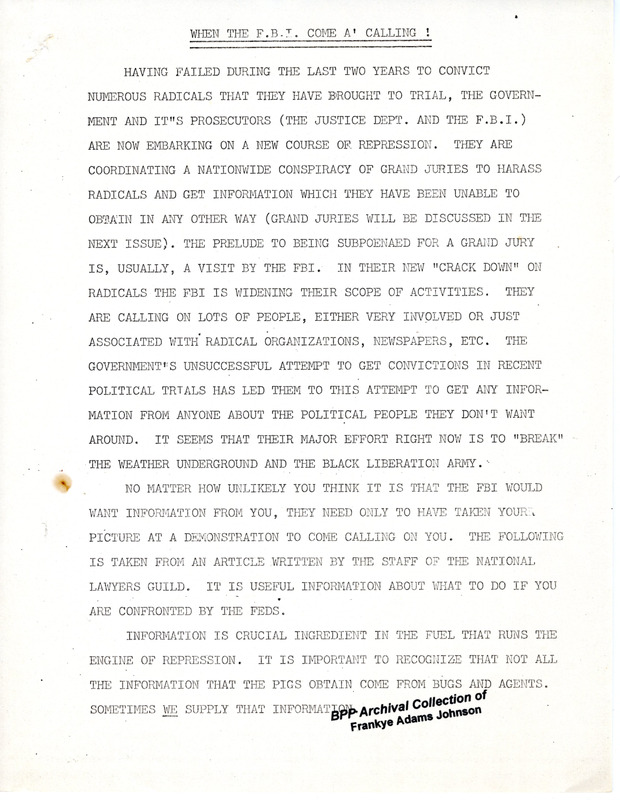
A memo describing one's rights when confronted by the Federal Bureau of Investigation (FBI). The memo states that the FBI is coordinating grand juries to harass radicals. Agents are always asking questions intentionally to incriminate the subject and therefore no one should ever speak with them without an attorney present.
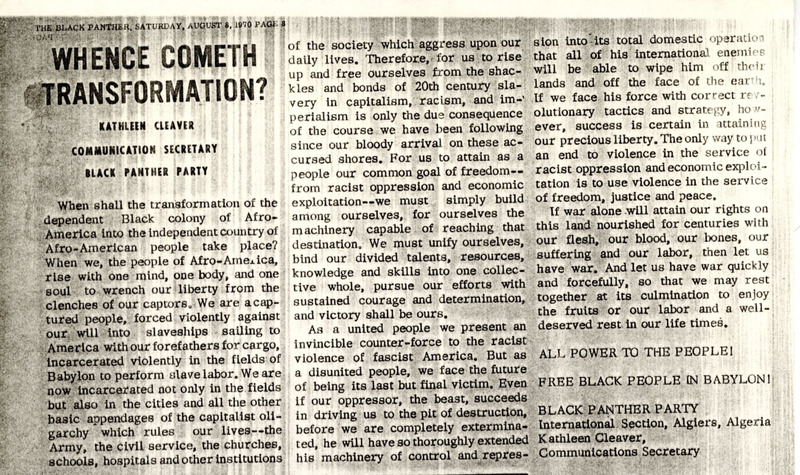
A newspaper article from The Black Panther. Communications Secretary Kathleen Cleaver argues that unity amongst Black people is necessary to fight oppression and that the use of violence in the service of freedom, justice, and peace is the only way to put an end to the violence of racism against “the Black colony of Afro-America.”
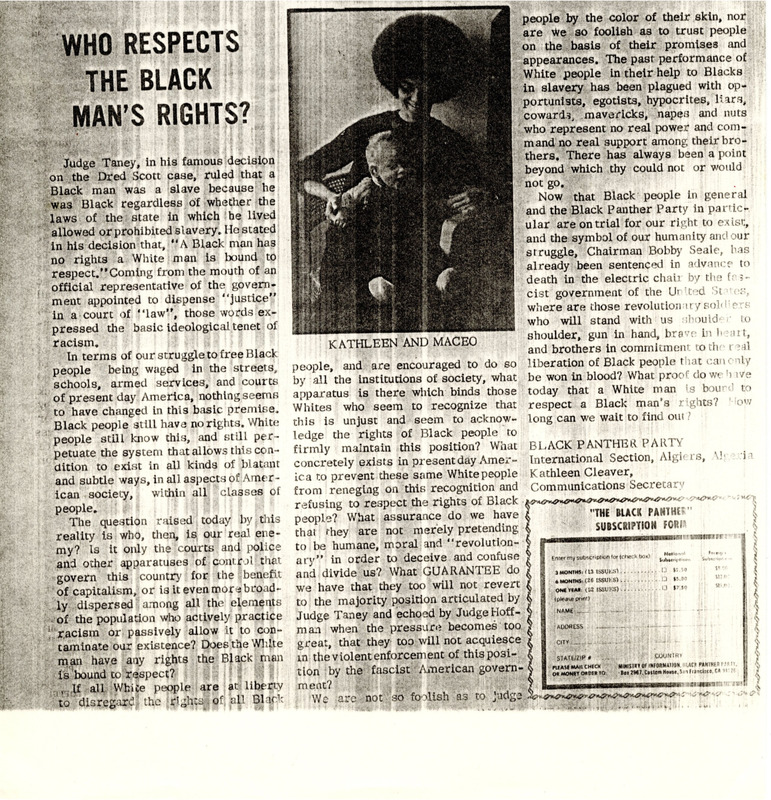
A newspaper article from The Black Panther. Communications Secretary Kathleen Cleaver ponders the idea of Black people's rights and how White people react to them. She wonders if revolutionary Whites are just pretending to be revolutionary as a way to divide Black people.
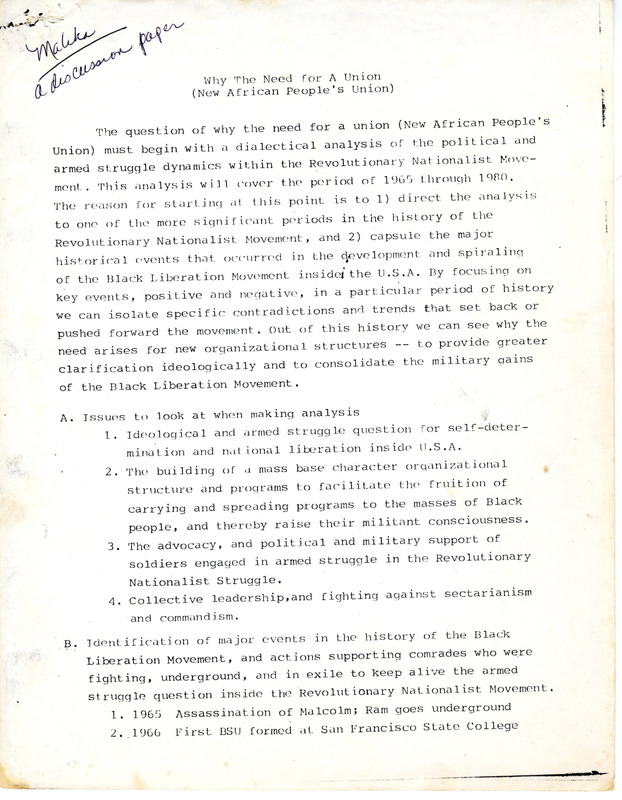
An undated essay about the need for a New African People's Union. The author argues for the union by identifying major historical events in the Black liberation movement that can be used to organize the union. This view of history can provide greater clarification ideologically and consolidate the military gains of the Black liberation movement.
A historical analysis outlining the need for a New African People's Union. The author writes that the need for the new union can be understood by doing a historical analysis on the years 1965-1980, the time when the Black liberation movement in the United States was spiraling, and that 1980 was a time of natural evolution within the movement.
A white political campaign button in support of Rev. Jesse L. Jackson for president in the 1988 Democratic Party primary. Rev. Jackson more than doubled his vote total from the 1984 race and finished the primary in second place behind eventual Democratic nominee Michael Dukakis.
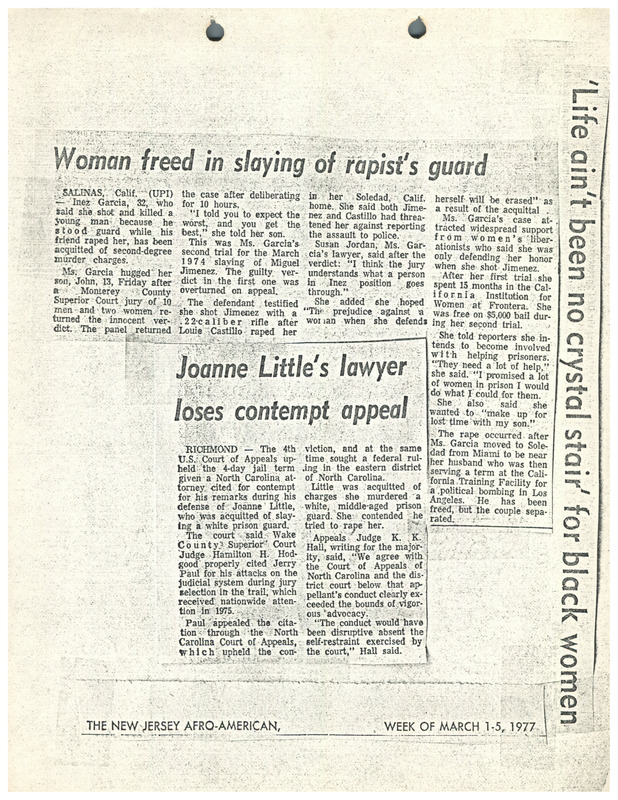
A newspaper article from The New Jersey Afro-American about Inez Garcia, a woman whose case became a rallying cry for feminists after she was acquitted for killing a man she says helped rape her. Garcia became a symbol for a woman’s right to defend herself. She says that she will go on to help other women who are imprisoned.
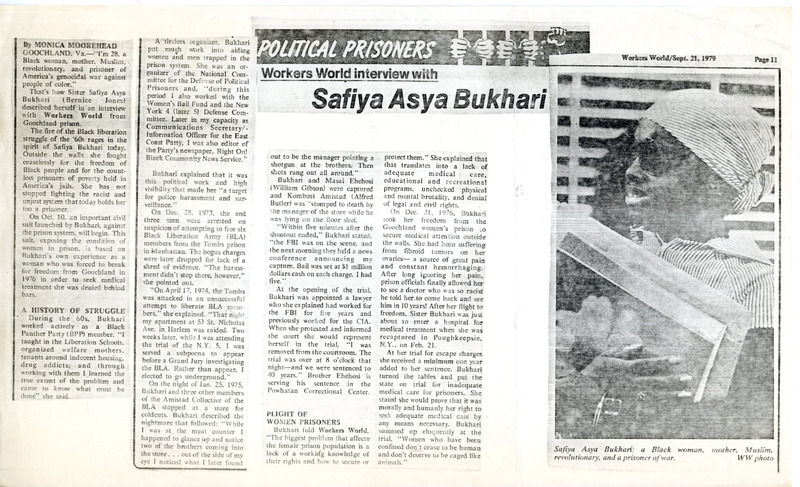
A newspaper article from Workers World. The writer interviews Safiya Asya Bukhari about her work in the community and with the Black Panthers and how that work brought police attention to her. At the time she was imprisoned at the Virginia Correctional Center for Women after being convicted in 1975 on weapons, murder, and robbery charges.
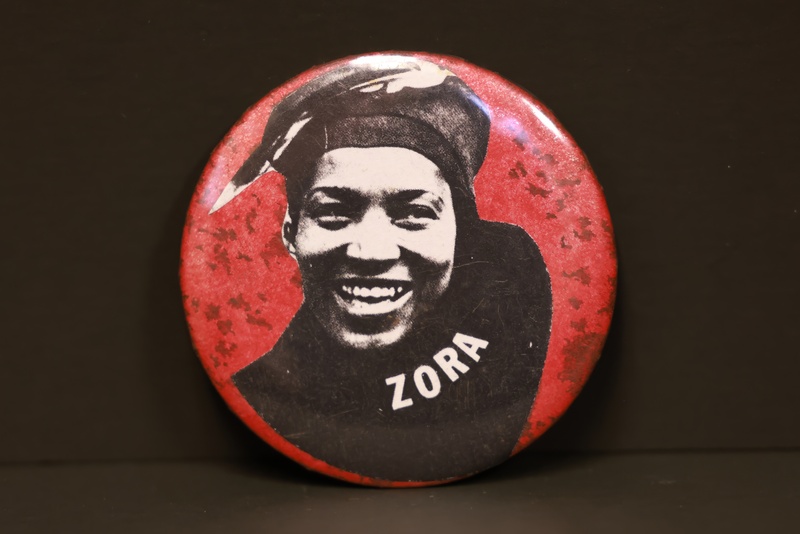
A multi-colored button with a photo of Zora Neale Hurston. The text reads “Zora.” Zora Neale Hurston was an author, filmmaker, and researcher, with a focus on African American and Caribbean folklore. Her most famous novel is “Their Eyes Were Watching God” and she wrote over 50 other works, including novels, short stories, plays, and essays.