Frankye Adams-Johnson Black Panther Party Collection
Title
Frankye Adams-Johnson Black Panther Party Collection
Date Modified
2025-12-12
Description
Frankye Adams-Johnson is a former English Professor at Jackson State University and former active member of the Black Panther Party for Self-Defense in New York City, where she served as an officer in the New York State Chapter. This collection, created or collected during her involvement in the Black Panther Party, consists of personal journal notebooks, correspondence, newspaper articles, fliers, meeting documents and her collection of political and movement buttons.
Curated By
Garrad Lee
Contributing Institution
Jackson State University
About This Record
The HCAC public history focused digital archive cataloging is an ongoing process, and we may update this record as we conduct additional research and review. We welcome your comments and feedback if you have more information to share about an item featured on the site, please contact us at: HCAC-DigiTeam@si.edu
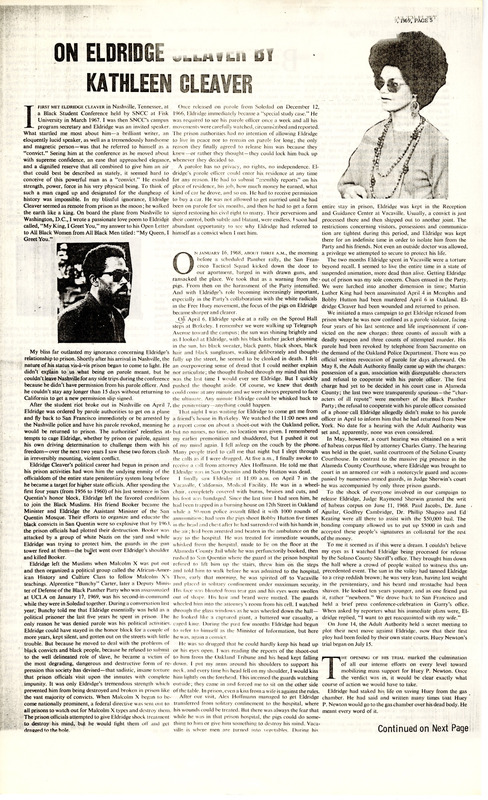
A newspaper article from The Black Panther by Kathleen Cleaver about her relationship with her then-husband Eldridge Cleaver and the legal issues he faced after an April 6, 1968, shootout with the police in Oakland, California. It is noted at the end of the article that it was reprinted from Ramparts Magazine.
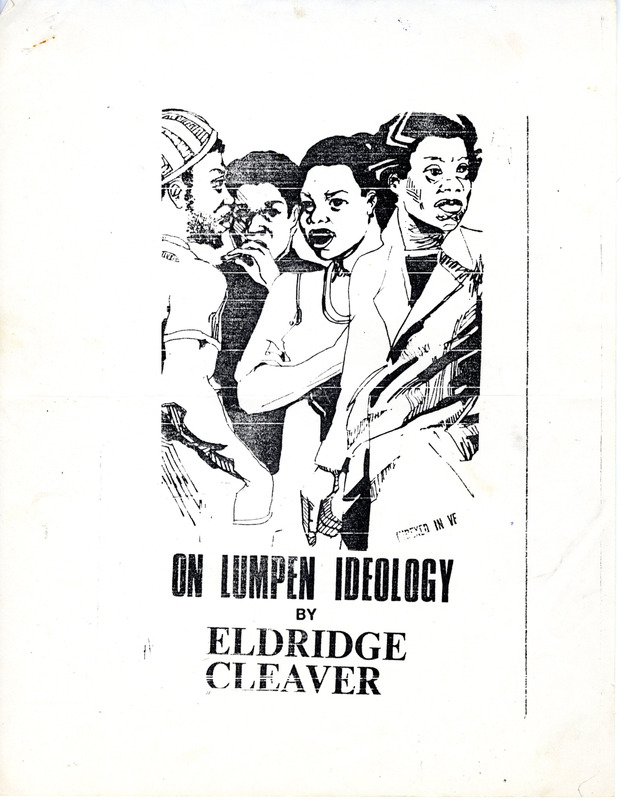
A journal article originally published in The Black Scholar in 1972. In the article, former Black Panther Eldridge Cleaver writes about Black liberation and the lumpenproletariat. Marx and Engels identified the lumpen as the underclass devoid of class consciousness. Cleaver, however, argues that the class can be organized and used in the movement.
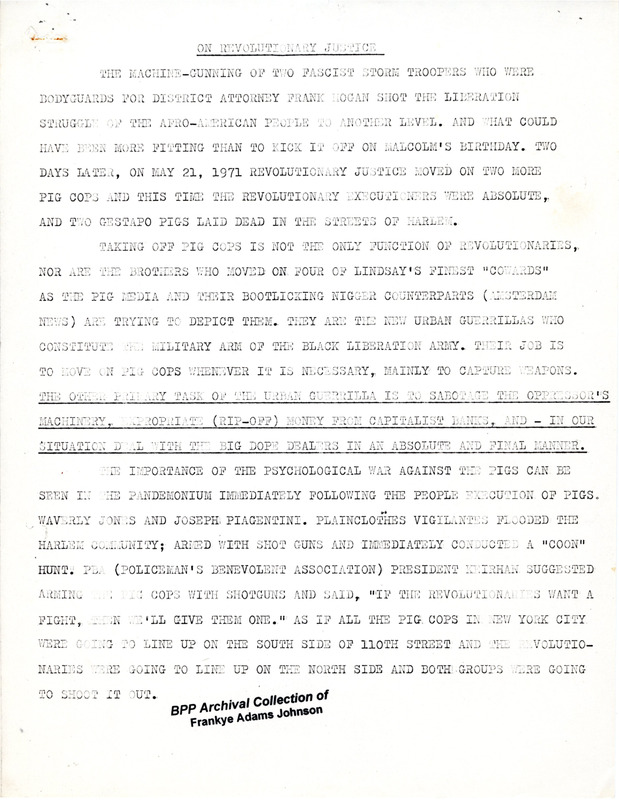
A short essay about the revolutionary killing of cops. The author gives two recent examples of revolutionaries killing cops, saying the killers are urban guerillas who constitute the military arm of the Black Liberation Army (BLA). The tagline of the essay is “All Power to the New Urban Guerilla, War to the End.”
The artwork and advertisement in the newspaper The Black Panther for a series of articles titled “On the Ideology of the Black Panther Party” by Eldridge Cleaver. At the time, Cleaver was serving as Minister of Information for the Black Panther Party in Oakland, California.
Nuh Abdul Qaiyum, who is imprisoned, is writing to reassure Frankye Adams-Johnson (Malika) of his love for her regardless of her pregnancy. He goes on to explain the things people tell him and the evil that comes for them. He tells her that they will remain strong in faith and in public.
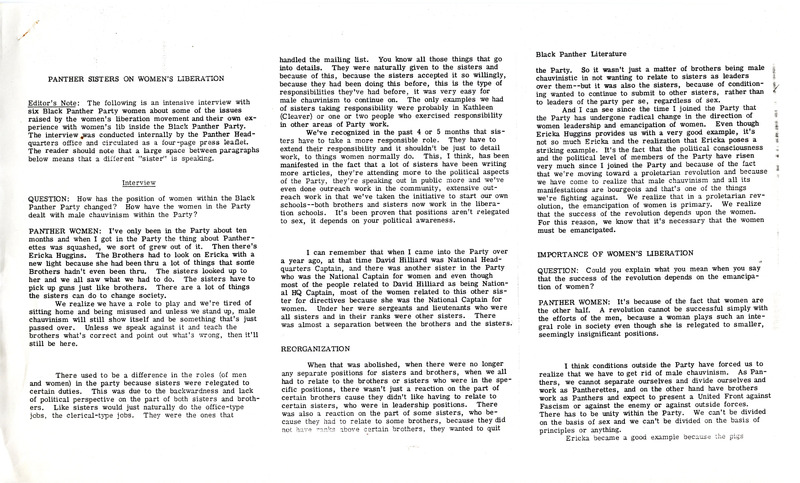
An interview with six unnamed Black Panther Women about the women's liberation movement and their experience with women's liberation within the Black Panther Party itself. The interviews were conducted at the Black Panther Party Headquarters on September 17, 1969 and circulated as a 4 page leaflet.
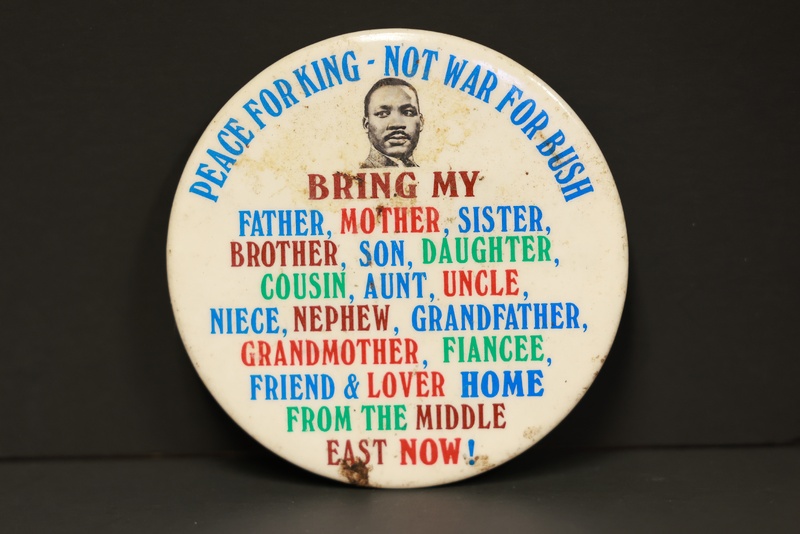
A white button with a picture of Dr. Martin Luther King. The text says "Peace for King-Not War for Bush: Bring my father, mother, sister, brother, daughter, cousin, aunt, uncle, niece, nephew, grandfather, grandmother, fiancee, friend & lover home from the Middle East now!"
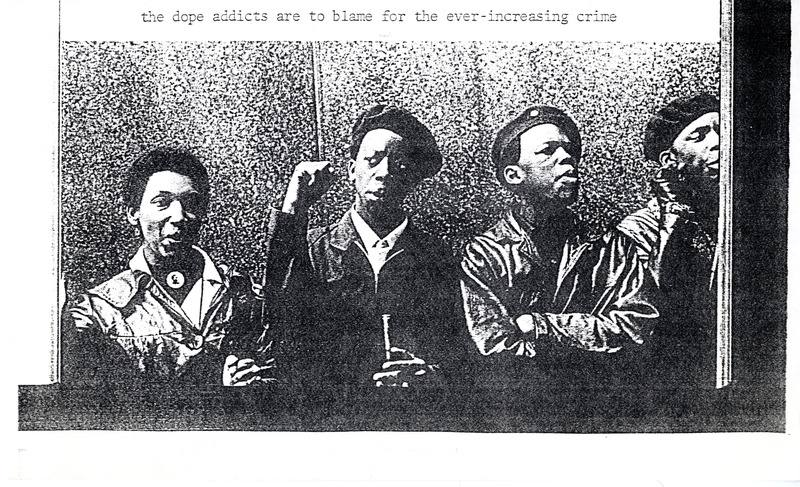
A photocopy of a picture from an unknown publication of four Black Panthers. The text above the picture reads "The dope addicts are to blame for the ever-increasing crime."
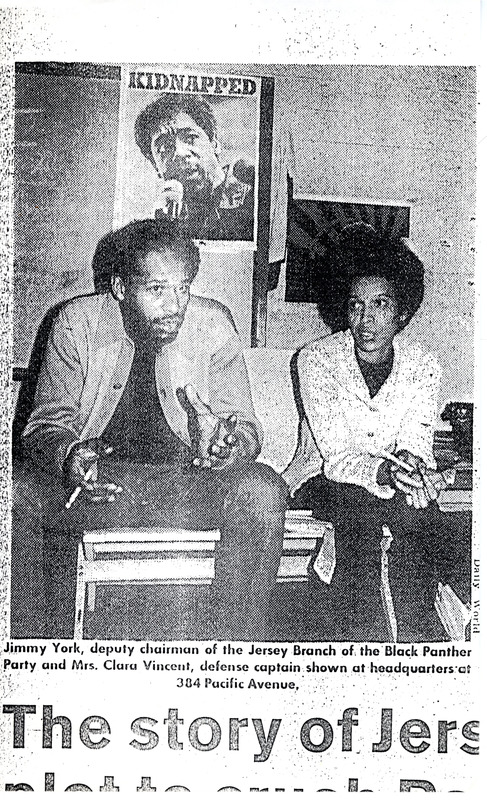
A photocopy of a picture from an issue of Jersey City, New Jersey, newspaper Daily World of Jimmy York, deputy chairman of the Jersey branch of the Black Panther Party, and Clara Vincent, defense captain.
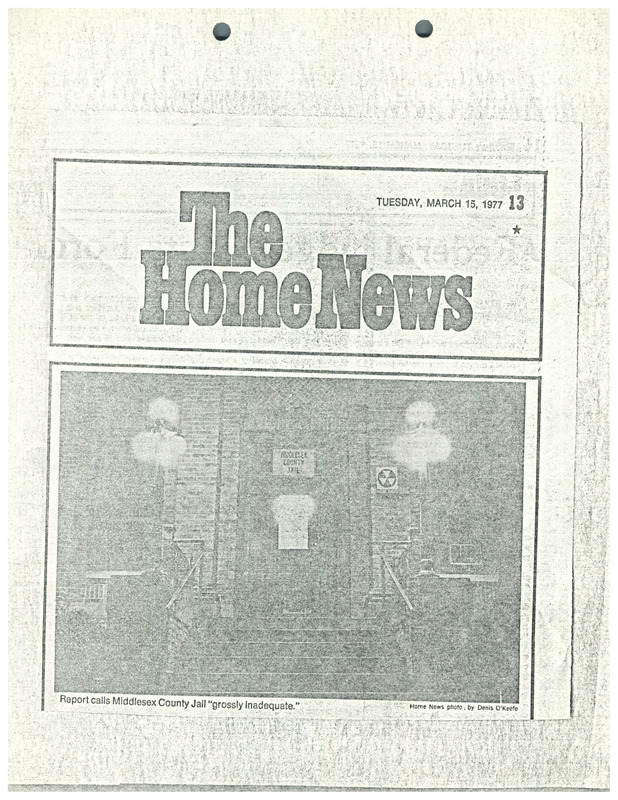
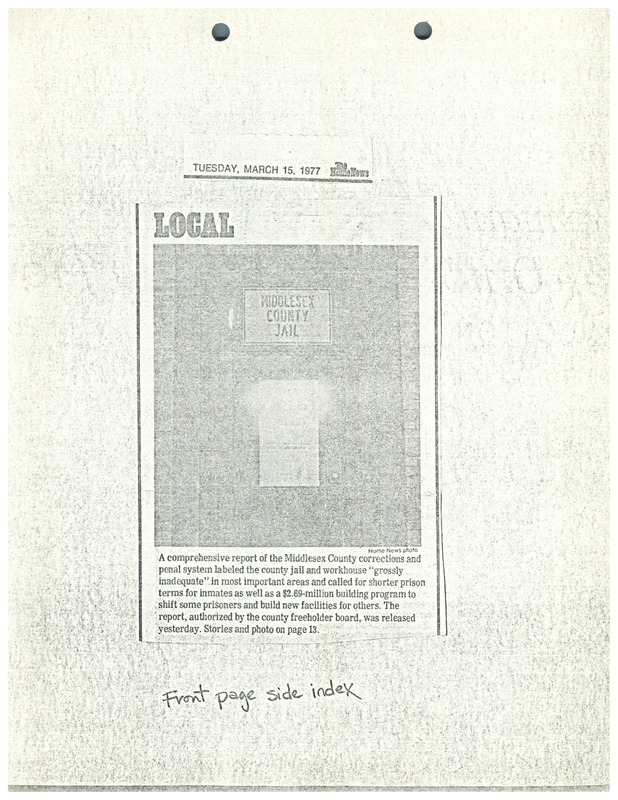
A photograph from the newspaper The Home News of Middlesex County Jail. The jail, where Assata Shakur (JoAnne Chesimard) was staying for her New Jersey trial for the 1973 killing of a state trooper, had been found "grossly inadequate" in a comprehensive report. Shakur was attempting to get transferred from the jail.
A photograph from the newspaper The Home News of Middlesex County Jail. The jail, where Assata Shakur (JoAnne Chesimard) was staying for her New Jersey trial for the 1973 killing of a state trooper, had been found "grossly inadequate" in a comprehensive report. The report called for shorter terms and millions of dollars in upgrades.
A newspaper article from The Black Panther that examines the relationship between the police and the Black Panther Party through the lens of capitalism. The author, Candy (no last name listed), writes that capitalism in the oppressor and those who fight against capitalism are fighting against the government and the police force that protects it.
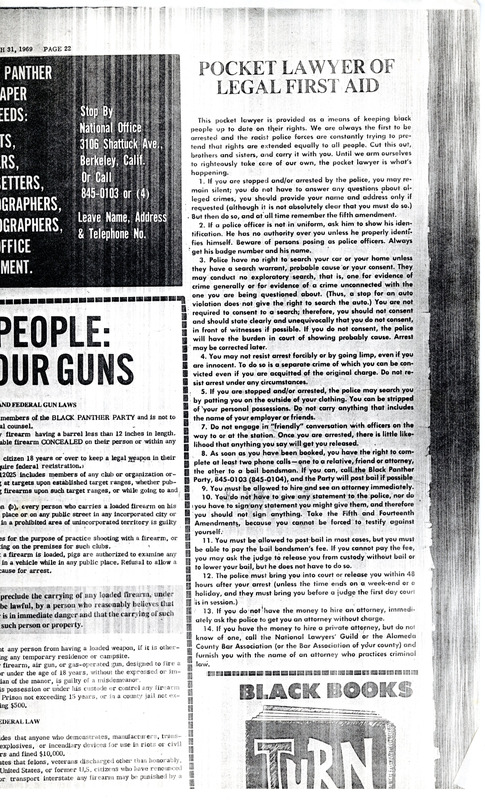
A newspaper article from The Black Panther. It outlines the 14 steps for Black people concerning Constitutional rights if confronted or arrested by the police. The article suggests that readers cut the article out of the paper and carry it with them in case of confrontations with the police.
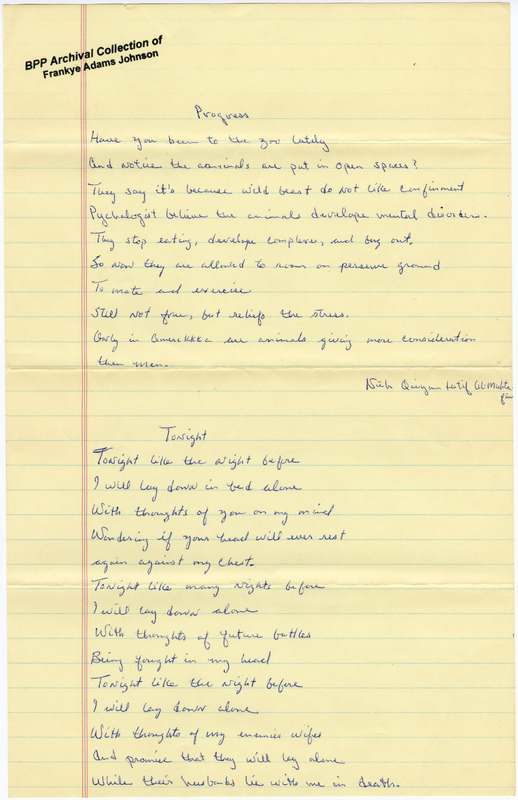
Poems by Nuh Abdul Qaiyum, who was sentenced to prison in 1975 for a 1971 Black Liberation Army (BLA) connected shooting of police officers in New York. This collection of poems is titled "I am Told" and explores themes such as freedom, humanity, and emotion.
In this postcard, Frankye Adams-Johnson (Malika)’s husband, Nuh Abdul Qaiyum, who is imprisoned, writes about seeing a young family member and the good that does for him. He updates his wife on the current situation with some of the comrades in the Black Panther Party. He mentions the solutions he must create and says he has much to learn.
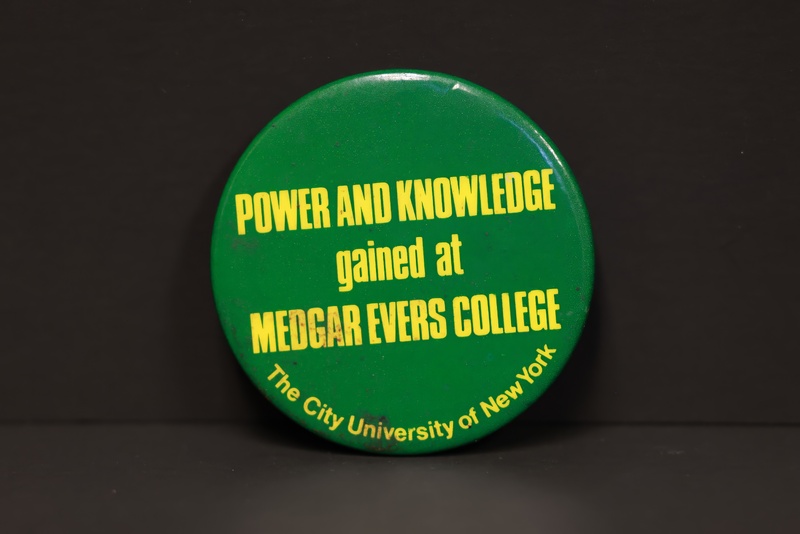
A green button that says: "Power and knowledge gained at Medgar Evers College." Text on the bottom of the button also says: "The City University of New York." Medgar Evers College was established in Brooklyn, New York, in 1970 as part of the Central University of New York (CUNY). The college is a public, 4-year, degree granting institution.
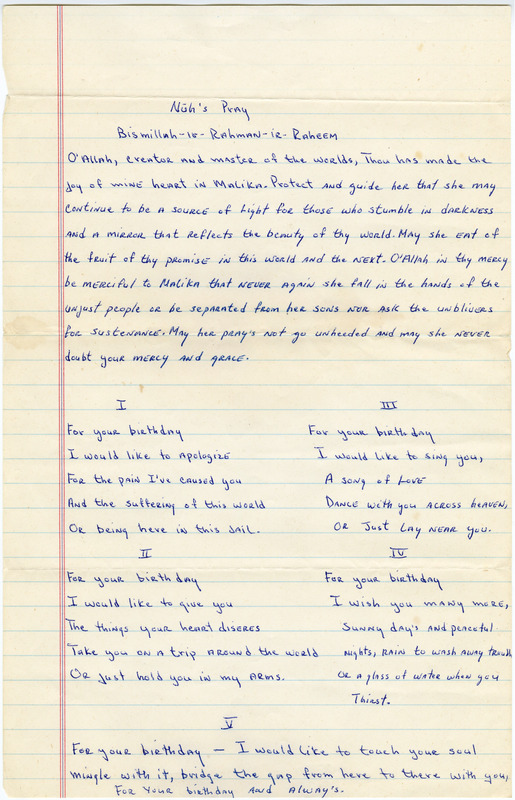
A letter from Nuh Abdul Qaiyum, who was sentenced to prison in 1975 for a 1971 Black Liberation Army (BLA) connected shooting of police officers in New York, to his wife Frankye Adams-Johnson (Malika). He sends a prayer and poems for her birthday.
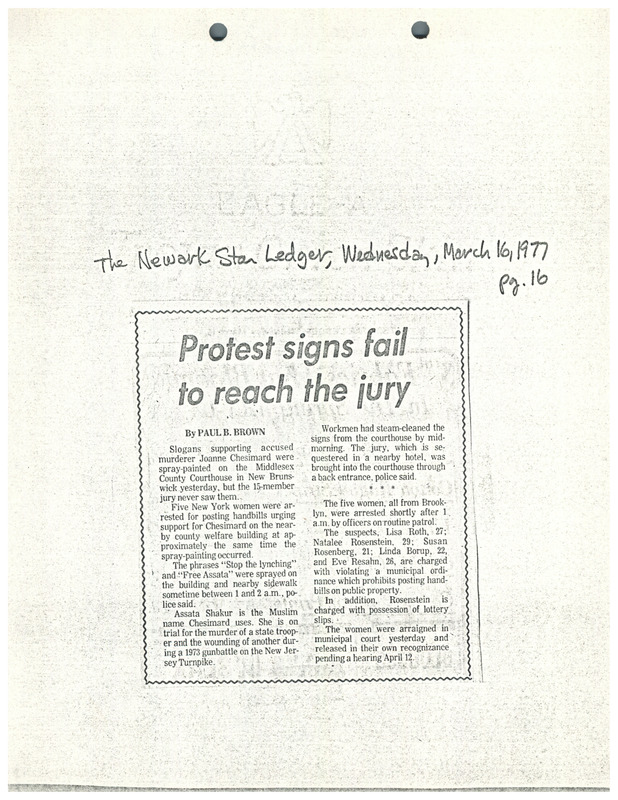
A newspaper article from The Star Ledger about slogans spray painted on the Middlesex County Courthouse in support of Assata Shakur (JoAnne Chesimard) during her trial trial for the 1973 killing of a state trooper. Five women were arrested for another incident where pro-Shakur handbills were posted on the nearby county welfare office.
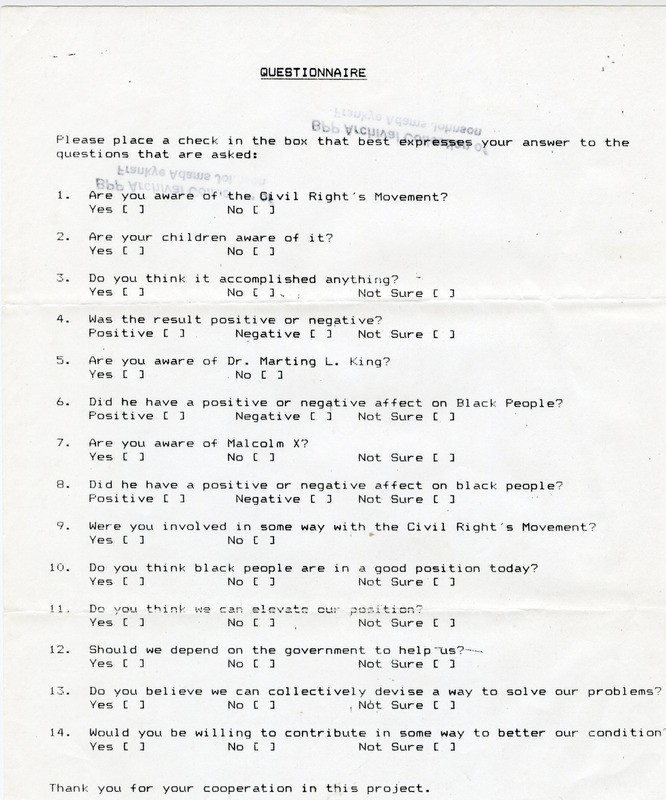
A questionnaire about the Civil Rights Movement and its impact on Black people. The questionnaire has 14 yes/no/not sure questions and has not been filled out. Questions include: “Are you aware of the Civil Rights Movement?;” “Do you think it accomplished anything?;” and “Do you think Black people are in a good position today?”
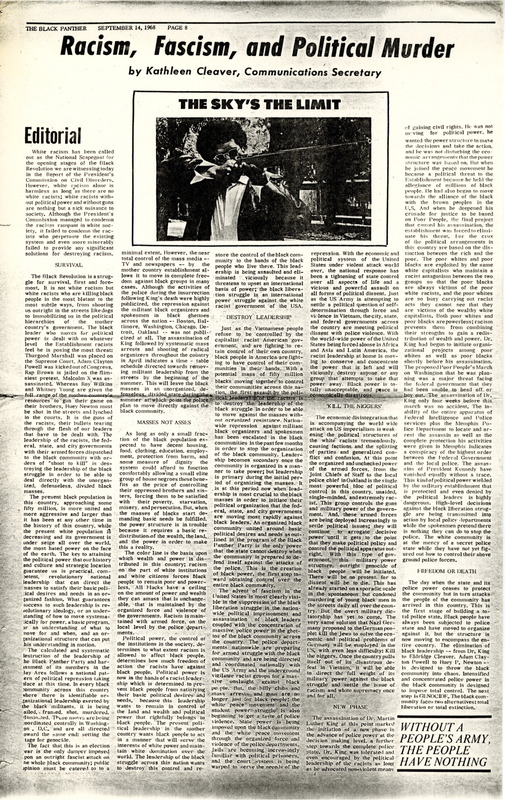
A newspaper article written by Communications Secretary Kathleen Cleaver in The Black Panther. The article, in response to the Kerner Commission report ordered by President Lyndon B. Johnson to look into the causes of the 1967 uprisings in several U.S. cities, argues that the government hadn’t done enough to combat systemic racism.
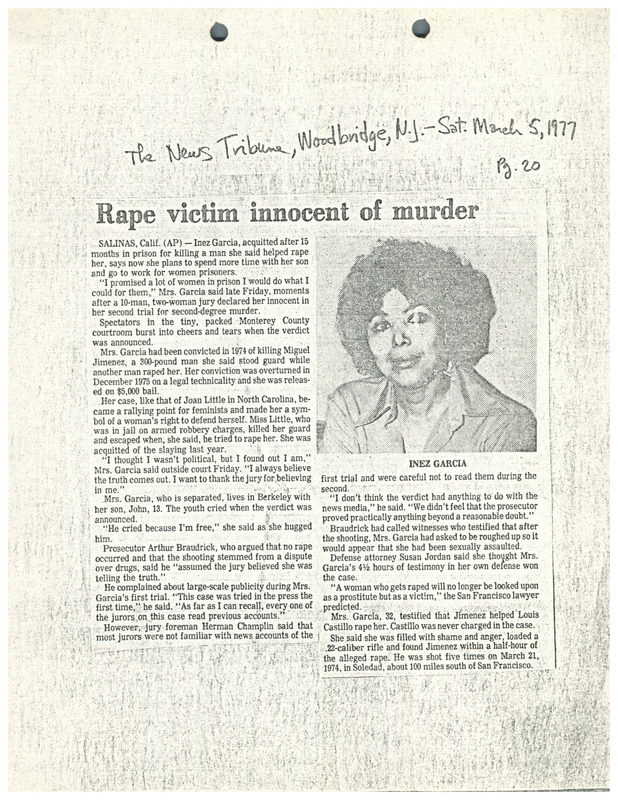
A newspaper article from The News Tribune about Inez Garcia, a woman whose case became a rallying cry for feminists after she was acquitted for killing a man she says helped rape her. Garcia became a symbol for a woman’s right to defend herself. She says that she will go on to help other women who are imprisoned.
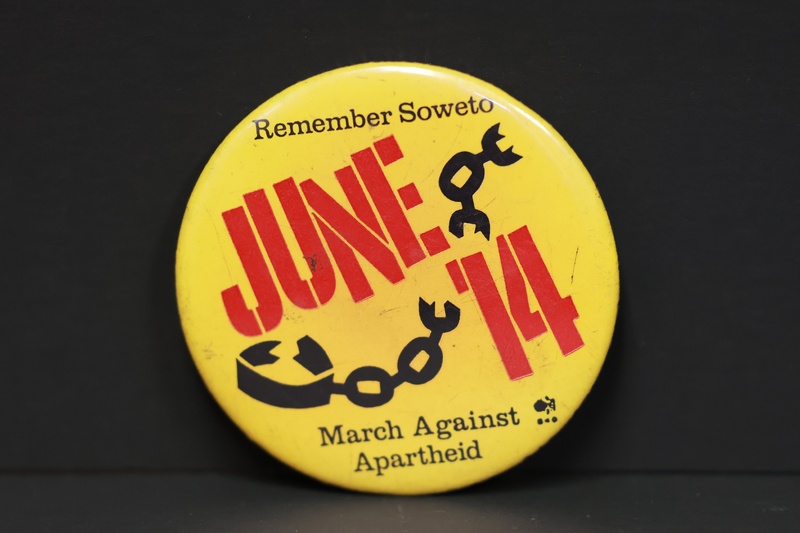
A gold button with a drawing of a broken shackle and chain with the text "Remember Soweto June 14 March Against Apartheid." On June 14, 1986, 40,000 people rallied in Central Park in New York City to call on President Ronald Reagan to impose strict economic sanctions on the government of South Africa as a means to ending apartheid in the country.
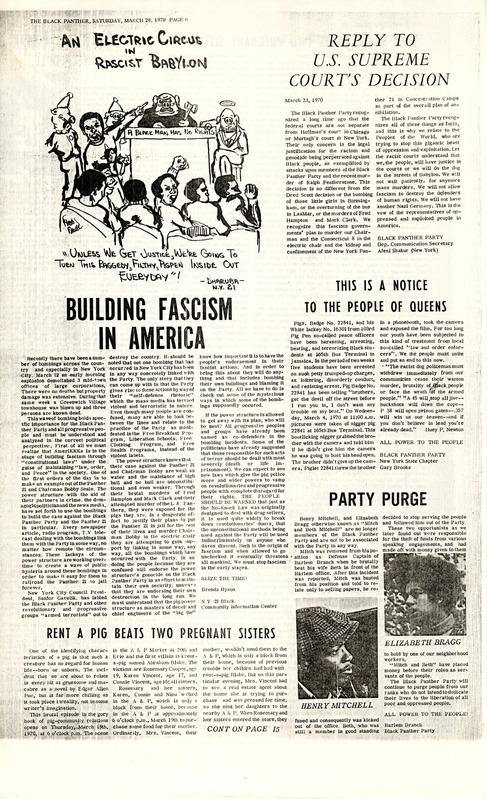
A newspaper article from The Black Panther describing an incident in Philadelphia, Pennsylvania, where two pregnant women suffered injuries after a run-in with a grocery store security guard who was notorious for harassing Black customers. The women were subsequently arrested by the police and calls were made for firing the security guard.
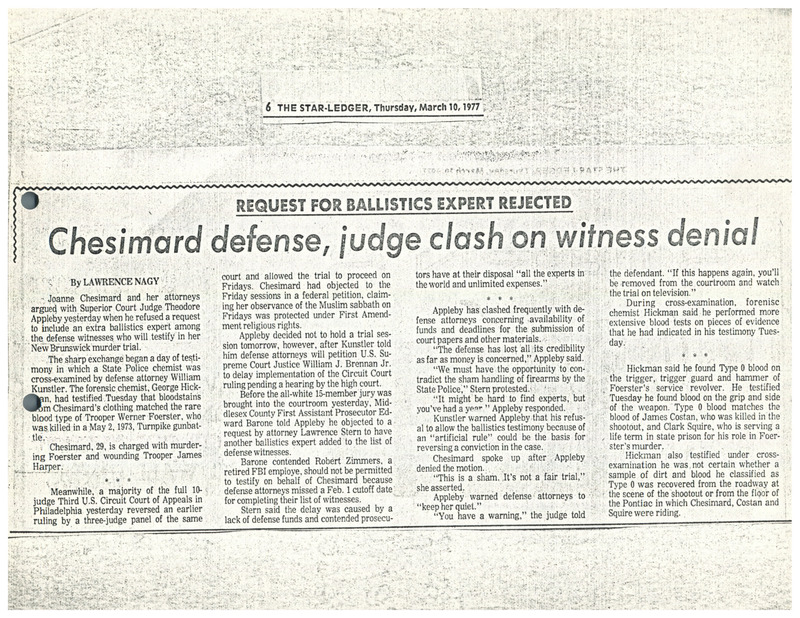
A newspaper article from The Star Ledger about the defense team for Assata Shakur (JoAnne Chesimard), on trial for the 1973 killing of a state trooper, being denied calling an extra ballistics witness by the judge. The prosecution contended the witness was not valid since the defense team missed the cutoff date to add witnesses to their list.
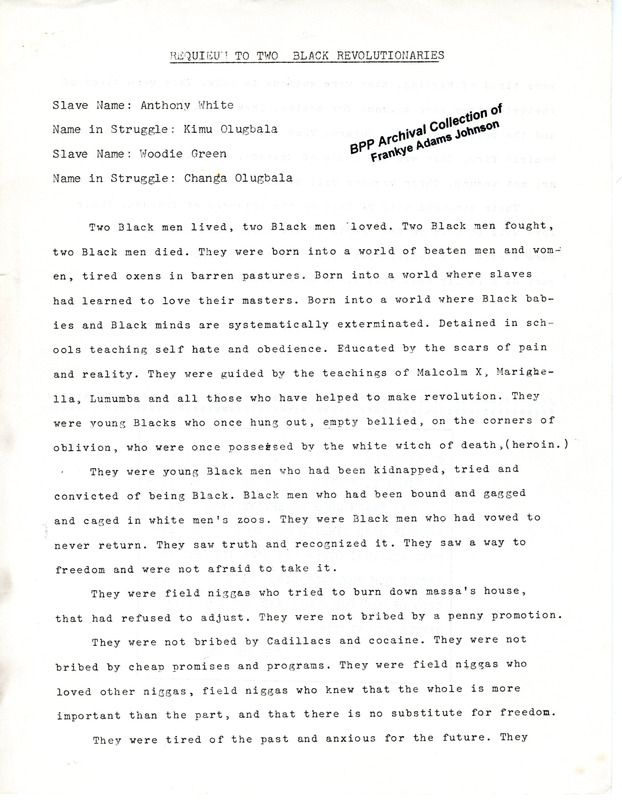
A requiem written to Anthony White (Kimu Olugbala) and Woodie Green (Changa Olugbala), two members of the Black Liberation Army (BLA) who died in prison. The author writes that their memory will be used as fuel for the ongoing struggle against oppression. A quote from Argentine Marxist revolutionary Che Guevara is printed at the bottom of page 2.
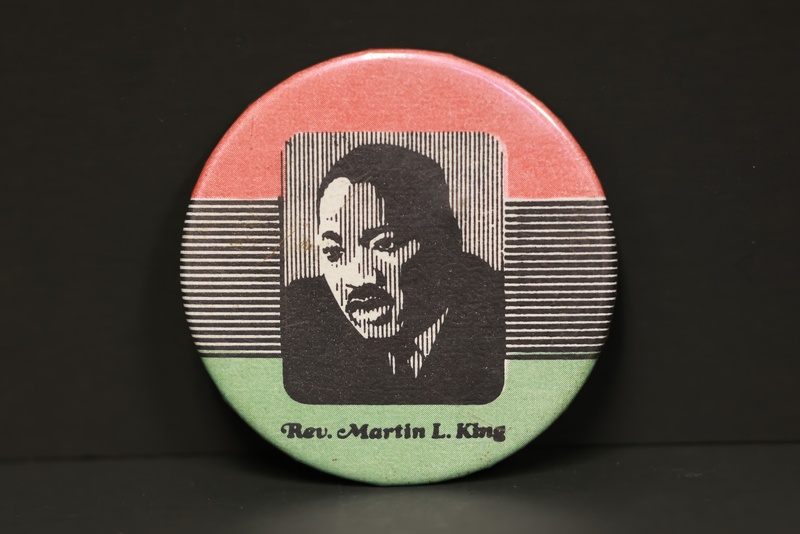
A red, green, and black button with an image of Dr. Martin Luther King Jr. Dr. King was a co-founder of the Southern Christian Leadership Conference (SCLC) and remained its leader, and the most prominent leader of the Civil Rights Movement in the South, until his assassination in Memphis in 1968.
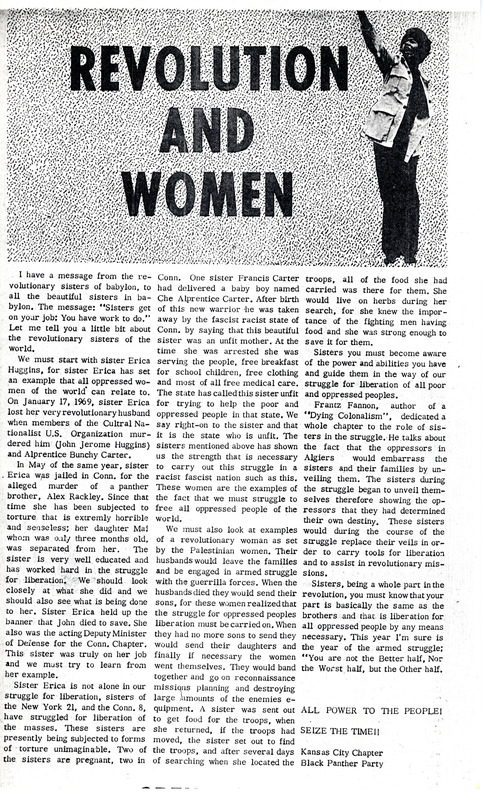
A newspaper article from The Black Panther recounting several examples of the role Black women have played in the movement for Black liberation (date unknown). The article is credited to the Kansas City Chapter of Black Panther Party. A poem about Black women is also included in the article, author unknown.
A newspaper article from The News Tribune about Assata Shakur (JoAnne Chesimard) being in New Jersey to stand trial for the May 1973 killing of a state trooper. The author writes about the process that went into Assata Shakur (JoAnne Chesimard) being confined to solitary confinement and the court hearing that took place to examine the evidence.
A newspaper article from The Home News about the heavy security that accompanied Clark Squire on his move from Trenton State Prison to Middlesex County for a six hour meeting with Assata Shakur (JoAnne Chesimard) and her defense team. Squire was earlier convicted of the same 1973 killing of a state trooper that Shakur was on trial for.