Frankye Adams-Johnson Black Panther Party Collection
Title
Frankye Adams-Johnson Black Panther Party Collection
Date Modified
2025-12-12
Description
Frankye Adams-Johnson is a former English Professor at Jackson State University and former active member of the Black Panther Party for Self-Defense in New York City, where she served as an officer in the New York State Chapter. This collection, created or collected during her involvement in the Black Panther Party, consists of personal journal notebooks, correspondence, newspaper articles, fliers, meeting documents and her collection of political and movement buttons.
Curated By
Garrad Lee
Contributing Institution
Jackson State University
About This Record
The HCAC public history focused digital archive cataloging is an ongoing process, and we may update this record as we conduct additional research and review. We welcome your comments and feedback if you have more information to share about an item featured on the site, please contact us at: HCAC-DigiTeam@si.edu
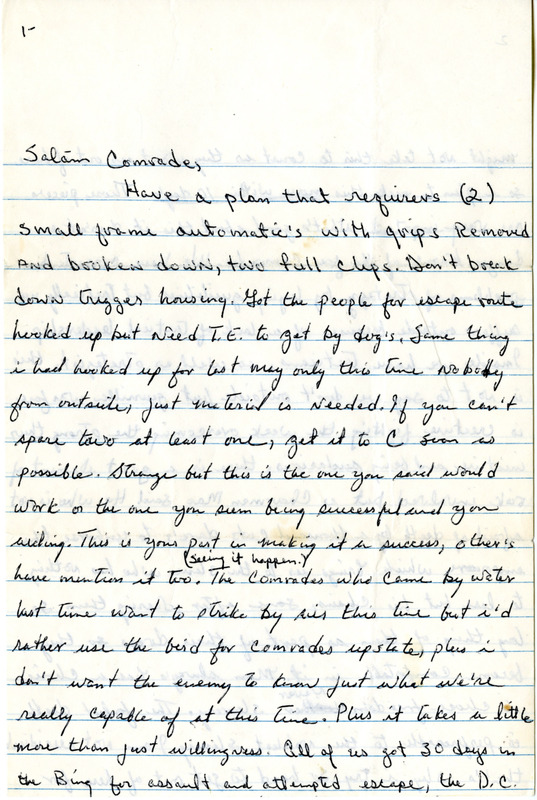
A letter from Nuh Abdul Qaiyum, who is imprisoned, to his wife Frankye Adams-Johnson (Malika). Nuh Abdul Qaiyum writes about materials he needs for an escape from prison. He explains that they are enslaved in prison, and he will choose freedom even if he dies. He ends by writing retrospectively about his personal life and the Black Panther Party.
A letter addressed to “All Black and Oppressed Third World People” from the Malcolm X Section of the Afro-American Liberation Army. The letter is a call for Black people to take up arms and take their freedom from America, even if that means “killing those who stand between us and the oppressor”
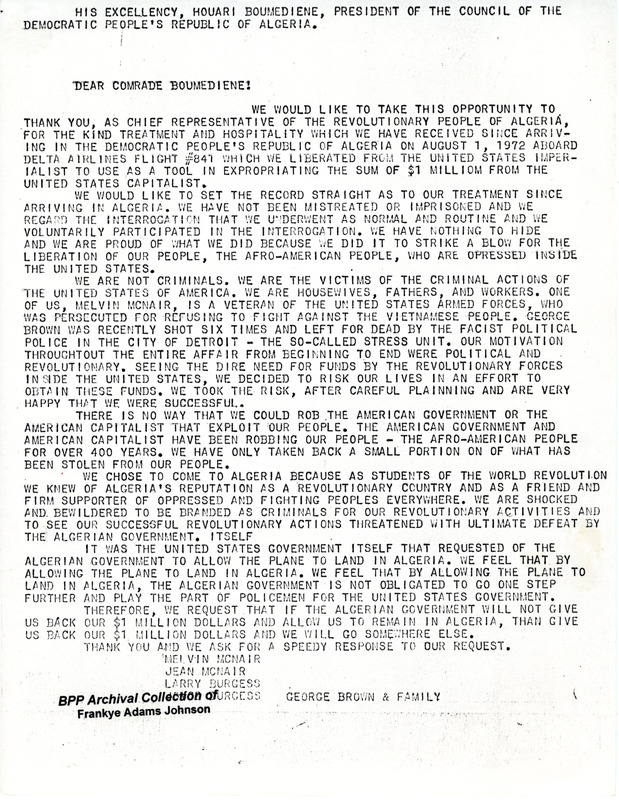
A letter to Algerian president Houari Boumediene from members of the Black Liberation Army (BLA) who had fled to his country from the United States. Melvin McNair, Jean McNair, Larry Burgess, and George Brown hijacked a plane in Miami on July 31, 1972 to seek political asylum in Algeria. The letter talks about their treatment in the country.
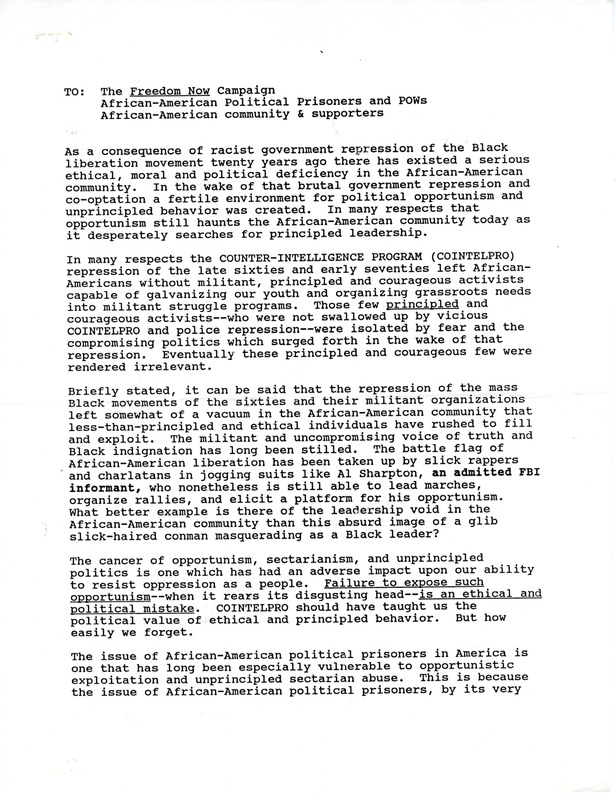
Black Panther Party leader, co-founder of the Black Liberation Army, and political prisoner Dhoruba Bin Wahd (Richard Moore) writes to the Freedom Now Campaign concerning several of the group's members exhibiting opportunistic tendencies on the issue of African-American political prisoners because of a power vacuum in the Black liberation struggle
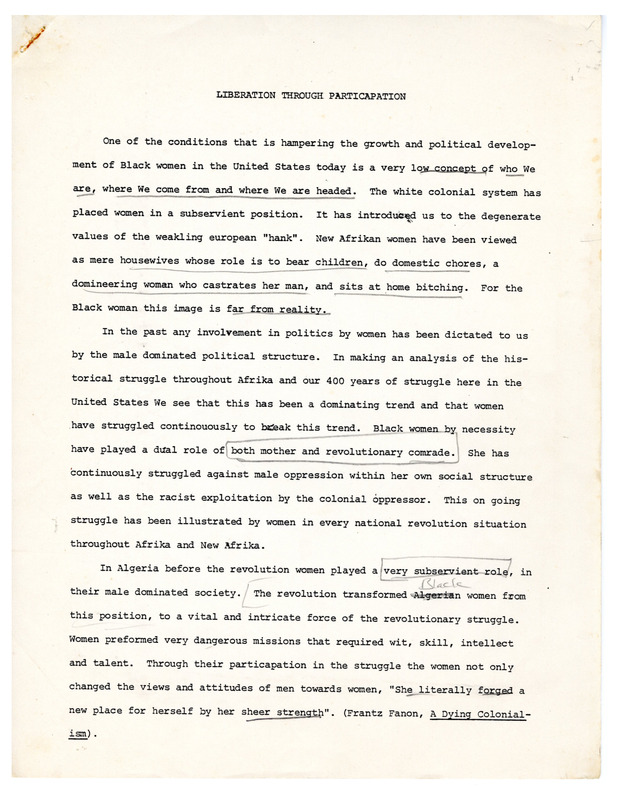
Bernice Jones (aka Safiya Bukhari) was a Black Panther Party member and vice president of the Republic of New Afrika. In this essay, she writes about the concept of New Afrikan Women and the New Afrikan Women's Organization (NAWO).
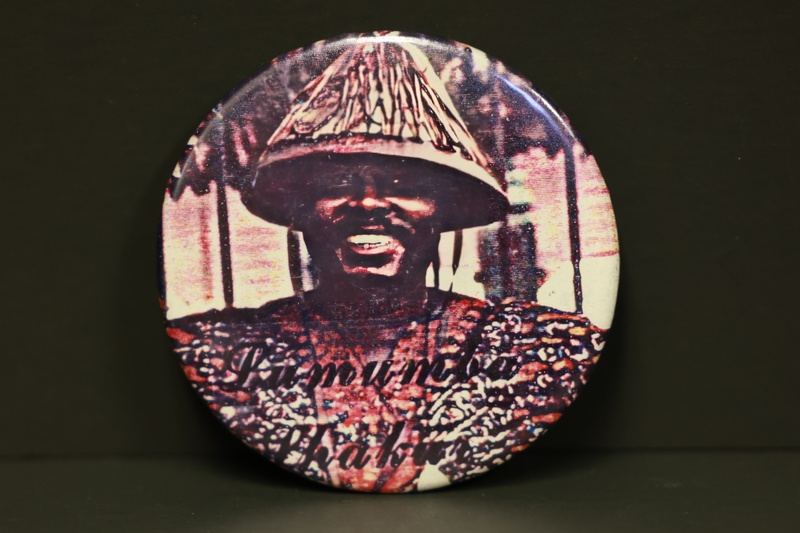
A multi-colored button with a photo of Lumumba Shakur. He was the first husband of Afeni Shakur and the two worked with the Black Panther Party in Harlem, New York, helping Black tenants organize rent strikes for adequate housing. In 1969, they were charged with conspiracy to bomb police buildings along with 19 others, known as the Panther 21.
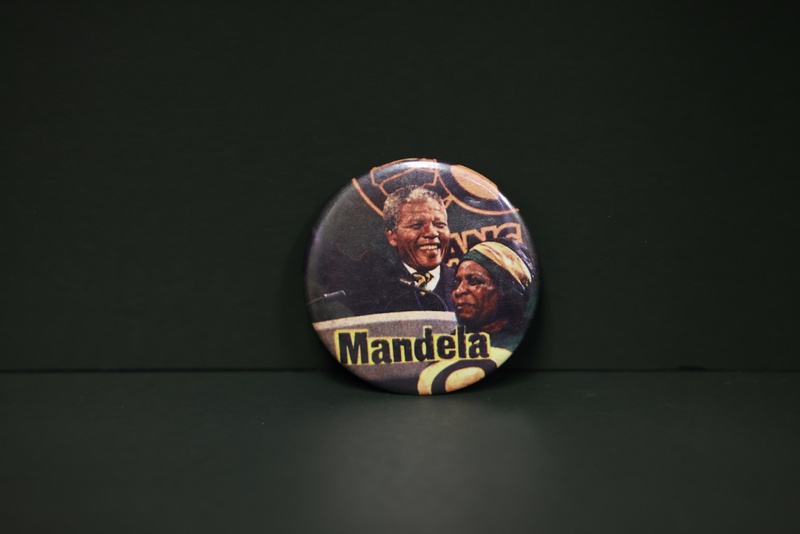
A multi-colored button with a picture of Nelson and Winnie Mandela. Nelson Mandela was an anti-apartheid activist in South Africa. After being imprisoned for 27 years due to his African Nationalist ideology, he was released in 1990 and led efforts to end apartheid. He was elected president in 1994 in the country's first fully democratic election.
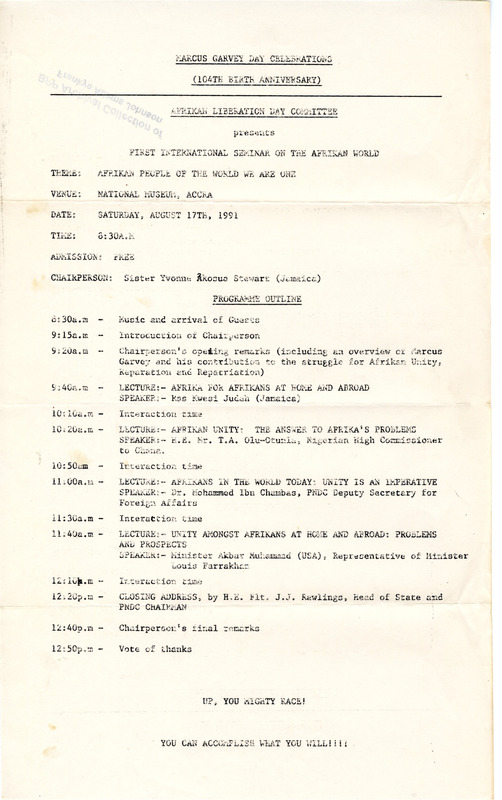
The program for the celebration of Marcus Garvey's 104th birth anniversary. Garvey was founder and first President-General of the Universal Negro Improvement Association and African Communities League (UNIA-ACL). The program is labeled as "First International Seminar on the Afrikan World" with the theme of "Afrikan people of the world we are one."
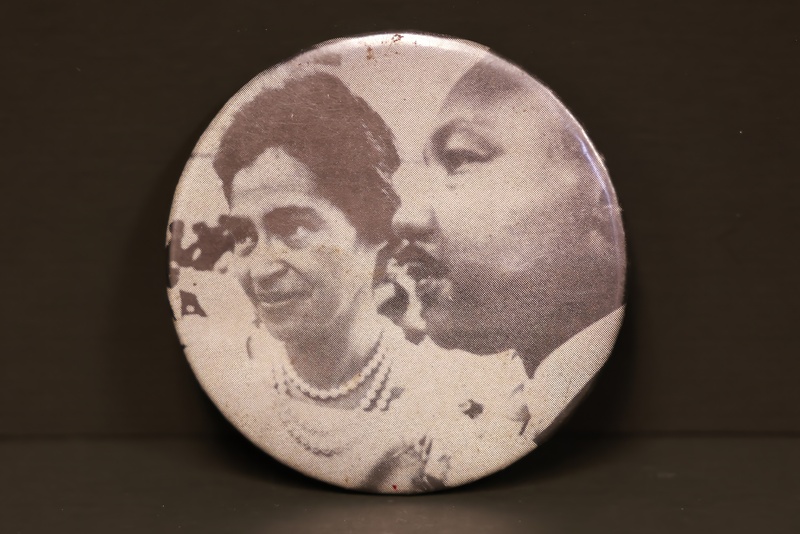
A button with a black and white photo of Dr. Martin Luther King Jr. and Rosa Parks. Dr. King was a co-founder of the Southern Christian Leadership Conference (SCLC) and remained its leader until his death. Rosa Parks’ refusal to give up her seat on a bus in 1955 sparked the Montgomery Bus Boycotts, which were led by Dr. King.
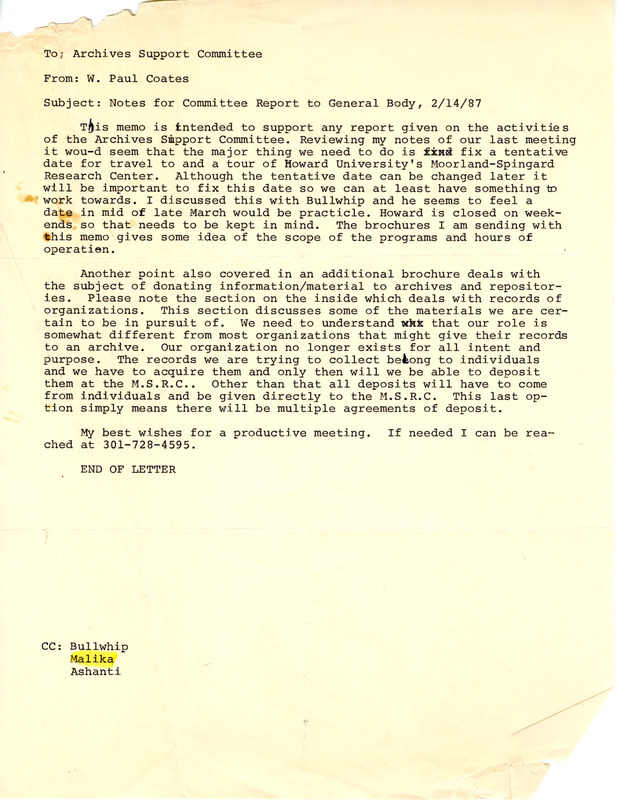
A memo from W. Paul Coates of the Black Panther Foundation to the Archives Support Committee about a proposed upcoming trip to Howard University's Moorland-Spingarn Research Center. Coates writes that the role of the foundation is to acquire records from individual members and then get those records into the archive at the research center.
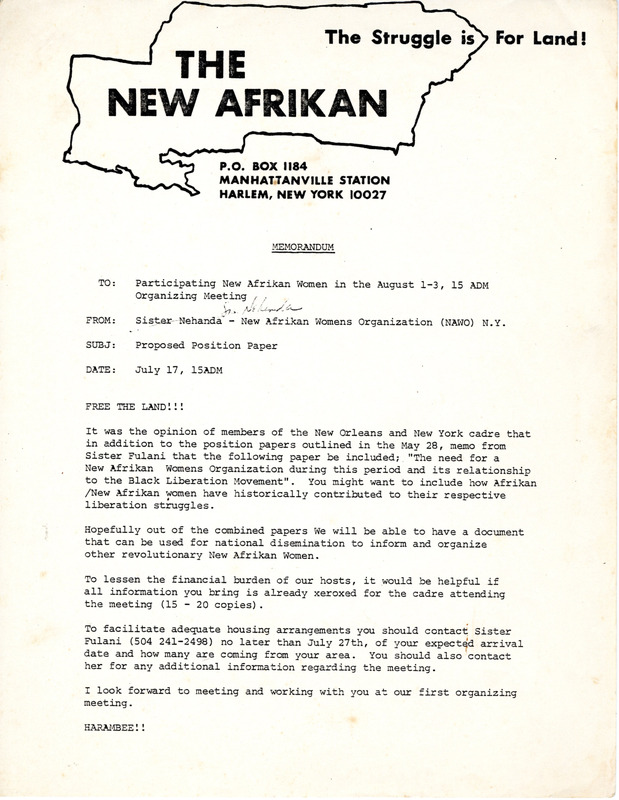
A memo from Black revolutionary woman Nehanda Abiodun, who was exiled to Cuba in 1982, suggesting that a document be created that can be used for dissemination to inform and organize other revolutionary New Afrikan Women around the country. The heading reads: “The New Afrikan: The Struggle is for Land!” The memo is dated July 17, 15 ADM.
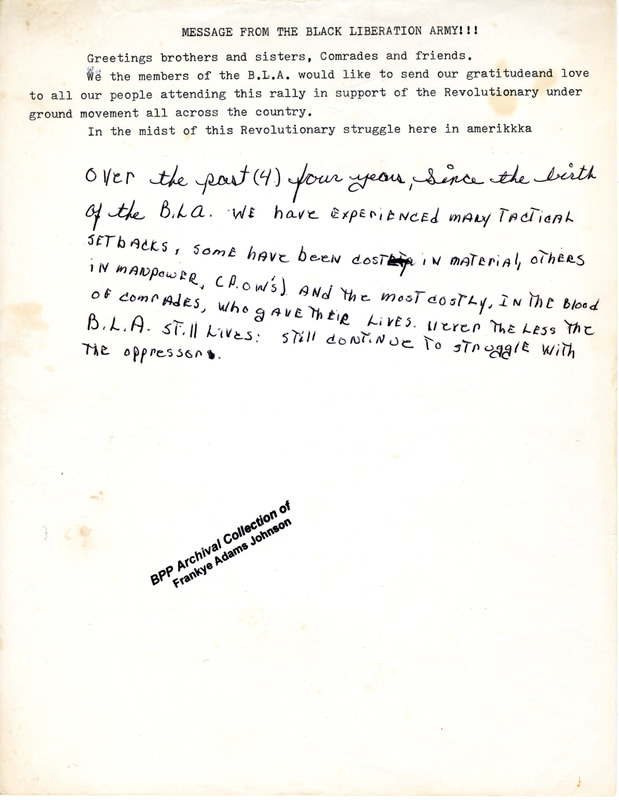
Brief greetings given on behalf of the Black Liberation Army (BLA) to people attending a rally in support of revolution. With handwritten notes by Frankye Adams-Johnson (Malika) about some of the tactical setbacks the BLA has experienced, the most costly of which being the loss of people who gave their lives to the struggle.
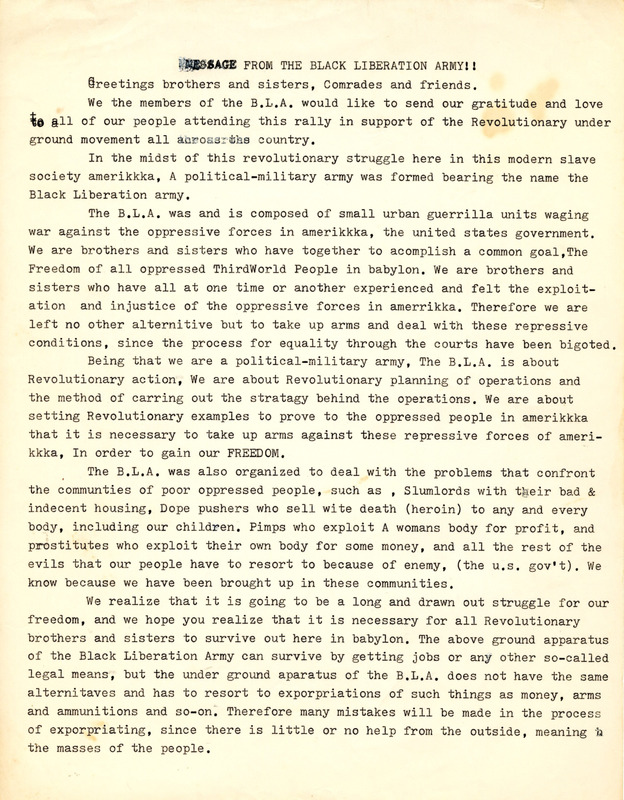
A message from the Black Liberation Army (BLA) to brothers and sisters, comrades and friends attending a rally. The message briefly outlines the history and tenets of the organization, including taking up arms against the oppressive government as well as combatting ills in the community such as slumlords, drug pushers, and pimps.
A message declaring the revolutionary intentions of the Black Liberation Army (BLA). The author sets up a dystopian military state scene and writes that revolutionaries must be prepared to do anything, including infiltration, violence, and more. The author also writes that those who die for the cause of revolution must be celebrated, not mourned.
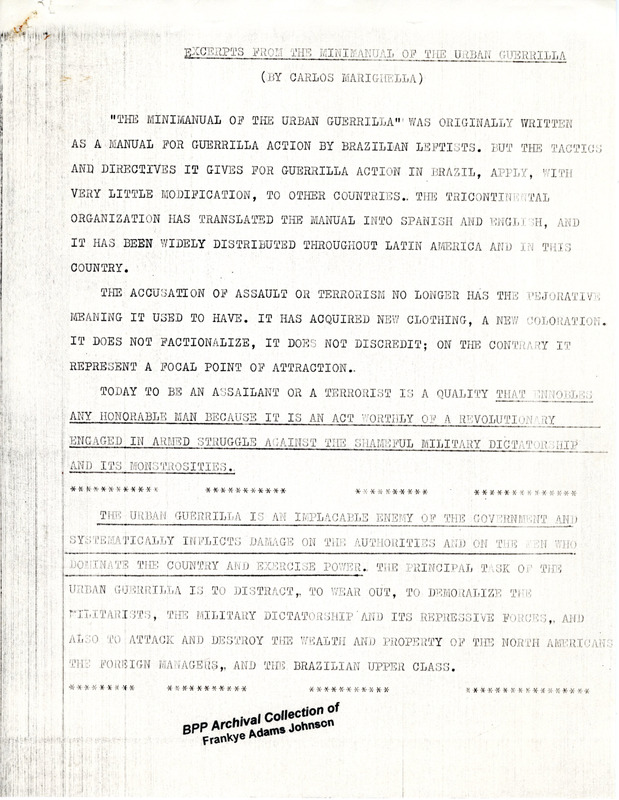
Excerpts from Carlos Marighella's Minimanual of the Guerrilla. It lays out tactics for struggle against an oppressive state. Marighella, a Brazilian Marxist–Leninist revolutionary, published the book in 1969 and it became popular in revolutionary circles, including within Black Nationalistic circles in the United States.
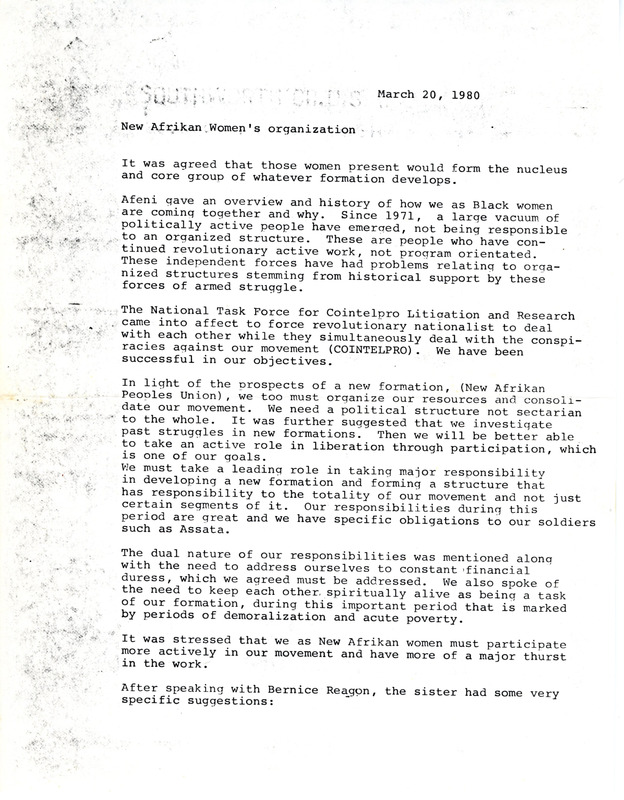
Minutes from a meeting of the New Afrikan Women’s Organization. Organizational plans to move forward with the new organization are discussed, especially in light of the vacuum left since 1971 in radical movements. Finances, future conferences, and methods of operation were also discussed in the meeting.
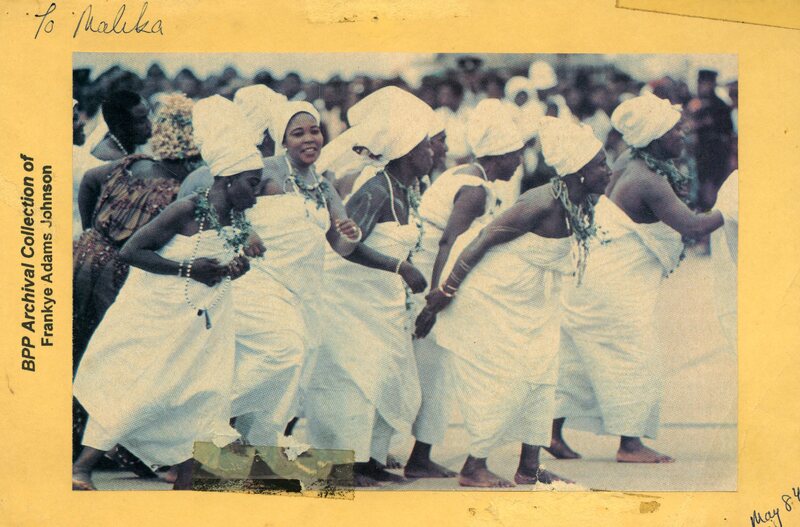
On the front of the Mother’s Day card there is a picture of a group of women. On the back of the card, Black Liberation Army (BLA) member Ashanti Alston expresses his Mother's Day wishes to Frankye Adams-Johnson (Malika), and he says that one day may come where there is no struggle because she deserves so much more from life.
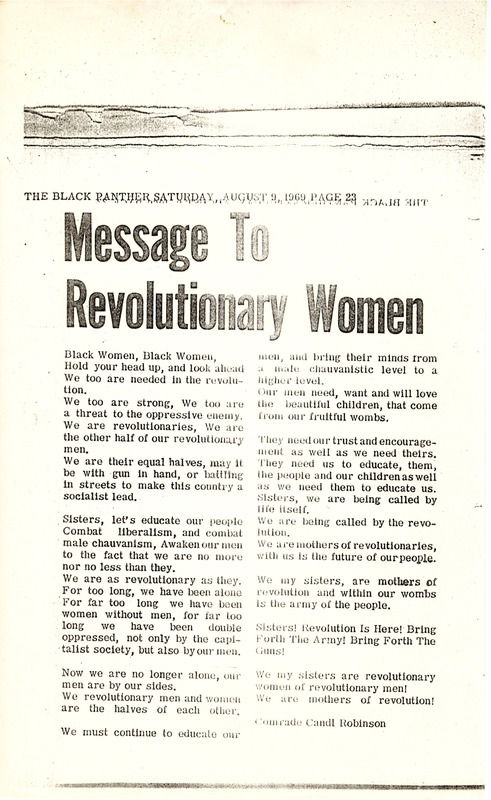
A newspaper article by Emma Simms of New Haven, Connecticut, in The Black Panther about the free breakfast program in New Haven. She writes on behalf of “the welfare moms of New Haven,” saying that welfare money doesn’t provide enough money for adequate food for children and the Black Panthers are filling that void in the community.
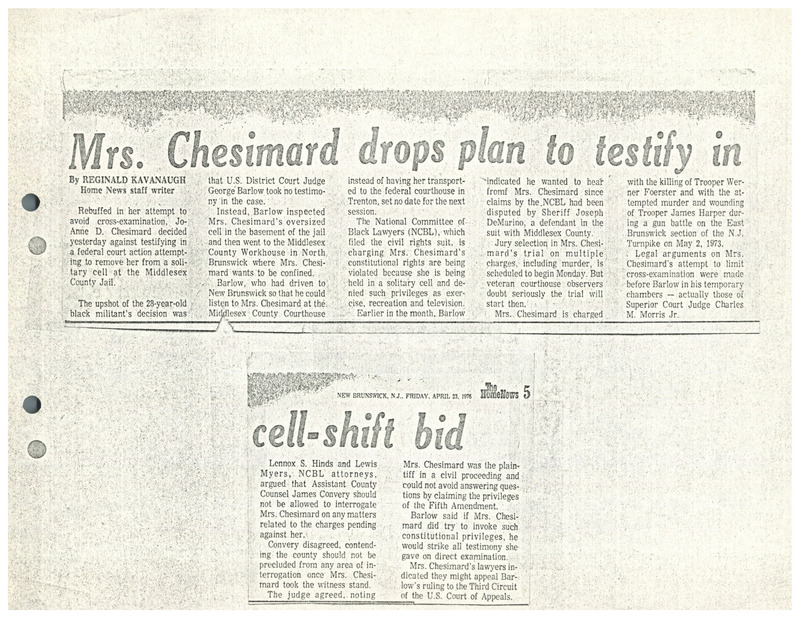
A newspaper article from The Home News about Assata Shakur (JoAnne Chesimard) dropping her plan to testify in her attempt to get moved to a larger cell while in Middlesex County to stand trial for the May 1973 killing of a state trooper. Shakur was convicted in 1977 of the killing and escaped prison in 1979.
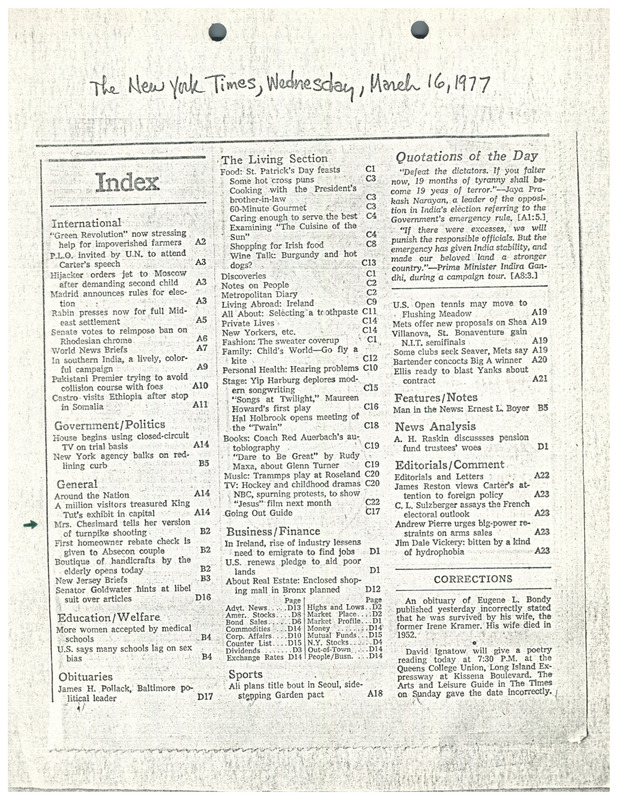
A newspaper article from The New York Times detailing the testimony Assata Shakur (JoAnne Chesimard) gave during her trial for the 1973 killing of a state trooper. In her testimony, she denied shooting anyone, or possessing a firearm, and gave her account of what happened that day.
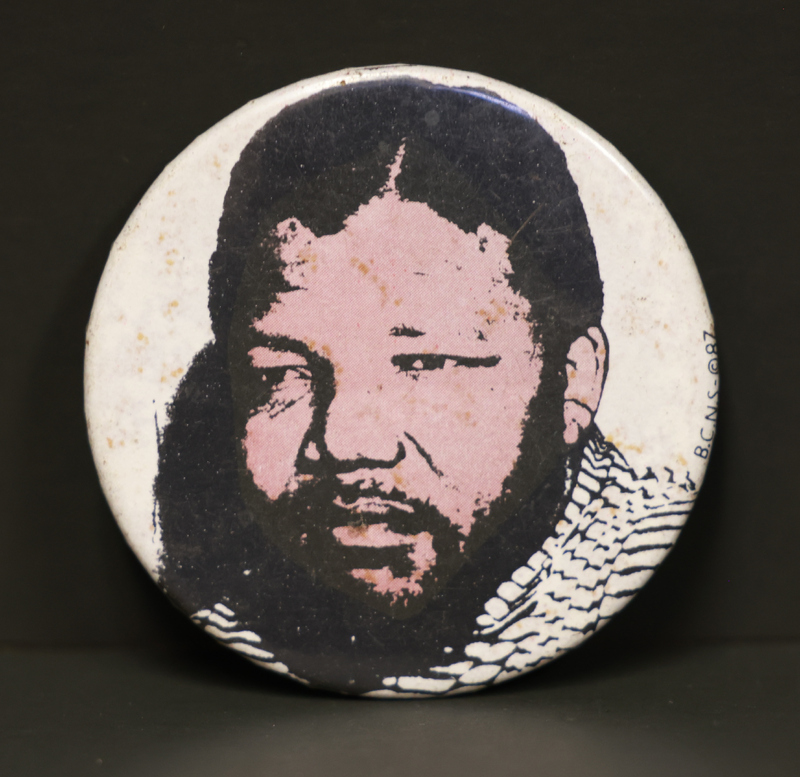
A button with a sketch of a photo of Nelson Mandela. Nelson Mandela was an anti-apartheid activist in South Africa. After being imprisoned for 27 years due to his African Nationalist ideology, he was released in 1990 and led efforts to end apartheid. He was elected president in 1994 in the country's first fully democratic election.
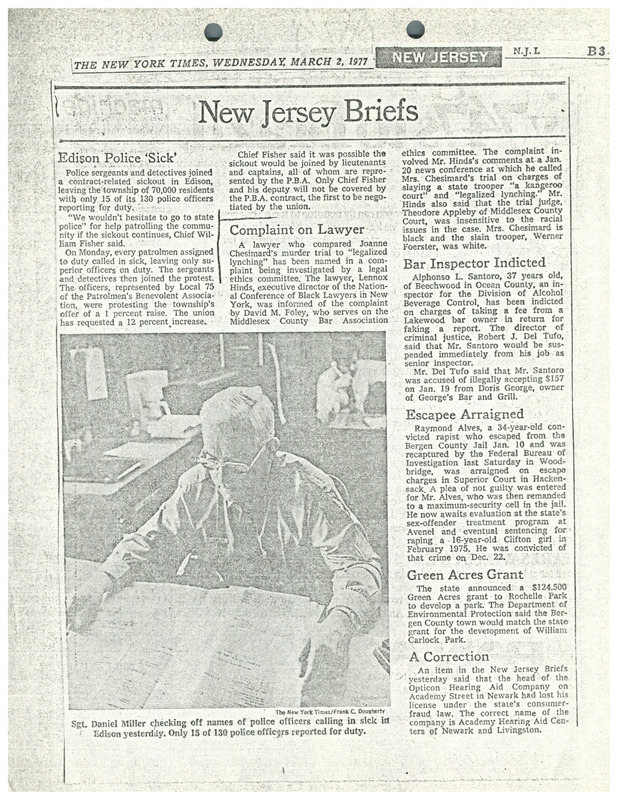
A news blurb from The New York Times about Lennox Hinds, president of the National Conference of Black Lawyers, speaking out against his critics for his support of Assata Shakur (JoAnne Chesimard), in her trial for the 1973 killing of a state trooper, after being cited by The Ethics Committee of the Middlesex County Bar Association.
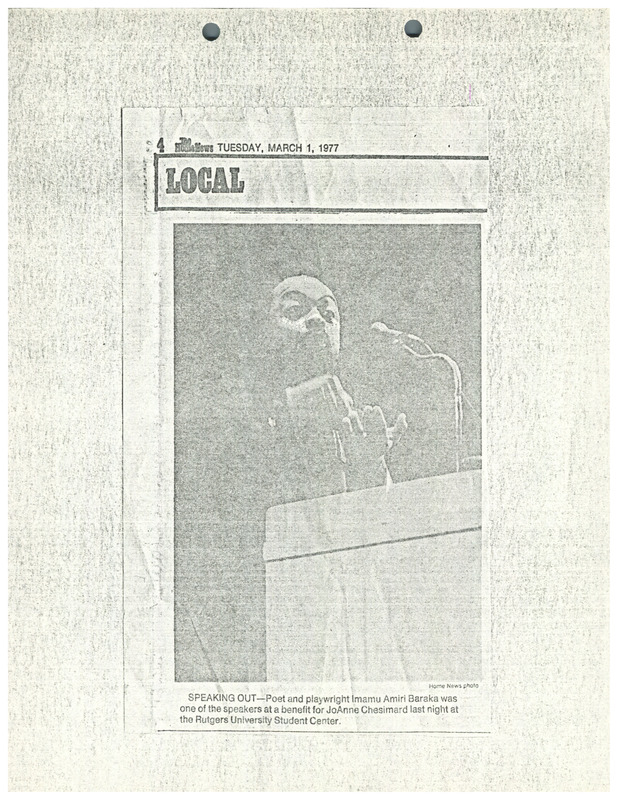
A photograph from the newspaper The Home News of poet and playwright Amiri Baraka speaking at a benefit for Assata Shakur (JoAnne Chesimard) at the Rutgers University Student Center in New Jersey. Shakur was on trial for the 1973 killing of a state trooper. Baraka was one of several speakers speaking on Shakur’s behalf at the benefit.
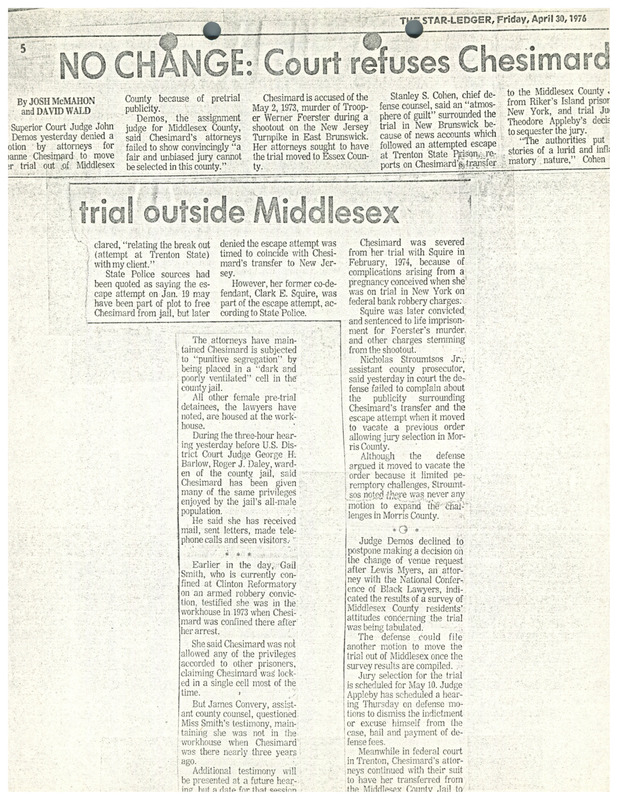
A newspaper article from The Star Ledger about Superior Court Judge John C. Demos denying a motion to move the murder trial of Assata Shakur (JoAnne Chesimard) for the 1973 killing of a state trooper out of Middlesex County because of the defense's inability to show that an unbiased jury couldn't be selected.
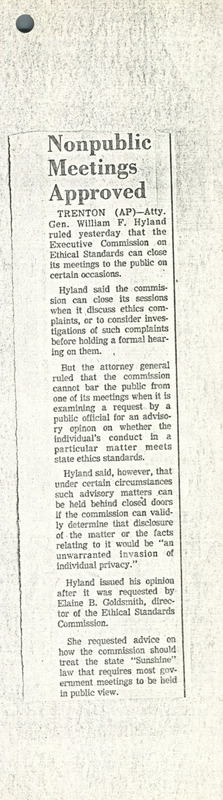
A newspaper article from the Asbury Park Press about Attorney General William F. Hyland ruling that the Executive Commission on Ethical Standards can close its meetings to the public on certain occasions. This article pertains to hearings in the trial of Assata Shakur (JoAnne Chesimard) for the 1973 killing of a state trooper.
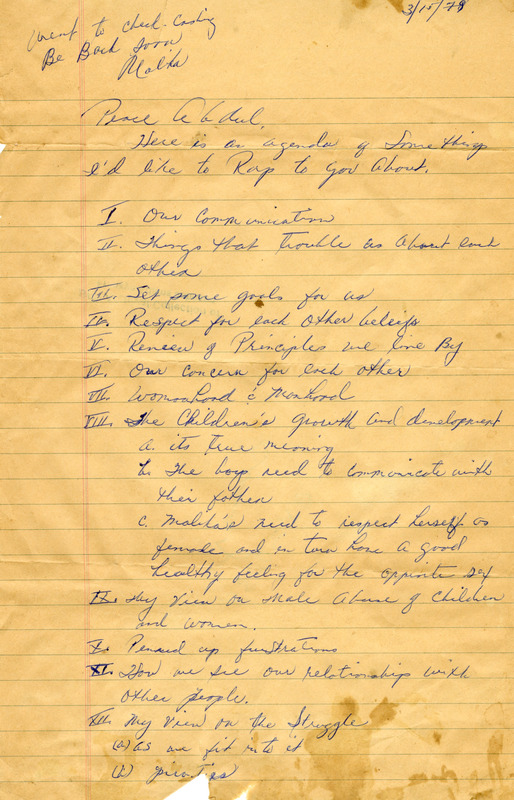
A note from Frankye Adams-Johnson (Malika) to her husband, Nuh Abdul Qaiyum, who was sentenced to prison in 1975 for a 1971 Black Liberation Army (BLA) connected shooting of police officers in New York. The note outlines some points to a conversation she wants to have with him about their life, their love, their beliefs, and the struggle.
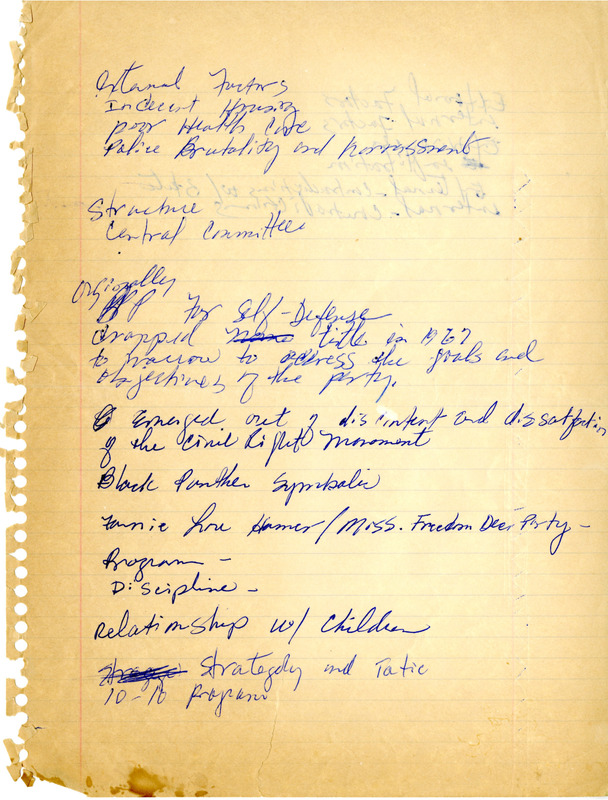
Three pages of notes about internal and external factors that led to the development of the Black Panther Party. Some of those factors included indecent housing, poor healthcare, and police brutality and harassment.
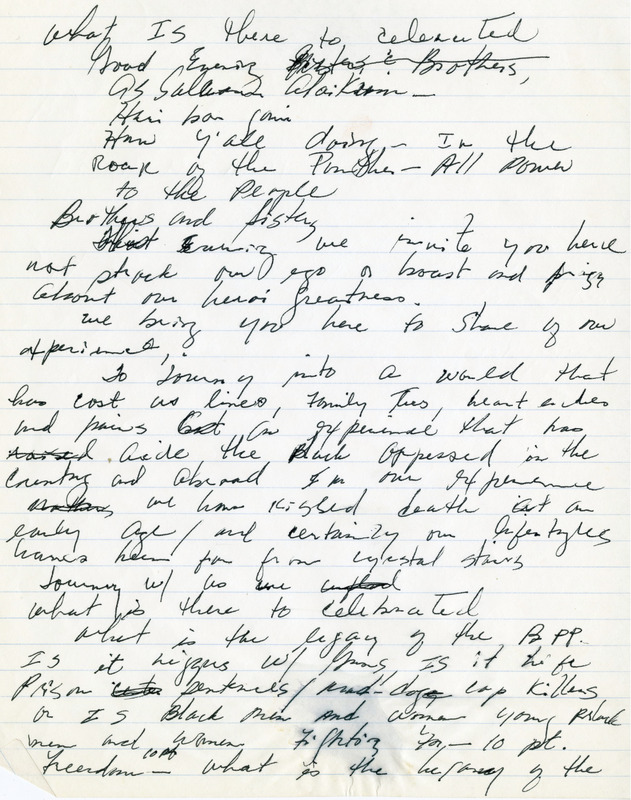
Notes and a draft of a speech by Frankye Adams-Johnson (Malika) reflecting on the Black Panther Movement. Page one outlines an opening to the speech and its purpose. The second page explores the use of education in the fight for liberation. The last pages cover government agencies and the decline of the Party.
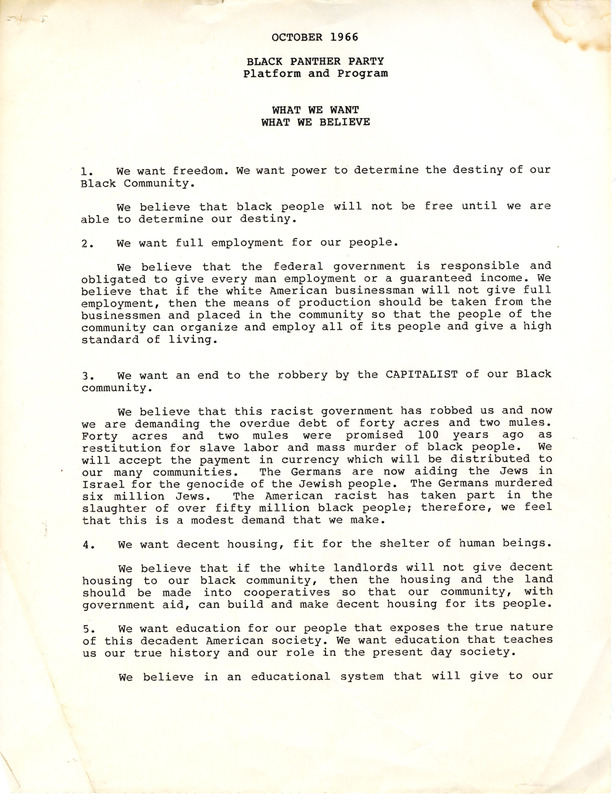
A copy of the Black Panther Party Ten Point Program. The Ten Point Program was created in 1966 by the founders of the Black Panther Party, Huey P. Newton and Bobby Seale. It serves as both the ideological underpinning of the Party as well as a day-to-day guide to living for members.