Frankye Adams-Johnson Black Panther Party Collection
Title
Frankye Adams-Johnson Black Panther Party Collection
Date Modified
2025-12-12
Description
Frankye Adams-Johnson is a former English Professor at Jackson State University and former active member of the Black Panther Party for Self-Defense in New York City, where she served as an officer in the New York State Chapter. This collection, created or collected during her involvement in the Black Panther Party, consists of personal journal notebooks, correspondence, newspaper articles, fliers, meeting documents and her collection of political and movement buttons.
Curated By
Garrad Lee
Contributing Institution
Jackson State University
About This Record
The HCAC public history focused digital archive cataloging is an ongoing process, and we may update this record as we conduct additional research and review. We welcome your comments and feedback if you have more information to share about an item featured on the site, please contact us at: HCAC-DigiTeam@si.edu
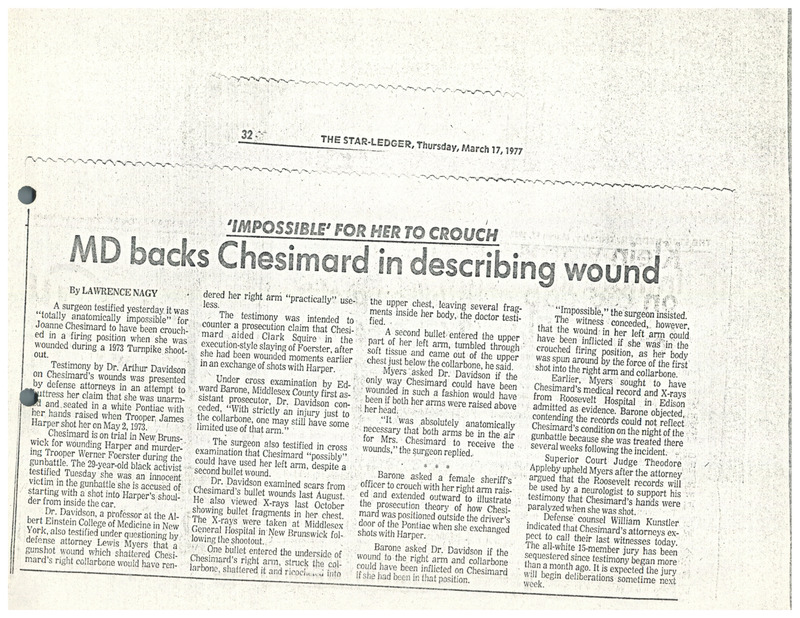
A newspaper article from The Star-Ledger about the testimony of defense witness Dr. Arthur Davidson during the trial of Assata Shakur (JoAnne Chesimard) for the 1973 killing of a state trooper. He testified about the wounds sustained by Shakur and argued that she could not have shot from the crouching position due to her wounds from the shootout.
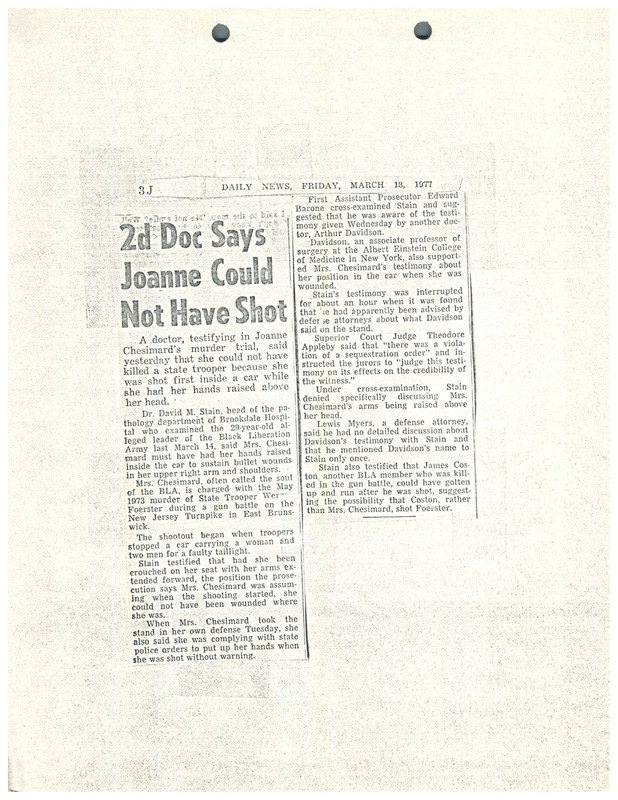
A newspaper article from Daily News about the testimony of defense witness Dr. David Spain during the trial of Assata Shakur (JoAnne Chesimard) for the 1973 killing of a state trooper. He testified about the wounds she sustained, arguing that she couldn’t have shot from a crouching position due to the position of her wounds from the shootout.
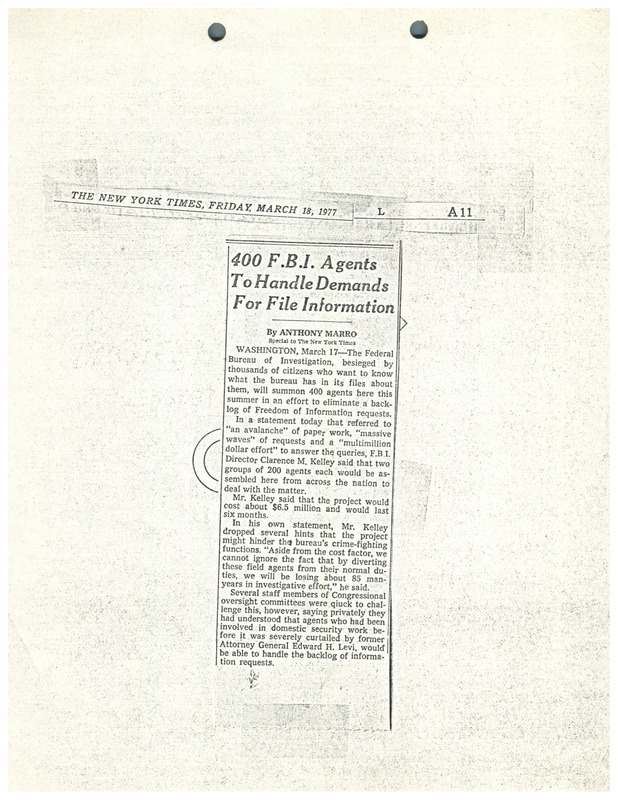
A newspaper article from The New York Times about the FBI assigning 400 agents to help eliminate a backlog of Freedom of Information requests. The agents will have a $6.5 million budget and it will take about 6 months to clear the thousands of requests that the FBI had received, causing the backlog of paperwork.
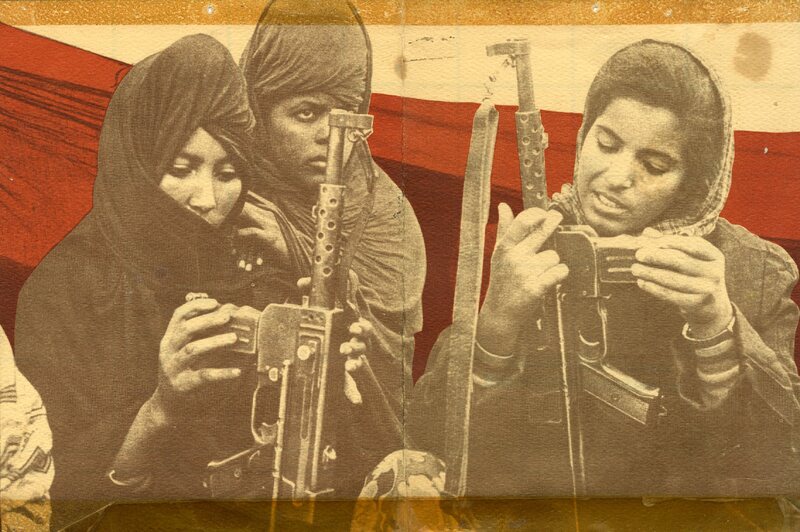
A calendar from October (year unknown). Picture of Zimbabwe liberation fighters on the front. The calendar marks the dates of the People's Republic of China's founding, the formation of the Patriotic Front (Zimbabwe), and the USSR October Revolution.
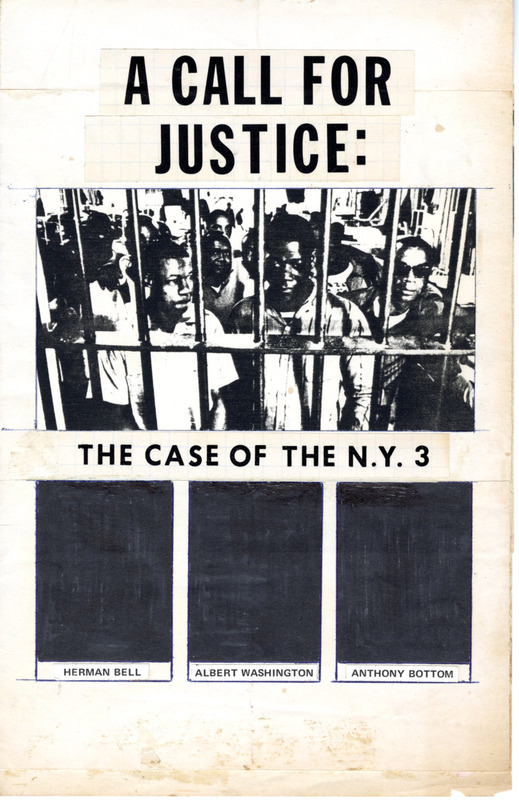
A handmade flier with a picture of prisoners behind bars. The pictures of Herman Bell, Albert Washington, and Anthony Bottom have been blacked out. The three men, known as the New York 3, were Black Panther Party and Black Liberation Army (BLA) members who were arrested and convicted of the May 21, 1971, killing of two police officers in Harlem.
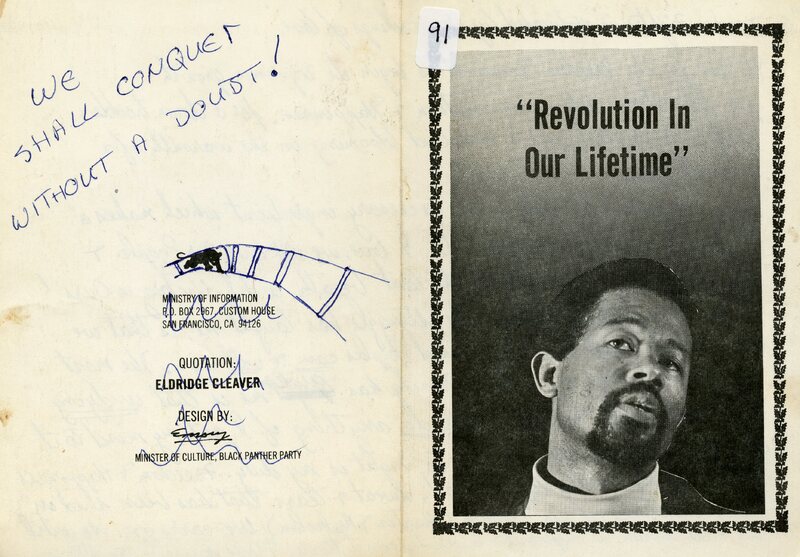
On the card is a picture of Eldridge Cleaver with the quote "Revolution in our lifetime." The sender stresses the need for a movement to start immediately that will instill love and self-determination in the people. They explain that it is out of their love for the People that they fight as a revolutionary, and that they will win.
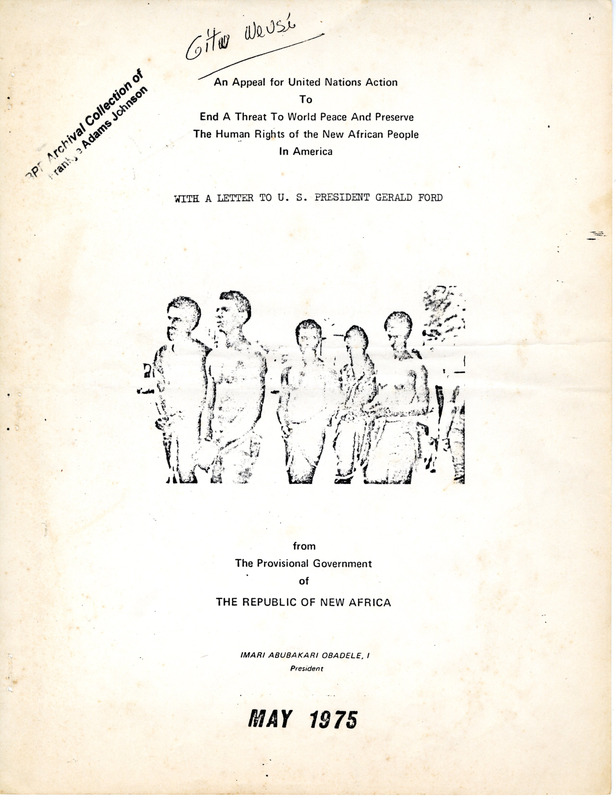
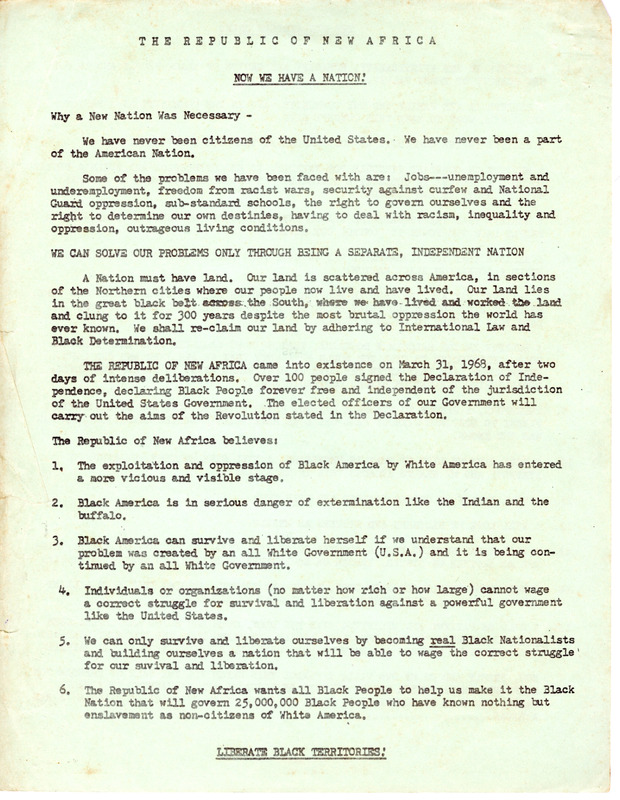
A Collection of Republic of New Africa Documents intended to persuade the United Nations to recognize the Republic of New Africa (RNA). The RNA was founded in 1968 as a Black nationalist and Black separatist movement. The documents include maps of the RNA, a memorandum to the United Nations, and a letter to President Gerald Ford.
A collection of The Republic of New Afrika documents: a memo titled “Now We Have a Nation!” explaining the necessity of a new nation for Black people in the United States; The New Afrikan Creed, a 15 point list of beliefs of the Republic of New Afrika; and a rewriting of the Declaration of Independence for the Republic of New Afrika.
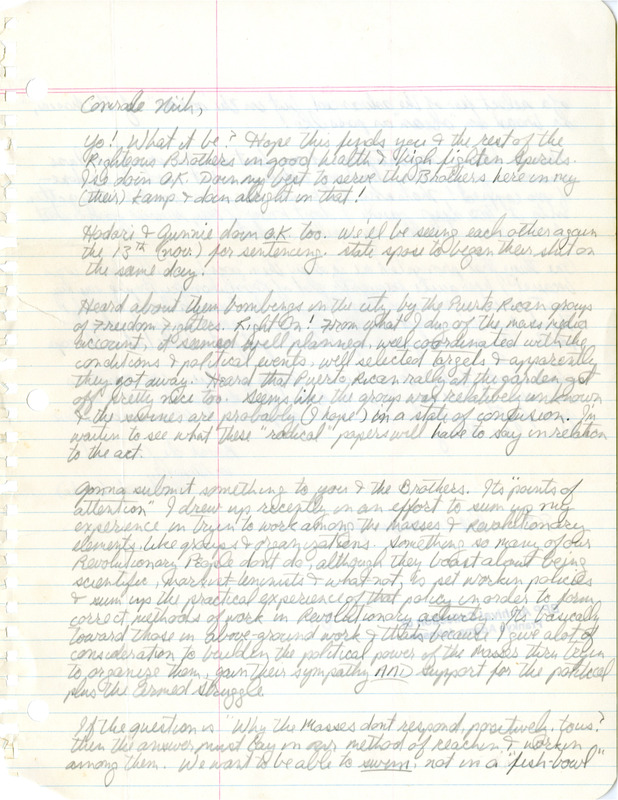
A letter from Ashanti Alston, a Black Liberation Army (BLA) member who was imprisoned for 11 years for a robbery to raise money for the BLA, to Nuh Abdul Qaiyum. He has come up with "points of attention" for the revolutionaries, and he wants Nuh Abdul Qaiyum and the other members to critique them.
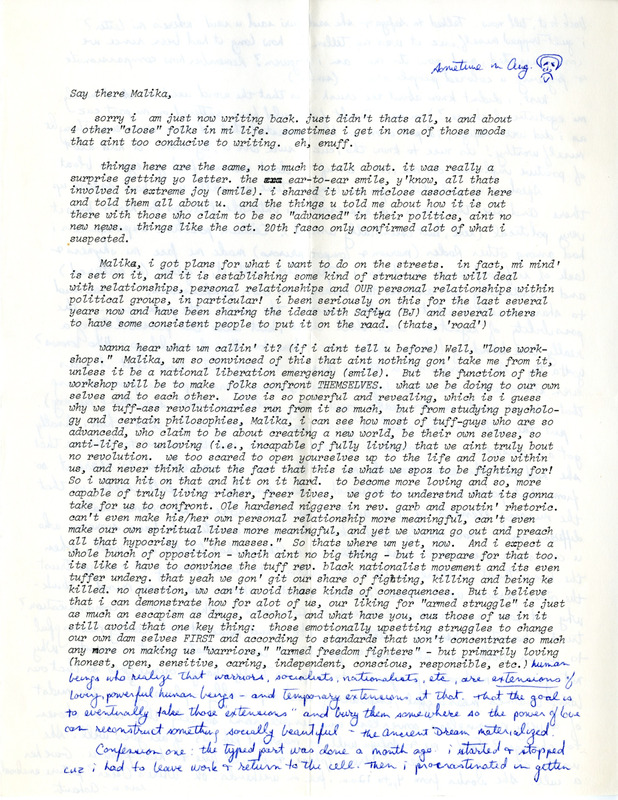
Ashanti Alston, a Black Liberation Army (BLA) member who was imprisoned for 11 years for a robbery to raise money for the BLA, writes that he would like to set up love workshops for revolutionaries to make them better leaders after seeing the positive impact that being open and loved has had in his life. The letter is dated “sometime in August.”
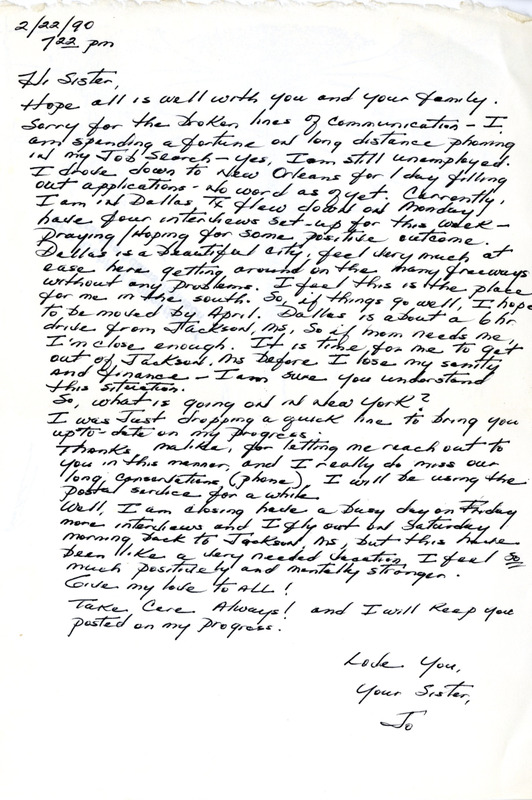
In this letter, Jo, Frankye Adams-Johnson (Malika)'s sister, is writing to update her with the extensive traveling she's been doing in her search for different employment opportunities. She also addresses her communication limitations.
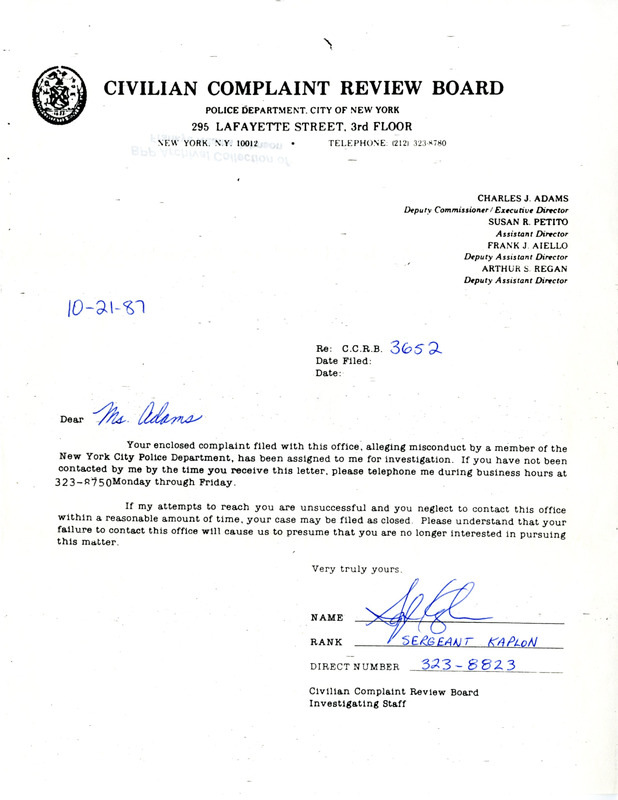
A letter from Sergeant Kaplon of the City of New York Police Department to Frankye Adams-Johnson (Malika) informing her that he will be handling her allegation of misconduct by the police. There is also a copy of the complaint where Frankye Adams-Johnson (Malika) witnessed seeing a police officer assaulting an unknown Black male.
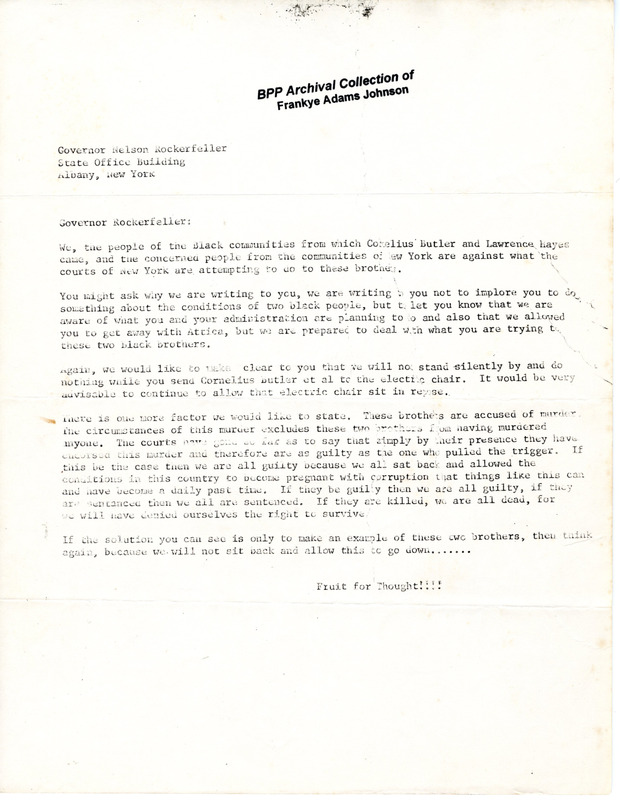
A letter to New York Governor Nelson Rockefeller on behalf of Cornelius Butler and Lawrence Hayes, who were being tried for murder. The men were convicted to the death penalty on April 11, 1972, for their role in the hold-up of a convenience store and the murder of a police officer. Supporters contend that neither of the men fired the shots.
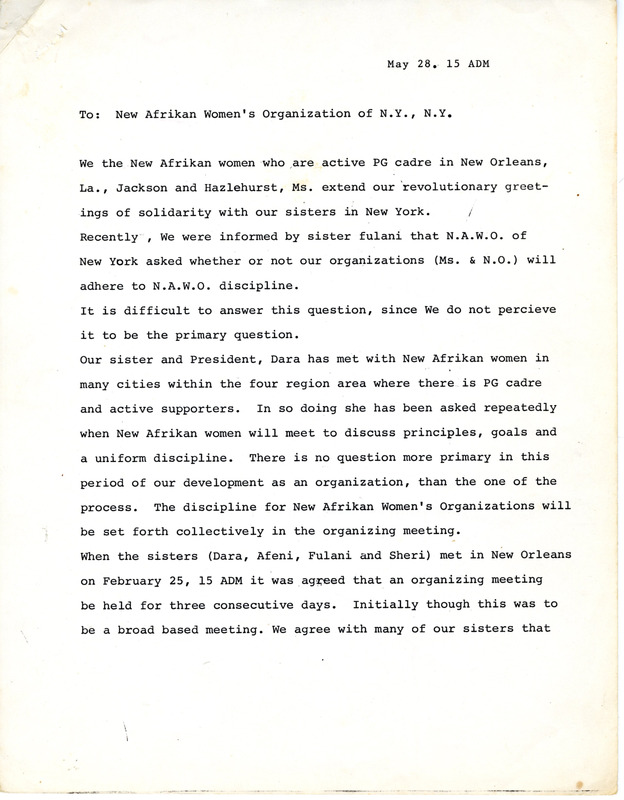
A letter to the New Afrikan Women's Organization (NAWO) of New York from the women in the organization representing New Orleans, Louisiana, and Hazlehurst and Jackson in Mississippi. The letter is dated “May 28, 15 ADM” and signed by NAWO member Fulani Sunni-Ali. She calls for a three day retreat for organizational meetings.
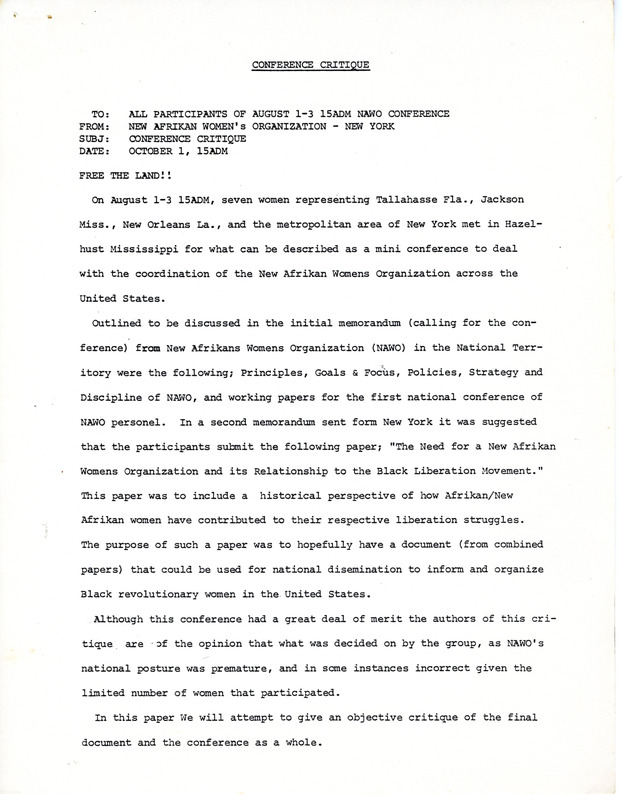
A letter to the participants of the New Afrikan Women's Organization (NAWO) conference on August 1-3 from the NAWO. The letter critiques the final paper that was produced by the conference as well as the conference as a whole, saying NAWO’s national posture was incomplete because of the limited number of women who participated in the conference.
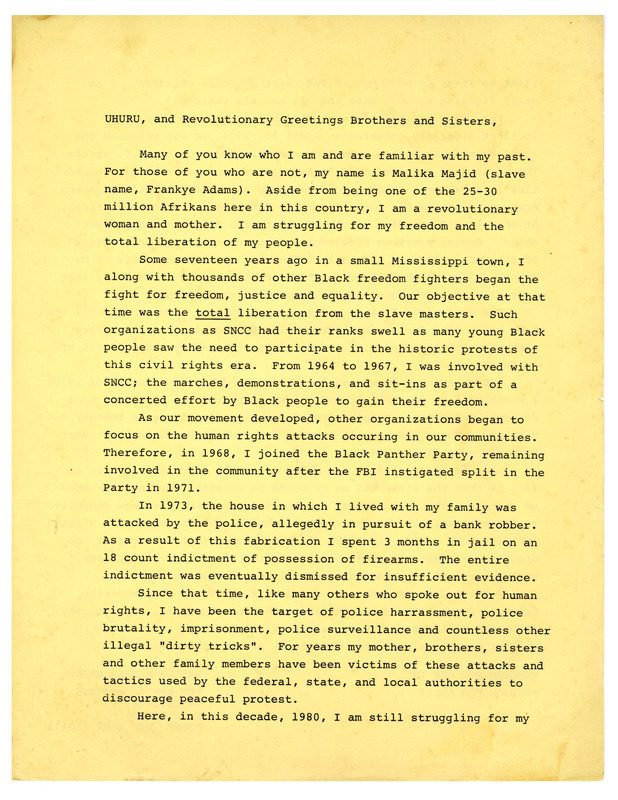
Frankye Adams Johnson (Malika) writes this letter to her supporters outlining the criminal charges she is facing in 1980 stemming from a 1974 arrest. She is asking for any support that may be given to her during this time.
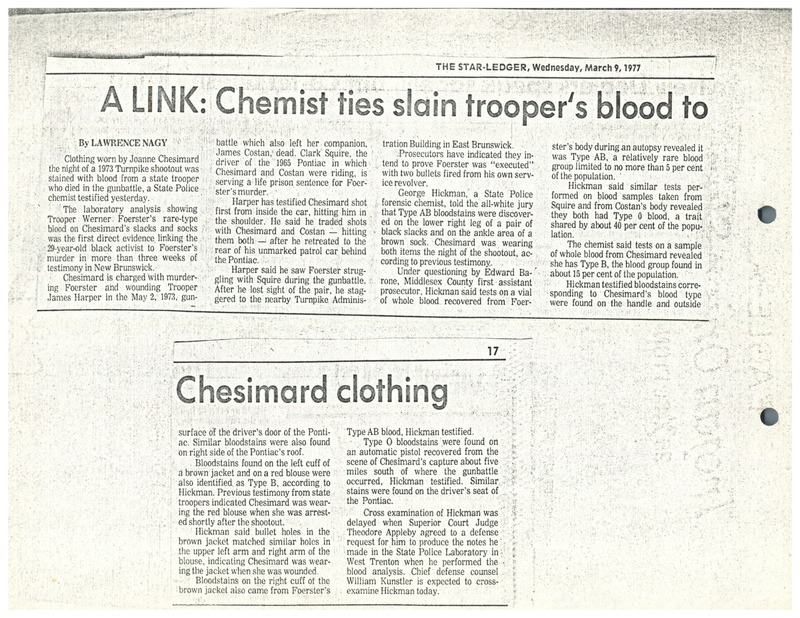
A newspaper article from The Star Ledger about evidence in the trial of Assata Shakur (JoAnne Chesimard) for the 1973 killing of a state trooper. Prosecution witnesses showed that blood found on the clothes of Assata Shakur (JoAnne Chesimard) matched the rare AB blood type of the slain state trooper.
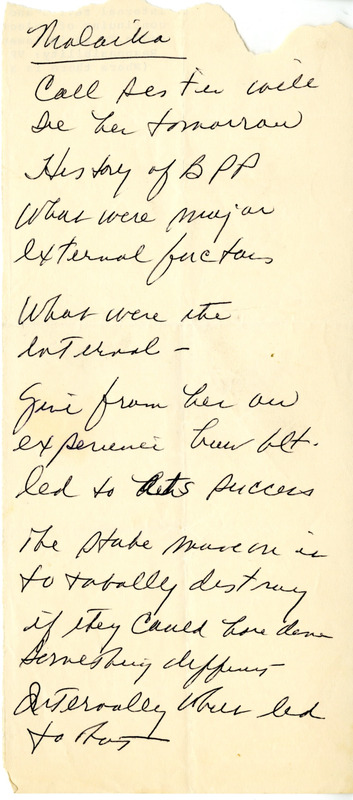
A list of questions about the history of the Black Panther Party written by an unknown author. The questions ask about the internal and external factors that led to their development. There are also questions referring to the success of the Party and doing things differently.
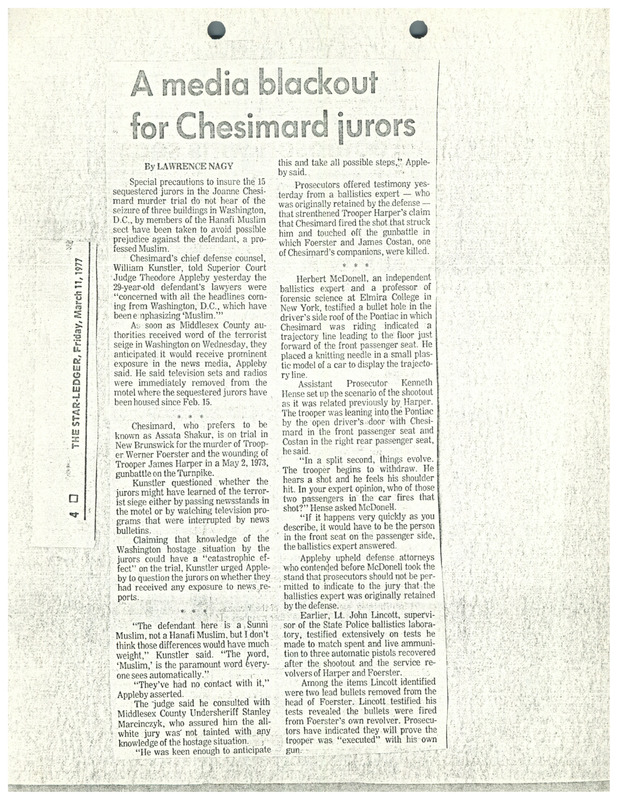
A newspaper article from The Star Ledger about the 15 sequestered jurors in the Assata Shakur (JoAnne Chesimard) trial for the 1973 killing of a state trooper being given a media blackout after the seizure of three buildings in Washington, D.C. by the Hanafi Muslim sect to avoid possible prejudice against Shakur, a professed Muslim.
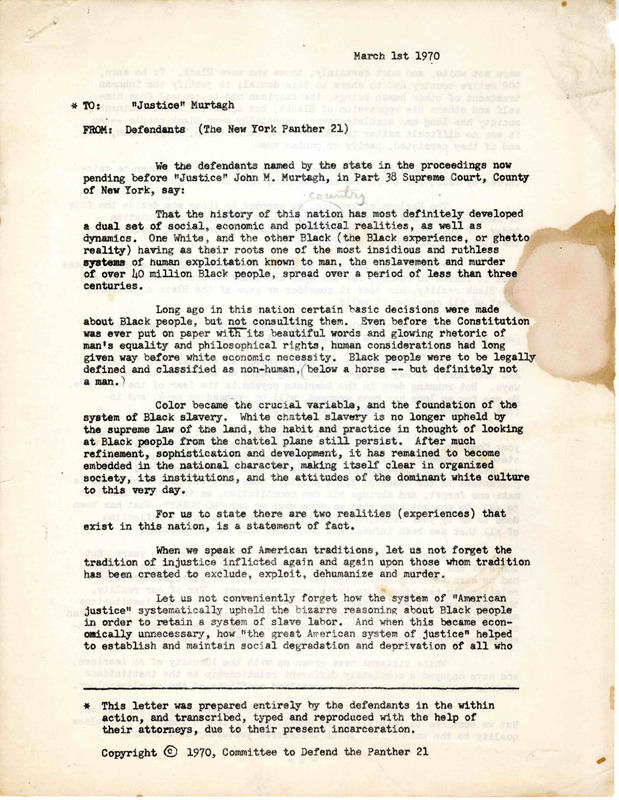
A letter from the Panther 21 to New York State Supreme Court Justice John M. Murtagh. The Panther 21 was a group of Black Panthers who were on trial for alleged bombing attacks against three police stations in New York City in 1969. The letter is an indictment of the American justice system where the 21 Black Panthers find themselves on trial.
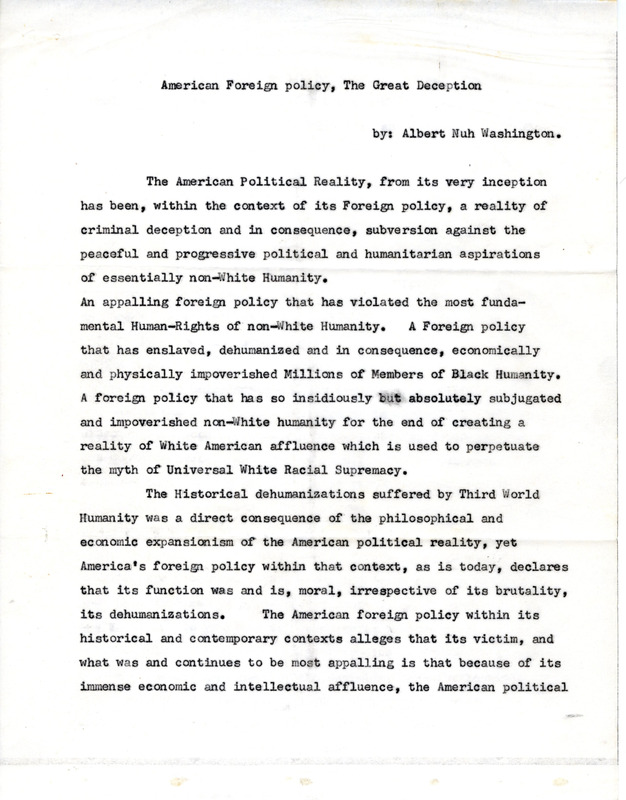
A paper by Albert Nuh Washington (Nuh Abdul Qaiyum) arguing that America's foreign policy serves the larger function of the subjugation of non-white people in the United States. Nuh Abdul Qaiyum was sentenced to prison in 1975 for a 1971 Black Liberation Army (BLA) connected shooting of police officers in New York,
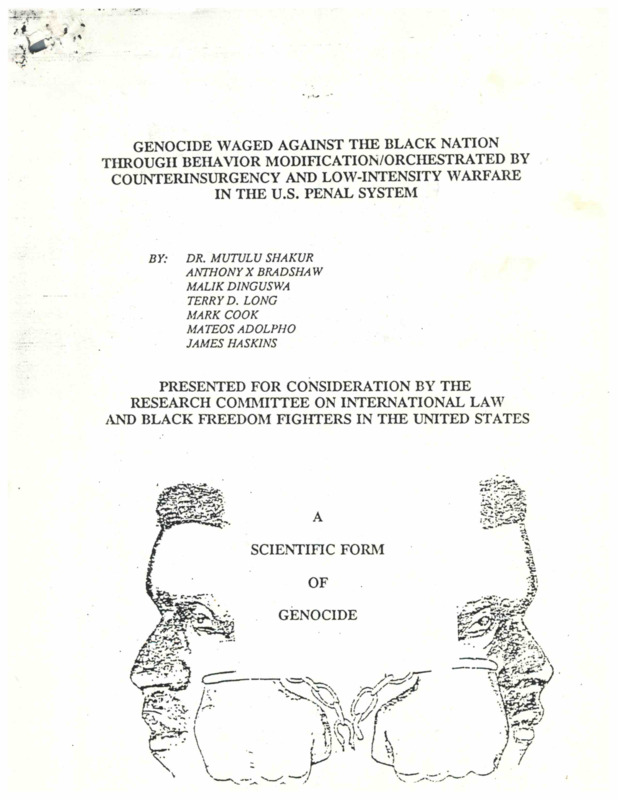
A paper by a team of Black prisoners who experienced behavior modification in prison. In this paper they argue that Black prisoners being given behavior modification is a form of genocide against Black people. The paper was presented for consideration by the Research Committee on International Law and Black Freedom Fighters in the United States.
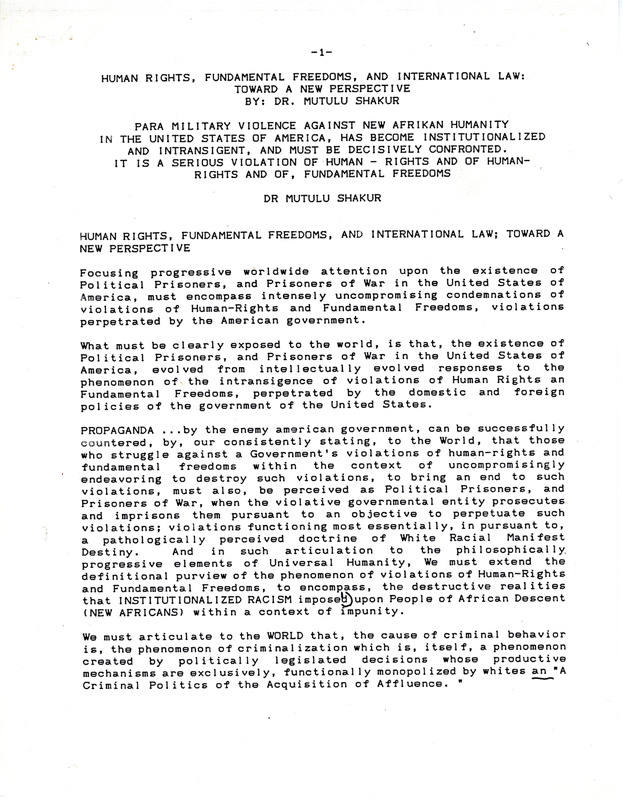
A paper by Dr. Mutulu Shakur that argues the existence of political prisoners reveals the violations of human rights perpetuated by the United States government against Black people. Dr. Shakur wrote this from prison, where he was serving a 60 year sentence for his role in a Black Liberation Army (BLA) led robbery in 1981.
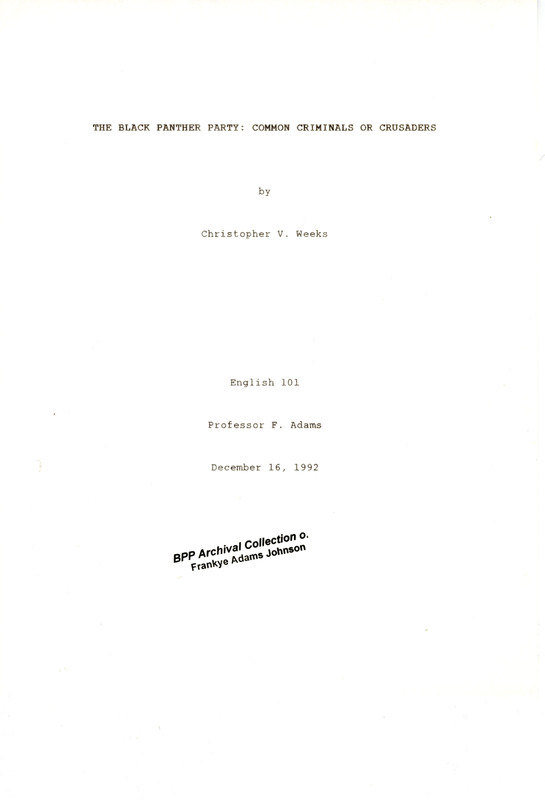
A paper by a student in Frankye Adams-Johnson (Malika)'s English 101 class about the history of the Black Panther Party. The author argues that the members of the Black Panther Party were not born revolutionaries, but were forced into this mind set by the oppressive ways of American society and deemed all of their actions necessary for liberation.
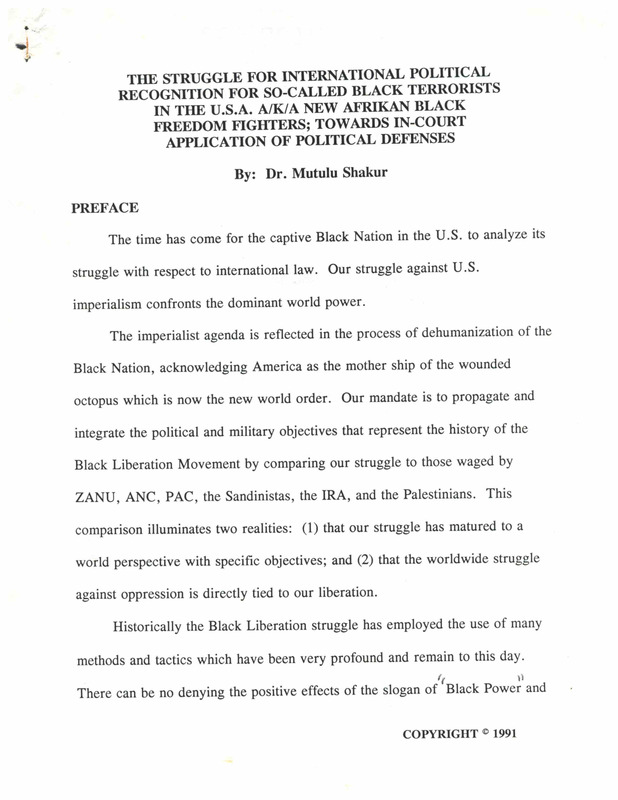
A paper by Dr. Mutulu Shakur arguing that the Black nation in the imperialistic United States is a captive nation and thus must look at the situation and solutions through the lens of international law. Dr. Shakur wrote this from prison, where he was serving a 60 year sentence for his role in a Black Liberation Army (BLA) led robbery in 1981.
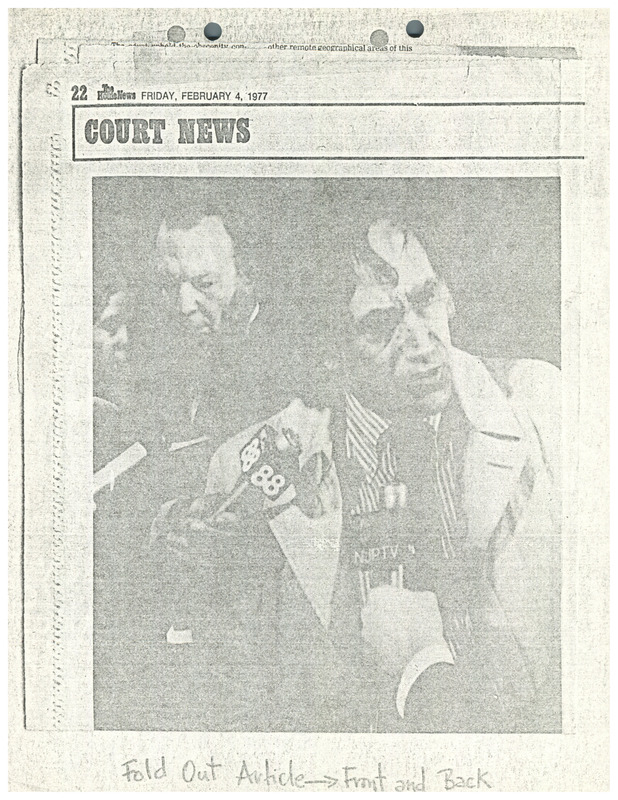
A cover photograph from the Court News Section of the newspaper The Home News featuring members of the defense team for Assata Shakur (JoAnne Chesimard) who was on trial for the 1973 killing of a state trooper. Shakur was convicted in 1977 of killing the state trooper during a shootout, escaped prison in 1979, and is still wanted by the FBI.
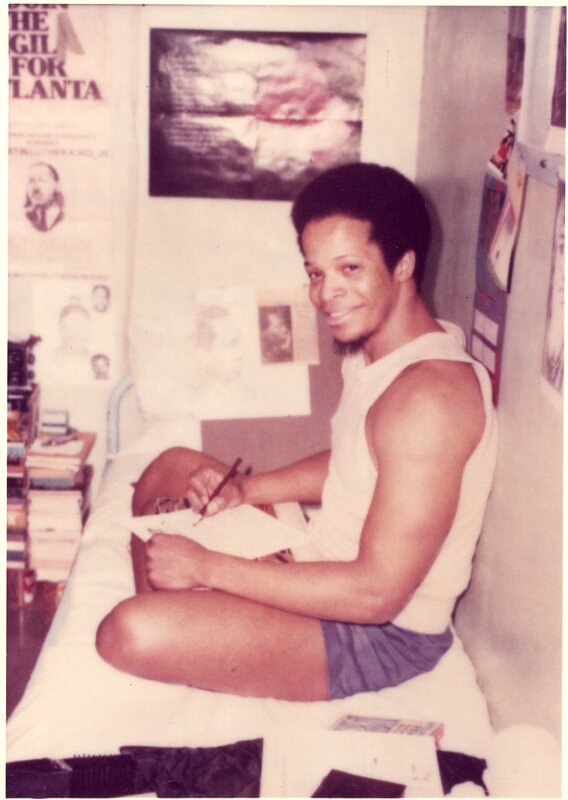
Ashanti Alston, a Black Liberation Army (BLA) member who was imprisoned for 11 years for a robbery to raise money for the BLA, says that he is getting big and his beard is too. He mentions his attempt to draw Nina Simone and says that the photo is two years old. The note is dated September 17th with no year listed.
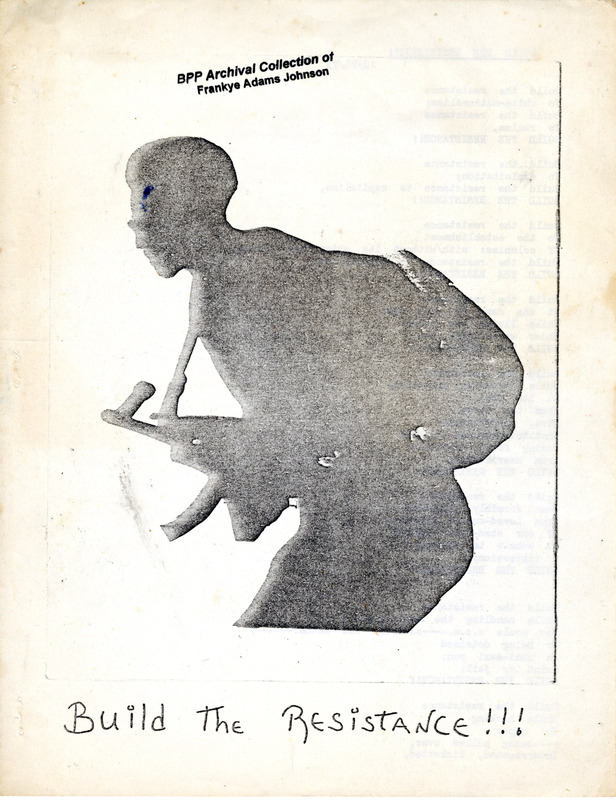
A poem by Ndugu Al-Jamil titled “Build the Resistance!!!” The cover page features the silhouette of an armed man appearing ready for combat. The poem is a call to arms for revolutionaries that outlines the problems facing the community such as police brutality, taxes, eviction, health care, education, and more.
An original poem by Malika Majid (Frankye Adams-Johnson) titled “A Poem for You.” In the poem, she reflects on the idea of resistance. The bottom of the page says “Lest We Forget: Poetry. From The Veterans For Whom Memories Are Precious Sources of Inspiration.”