University Museum at Texas Southern Permanent Collection
Title
University Museum at Texas Southern Permanent Collection
Date Modified
2025-09-22
Description
The University Museum at Texas Southern has collected a rich body of artwork by students, faculty, alumni, and outside artists. Dr. John T. Biggers, who founded the art department at Texas Southern University in 1949, established a tradition of collecting a selection of works from every graduating senior art student. Over the years, the collection has grown to include more than a thousand pieces of student artwork. Also included are works donated by alumni of the art program and art faculty members, including iconic artists John Biggers and Carroll Harris Simms. Lastly, there is a small but significant body of work by outside artists that has been donated by various collectors.
Contributing Institution
Texas Southern University
About This Record
The HCAC public history focused digital archive cataloging is an ongoing process, and we may update this record as we conduct additional research and review. We welcome your comments and feedback if you have more information to share about an item featured on the site, please contact us at: HCAC-DigiTeam@si.edu
This unknown student’s bust was created during their time as an art student at TSU. Under the instruction of Professor Carroll Harris Simms, artists would create self-portraits embellished with decorations like spirals and accentuated crown pieces, like in this sculpture. These busts are inspired by Nok terracotta sculptures and Ife busts, which Simms saw during his travels to Western Africa.
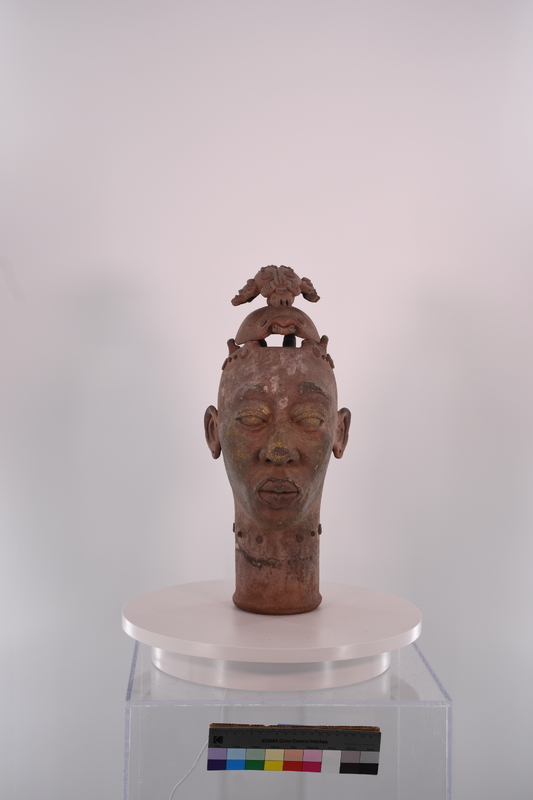
This unknown student’s bust was created during their time as an art student at TSU. Under the instruction of Professor Carroll Harris Simms, artists would create self-portraits embellished with decorations like spirals and accentuated crown pieces, like in this sculpture, which features a tortoise, a common symbol of longevity. These busts are inspired by Nok terracotta sculptures and Ife busts, which Simms saw during his travels to Western Africa.
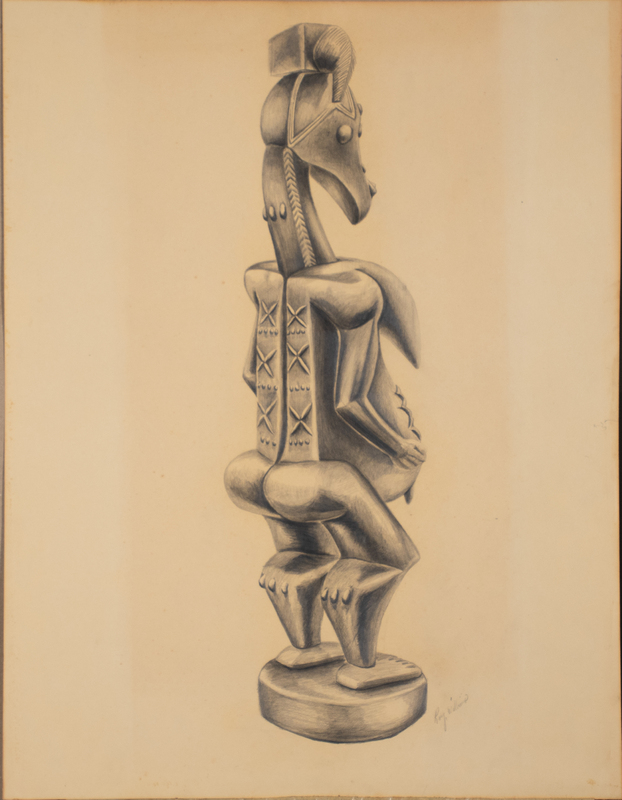
Williams' drawing is of a Senufo female carving. Texas Southern art students would often use the African Art collection on campus to create drawings like this. Dr. Biggers, the founder of the art department, would bring artwork from his travels to Africa back to Houston. This practice allowed students to get a glimpse of African customs and art, which was a key part of the Afrocentrist curriculum that Biggers worked to develop.
“Shrine #2,” by Harry Vital, features an intersex bird with both male and female features. This is a common theme found in Dogon sculptures originating from West Africa; these types of statues play a role in fertility rituals. The body has a smooth surface, while the wings and head are embellished with spiral designs.
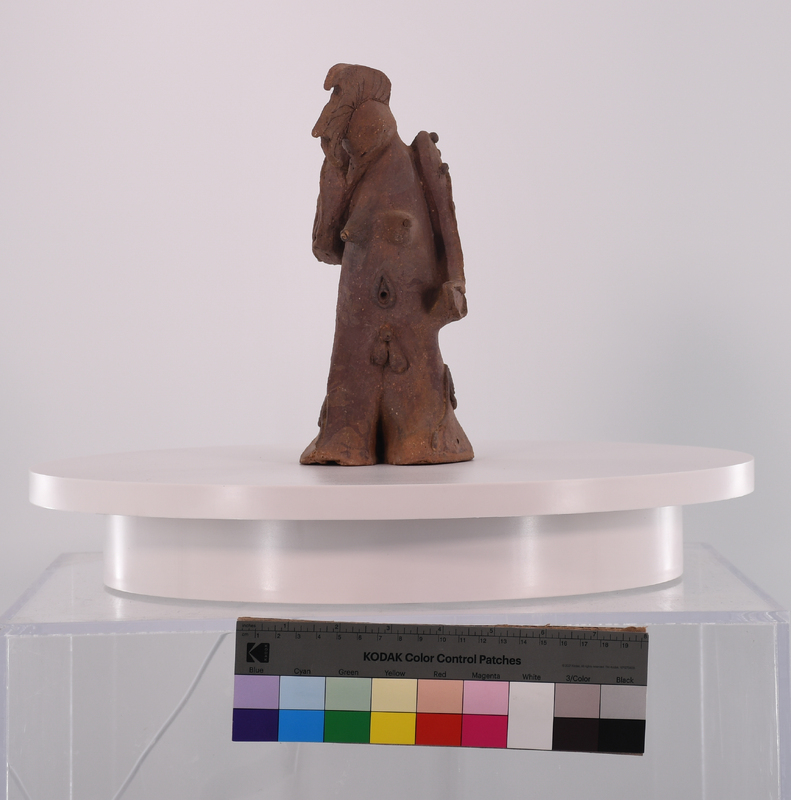
Vital's maquette appears to portray an intersex human-chicken hybrid, which displays both male and female sex organs. The artist adorned the sculpture with swirl embellishments, a common motif in TSU terracottas. Vital would go on to make a full-scale version of this sculpture.
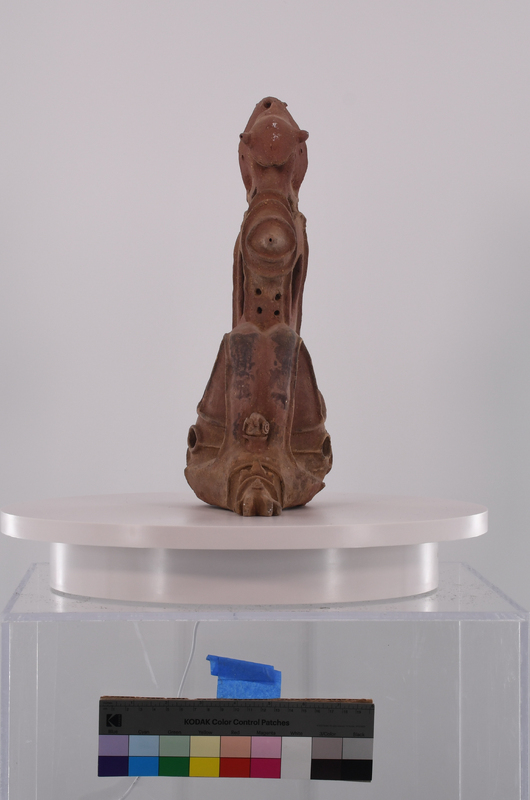
Like his other sculptures, Vital's maquette highlights hybridism, animal forms, and sexuality. Overall, the sculpture's form resembles a person sitting on a throne. On both sides of the top, a reptile creature sits above the shape of an open eye or breast. Towards the bottom, a phallic form is decorated with swirls, while a single claw-like structure supports the sculpture. The sculpture makes use of negative space in multiple sections.
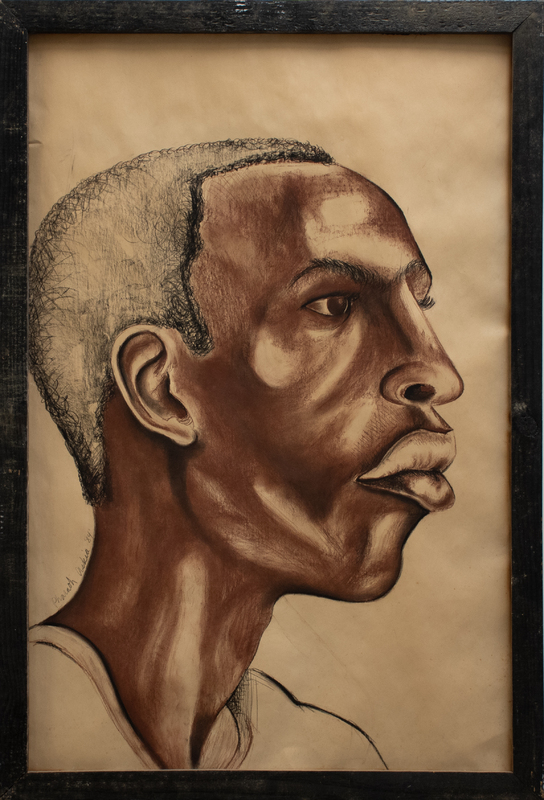
Askia’s drawing is a side portrait of a man looking into the distance. There is no background and only a sliver of his shirt is visible, implying the man is not confined to a specific time or setting. Many of Askia’s pieces are similar - drawn with pastel on paper, and placing the subjects outside of time and space.
This small ceramic plate created by Carroll Harris Simms is made from red clay with a white, bubbling glaze. It has slightly raised, curved edges. Simms worked alongside Dr. John T. Biggers to build Texas Southern's art department from the ground up. Simms' decorative artworks remain in high demand by collectors.
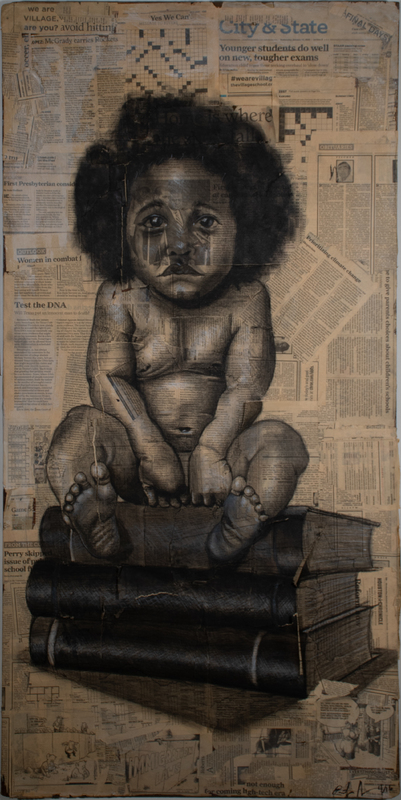
This drawing by Prinston Nnanna shows a Black baby sitting on a pile of books. Behind the baby, there is a collection of various political newspaper clippings and headlines, which may be provoking the child's saddened disposition.
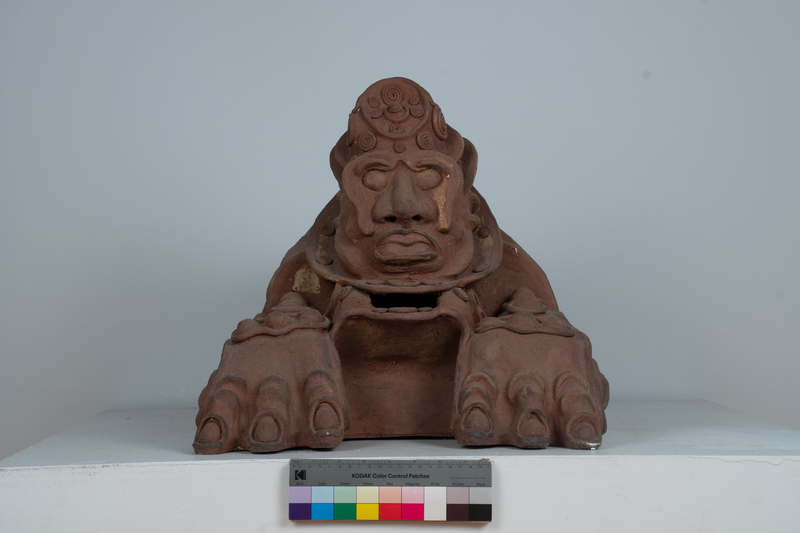
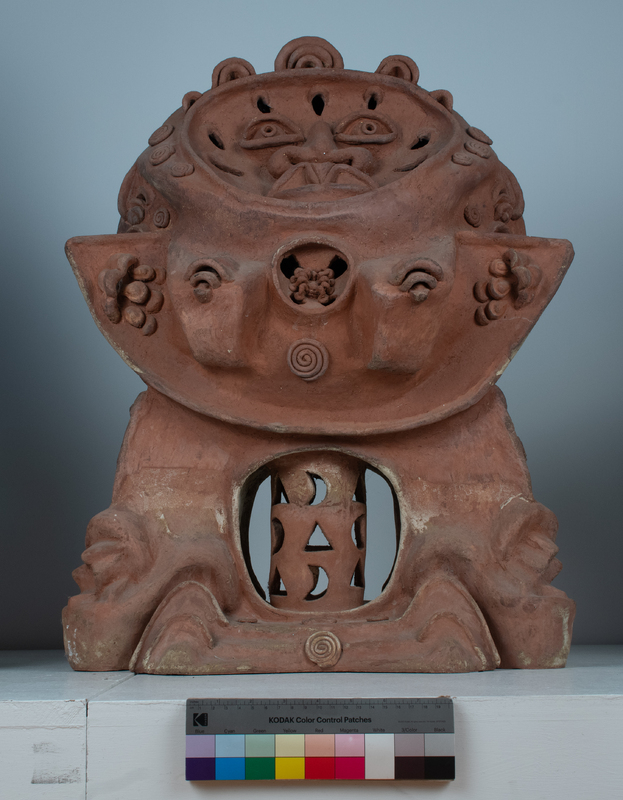
This sculpture’s form resembles a sphinx, with its humanlike face and animal body parts. The body is covered in ornamental embellishments, especially spirals. These decorations are a key characteristic of the terracotta sculptures created by the students of Professor Carroll Harris Simms, with spirals as a key motif.
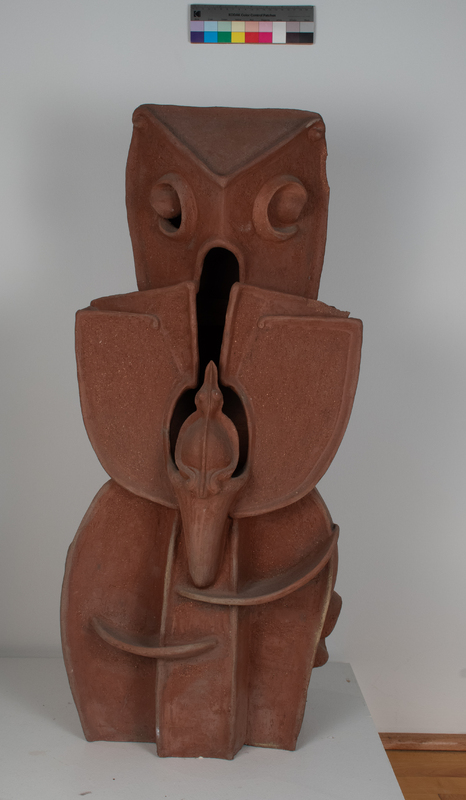
This sculpture features a small bird placed in the lap of a larger abstract figure, perhaps suggesting the larger figure is the small bird’s mother. The body of this sculpture has a smooth surface finished with a thin rim around the edges. The act of nurturing and providing shelter is reflected in the placement of the smaller bird. Mother-child relationships are frequently showcased in TSU student terracottas.
This watercolor painting by Frank Perkins features a scene at a baseball stadium. This work may be an homage to the Negro Leagues, which offered Black baseball players the chance to play professionally prior to Jackie Robinson's integration of Major League Baseball. Iconic Black baseball players like Robinson, Willie Mays, Satchel Paige, Josh Gibson, and many more played in the Negro Leagues.
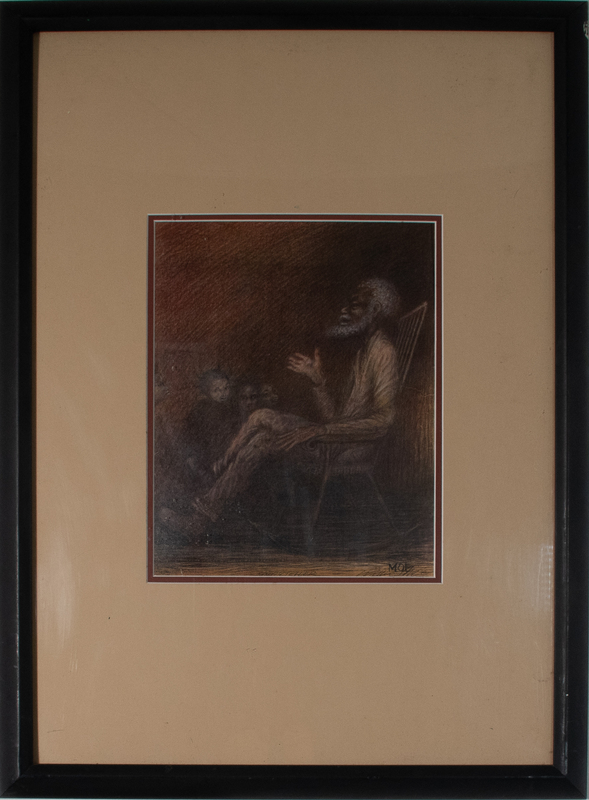
In this drawing by Willie Moe, a group of children gather around an elderly man in a rocking chair to hear his stories. Oral storytelling is an essential part of preserving the past, particularly in communities that have been denied the opportunity to write their own histories.
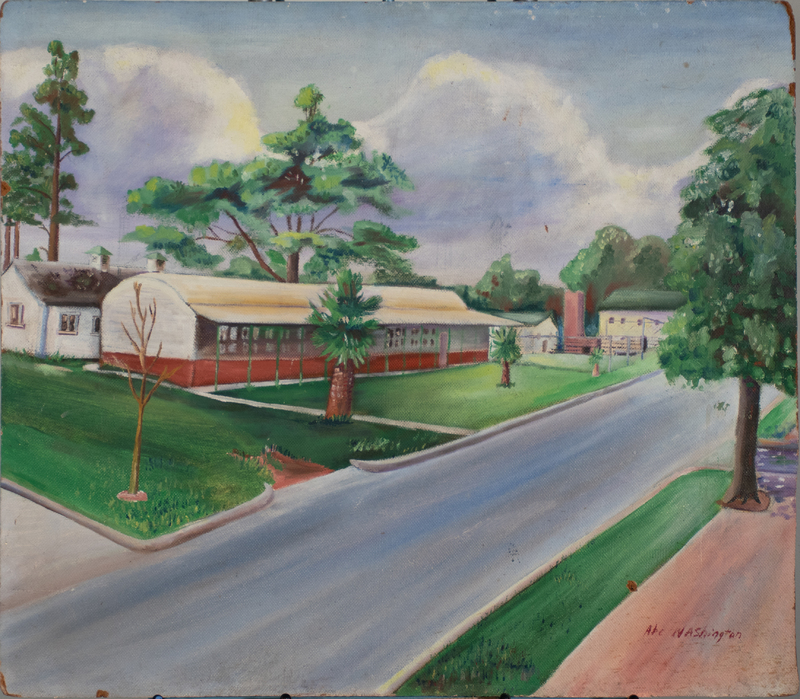
Washington’s landscape painting shows a suburban setting, with a paved road, low homes, and a mix of palm and deciduous trees. Washington grew up in Port Arthur, Texas, a small oil city along the Gulf Coast. This scene is perhaps reminiscent of Washington’s home and early life. Dr. John Biggers encouraged Texas Southern student artists to create art based on what they saw – perhaps this instruction inspired Washington’s painting.
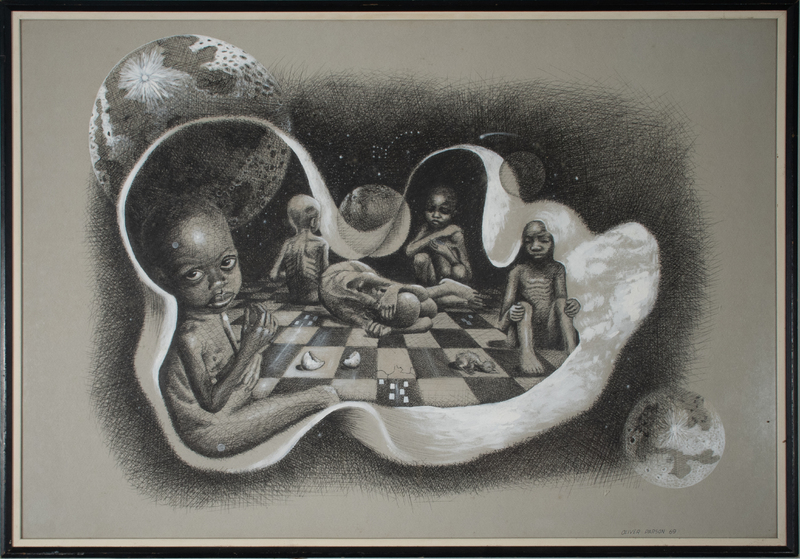
This drawing by Oliver Parson shows a group of emaciated children seated on a checkerboard patterned floor. There is also a chick, just hatched from its egg, that seems to be struggling to survive. Parson has an incredible talent for conveying powerful emotions in his works. The checkerboard and other sacred geometry imagery appear frequently in the works of Dr. Biggers's students.
“Sun Stool,” created by Anthony Haynes, resembles an Ashanti stool, a seat for royalty of the Ashanti Empire. The sculpture is decorated with spiral embellishments, triangles, moons, and other indentations. Facial features are also included at the front head of the stool; the rear face of the stool resembles a baboon's face.
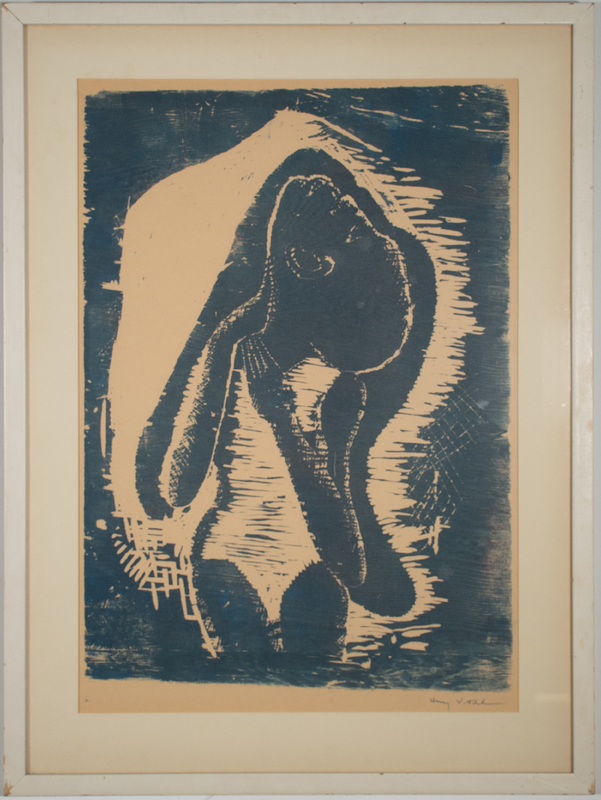
This print by Harry Vital shows a woman in a swimsuit tilting her head upwards. Dr. John T. Biggers taught students the craft of printmaking while he was a professor at Texas Southern University. Vital followed in Biggers' footsteps and became a longtime art professor at TSU.
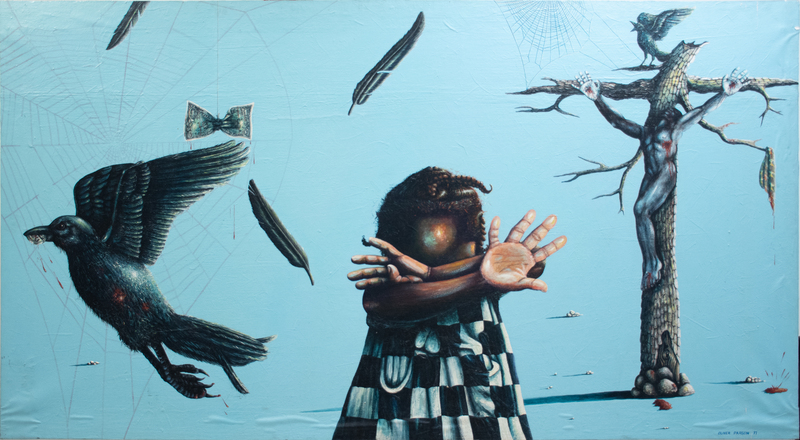
Parson’s painting shows a young girl shielding her face. To the left, a crow holds a coin and a dollar bill is on a fishing line; to the right Jesus is crucified, below a perched crow. The crows may allude to Jim Crow, which made racism law from after the Civil War until the 1960s; crows are also a symbol of death. The dollar bill as bait perhaps suggests the corrupting nature of money.
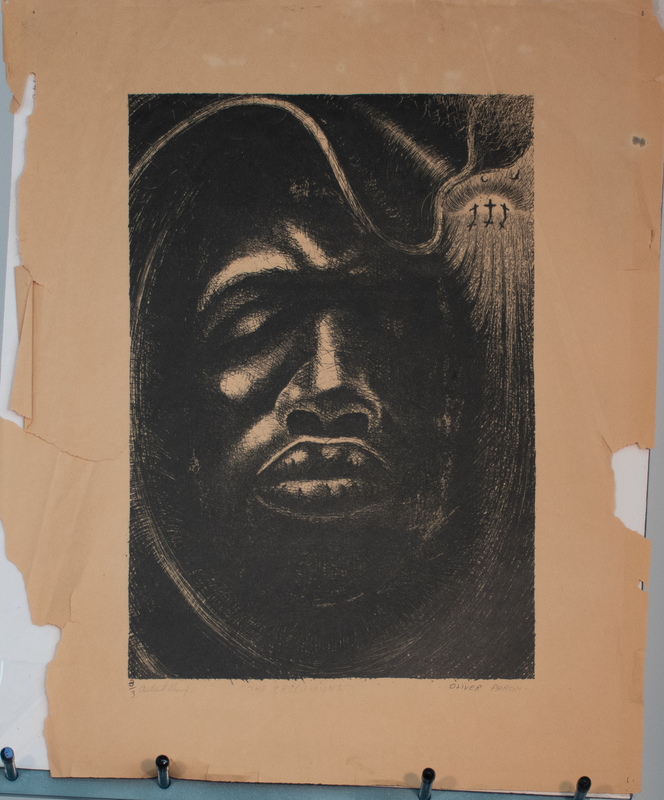
Parson's print shows a face with closed eyes and a solemn expression on its face. In the background, three crosses stand ominously, alluding to the crosses where Jesus, Dismus, and Gestas were crucified. Dark, crosshatched swirls fill the entire composition. Parson and other TSU students learned the crosshatching technique from Dr. Biggers and used it to create smooth, detailed shapes.
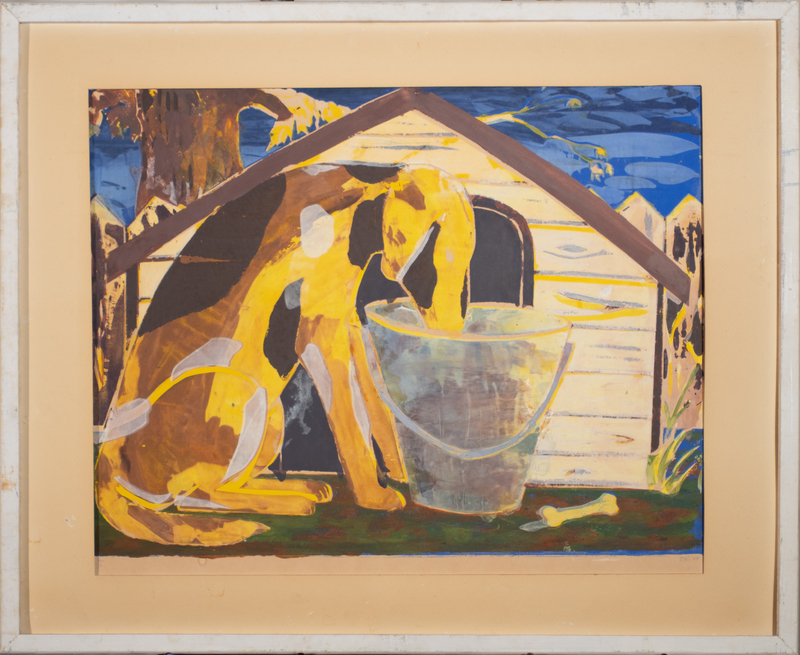
Sampson’s print shows a large, colorful dog drinking from a pail of water. The setting appears rural, with a wooden fence and a large tree in the background. Sampson’s artwork in TSU’s permanent collection often depicts nature and rural homes. More broadly, animals and the natural world are frequent subjects of the artwork of TSU students.
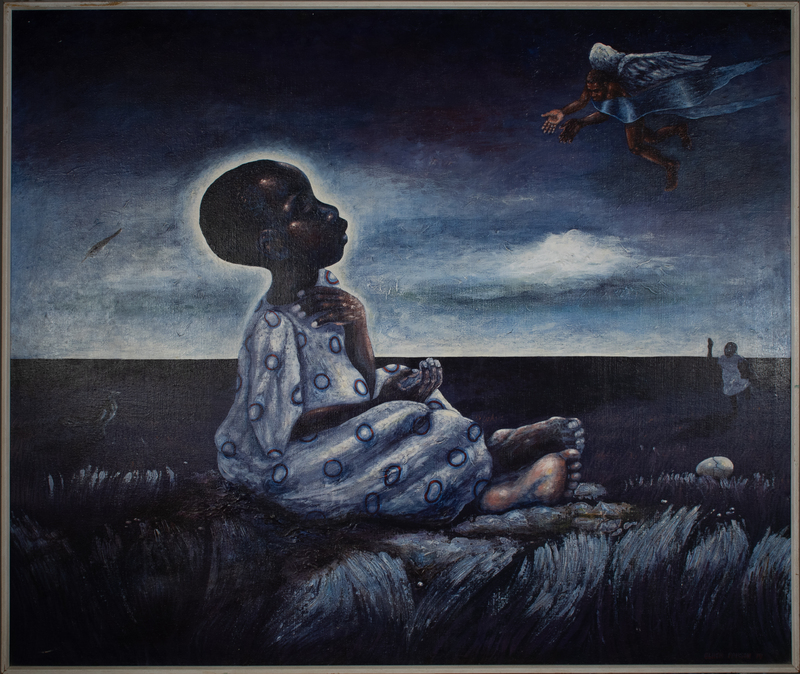
This work, by Oliver Parson, is a calm and dreamlike scene of a child sitting in a prairie, as an angel and a person both race towards him. Both figures may represent salvation; the person aims to rescue him from death, while the angel tries to save him from Earth. A faint glow emanates from the child.
Donato's painting shows a crowd gathering around him after a car crash, but not rendering aid. Donato crafts a scene that blends reality and fiction: he portrays himself bloodied like Jesus on the cross, surrounded by real neighbors of his from Frenchtown, a section of Houston's Fifth Ward, but there was no such car crash.
Sifuentes' print depicts the exterior of an old church. An adult and small child are seen entering the church, which lies at the end of a winding path. Chickens are seen pecking at the ground, lending a sense of place to this rural scene. Churches and other religious imagery appear frequently in the artwork of Texas Southern students. Sifuentes later went on to become an art professor at Texas Southern.
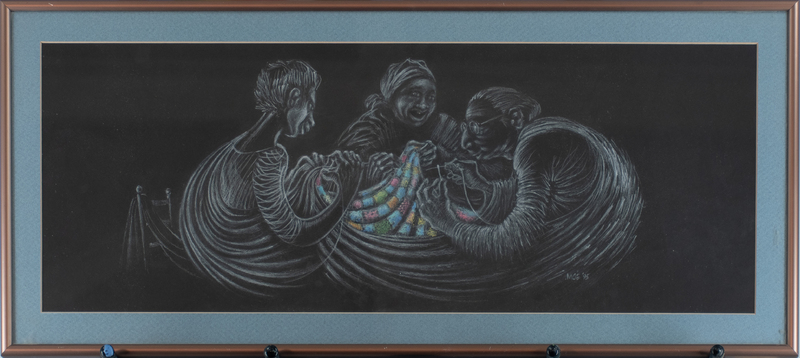
Moe’s drawing shows three elderly women working together to craft a quilt. Quilting is a traditional craft of Southern Black women, and also an important community activity. Moe’s composition is set against black paper and drawn all in white, with the exception of the vibrant colors of the quilt. This shows the richness of the communities and lives embodied in the quilt.
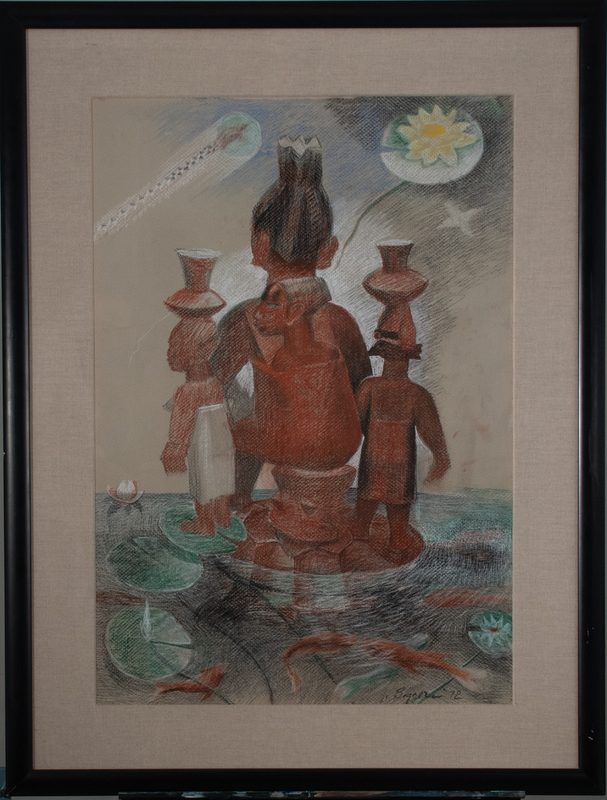
In the center of this drawing, a mother, wearing her child on her back, floats on the back of a tortoise, flanked by a female and male carving. Lilypads float alongside them, while fish swim throughout the pond. In the sky, a lily covers the full moon, while a turtle flies into the night, representing the connection between the terrestrial and celestial. While living in Houston, Dr. Biggers often walked along Buffalo Bayou in the morning, watching fish swim as the sun slowly replaced the moon in the sky.
Moore’s bust was created during his time as an art student at TSU. Under the instruction of Professor Carroll Harris Simms, artists would create self-portraits embellished with decorations like spirals and accentuated crown pieces, like in Moore’s sculpture. Moore’s crown details include horns on both sides, green holes in the head, and a miniature mask in the center of the forehead. These busts are inspired by Nok terracotta sculptures and Ife busts, which Simms saw during his travels to Western Africa.
Davis's sculpture depicts a stylized version of the artist's head and neck, with a removable crown piece. The crown looks like a turtle with an insect atop it. The neck, crown, and forehead are all adorned with swirls, the most common motif in the terracottas of Simms' students.
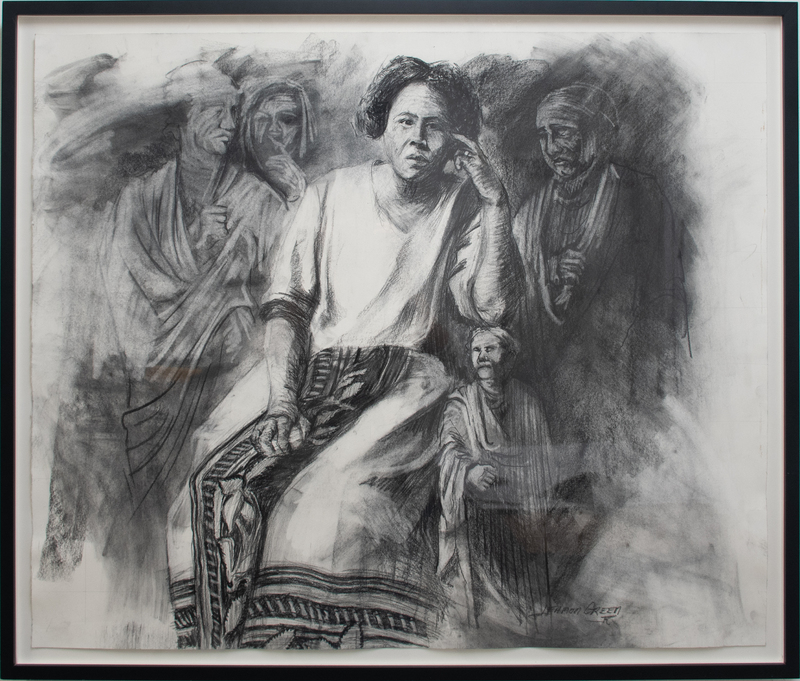
Green's drawing depicts a central female figure, deep in thought, surrounded by faint, whispering figures. The scene is reminiscent of a queen's court, with the monarch encircled by attendants and advisors. Green taught painting and printmaking courses at Texas Southern until his retirement in 2024.
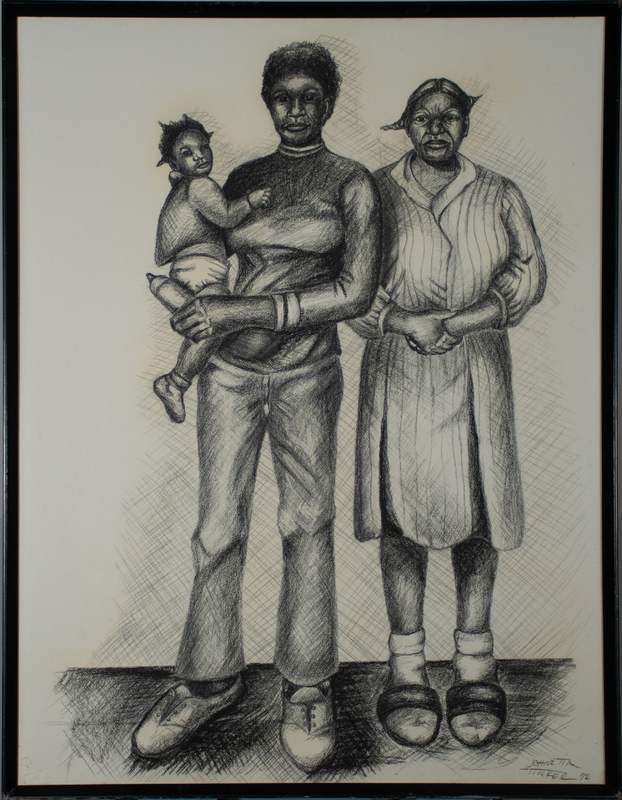
Tinker's drawing appears to portray three generations of women, with a baby, her mother, and her grandmother. The mother holds her daughter and her bottle; the grandmother stands behind them with her hands crossed. Dr. Biggers’ artwork often centered women and their contributions to the family and society. He passed these themes along to his students, who, like Tinker, frequently highlight the relationship between mother and child.
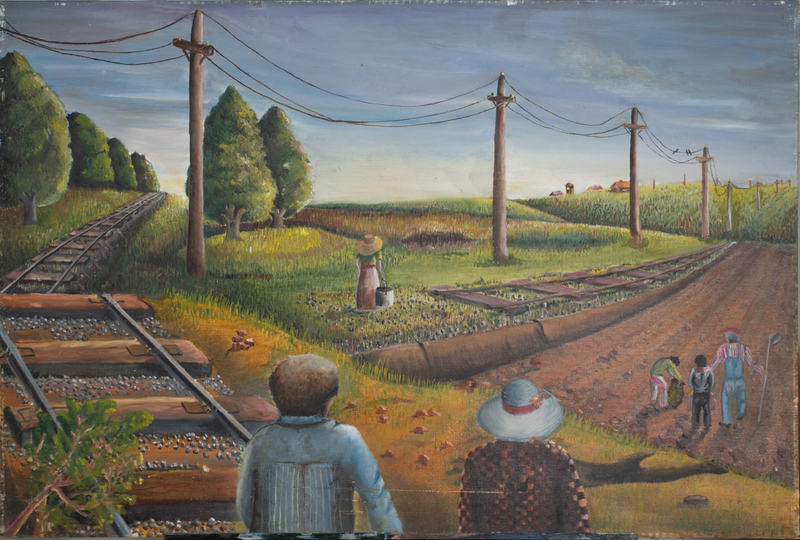
Leonard Henderson's cool-colored composition depicts a calm landscape of farmers working a field next to train tracks. The tracks running next to the field may hint at the contrast between urban and rural life, and show the development of rural areas during the turn of the 20th century.