The HCAC public history focused digital archive cataloging is an ongoing process, and we may update this record as we conduct additional research and review. We welcome your comments and feedback if you have more information to share about an item featured on the site, please contact us at: HCAC-DigiTeam@si.edu
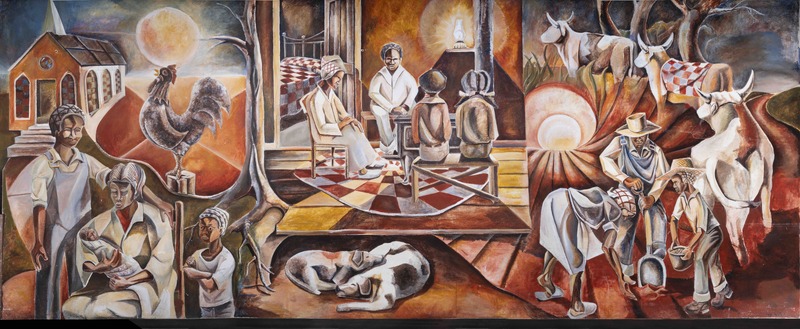
In a triptych style, Williams’ mural shows three central themes: a family gathered around a newborn (religion), seated near a hearth (home), and working together in the fields (labor). Black rural life is a major subject in the Hannah Hall murals.
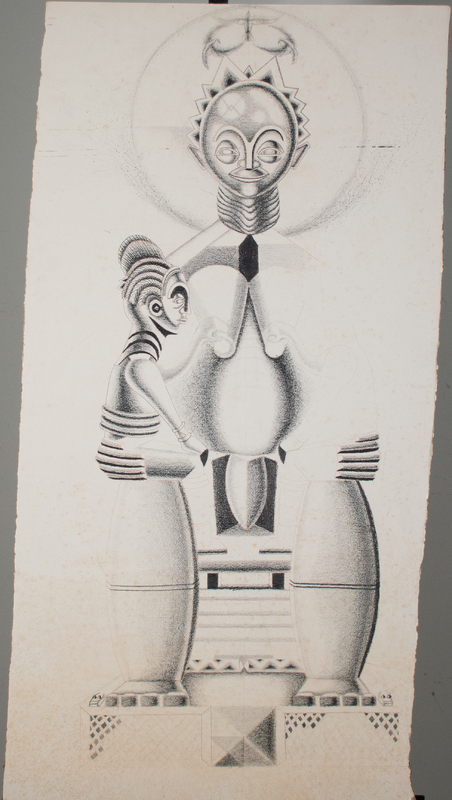
This drawing combines elements of traditional African sculpture and futuristic motifs. The figures’ faces resemble Ashanti akuaba (fertility dolls). The seated mother with a child is also a common motif in African sculpture, as seen in some works from the University Museum’s collection. The figures’ hair textures suggest a more futuristic design.
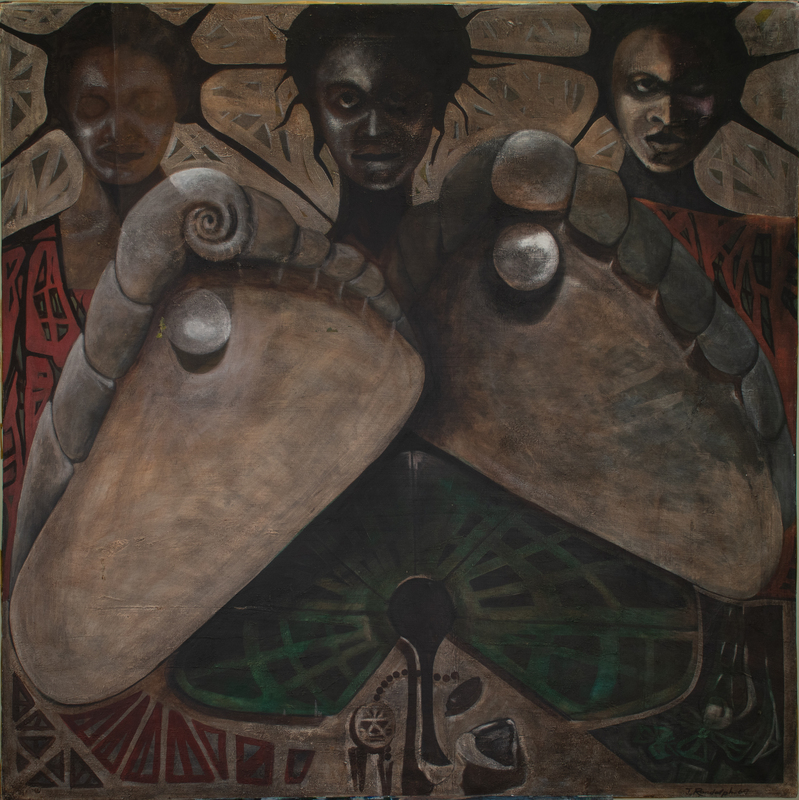
Randolph’s painting shows giant pearls, embedded in oversized shells, in front of a group of three Black women. The pearls reference the beauty of the women, whose hair extends out from their heads to form a unifying pattern between them. Towards the bottom, a leaf fan implies regalness, while the small mask indicates African heritage.
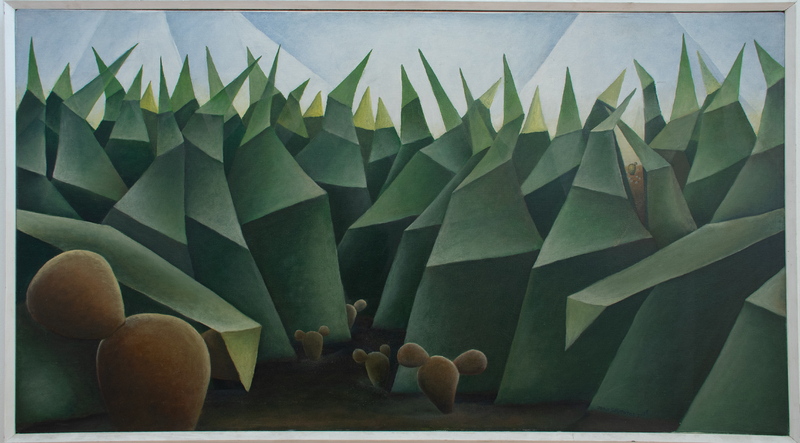
This painting by Jesse Sifuentes shows a landscape scene featuring cactuses. Several TSU art alumni have recalled that Dr. John Biggers taught them based on themes more than techniques. Many works from the 1970s use geometric styles, perhaps a reflection of lessons from the time. Sifuentes went on to become a ceramics professor at Texas Southern.
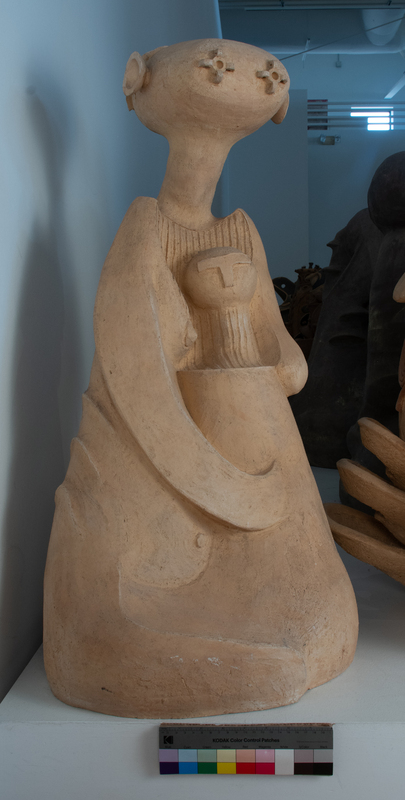
This sculpture is of a mother wrapping her arms around a childlike figure. The artist uses geometric shapes and line work to decorate the bodies and facial features and animate their embrace. Parental protection and the mother-child relationship are frequent subject matters displayed in students' work at Texas Southern University.
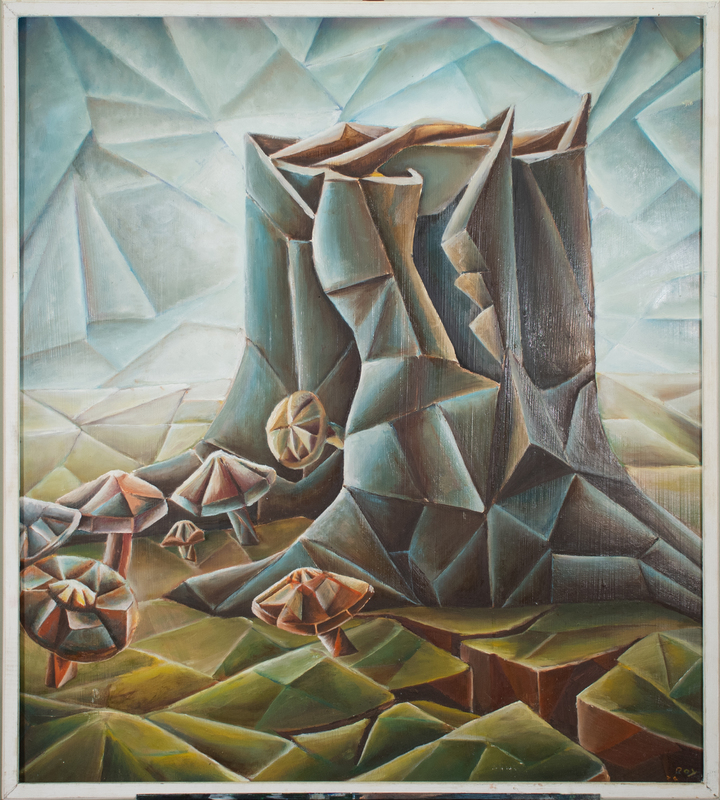
This painting by Roy Vinson Thomas is a landscape piece depicting a tree stump and mushrooms in cubist style. Cubism depicts forms using multiple geometric shapes to create depth. Many works in Texas Southern's permanent collection, particularly from the late 1970s, use this art style.
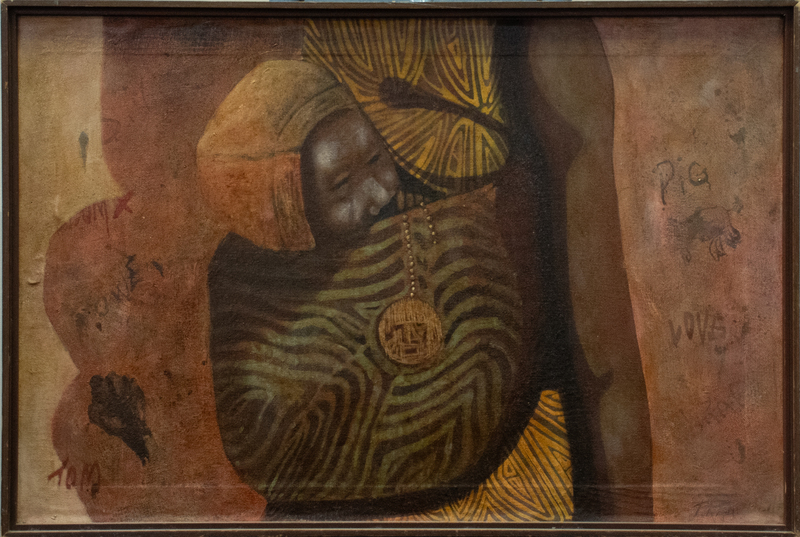
Randolph’s painting shows a mother in an African dress wearing her child on her back with a chitenge. The wall is graffitied with words like pig, power, and love, and an image of a Black power fist. The work contrasts the African aesthetic of the figures with the African-American political graffiti, expressing an idea of global Blackness.
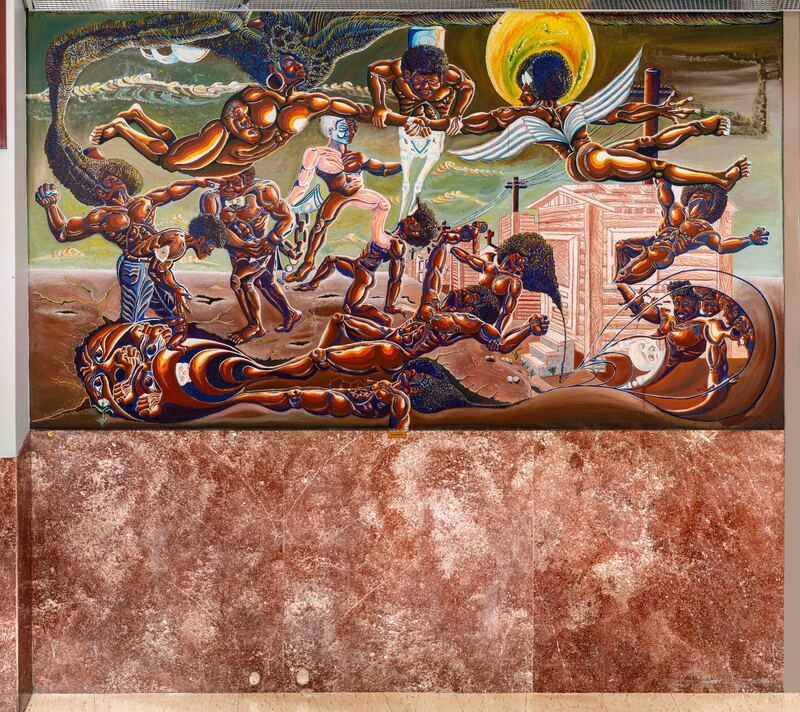
Set against a background of shotgun houses, Black people engage in a struggle to break free from chains and physical limitations. Extreme musculature and angel wings suggest supernatural strengths. A motif in Settles’ work is the power and beauty of Black hair.
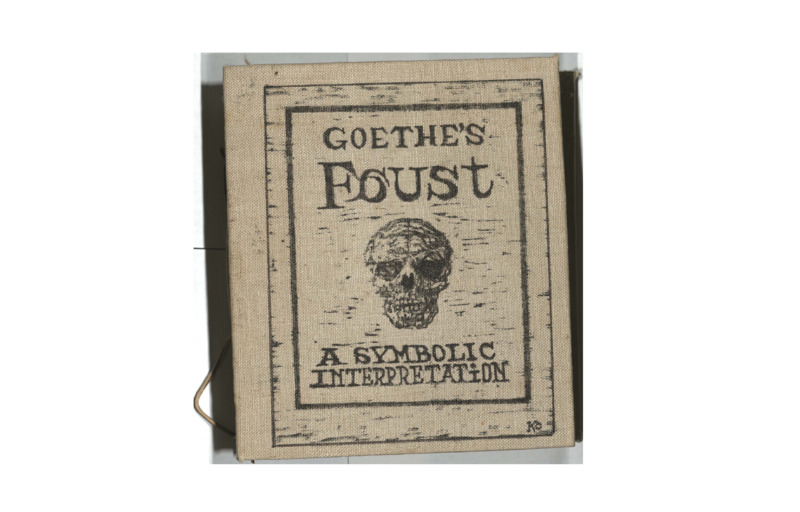
Oliver created this notebook for an undergraduate English course. The notebook, which he made and bound by hand, includes the artist’s interpretation of Johann Wolfgang von Goethe’s play, Faust, a Tragedy, and several original illustrations to accompany his writing.
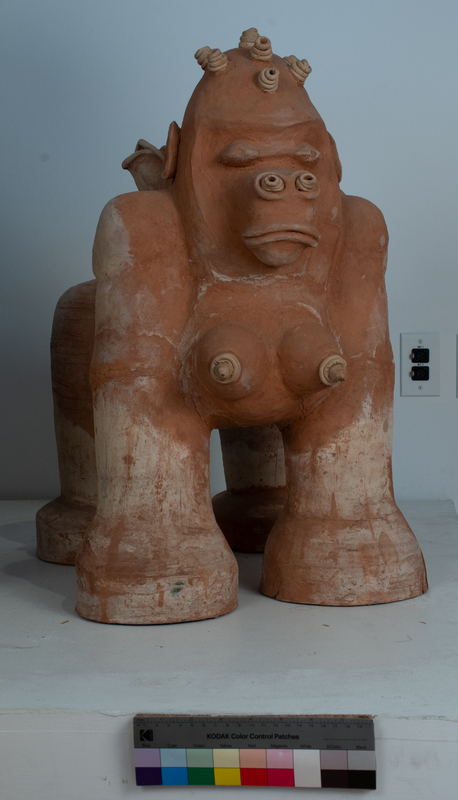
This terracotta sculpture features a mother gorilla with a child clinging to her back. The mother’s head, face, and body are adorned with spiral embellishments. A common theme featured in Texas Southern University’s permanent collection of terracotta sculptures is the relationship between mothers and their children.
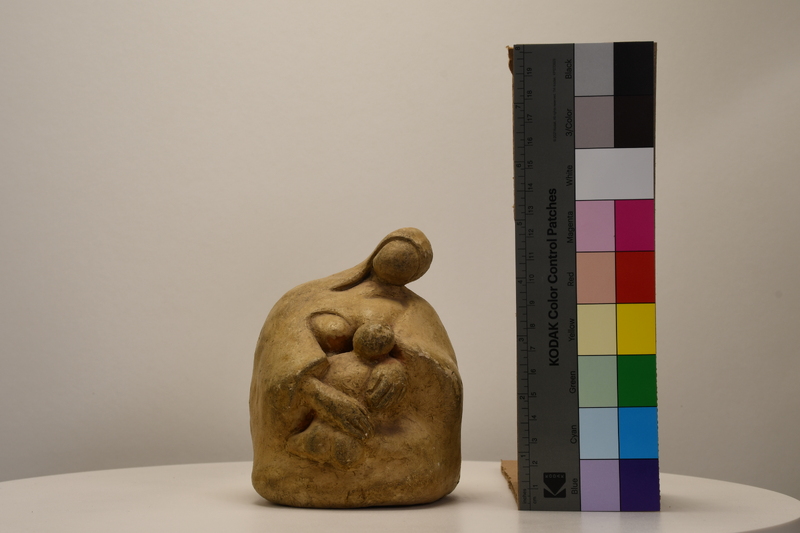
Taylor's maquette shows a mother tightly embracing one or two children. The theme of the mother and child was a recurring motif amongst the students of Professor Carroll Harris Simms, the ceramics instructor at TSU. Simms worked alongside Dr. Biggers to build TSU's art program.
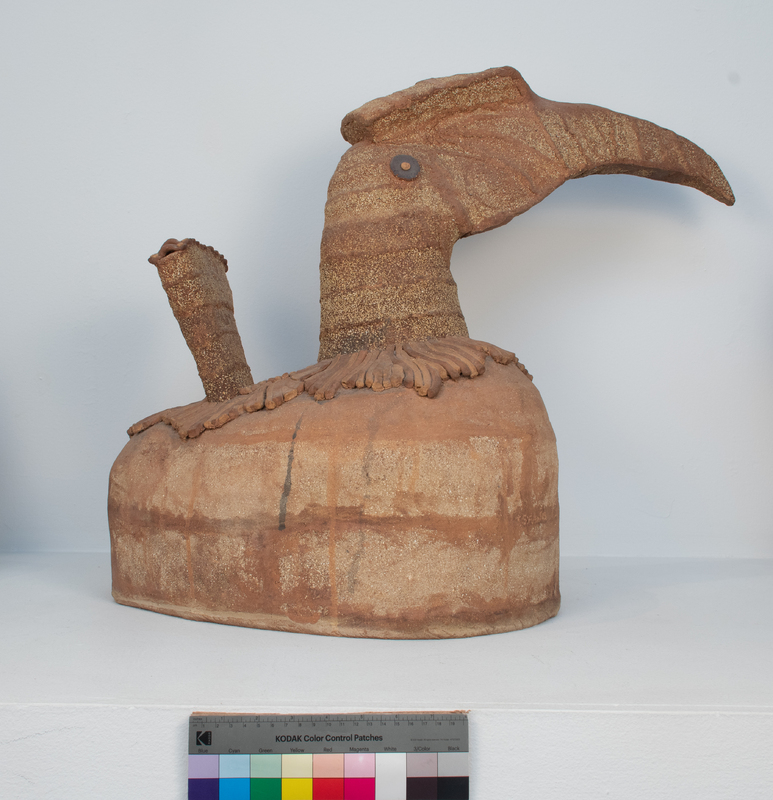
Jesse Sifuentes’ “Greater Hornbill” was created using the slab method, which was taught to students of Carroll Harris Simms. This method entails layering evenly rolled clay mixed with sand as artists build up their figures, working from the bottom layer to the top. Sifuentes frequently features hornbills, unique birds found in parts of Africa and Southeast Asia, in his art.
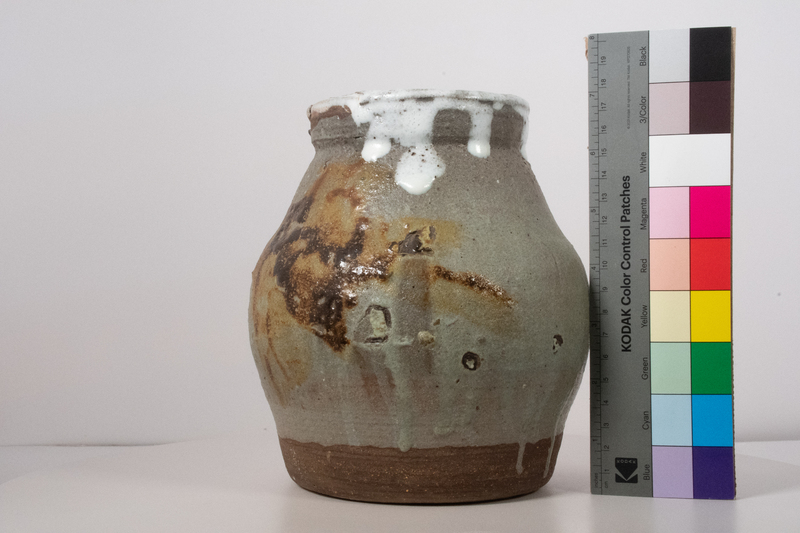
This small ceramic vessel created by Professor Carroll Harris Simms has a green hue, with a brown base and white-glazed lip and interior. Simms believed pottery to be an equally important artistic pursuit to sculpture and was encouraged to hear pottery was held in the same regard in West Africa.
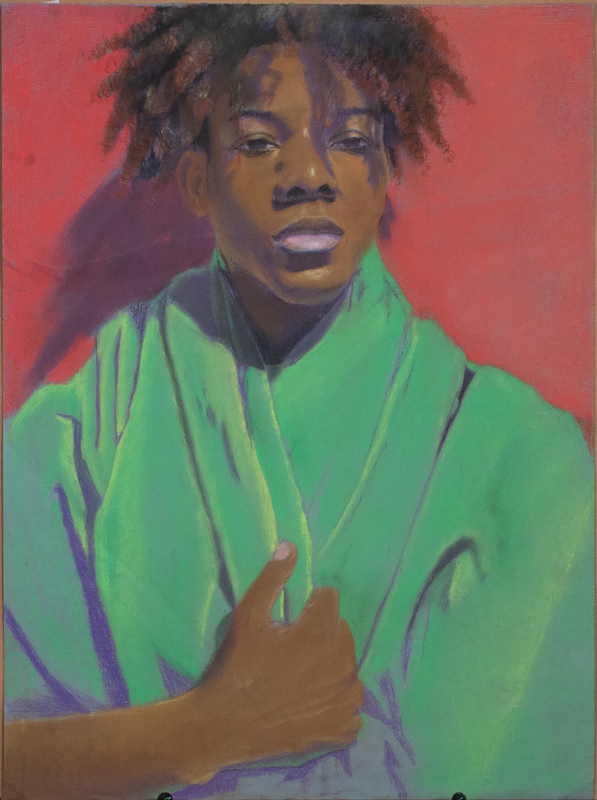
Sauls’ drawing is a portrait, completed in pastel, of a person with curly hair wrapped in a green robe. As a part of the curriculum at TSU, art students are required to create portraits. Some opt for self-portraits, while others begin to create images of those including family, friends, and peers. A variety of portraits created with different mediums can be found in the permanent collection.
Gabriel's senior notebook includes her written philosophy of art, photographs of the artist’s works and her process, and a copy of her senior exhibition brochure. As a part of the Texas Southern art curriculum under Dr. John T. Biggers and Professor Carroll Harris Simms, students would create these notebooks to explain their artistry and showcase the works they created as students.
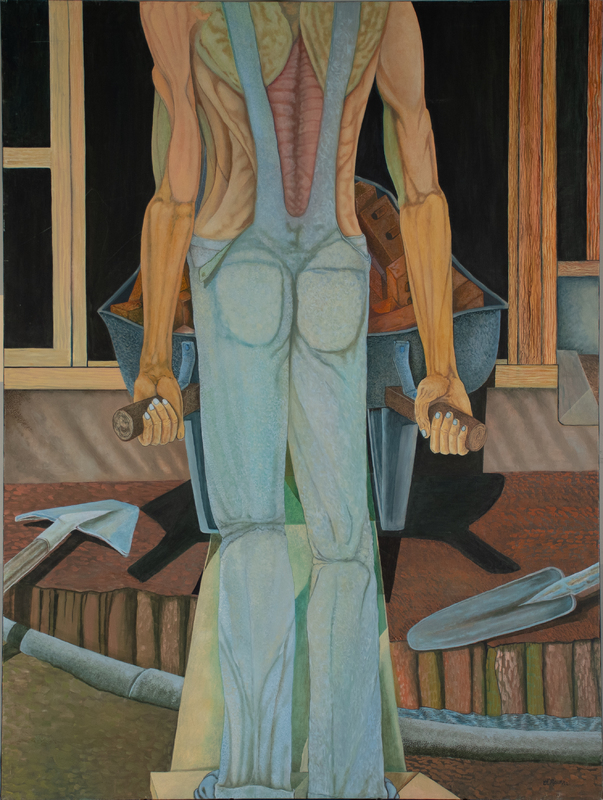
Renfro’s painting displays an image of a working man dressed in overalls from behind. The man is wheeling bricks towards a construction site. His bones and muscles are made visible in the composition, perhaps to highlight the physical demands of his labor. Dr. Biggers taught his students to portray the human form with care and detail, particularly oft-neglected features like hands and feet.
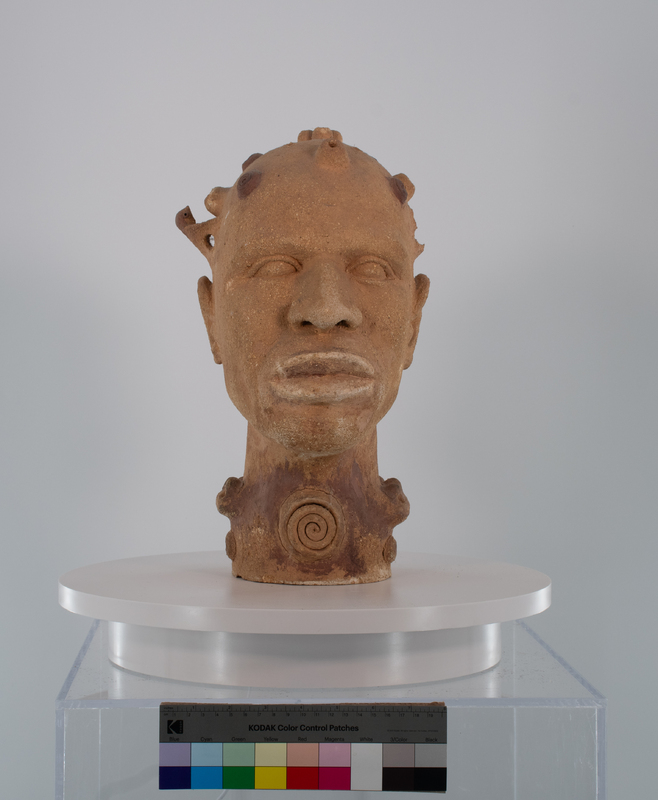
Vital’s bust was created during his time as an art student at TSU. Under the instruction of Professor Carroll Harris Simms, artists would create self-portraits embellished with decorations like spirals and accentuated crown pieces, like in Vital’s sculpture. These busts are inspired by Nok terracotta sculptures and Ife busts, which Simms saw during his travels to Western Africa. Vital later became a member of TSU’s art faculty.
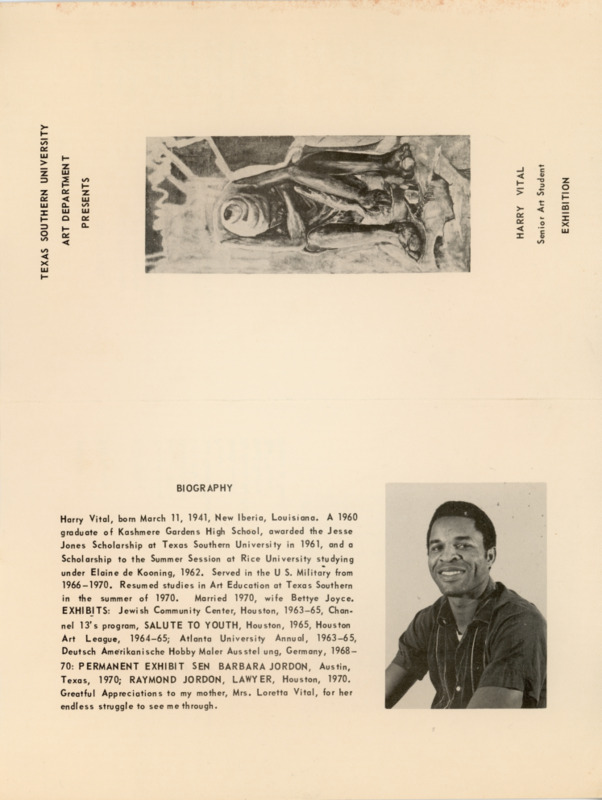
This is a brochure for Vital’s senior art exhibition. The culmination of the Texas Southern art curriculum is a senior exhibition where students showcase artwork created over the course of their undergraduate studies. The brochure features a portrait of Vital, a brief biography, a catalog of the artwork featured in the exhibition, and a photo of one of his paintings and sculptures. After graduating, Vital returned to TSU to teach art for many years.
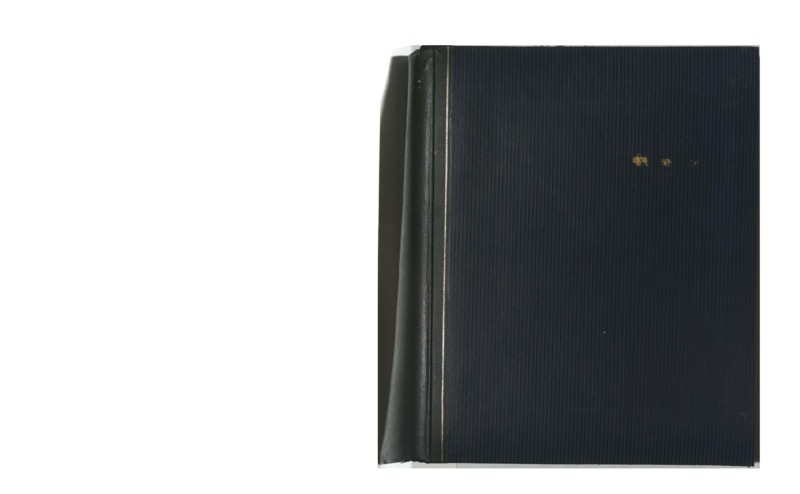
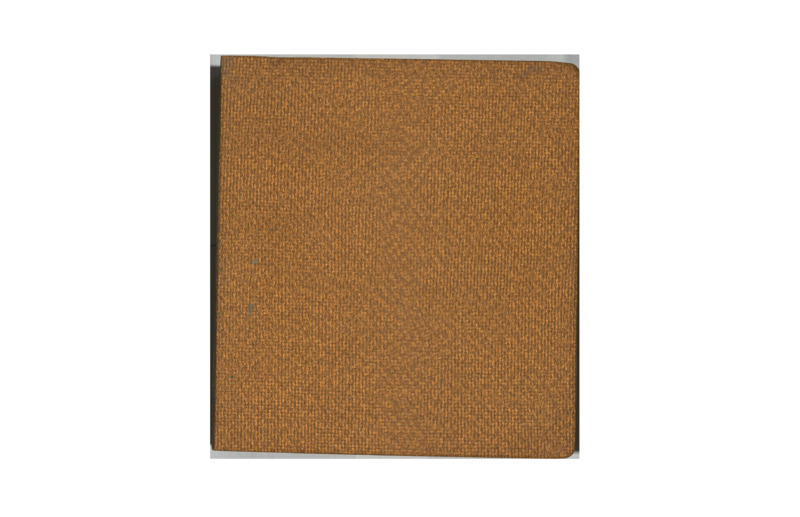
Vital’s senior notebook includes his written philosophy of art, photographs of the artist’s works and his process, and a copy of his senior exhibition brochure. As a part of the Texas Southern art curriculum under Dr. John T. Biggers and Professor Carroll Harris Simms, students would create these notebooks to explain their artistry and showcase the works they created as students.
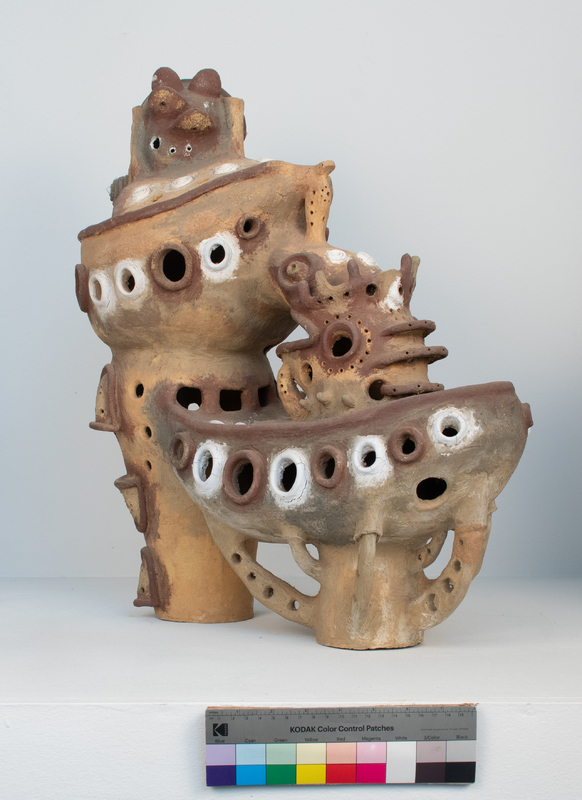
Harvey L. Johnson’s “Shrine” includes embellishments painted with white and brown slips, with small holes punched in various placements along the body of the sculpture. A variety of shrines are featured in the collection of student artists at Texas Southern University. These shrines were inspired by Professor Carroll Harris Simms’ travels to Nigeria.
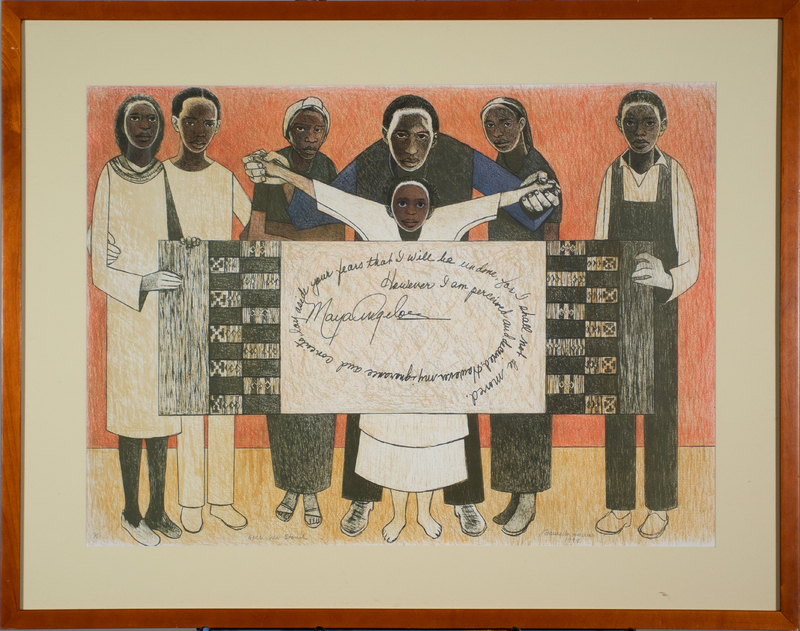
Lewis’s print shows a group of people holding a Kente-style textile, inscribed with the words, “However I am perceived and deceived, however my ignorance and conceits, lay aside your fears that I will be undone, for I shall not be moved," a selection from Maya Angelou’s poem Our Grandmothers; John Biggers also created illustrations to accompany Angelou's poem. Lewis was a leading African-American artist and art historian. She and Biggers studied together at Hampton University.
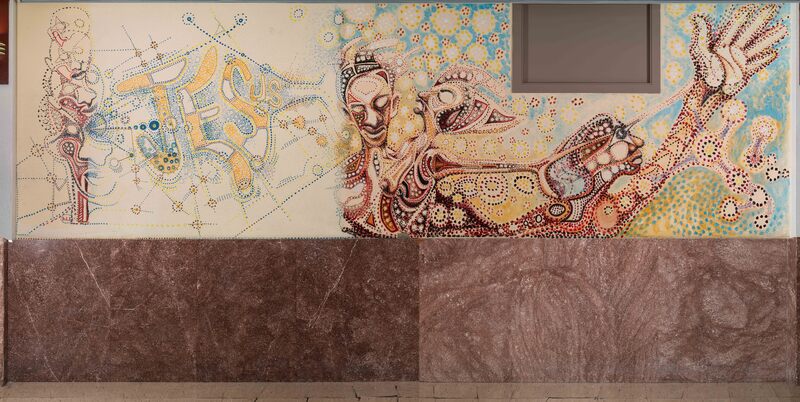
The only Hannah Hall mural in a pointillist style, it was partly destroyed during renovations. Edwards returned to repaint it. Perhaps because of the time demands of the pointillist technique, the repainted left side is less detailed than the right. Jesus, Mary, and Joseph are painted in abstract forms.
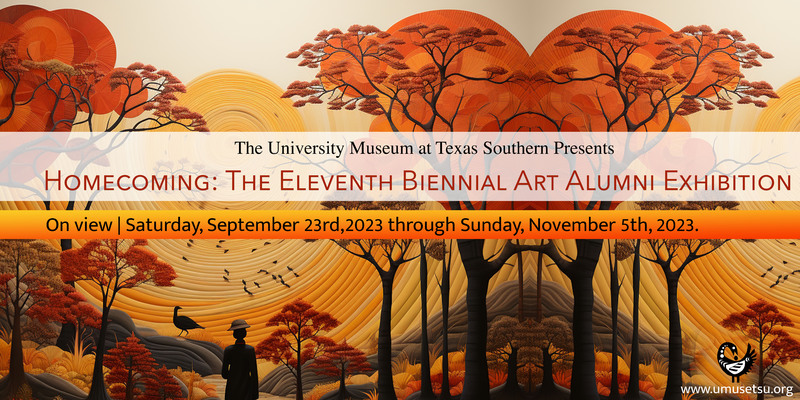
This is a digital flyer for the Fall 2023 Homecoming: The Eleventh Biennial TSU Art Alumni Exhibition at the University Museum at Texas Southern. The University Museum hosts an art alumni exhibition every other fall, alternating with an art faculty exhibition. Alumni showcase their artwork, which ranges from paintings, prints, and photographs to sculpture, jewelry, and wood carving.
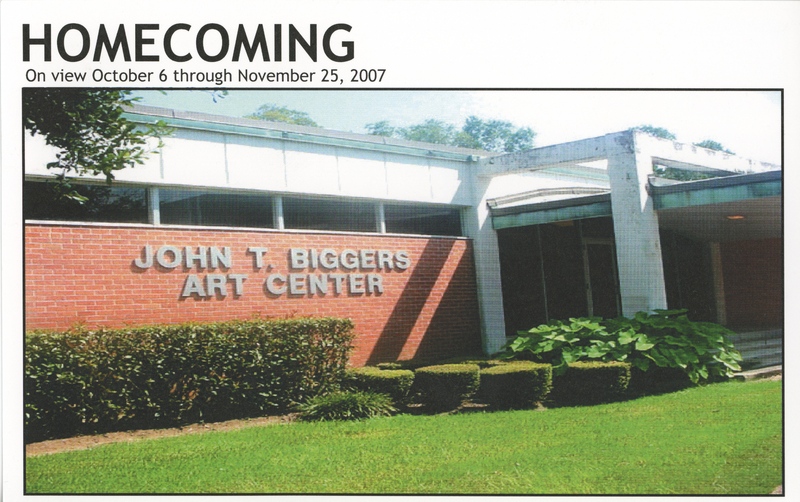
This is an invitation to the Fall 2007 Homecoming: The Third Biennial TSU Art Alumni Exhibition at the University Museum at Texas Southern. The University Museum hosts an art alumni exhibition every other fall, alternating with an art faculty exhibition. Alumni showcase their artwork, which ranges from paintings, prints, and photographs to sculpture, jewelry, and wood carving.
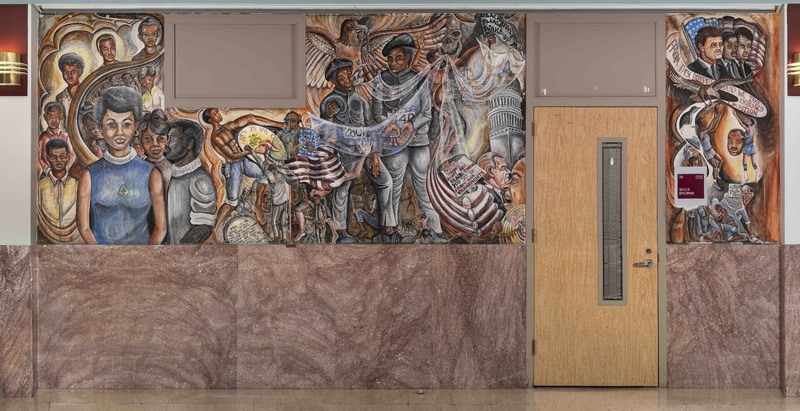
Ellison’s pair of murals speaks to political and social issues of the 1960s and 1970s. The murals express hope through resistance, in spite of the challenges facing Black America. In the middle, a bald eagle holds a broken lynch rope in its beak and “the law” in its talons.
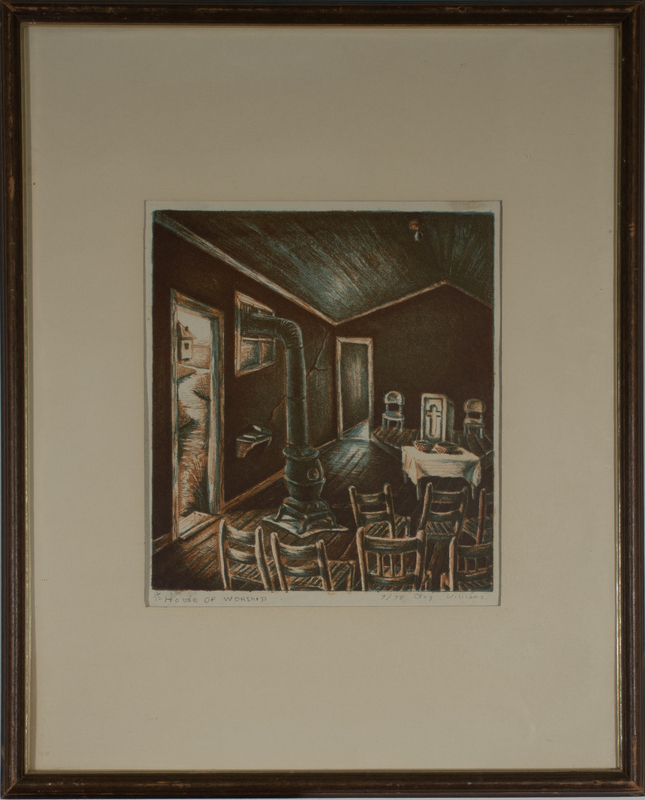
This print by Roy Williams depicts a modest Christian worship house. The door is open, and the seats are arranged as if a service is about to begin or has just ended. A fireplace warms the church, and a path out the door snakes through a field. Dr. John T. Biggers taught students the craft of printmaking while he was a professor at Texas Southern University.
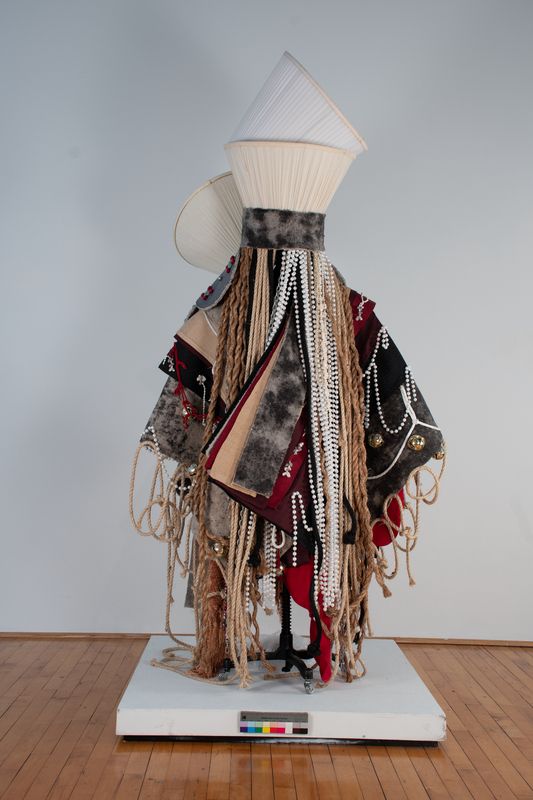
Noah is a Cameroonian artist who had a residency at TSU in Spring 2023. The work was inspired by Bamiléké masquerades and the Demeure 5 costume by Étienne-Martin, and is made of materials from second-hand shops in Houston. Noah wore the costume during an interactive procession down the Tiger Walk, TSU’s central campus walkway. The costume became part of the exhibition, Memory Palaces: Creations of Franck Kemkeng Noah.
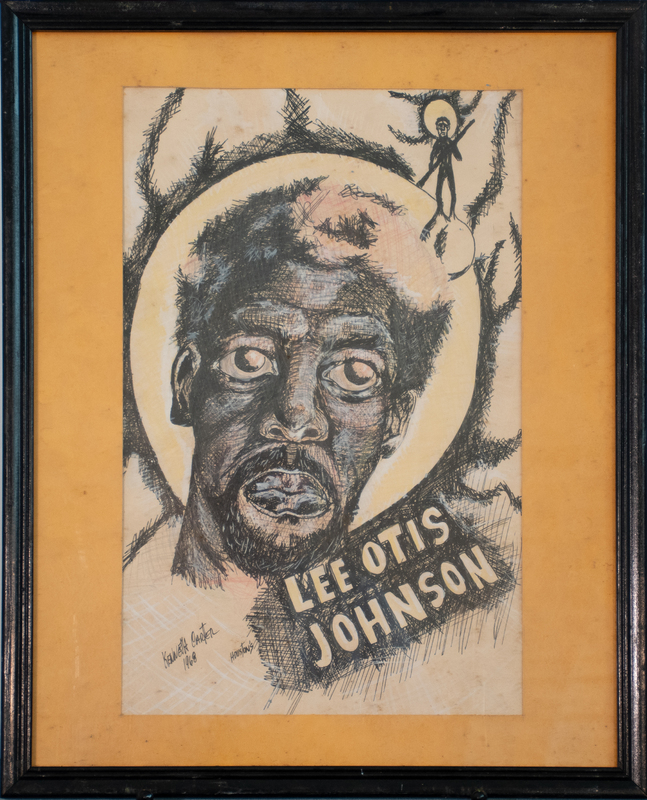
Carter’s drawing is of Lee Otis Johnson, a former TSU student, organizer, and leader of the Houston Student Non-Violent Coordinating Committee. Houston police repeatedly targeted Johnson, and in 1968 they arrested him for passing marijuana to an undercover officer, and a judge sentenced him to 30 years in prison. This injustice gained widespread notoriety, and “Free Lee Otis” became a rallying cry.
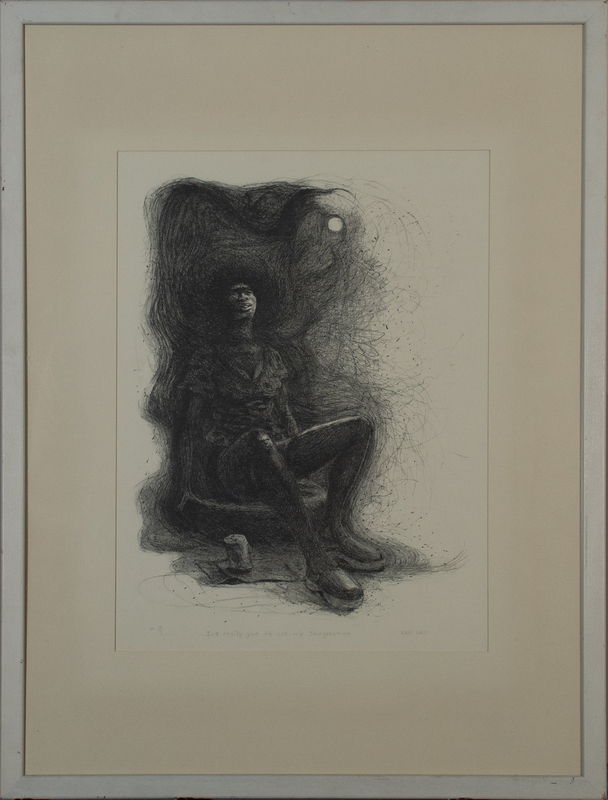
Hall's print depicts a seated woman with a dark aura around her. A candle sits near her feet, perhaps just having been blown out. Light from the moon reflects on her face, knee, and shoe. The sketched lines extending out from the figure may suggest her imagination expanding past her physical form. Hall later became a longtime art teacher in Houston Independent School District.
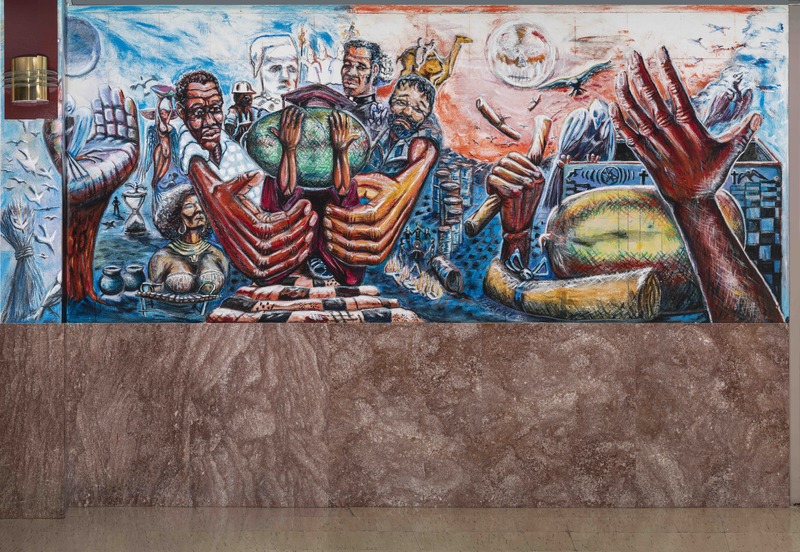
The artist boldly tackles the often stereotypical image of the watermelon while depicting the hypocrisy of organized religion in the Black community and the constant threat of the Klan. The large, reaching hands pull at a recent graduate, whose face is obscured by the watermelon they are holding.