The HCAC public history focused digital archive cataloging is an ongoing process, and we may update this record as we conduct additional research and review. We welcome your comments and feedback if you have more information to share about an item featured on the site, please contact us at: HCAC-DigiTeam@si.edu
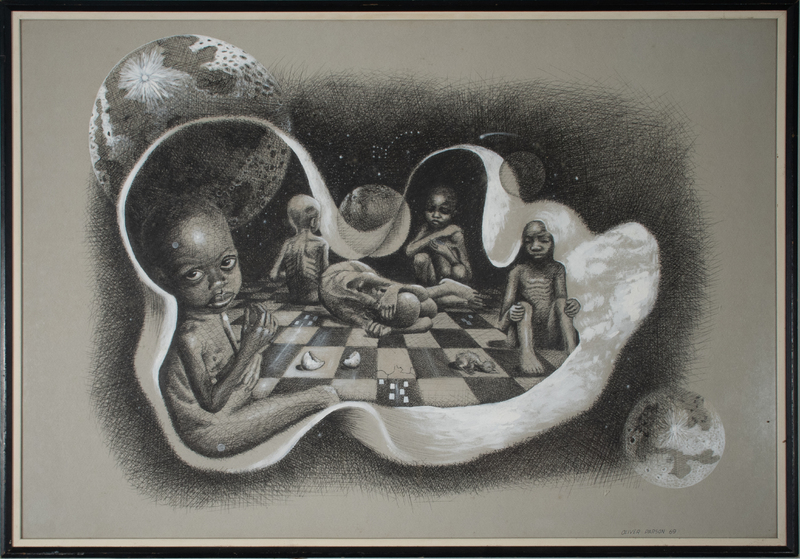
This drawing by Oliver Parson shows a group of emaciated children seated on a checkerboard patterned floor. There is also a chick, just hatched from its egg, that seems to be struggling to survive. Parson has an incredible talent for conveying powerful emotions in his works. The checkerboard and other sacred geometry imagery appear frequently in the works of Dr. Biggers's students.
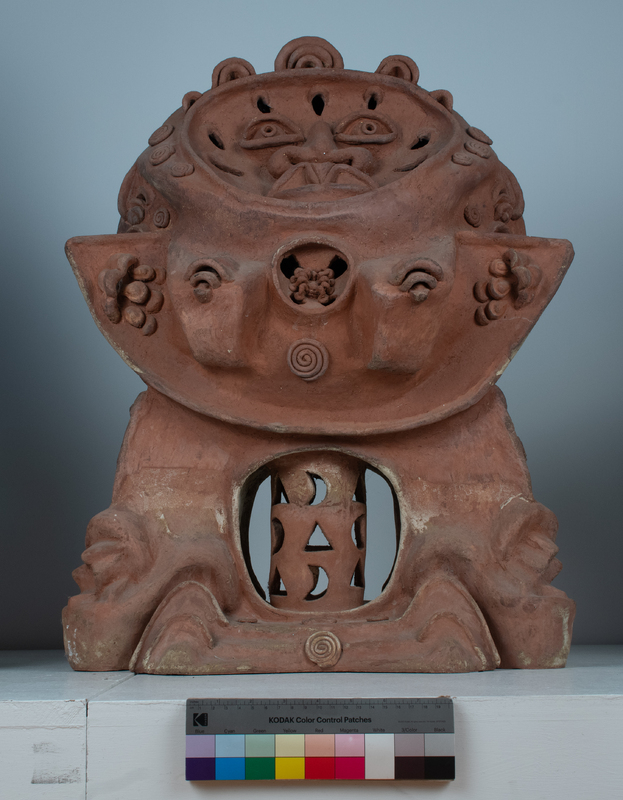
“Sun Stool,” created by Anthony Haynes, resembles an Ashanti stool, a seat for royalty of the Ashanti Empire. The sculpture is decorated with spiral embellishments, triangles, moons, and other indentations. Facial features are also included at the front head of the stool; the rear face of the stool resembles a baboon's face.
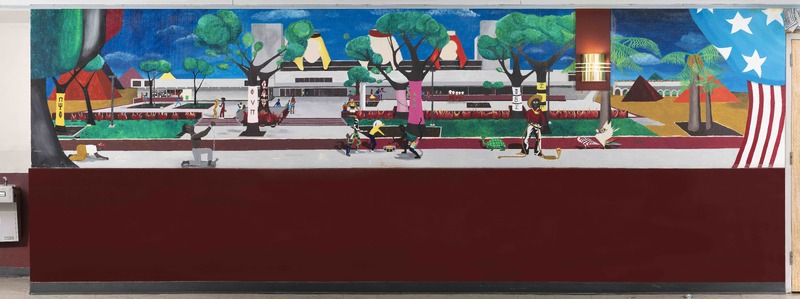
Focusing on the Sterling Student Life Center, the artist captures the lively activities of students and reflects the importance of Black fraternities and sororities in HBCU student life. Realism is paired with the surreal imagery of fantastic figures dancing around the music blasting from a boombox.
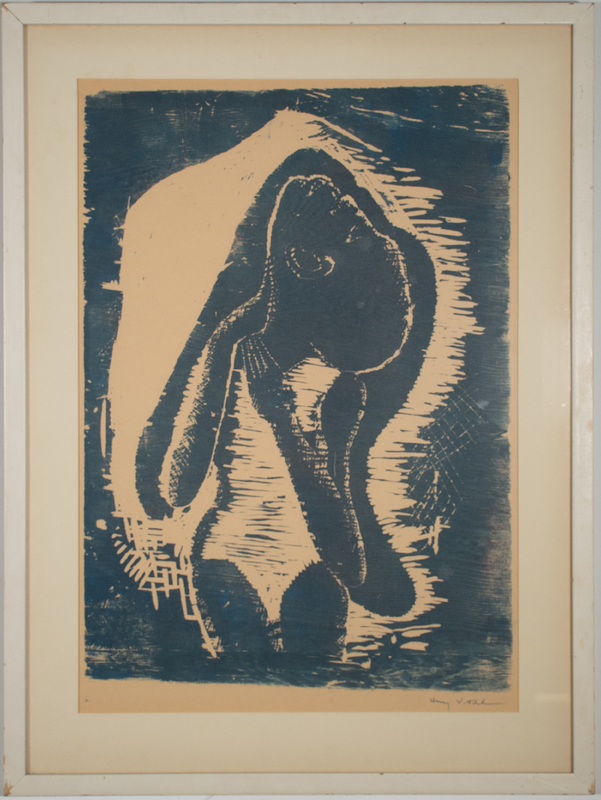
This print by Harry Vital shows a woman in a swimsuit tilting her head upwards. Dr. John T. Biggers taught students the craft of printmaking while he was a professor at Texas Southern University. Vital followed in Biggers' footsteps and became a longtime art professor at TSU.
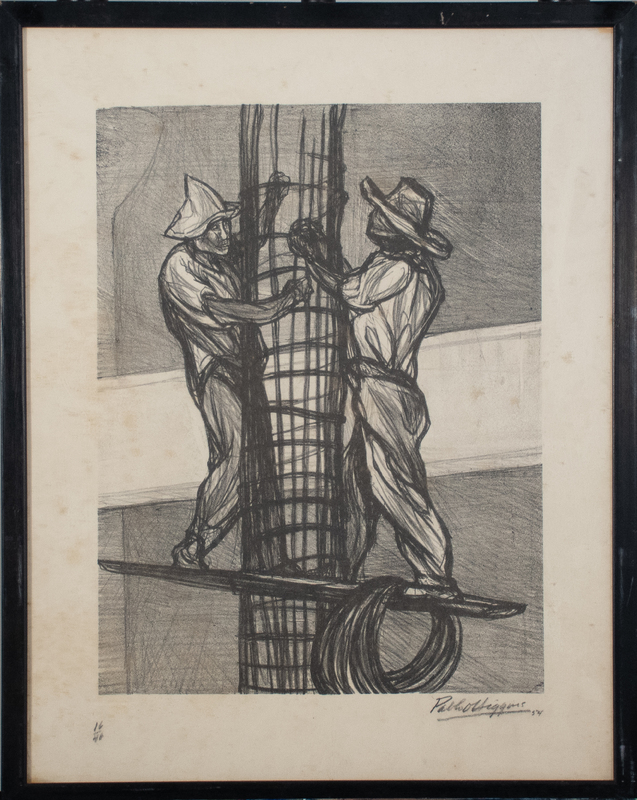
O'Higgins' print shows two men balancing on a board and working on a cylindrical structure. Unlike most of the works held by the University Museum, O’Higgins had no connection to Texas Southern; this piece was donated by a collector. O'Higgins was an established artist in the 20th century and was mentored by Diego Rivera.
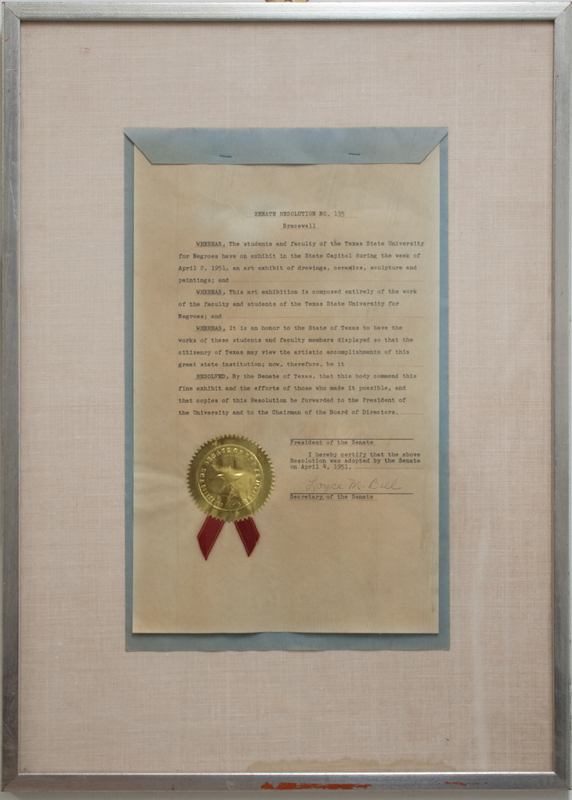
This Texas Senate resolution commends the art students and faculty of Texas State University for Negroes (now Texas Southern University) for their exhibition in the State Capitol in April 1951. It is notable that this exhibition took place years before desegregation.
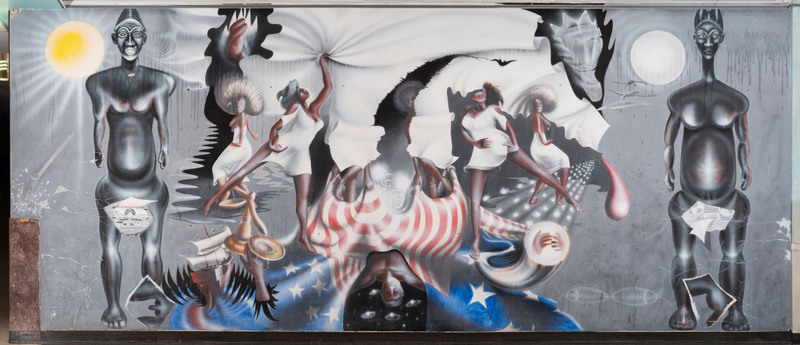
A commentary on the conflict between technology and progress, history and culture, Davis painted this mural in response to the destruction of several Hannah Hall murals to create windows into a new computer lab. Davis’ own mural was later damaged by subsequent construction, as foreseen in its design.
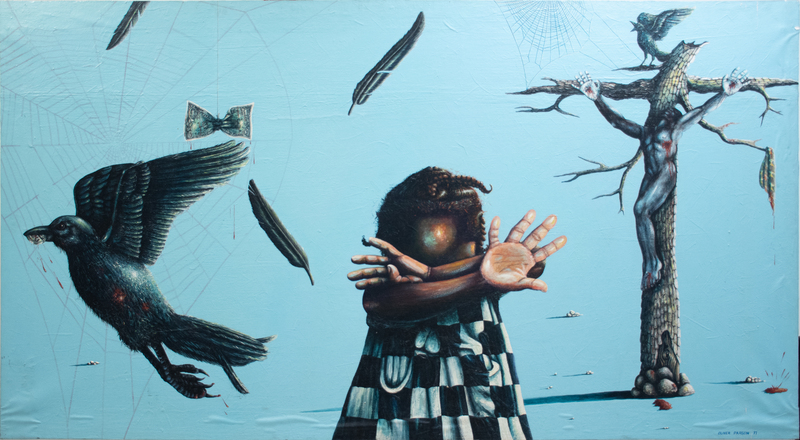
Parson’s painting shows a young girl shielding her face. To the left, a crow holds a coin and a dollar bill is on a fishing line; to the right Jesus is crucified, below a perched crow. The crows may allude to Jim Crow, which made racism law from after the Civil War until the 1960s; crows are also a symbol of death. The dollar bill as bait perhaps suggests the corrupting nature of money.
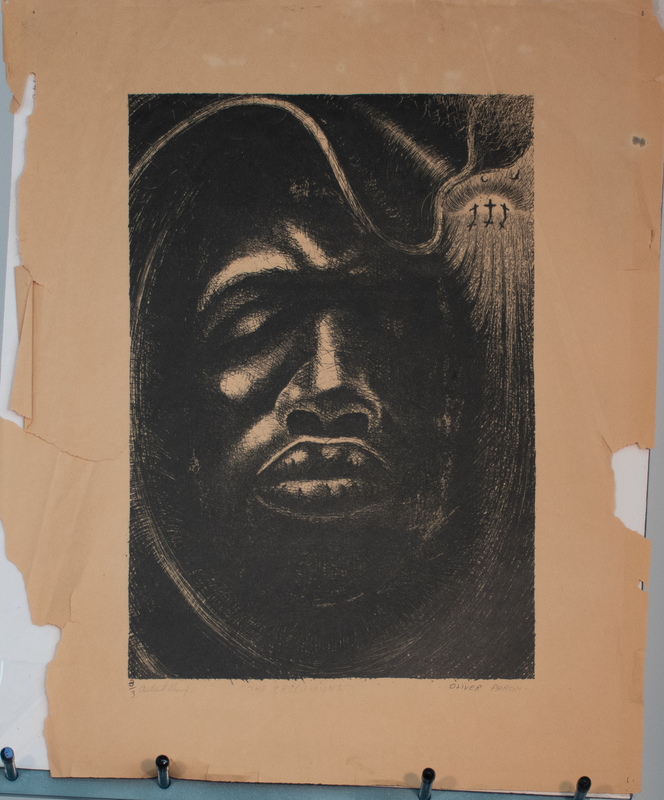
Parson's print shows a face with closed eyes and a solemn expression on its face. In the background, three crosses stand ominously, alluding to the crosses where Jesus, Dismus, and Gestas were crucified. Dark, crosshatched swirls fill the entire composition. Parson and other TSU students learned the crosshatching technique from Dr. Biggers and used it to create smooth, detailed shapes.
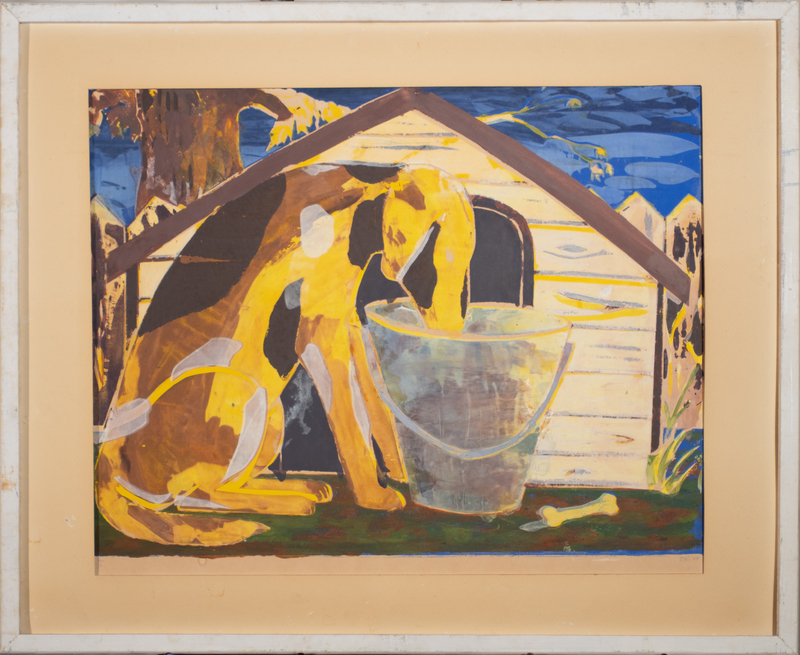
Sampson’s print shows a large, colorful dog drinking from a pail of water. The setting appears rural, with a wooden fence and a large tree in the background. Sampson’s artwork in TSU’s permanent collection often depicts nature and rural homes. More broadly, animals and the natural world are frequent subjects of the artwork of TSU students.
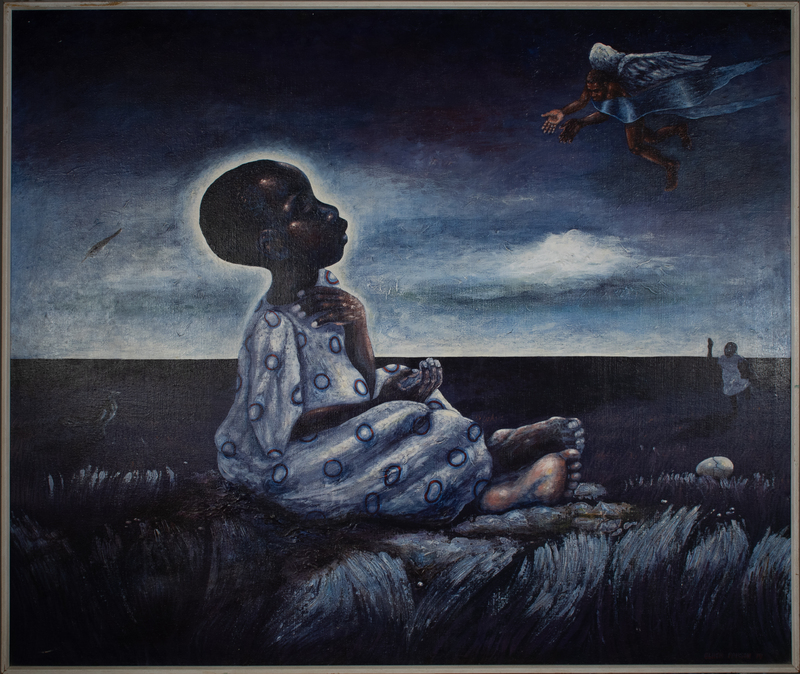
This work, by Oliver Parson, is a calm and dreamlike scene of a child sitting in a prairie, as an angel and a person both race towards him. Both figures may represent salvation; the person aims to rescue him from death, while the angel tries to save him from Earth. A faint glow emanates from the child.
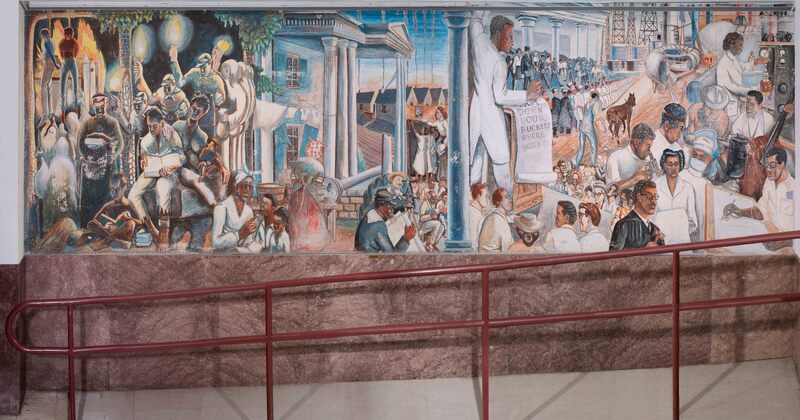
Washington’s mural is a timeline of Black education. On the left, he depicts slavery and lynching above enslaved people secretly reading. In the center, students write “Emancipation Proclamation” and Booker T. Washington delivers his "Atlanta Compromise" speech. The right depicts emerging Black professionals.
Donato's painting shows a crowd gathering around him after a car crash, but not rendering aid. Donato crafts a scene that blends reality and fiction: he portrays himself bloodied like Jesus on the cross, surrounded by real neighbors of his from Frenchtown, a section of Houston's Fifth Ward, but there was no such car crash.
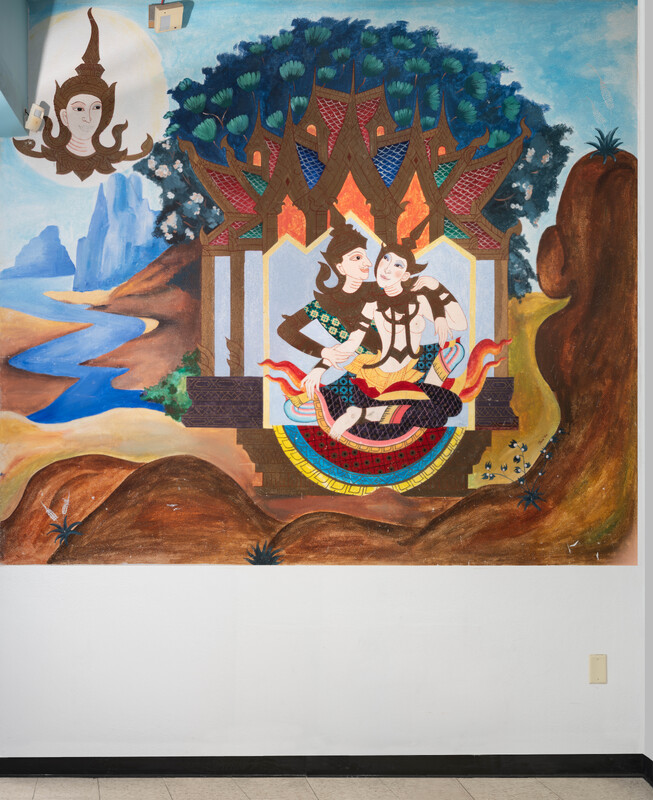
Charoennimuang’s Hannah Hall mural draws inspiration from her birth country, Thailand. In her own words, it “is a Thai style mural-painting that expresses the love of two human beings…surrounded by the beauty of nature…. The man and woman are dressed up in Thai-style like the old days…neatly weaved and knitted in a Thai pattern…made of Thai silk.” The study for this mural included a dragon in the upper right corner that was cut from the final design.
Sifuentes' print depicts the exterior of an old church. An adult and small child are seen entering the church, which lies at the end of a winding path. Chickens are seen pecking at the ground, lending a sense of place to this rural scene. Churches and other religious imagery appear frequently in the artwork of Texas Southern students. Sifuentes later went on to become an art professor at Texas Southern.
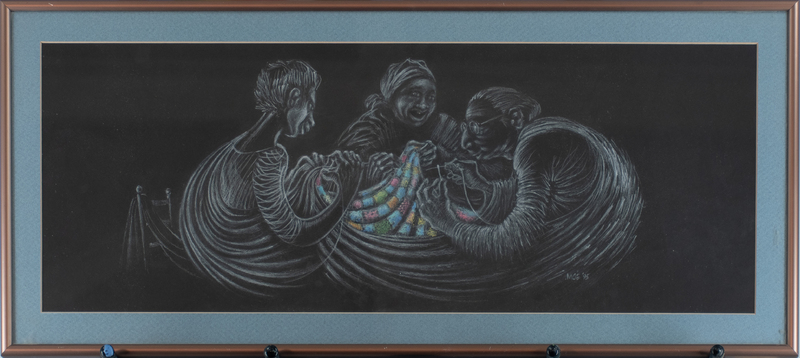
Moe’s drawing shows three elderly women working together to craft a quilt. Quilting is a traditional craft of Southern Black women, and also an important community activity. Moe’s composition is set against black paper and drawn all in white, with the exception of the vibrant colors of the quilt. This shows the richness of the communities and lives embodied in the quilt.
In this mural, Mother Nature is attacked by oil derricks, pollution, and industrialization. Jones painted this work as a response to the rapid expansion of oil drilling throughout Texas. Jones still engages with nature, now creating wood carvings from fallen timber after Galveston storms.
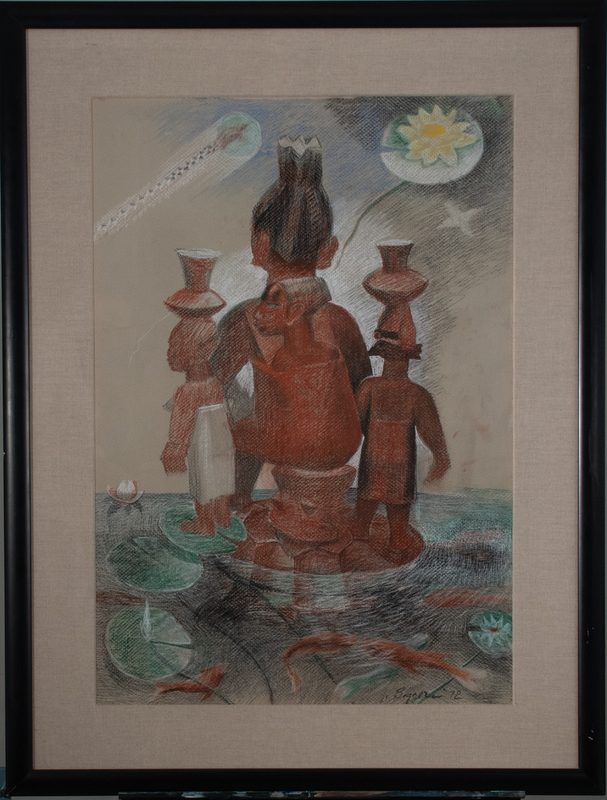
In the center of this drawing, a mother, wearing her child on her back, floats on the back of a tortoise, flanked by a female and male carving. Lilypads float alongside them, while fish swim throughout the pond. In the sky, a lily covers the full moon, while a turtle flies into the night, representing the connection between the terrestrial and celestial. While living in Houston, Dr. Biggers often walked along Buffalo Bayou in the morning, watching fish swim as the sun slowly replaced the moon in the sky.
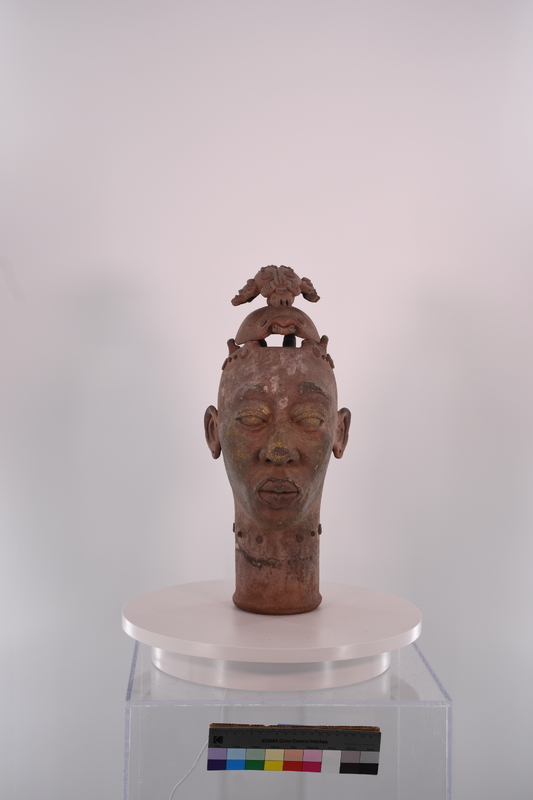
Moore’s bust was created during his time as an art student at TSU. Under the instruction of Professor Carroll Harris Simms, artists would create self-portraits embellished with decorations like spirals and accentuated crown pieces, like in Moore’s sculpture. Moore’s crown details include horns on both sides, green holes in the head, and a miniature mask in the center of the forehead. These busts are inspired by Nok terracotta sculptures and Ife busts, which Simms saw during his travels to Western Africa.
Davis's sculpture depicts a stylized version of the artist's head and neck, with a removable crown piece. The crown looks like a turtle with an insect atop it. The neck, crown, and forehead are all adorned with swirls, the most common motif in the terracottas of Simms' students.
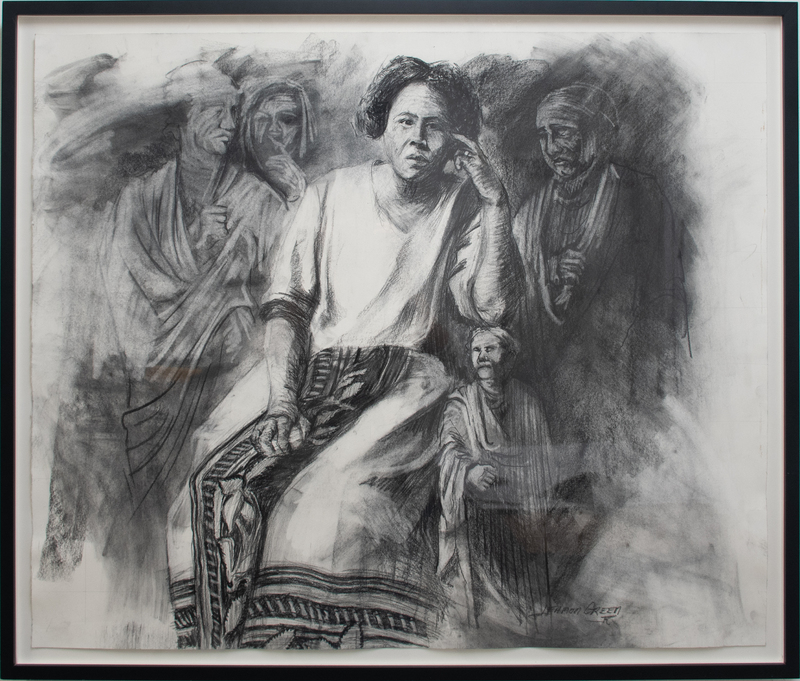
Green's drawing depicts a central female figure, deep in thought, surrounded by faint, whispering figures. The scene is reminiscent of a queen's court, with the monarch encircled by attendants and advisors. Green taught painting and printmaking courses at Texas Southern until his retirement in 2024.
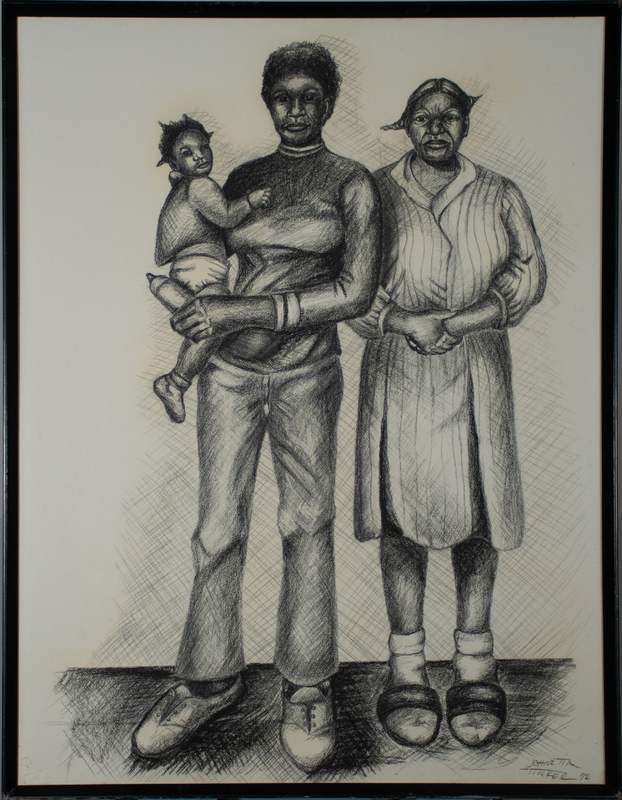
Tinker's drawing appears to portray three generations of women, with a baby, her mother, and her grandmother. The mother holds her daughter and her bottle; the grandmother stands behind them with her hands crossed. Dr. Biggers’ artwork often centered women and their contributions to the family and society. He passed these themes along to his students, who, like Tinker, frequently highlight the relationship between mother and child.
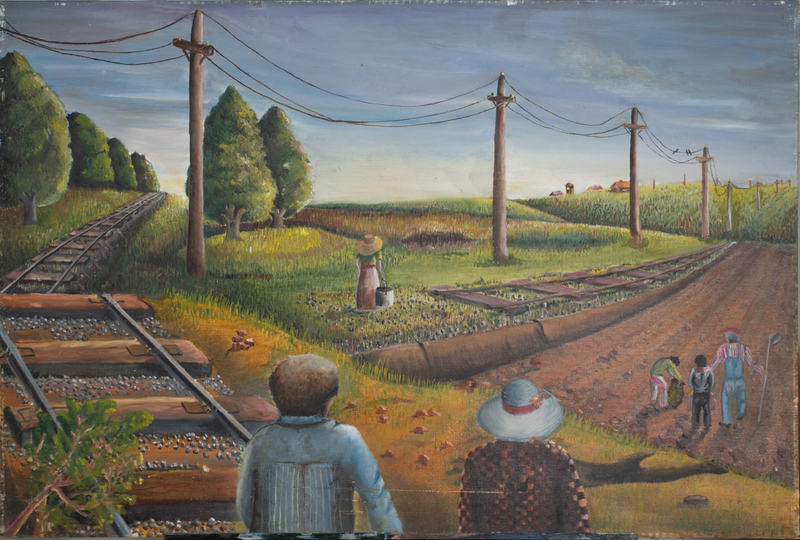
Leonard Henderson's cool-colored composition depicts a calm landscape of farmers working a field next to train tracks. The tracks running next to the field may hint at the contrast between urban and rural life, and show the development of rural areas during the turn of the 20th century.
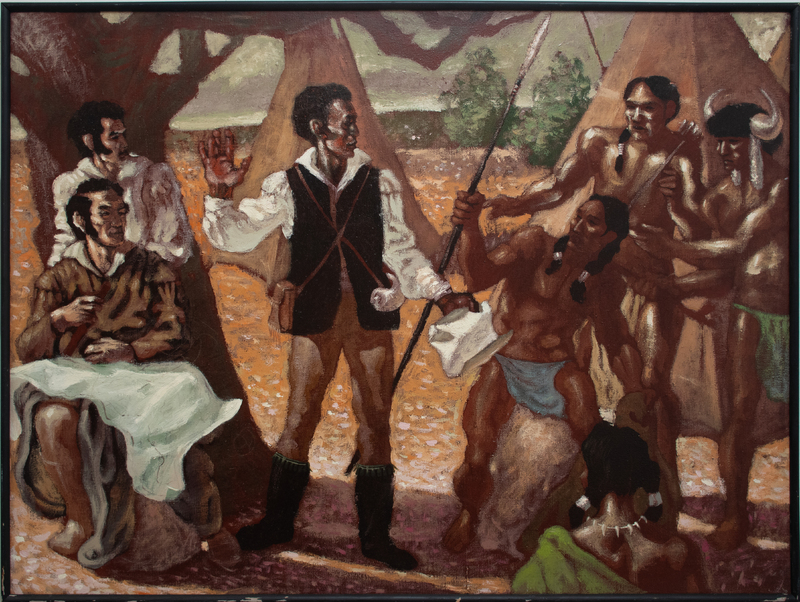
Oliver's painting depicts an accord between settlers and a group of indigenous Americans. Colonizers consistently broke their agreements with tribes and took more and more land from them. Indigenous peoples of the American Southwest are frequent subjects of Oliver's work.
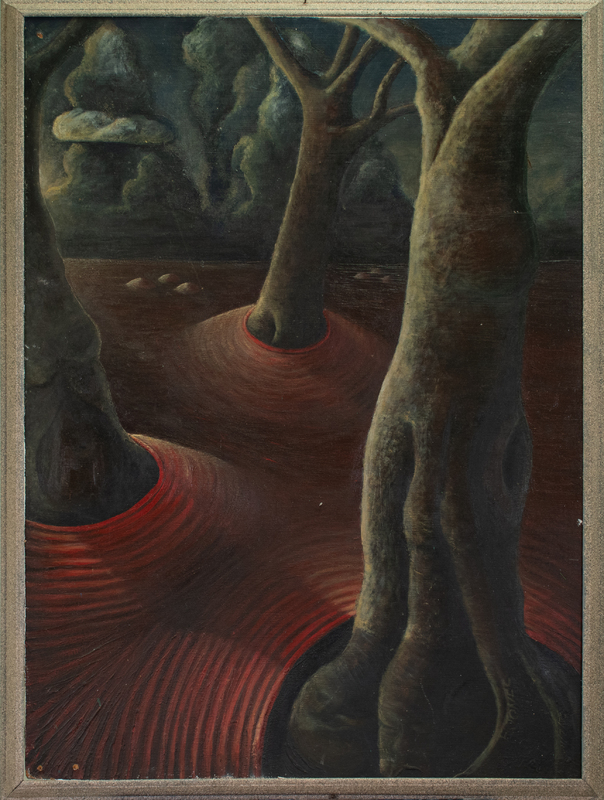
This work by Earl Jones is an abstract, desert landscape of barren trees, emerging from red and orange rings in the ground. Jones was a student at Texas Southern in the mid-1970s and was taught by artists and instructors like Dr. John T. Biggers and Professor Carroll Harris Simms. Biggers frequently urged his students to draw inspiration from nature and their immediate surroundings.
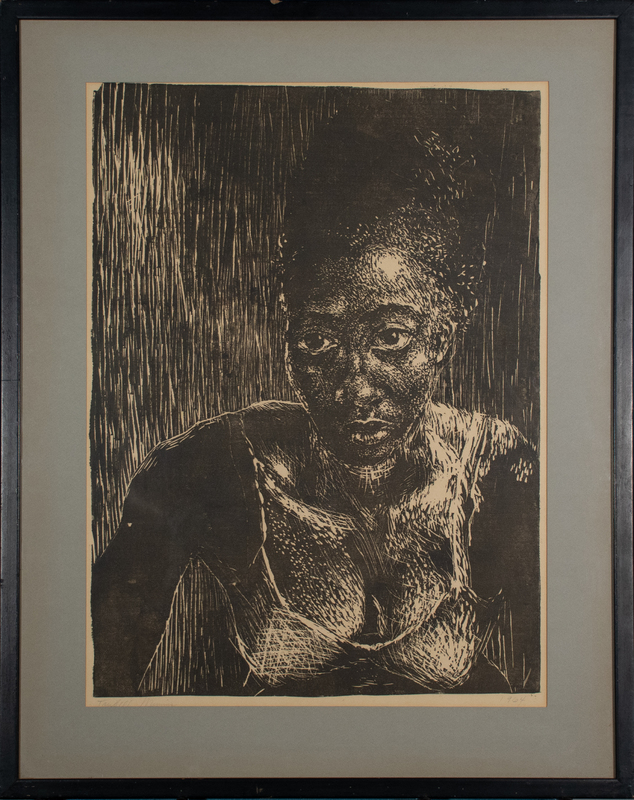
Obey’s print is a self-portrait. Under the direction of Dr. Biggers and Professor Simms, students would paint and draw self-portraits and sometimes sculpt self-portraits of their busts. This print depicts Obey in her bra; she also painted a self-portrait in a similar style. Biggers once referred to Obey as "one of our finest painters.”
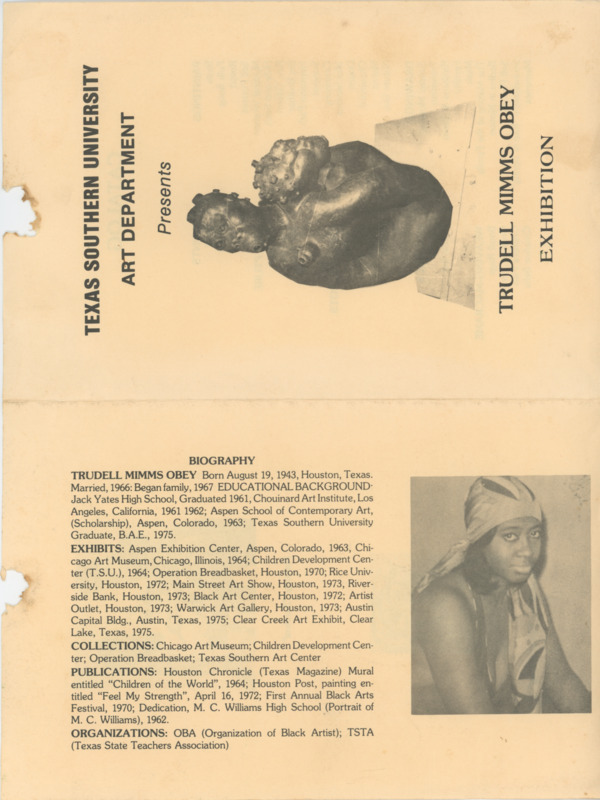
This is a brochure for Obey’s senior art exhibition. The culmination of the Texas Southern art curriculum is a senior exhibition where students showcase artwork created over the course of their undergraduate studies. The brochure features a photo of Obey, a brief biography, a catalog of the artwork featured in the exhibition, a photo of her terracotta sculpture, a photo of one of her drawings, and a photo of one of her paintings. Dr. Biggers remembered Obey as one of his favorite students.
Obey's senior notebook includes her written philosophy of art, photographs of the artist’s works and her process, and a copy of her senior exhibition brochure. As a part of the Texas Southern art curriculum under Dr. John T. Biggers and Professor Carroll Harris Simms, students would create these notebooks to explain their artistry and showcase the works they created as students.
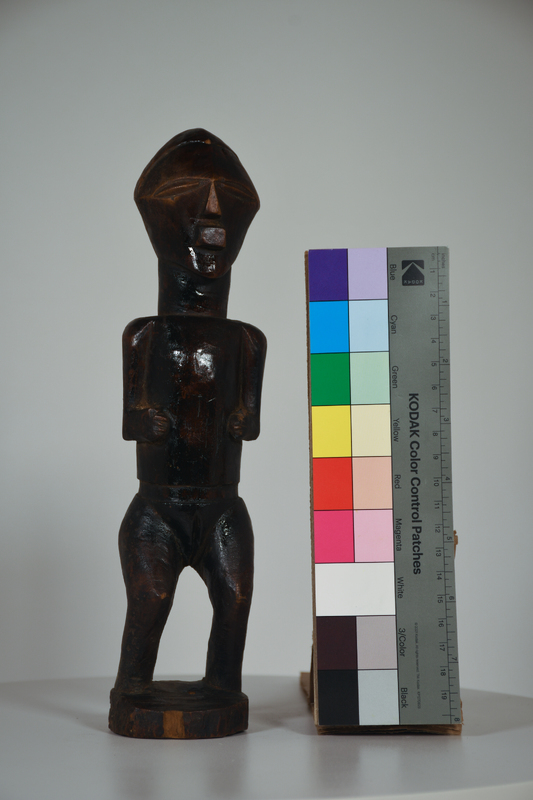
This is a simple work of a richly colored woman featuring a geometric face with oval eyes, a triangle nose, and a prominent square mouth. The sculpture has African origins, yet the specific ethnic group is unknown because of the lack of body markings and hair adornments. The sculpture has a glossy finish.
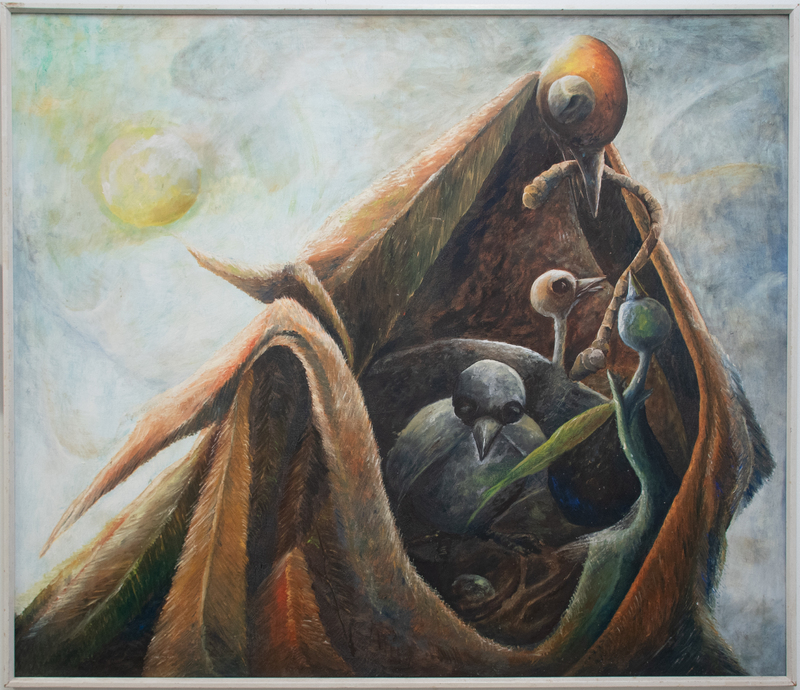
Vital's painting depicts a bird feeding a worm to its three offspring, reflecting the theme of the mother & child(ren) relationship that often appears in TSU student work. The artist often featured animals and nature in his work. After his graduation, Vital taught art for many years at Texas Southern.