The Margaret Walker Center is an archive and museum dedicated to the preservation, interpretation, and dissemination of African American history and culture. Founded as the Institute for the Study of the History, Life, and Culture of Black People by Margaret Walker in 1968, the Center seeks to honor her academic, artistic, and activist legacy through its archival collections, exhibits, and public programs. Open to the public, the Center houses significant records like the papers of the late Margaret Walker; those of the former U.S. Secretary of Education, Roderick Paige; and an oral history department that includes nearly 1000 interviews. It also offers museum and exhibit spaces that highlight the Center’s collections and the history of Jackson State University.
Curated By
Garrad Lee
Date Modified
2025-12-12
Rights
All rights held by the Margaret Walker Center. For permission to publish, distribute, or use this image for any other purpose, please contact Margaret Walker Center, Jackson State University, 601-979-3935 Attn: Center Director
About This Record
The HCAC public history focused digital archive cataloging is an ongoing process, and we may update this record as we conduct additional research and review. We welcome your comments and feedback if you have more information to share about an item featured on the site, please contact us at: HCAC-DigiTeam@si.edu
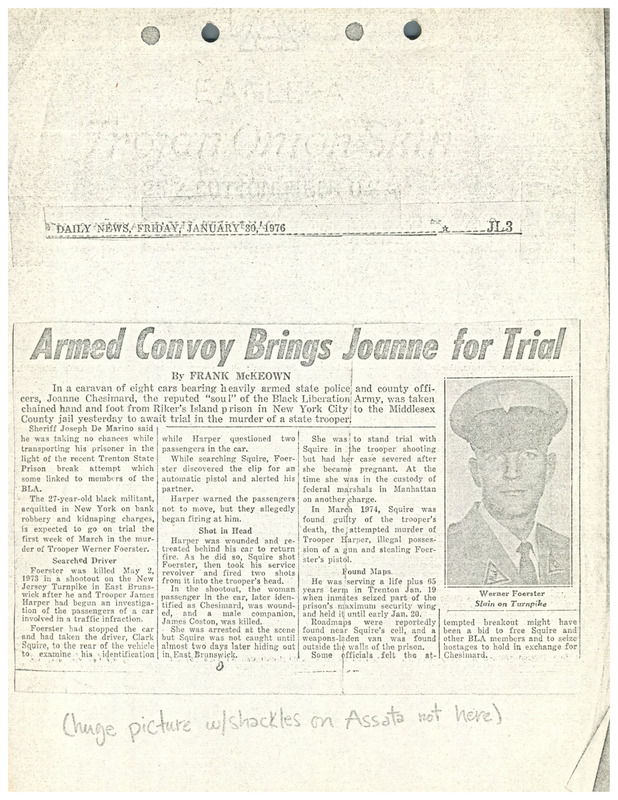
A newspaper article from Daily News about Assata Shakur (JoAnne Chesimard) being in New Jersey to stand trial for the May 1973 killing of a state trooper. Shakur was convicted in 1977 of killing the state trooper during a shootout, escaped prison in 1979, and is still wanted by the FBI.
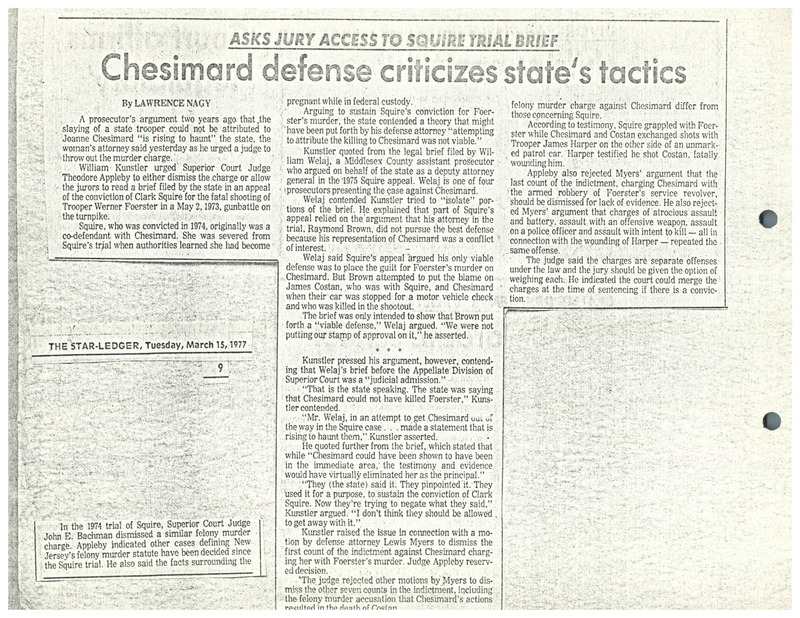
A newspaper article from The Star Ledger about the defense team for Assata Shakur (JoAnne Chesimard), who was on trial for the 1973 killing of a state trooper, opening their case by calling for dismissal of the murder charge on the grounds that she cannot be convicted since Clark Squire has already been convicted of the killing.
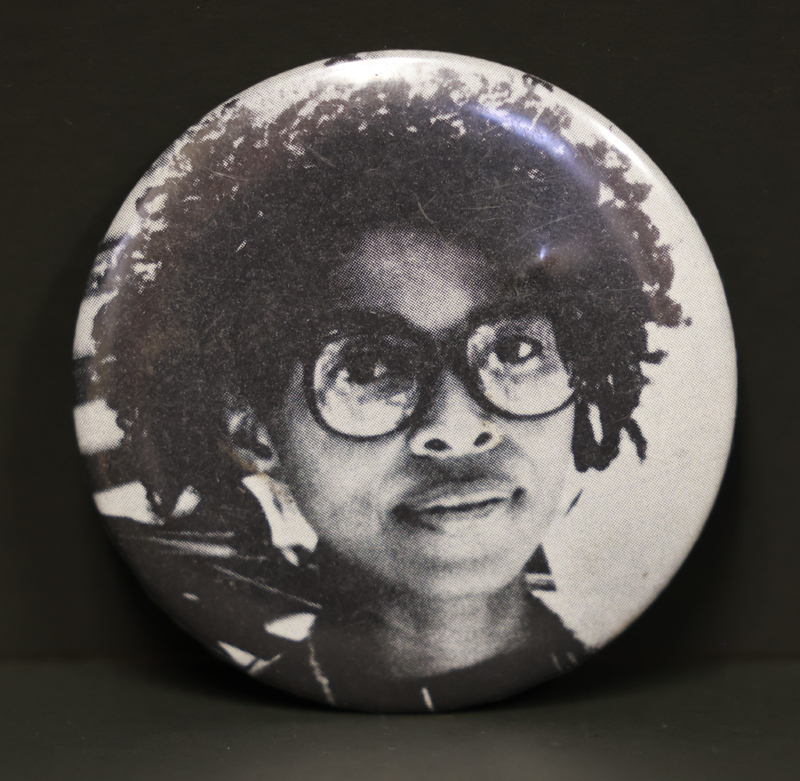
A button with a black and white photo of Assata Shakur. She is a political activist and was a member of the Black Liberation Army (BLA), an organization that engaged in armed struggle with the U.S. government. In 1977, she was convicted in a cop-killing case from 1973. Escaping prison in 1979, she has lived in political asylum in Cuba ever since.
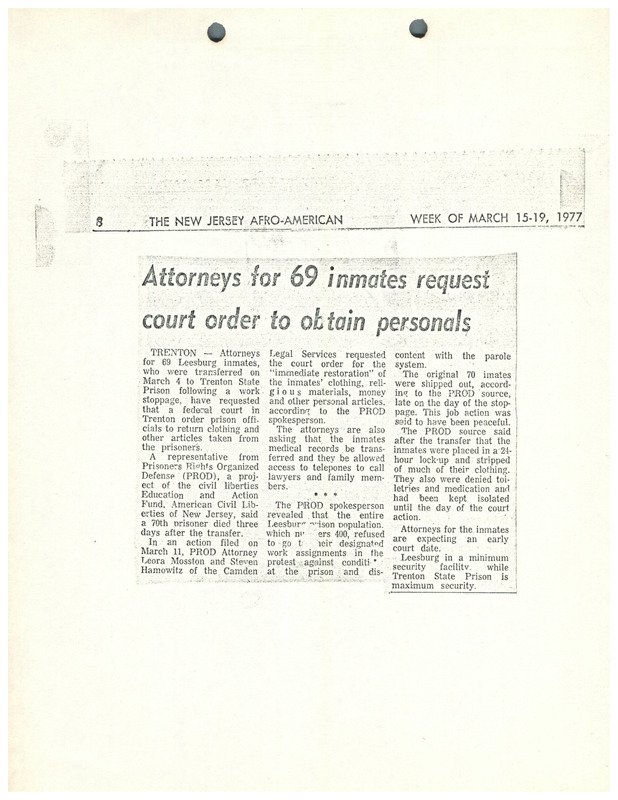
A newspaper article from The New Jersey Afro-American about prisoners who refused work assignments as a protest over living conditions. The prisoners were transferred and denied their personal belongings, telephone calls, and medical care. The group Prisoner’s Rights Organized Defense (PROD) asked a judge to restore everything for the inmates.
Barbara Strauss was a member of the board of directors of the Bethlehem Center in Jackson, Mississippi, a United Methodist Church organization that does work in impoverished communities. She talks about her extensive work in these communities and the Bethlehem Center sponsoring the opening of the first Head Start in Jackson.
Barbara Mason discusses the beginnings of Head Start in Utica, Mississippi, in 1965 and sending her daughter to attend the Head Start Center at St. Mark's Catholic Church. She goes on to talk about working at a Head Start center in Jackson, Mississippi, as a driver for the kids in the program.
Beatrice Coats talks about her involvement in voter registration work with the Mississippi Freedom Democratic Party. She talks extensively about her experiences helping to register people to vote in 1964, after being a registered voter herself since 1946. That work led her to helping open a Head Start Center in Hollandale, Mississippi.
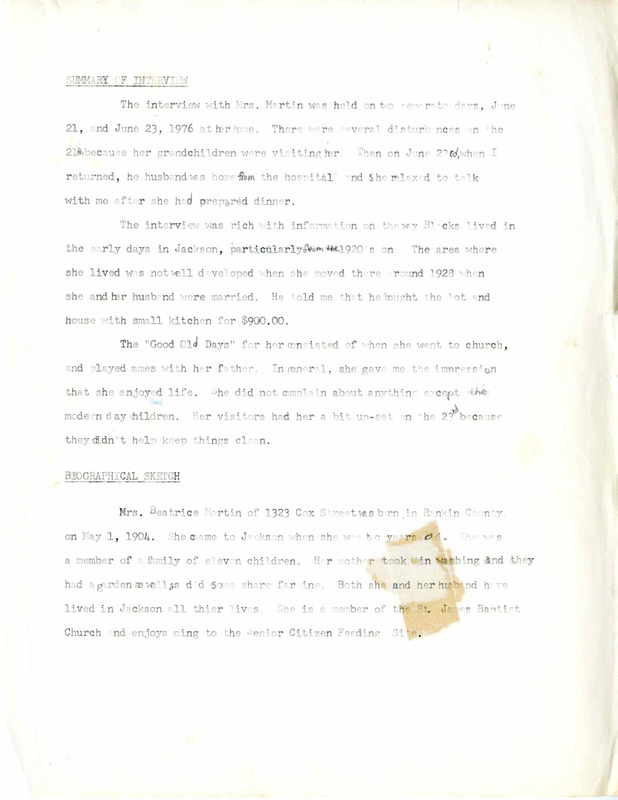
Beatrice Martin was born in Rankin County, Mississippi, in 1904 and moved to Jackson two years later. For her, the "Good Old Days" were when she was younger and went to church and played games with her father. She discusses getting married in 1928 and purchasing some land and a home in a part of Jackson that had not yet been fully developed.
Bernard Thornton was born in 1908 in Natchez, Mississippi. He lived 53 of his 68 years in Jackson, Mississippi. The purpose of the interview was to learn information concerning the function of the Lynch Street C.M.E. Church in the community. Mr. Thornton talks about being a member of the church since 1925 and a trustee since 1945.
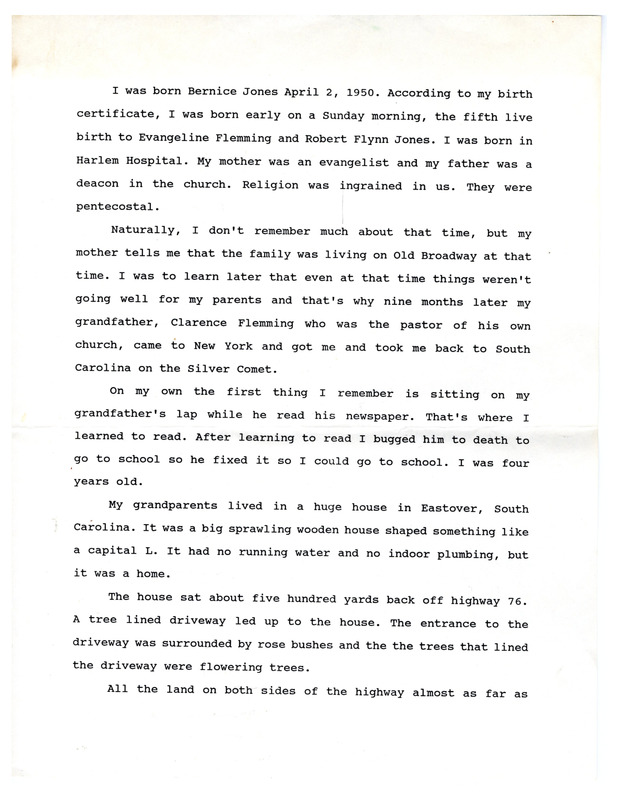
Bernice Jones (aka Safiya Bukhari) was a Black Panther Party member and vice president of the Republic of New Afrika. In this personal narrative, she tells her life story from the time of her birth in 1950 until her time in high school.
Bessie Funches began work as a teacher at the first Head Start in Gulfport, Mississippi (Harrison County Head Start) in 1966 and worked as a resource teacher for that summer. In 1973, Ms. Funches became Special Service Director of Harrison County Head Start. She talks about her experiences in the classrooms with the students and other workers.
Bessie Warren took a job in 1972 at Lift Incorporated Community Action Agency in Tupelo, Mississippi, where she worked as a rotating teacher’s assistant. Later, she became Head Start Educational Coordinator and Career Development Officer, positions she had held for 12 years up to the time of the interview.
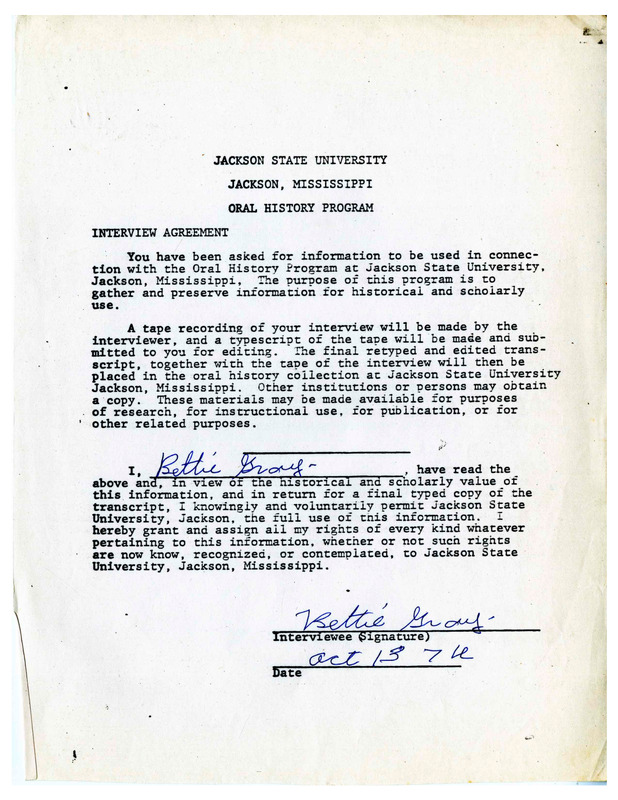
Betty Gray was born in Jackson, Mississippi, in 1903. She remembers the "Good Old Days" as a child growing up in Jackson when school days, games, and family all made for pleasant times. She also talks about her memories of the Farish Street District as well as Emmett Till and Martin Luther King, Jr. The transcript is edited with handwritten notes.
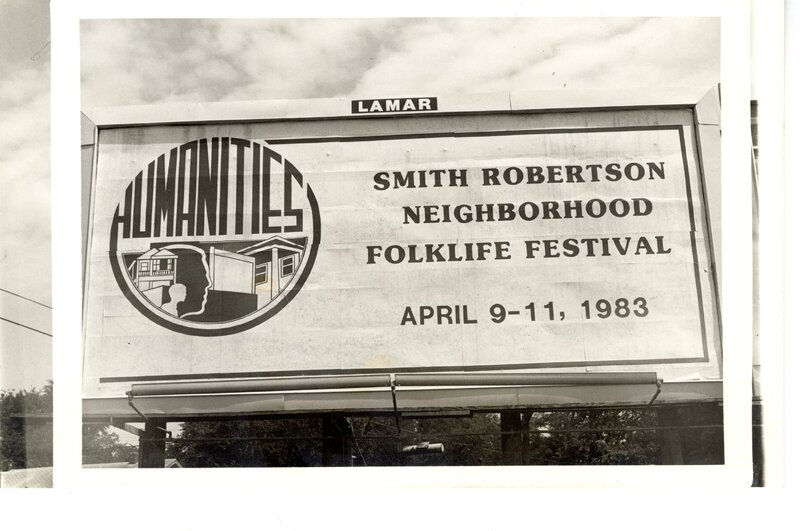
A photograph of a billboard advertising the Smith Robertson Neighborhood Folklife Festival, April 9-11, 1983. The festival was a one-time grant sponsored event held on the grounds of the Smith Robertson Museum to celebrate the rich history and culture of the Farish Street Historic District.
White square button for the Birmingham, Alabama, 1963 Foot Soldiers Reunion. There is also text on the button that says: "Inspired by what we did for ourselves-and the world." The 1963 Foot Soldiers were children marchers in Birmingham who encountered police resistance in the form of water hoses, attack dogs, and arrests.
A birthday card from Ashanti Alston, a Black Liberation Army (BLA) member who was imprisoned for 11 years for a robbery to raise money for the BLA, to Frankye Adams-Johnson (Malika). Ashanti Alston wishes her a happy birthday and gives her an update on her birthday gift.
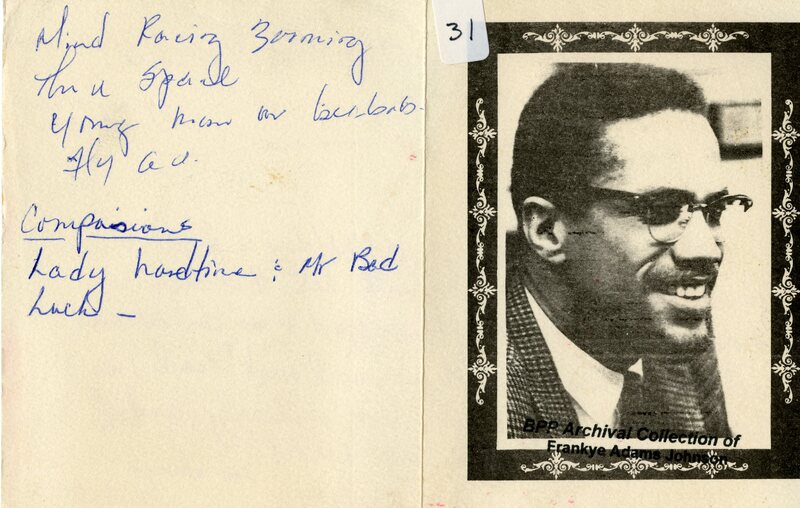
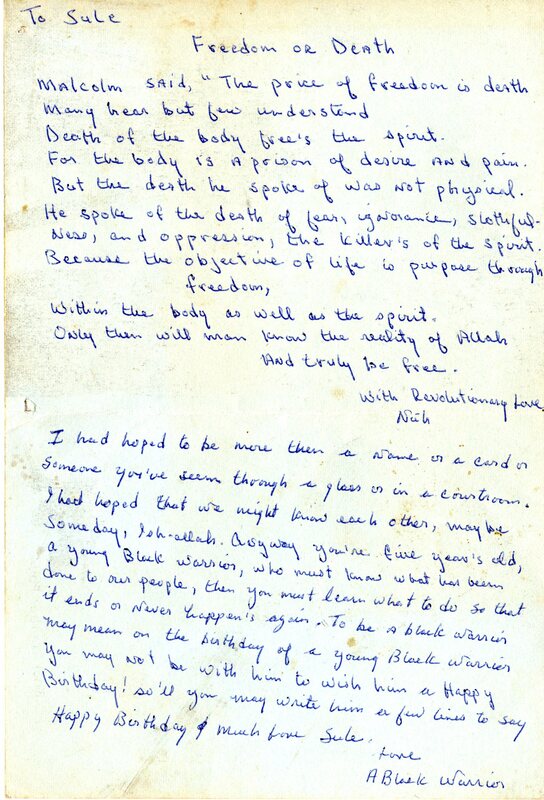
A birthday card from Nuh Abdul Qaiyum, who is imprisoned, to Sule for his 5th birthday. A photo of Malcolm X is on the cover. Nuh Abdul Qaiyum quotes Malcolm X and explains the importance of letting go of fear, ignorance, and oppression. He expresses disappointment that he is not free to wish Sule, “young Black warrior,” a happy birthday in person.
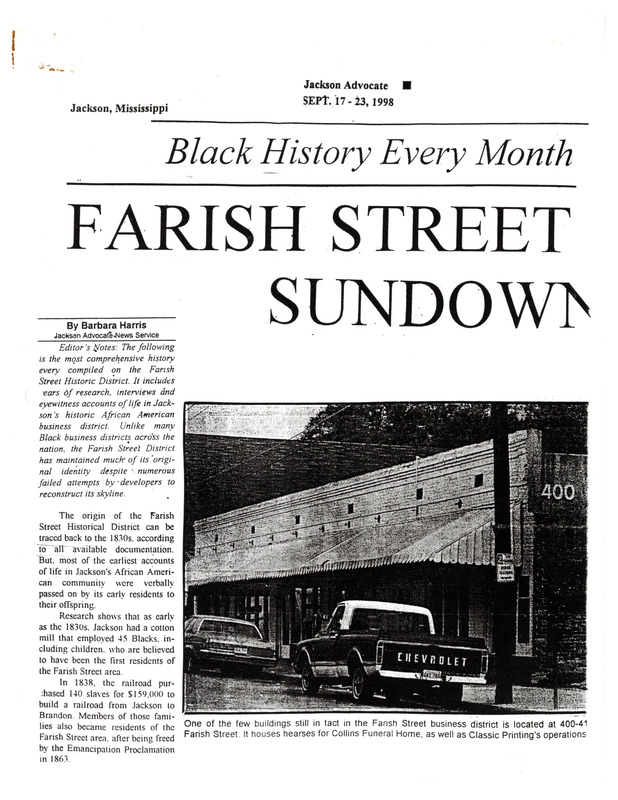
A newspaper article from the Jackson Advocate about the history of the Farish Street Historic District. Some research for the article comes from Jackson State's Farish Street Oral History Collection.
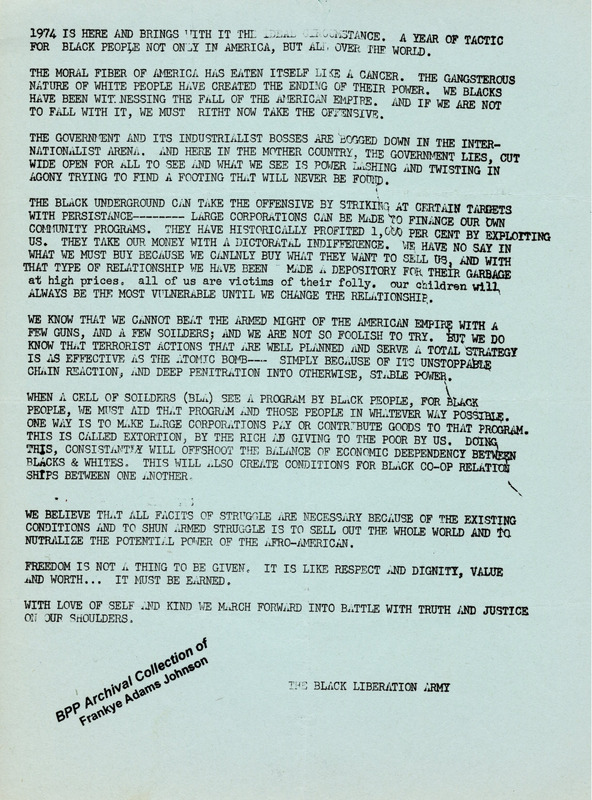
A directive from the Black Liberation Army (BLA) calling Black people in the United States to organize against the white power complex. The author writes that the end of the American empire is near and that the BLA will aid any programs that are for Black people, by Black people, including forcing corporations to contribute goods to the cause.
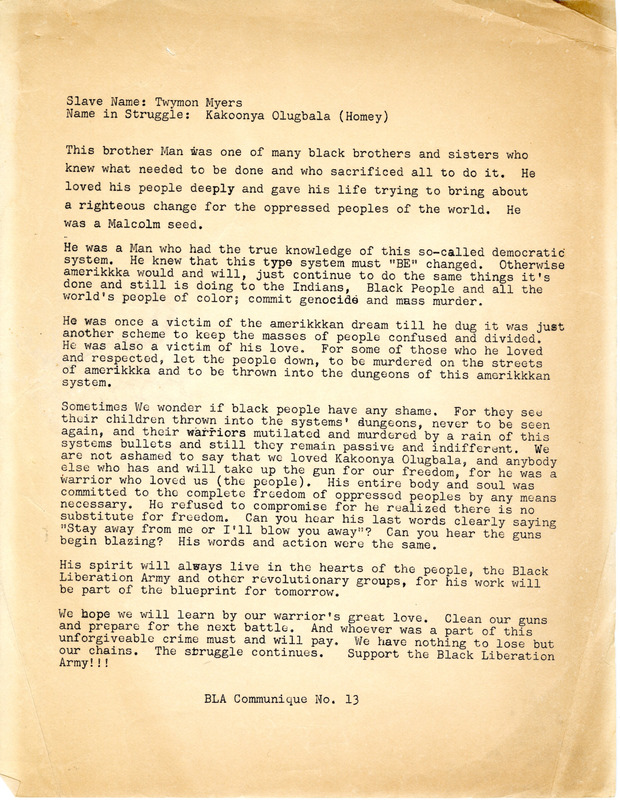
A memo from the Black Liberation Army (BLA) eulogizing Kakoonya Olugbala (Twymon Myers) who gave his life to the struggle against oppression. He was killed in a shootout with New York Police and FBI agents on November 14, 1973, after a long manhunt (he was on the FBI’s most wanted list) because of his involvement with previous police shootings.
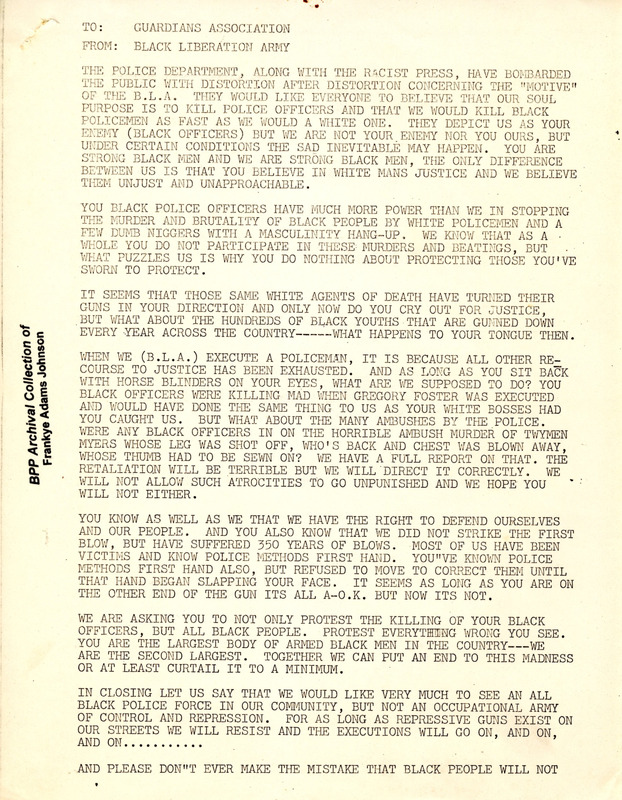
A memo from the Black Liberation Army (BLA) to the Guardians Association. The memo explains the BLA's stance on killing police and pleads with Black police officers to no longer side with their white counterparts. The Guardian’s Association is a fraternal organization primarily composed of Black law enforcement officers.
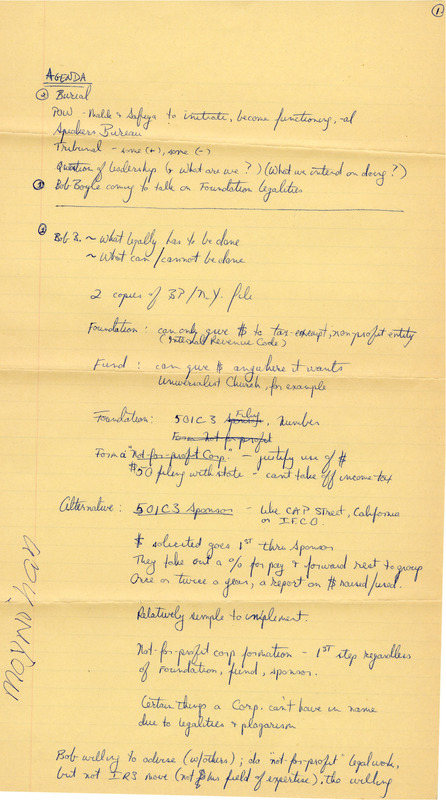
An agenda for a meeting of the Black Panther Foundation in 1987. The Black Panther Foundation discussed their leadership and a defined mission of the foundation. There is also a note about a meeting with Howard University about establishing a Black Panther Party archive.
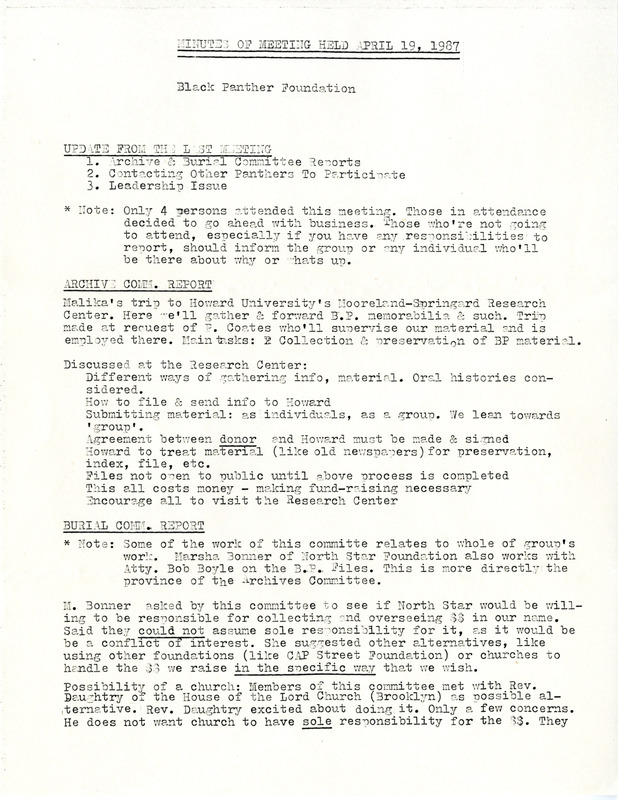
Minutes from a meeting of the Black Panther Foundation on April 19, 1987. Low attendance at the last meeting was briefly mentioned before a meeting regarding Howard University's Black Panther archive was discussed. Members discussed the burial committee, money, reaching out to new members, and the foundation’s responsibility.
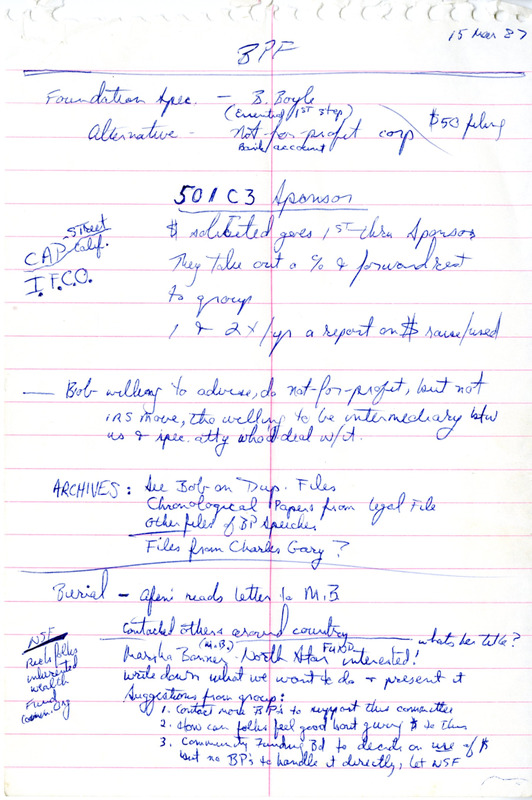
Handwritten notes of minutes from a March 17, 1987 meeting of the Black Panther Foundation. The meeting covered such topics as sponsors for the foundation, archives, burial, prisoners of war, speakers bureau, leadership, and criticisms.
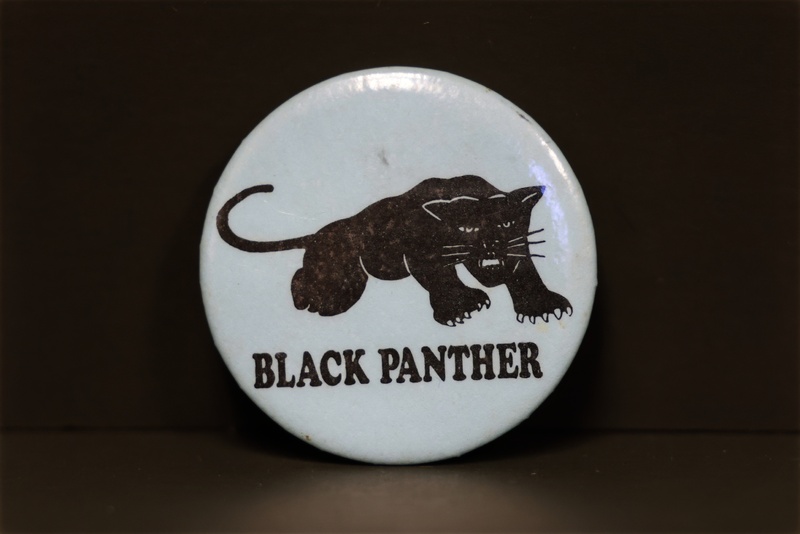
A blue button with the Black Panther logo and text that says “Black Panther.” The Black Panther Party for Self Defense was founded in 1966 by Bobby Seale and Huey P. Newton in Oakland, California. Rooted in Black Power and Marxist-Leninist ideologies, the Black Panther Party would soon spread with branches all over the United States.
A proposed budget and income statement prepared for the Black Panther Newspaper Committee. The budget totals $221,750 and covers everything needed to operate the paper for a year: salaries, equipment and supplies, communication, printing, travel expenses, attorney and accountant fees, and office rental.
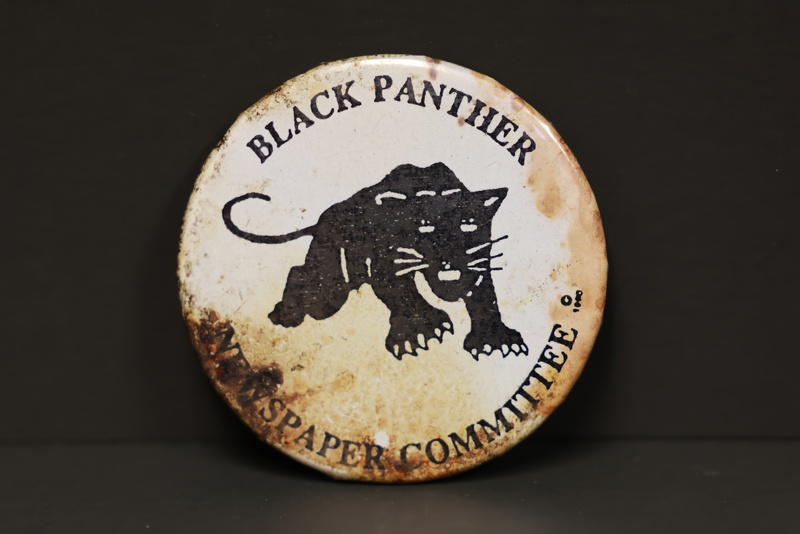
A white button with a picture of the Black Panther Party logo. The text says "Black Panther Newspaper Committee." The Black Panther newspaper began as a 4 page newsletter in 1967 by Black Panther Party founders Huey P. Newton and Bobby Seale. The paper went on to express the party’s core ideologies to a large national and international readership.
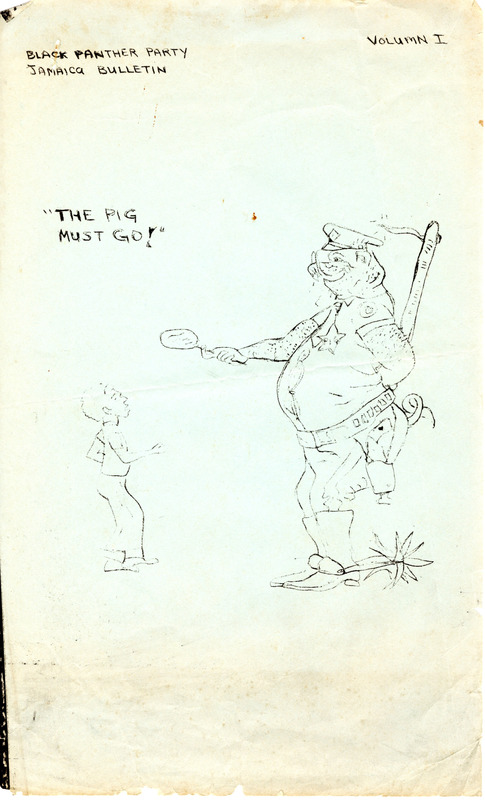
Volume 1 of The Black Panther Party Jamaica Bulletin from Jamaica Queens, NY, February 28, 1969. Included in the bulletin are a political cartoon titled "The Pig Must Go"; an article titled "Panthers Harassed by F.B.I."; and an abridged version of Black Panther Party Ten Point Program.