The HCAC public history focused digital archive cataloging is an ongoing process, and we may update this record as we conduct additional research and review. We welcome your comments and feedback if you have more information to share about an item featured on the site, please contact us at: HCAC-DigiTeam@si.edu
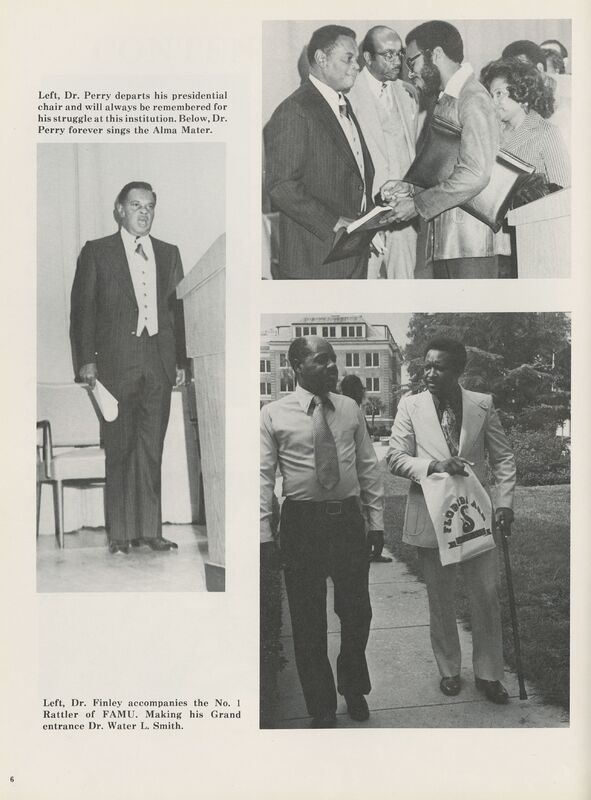
These images were featured in the 1978 Rattler Yearbook. It shows the transition of Florida A&M president Dr. Benjamin L. Perry to new president Dr. Walter L. Smith. Perry is seen singing the FAMU Alma Mater while Smith strolls around campus with faculty member Dr. Finley.
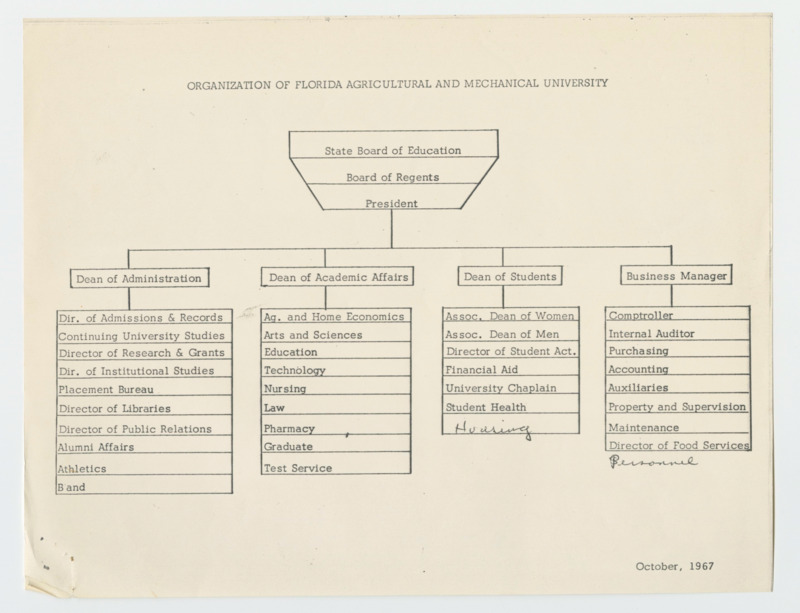
This collection holds a graphic of the FAMU institutional leadership hierarchy and an attached letter between President George W. Gore, Jr. and Dr. B. L. Perry, Jr., dated November 29, 1967. The graphic breaks down the organization of leadership and lists each role’s title and the offices they oversee/report to.
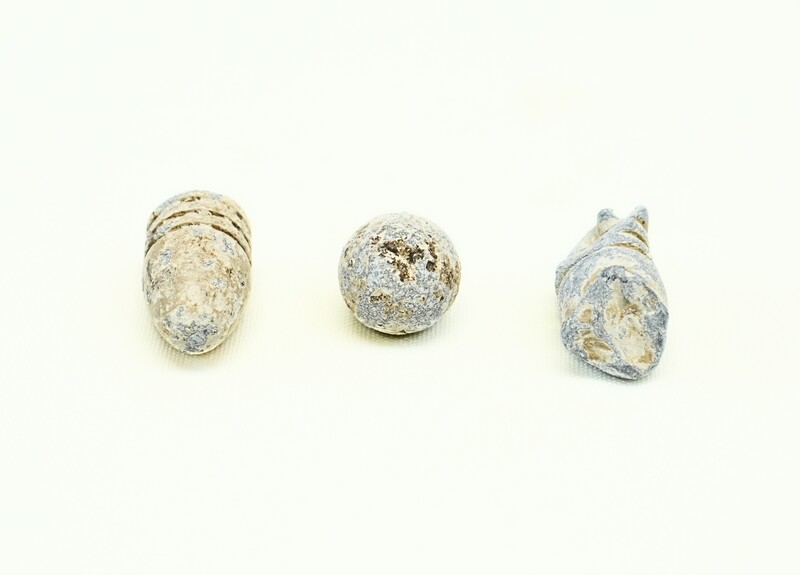
These original Civil War bullets serve as tangible reminders of the intense conflict that defined a nation divided. Each bullet reflects the technology of the era and the harsh realities faced by soldiers on the battlefield. Collected from various historic sites, they illustrate the significant role of firearms in shaping military strategies.
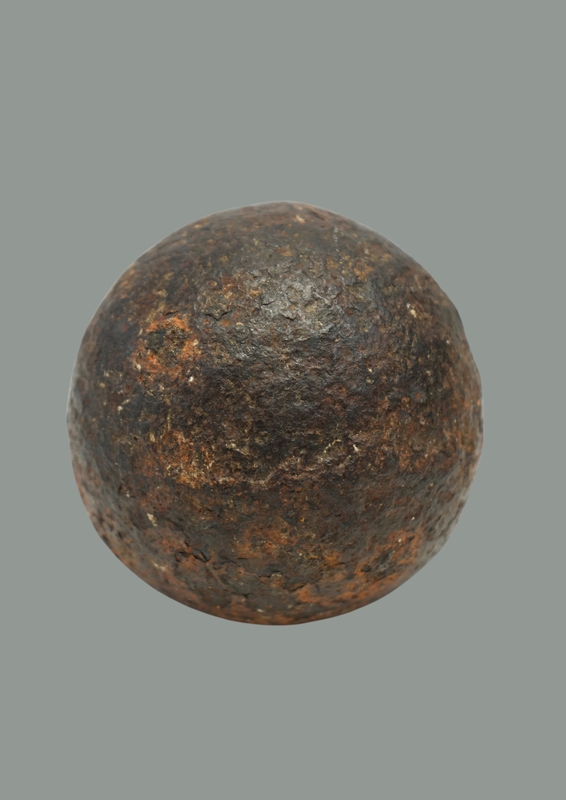
These original Civil War cannonballs exemplify the artillery used during one of America’s most tumultuous periods. Crafted from iron, they were designed for devastating impact in battles, symbolizing the intensity and destruction of war.
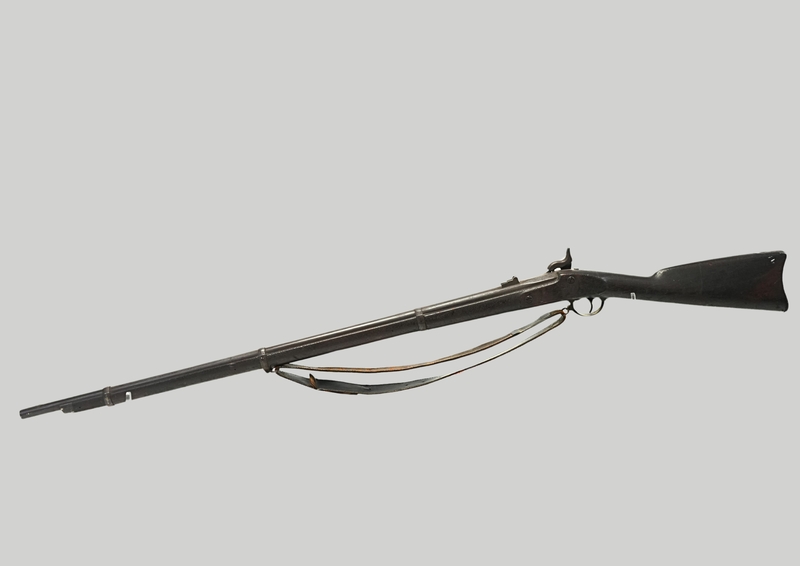
This original Civil War musket, complete with a strap, represents the military history and conflicts that shaped America during the 19th century. Crafted for accuracy and durability, the musket served soldiers on both sides of the war, symbolizing the struggle for freedom and unity.
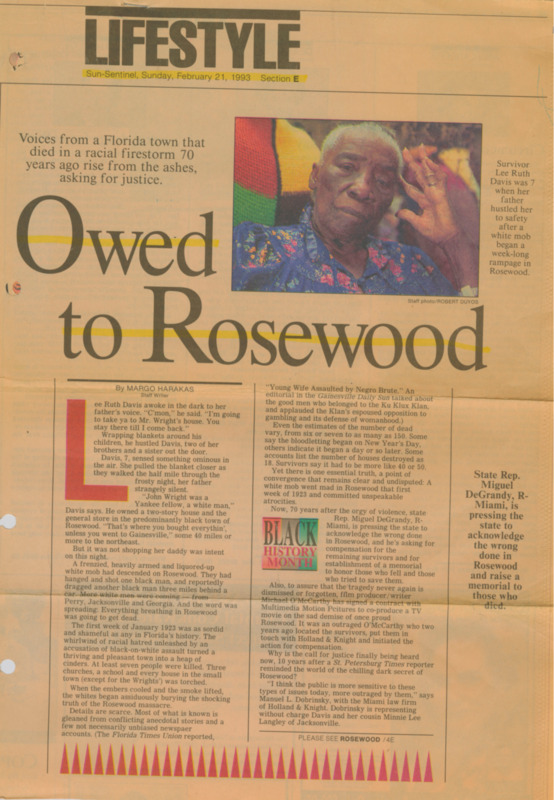
This February 1993 Lifestyle Sun Sentinel article was written by Margo Harakas. Harakas interviewed a survivor of the 1923 Rosewood Massacre, Lee Ruth Davis. Davis was 7 when her father woke her in the dead of night to take her to John Wright’s home, a white man who harbored the Black residents of Rosewood while the mob raged on outdoors.
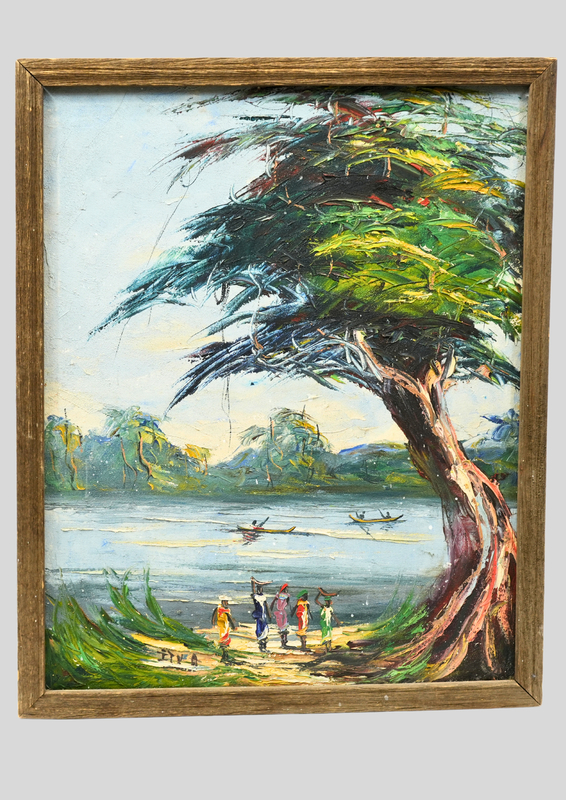
This untitled painting from the FAMU Black Archives/Caribbean Art Collection has limited identification for proper attribution. However, the vibrant blue, green, and orange paint jumps out of the frame, showcasing a glimpse into life in the Caribbean.
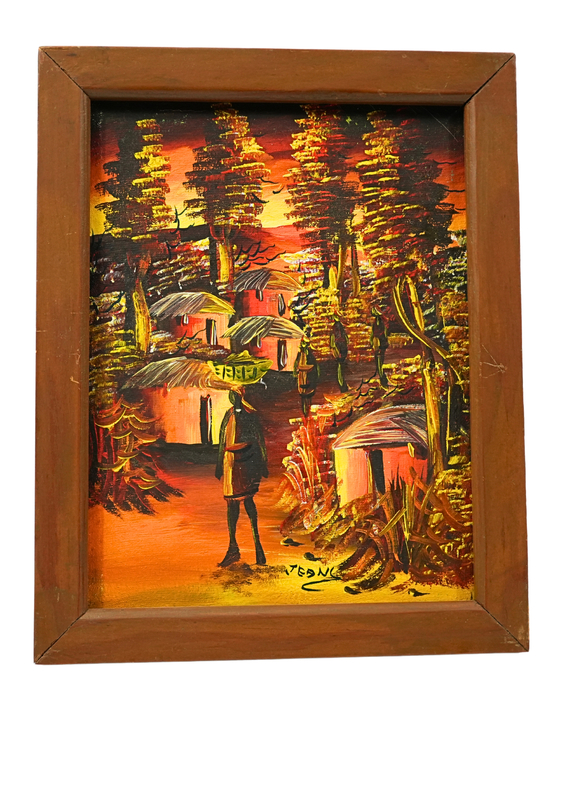
This untitled painting from the FAMU Black Archives/Caribbean Art Collection has limited identification for proper attribution. While it appears to be the same artist from the collection, this piece depicts a village scene with bright orange lighting basking from a setting, or rising, sun – a contrast from the blue paintings seen earlier.
This untitled painting from the FAMU Black Archives/Caribbean Art Collection has limited identification for proper attribution. It features a lush green scene, complete with a cascading blue waterfall and four people strolling in it.
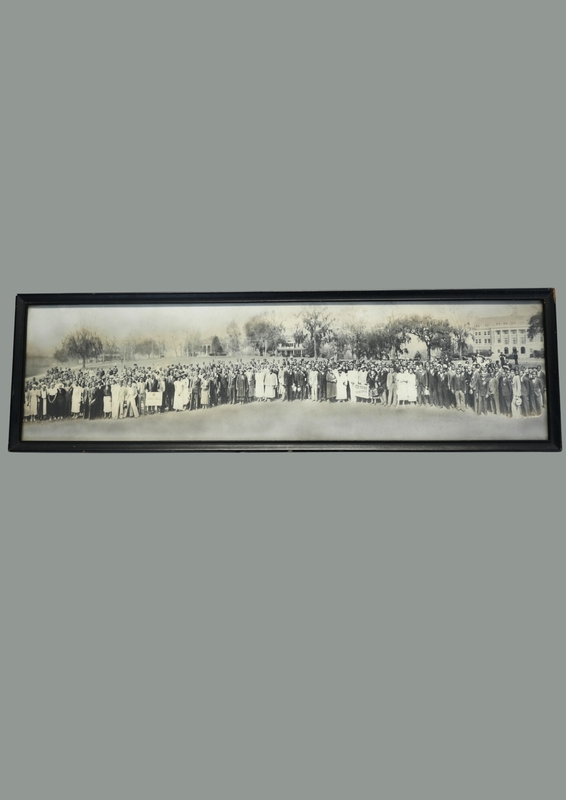
A 1934 panoramic group picture on the campus of Florida A&M University. The picture was taken in the midst of the Great Depression. It captures members of the Fourth State Basketball Tournament, and members of the 42nd Annual Florida State Teachers Association (FSTA), including Dr. Mary McLeod Bethune, founder of Bethune Cookman College.
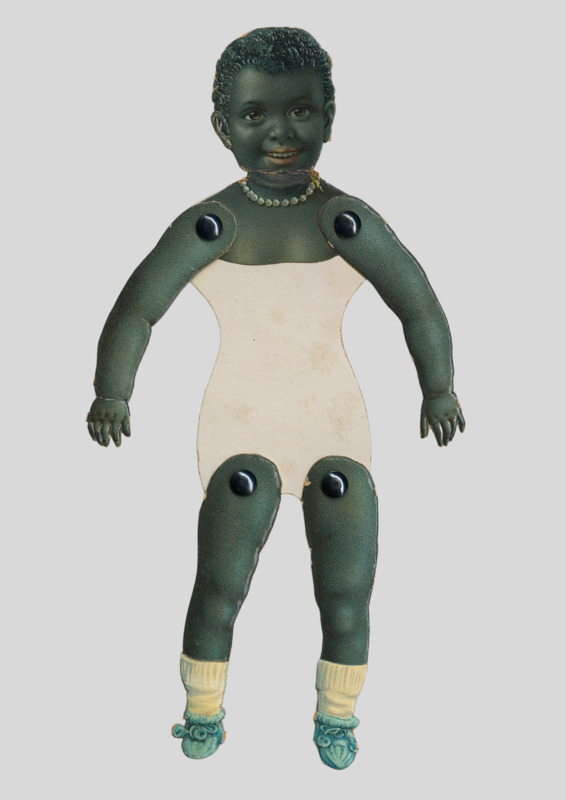
Black paper doll features movable joints, cut from paper and assembled with small fasteners. The doll, reflecting 19th-century craftsmanship. These dolls, often simple in design, were popular children's toys, but also highlight complex themes of race and identity in post-Reconstruction America.
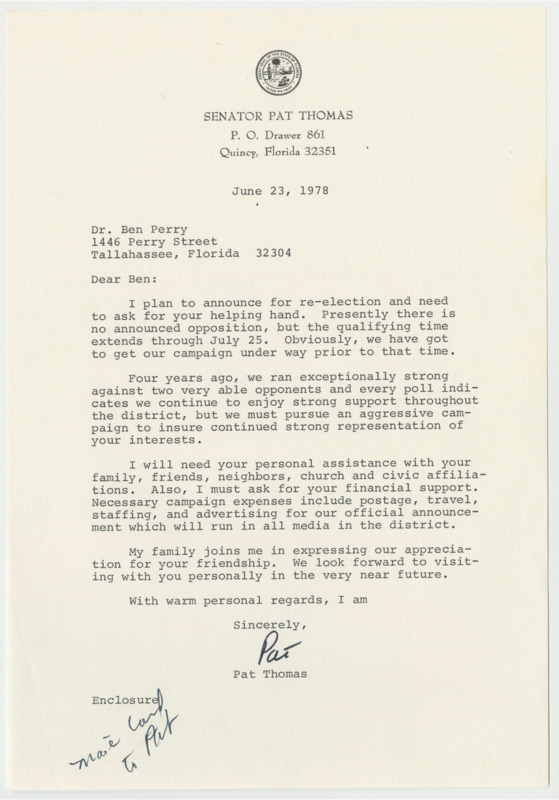
A series of letters from Democratic Senator Pat Thomas asking for his friend, Dr. B. L. Perry Jr.’s, help in his re-election bid, and a $25 donation check from Dr. Perry to Thomas’ campaign made on August 2, 1978. Thomas requested Dr. Perry’s personal connections and financial support and expressed his thanks once successfully re-elected.
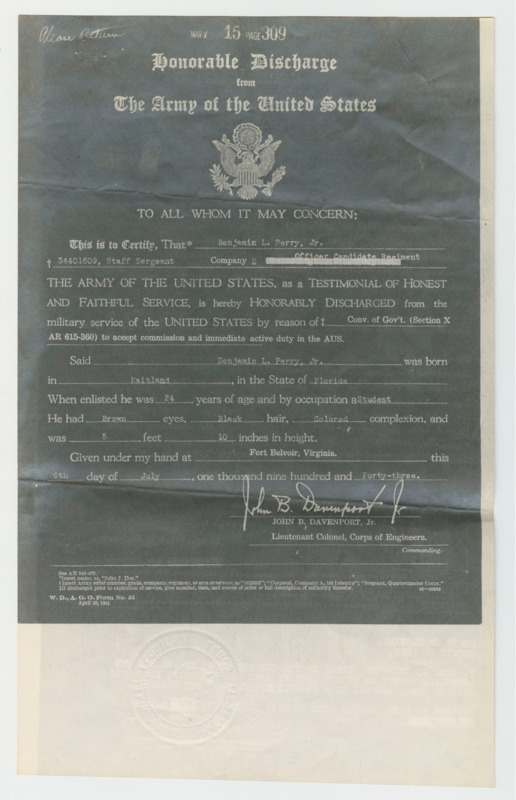
An official enlistment record of Benjamin L. Perry, Jr., a staff sergeant who served for nine months and 26 days under the Corps of Engineers in the 1940s. This document shows the well-rounded experience of the future president of Florida A&M University, clarifying his vaccinations, “excellent” character, marital status, and honorable discharge.
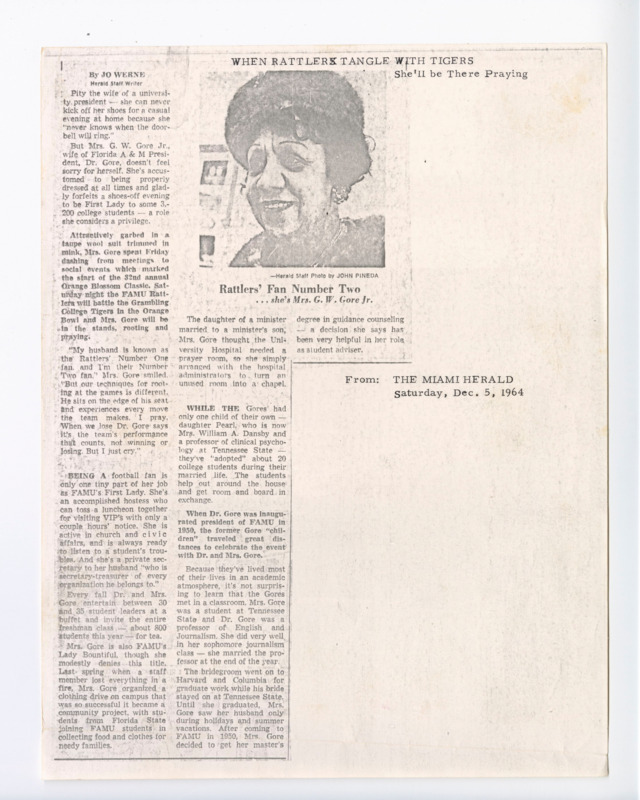
A collection of letters and newspaper clippings about First Lady Pearl Gore, along with personal memorabilia, provides a glimpse into her impactful role at FAMC. These separate pieces highlight her contributions, her connection to the community, and the legacy she helped shape alongside her husband, President George W. Gore.
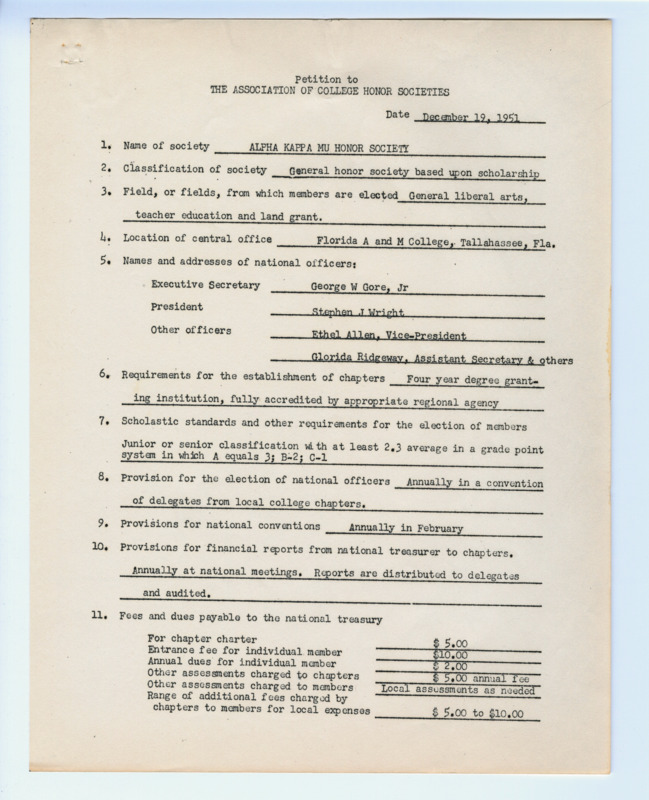
This document shows the origins of the Alpha Kappa Mu Honor Society, a general honor society based upon scholarship created by George W. Gore, Jr. This application was authorized in 1951 at the convention and action of the executive committee.
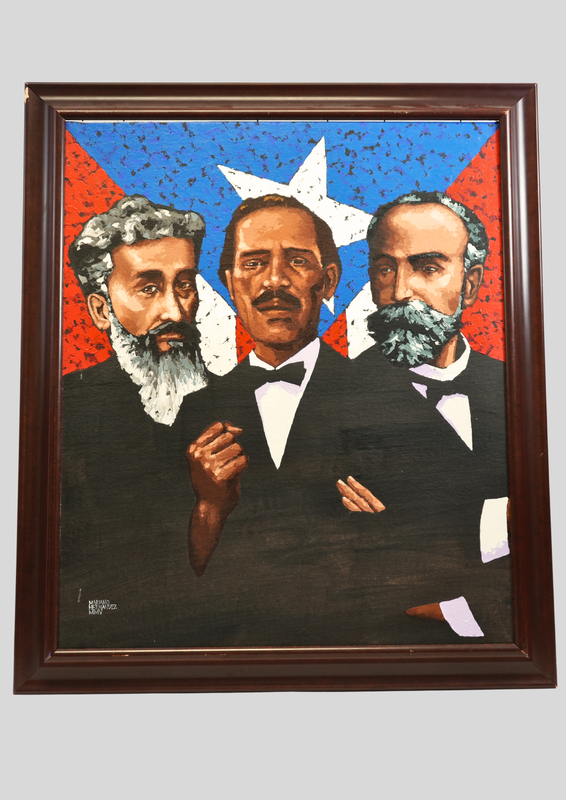
In this original 2005 piece by Mariano Hernandez, physician Ramon Emetrio Betances and attorneys Pedro Albizo Campos and Eugenio Maria de Hostos are honored as instrumental leaders in the Puerto Rican independence movement. FAMU alum and former assistant director for the Meek-Eaton Black Archives Dr. Will Guzman donated this artwork.
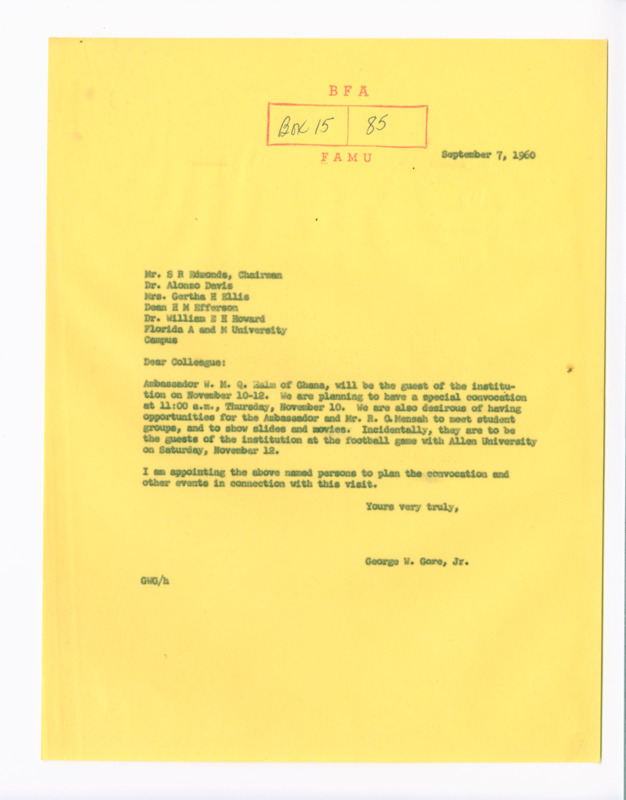
Letters between President Gore and the Embassy of Ghana discuss plans to strengthen educational ties at FAMU for increased access for future Ghanaian students. These exchanges cover scholarship options, academic opportunities, and an invitation for the Ambassador to attend a FAMU football game.
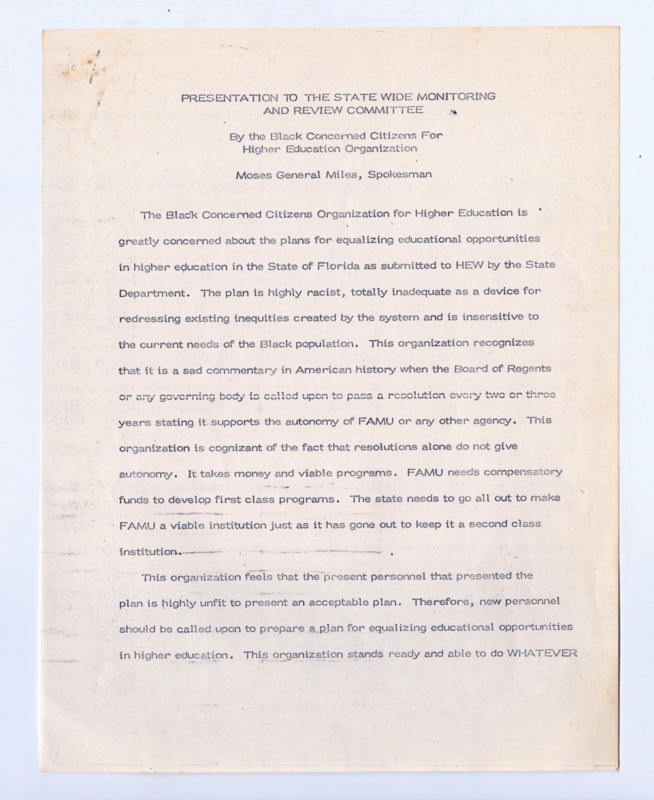
Moses General Miles was the spokesman for the Black Concerned Citizens for Higher Education Organization. The committee was brought together for a presentation to the Statewide Monitoring and Review Committee in response to new HEW standards, which the group claimed were ‘racist,’ ‘inadequate… for redressing existing inequities’ and ‘insensitive.’
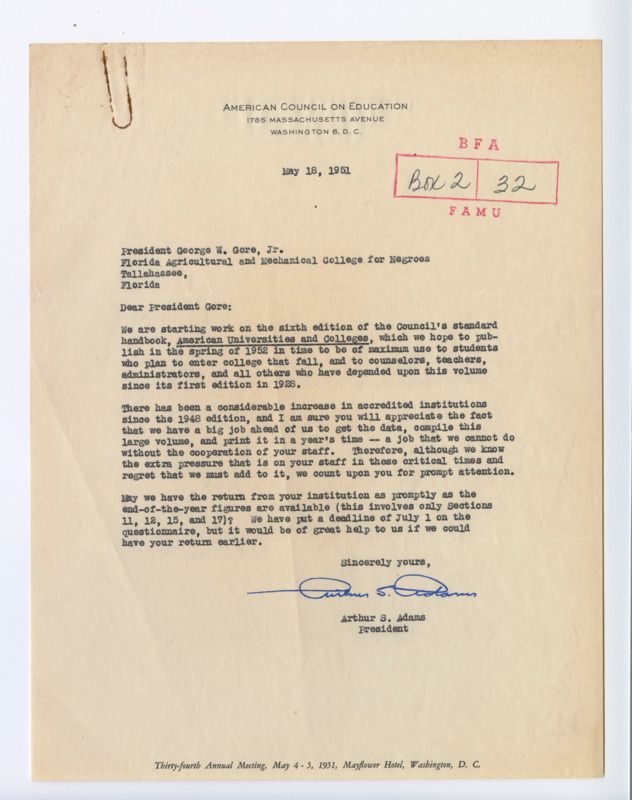
President Adams requested FAMC’s undergraduate and financial statistics for the college handbook to showcase the institution's remarkable academic growth and financial strength following desegregation. This provided prospective students and stakeholders a vibrant snapshot of FAMC’s promising future.
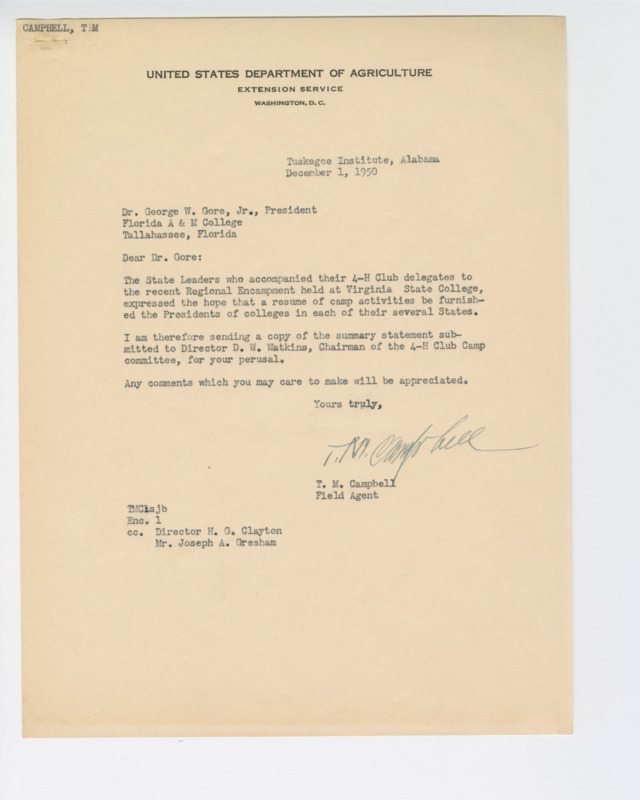
President Campbell of the United States Department of Agriculture engaged with university administrators who attended the 4th Regional Conference. He showcased the exciting developments at Florida A&M College while stressing the importance of collaboration among institutions, especially through innovative partnerships in higher education.
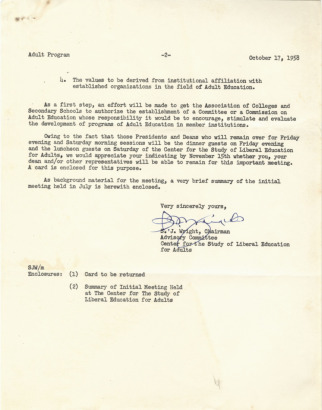
Messages between Mr. Peter Siegle, Research Director at the Center for the Study of Liberal Education for Adults, and President Gore, discuss specific concerns about the challenges faced by the Black community in the South and expanding higher education opportunities for adults.
A series of letters between (or CC’d) George W. Gore, Jr. and A. S. Gaither discussing varying topics and an attached Atlanta Daily World article written by Gaither. Over the years, Gore congratulated Gaither and coordinated with him over a Bethune Cookman/Althea Gibson celebration/campus visit, football game schedules, and leadership changes.
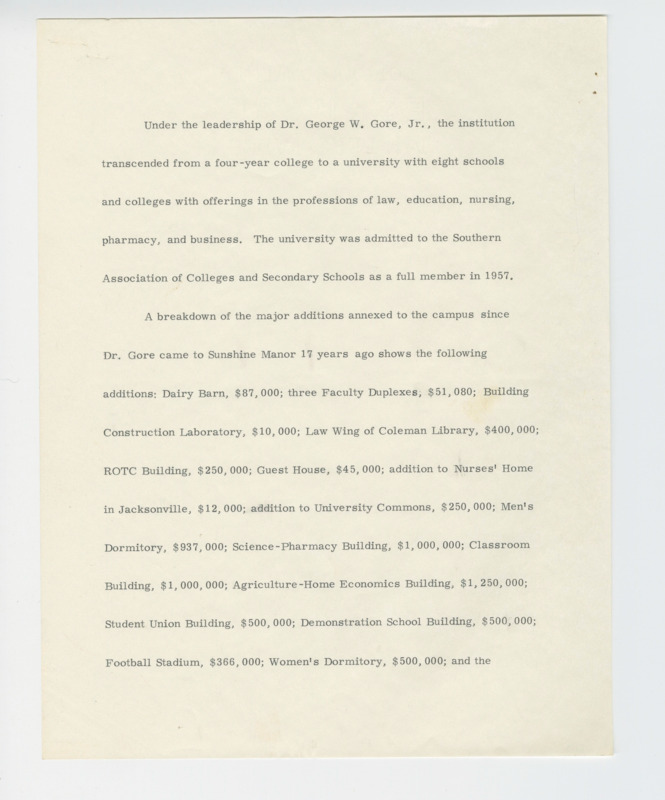
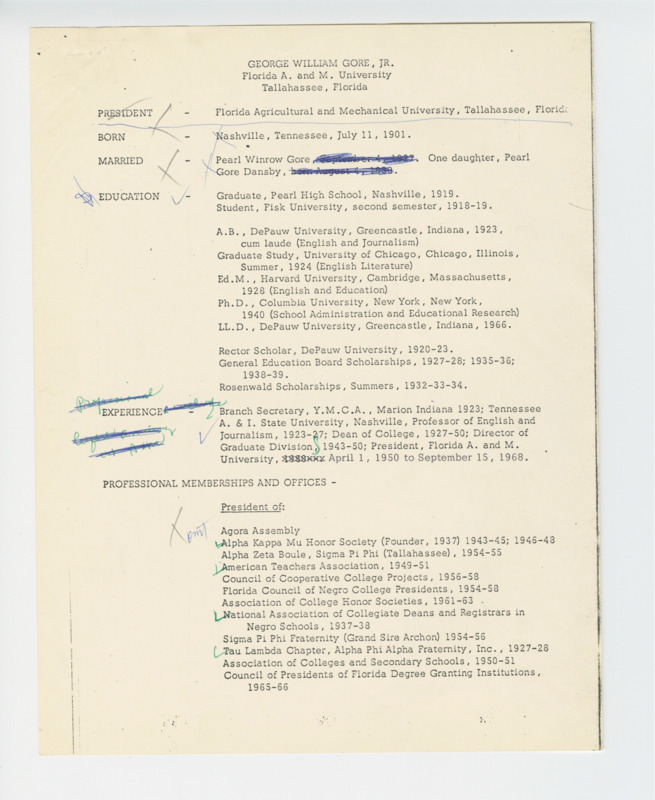
Biographical information on President Gore highlights his education, achievements, and memberships, offering a deeper insight into his life and leadership. These three packets go beyond a biography, providing a sketch of his journey, his transition as a new Floridian, and his transformative impact on FAMC and FAMU during his presidency.
This packet explores President Gore's transformative leadership at Florida A&M College (FAMC), later FAMU, showcasing milestones in accreditation, academic and non-academic advancements, and the growth of music, drama, and departments. It also honors his personal recognitions, including numerous Greek letter awards, and his enduring legacy.
Biographical information on President Gore mentions his education, professional achievements, and memberships. It details his journey as a visionary leader, his academic background, his affiliations with esteemed organizations, and his impact on both FAMC and FAMU during his presidency.
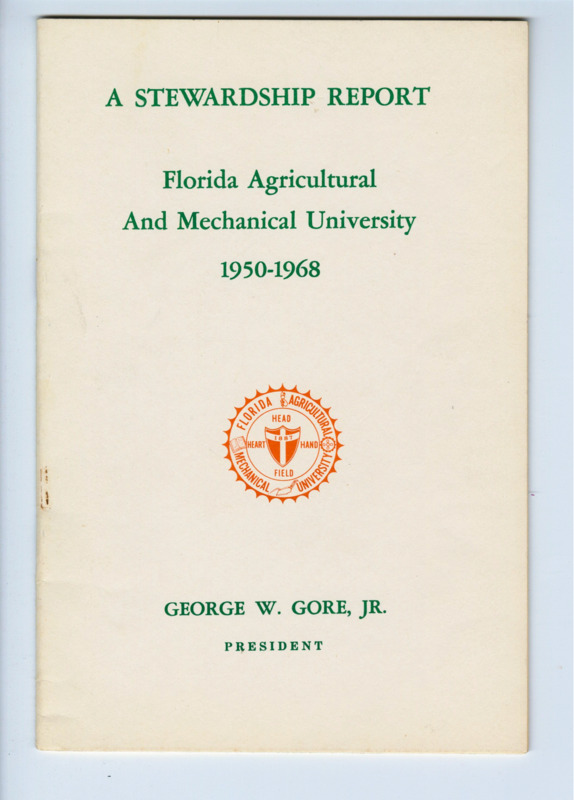
The 1968 stewardship report for President Gore showcases his visionary leadership and transformative achievements at FAMC and FAMU. It highlights advancements in academics, campus development, and student life, reflecting his steadfast commitment to the university’s progress, excellence, and lasting impact on the community.
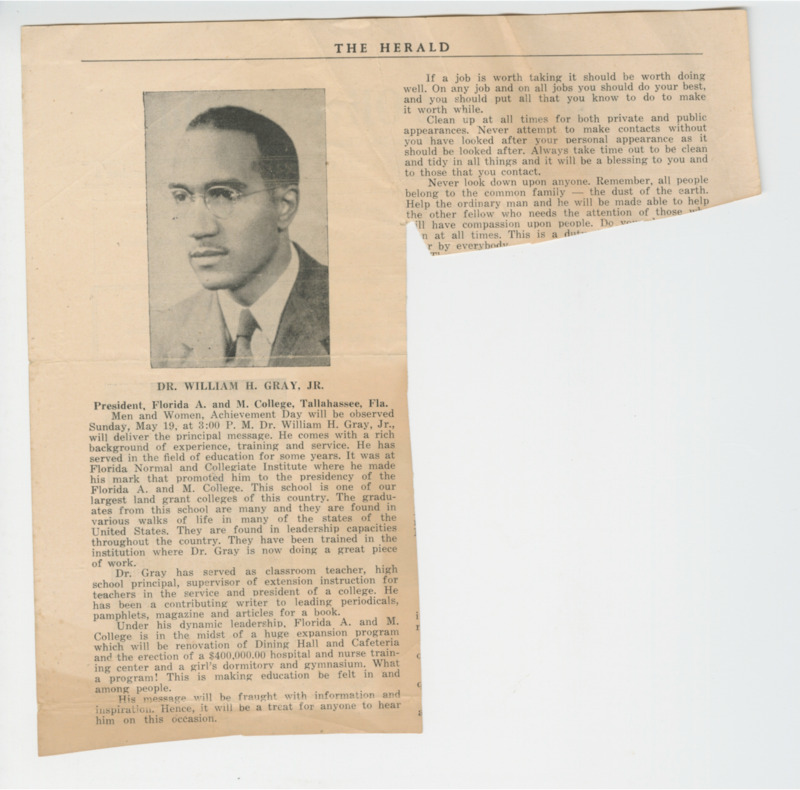
The Herald announced President William H. Gray's Achievement Day address, highlighting his extensive background as a teacher, high school principal, supervisor of extension instruction, and writer. His message, packed with valuable insights, invited both men and women to attend this special event celebrating growth and knowledge.
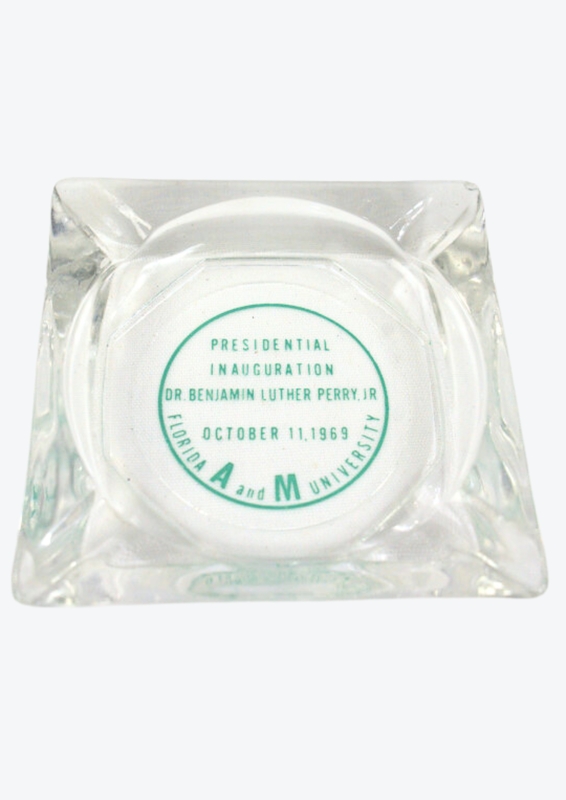
A 1969 presidential inauguration ashtray that commemorates the swearing-in of President B.L. Perry at Florida Agricultural and Mechanical University. As a historical artifact, it symbolizes his leadership during a transformative period for FAMU, marking a significant moment in the university's growth and development.
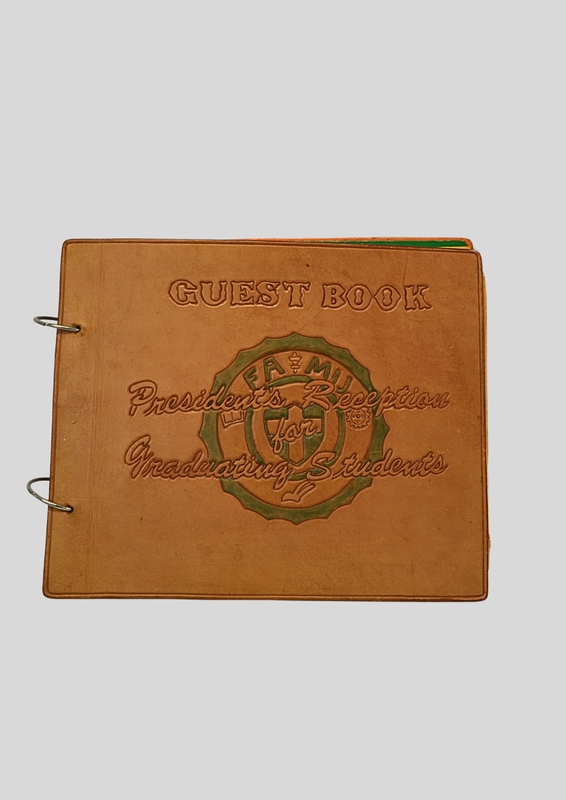
This reception book, created by President B.L. Perry, is dedicated to the graduating students, parents, and friends of Florida Agricultural & Mechanical University. Designed to collect valuable feedback, it records the names, dates, addresses, and remarks of attendees from 1971 to 1977.
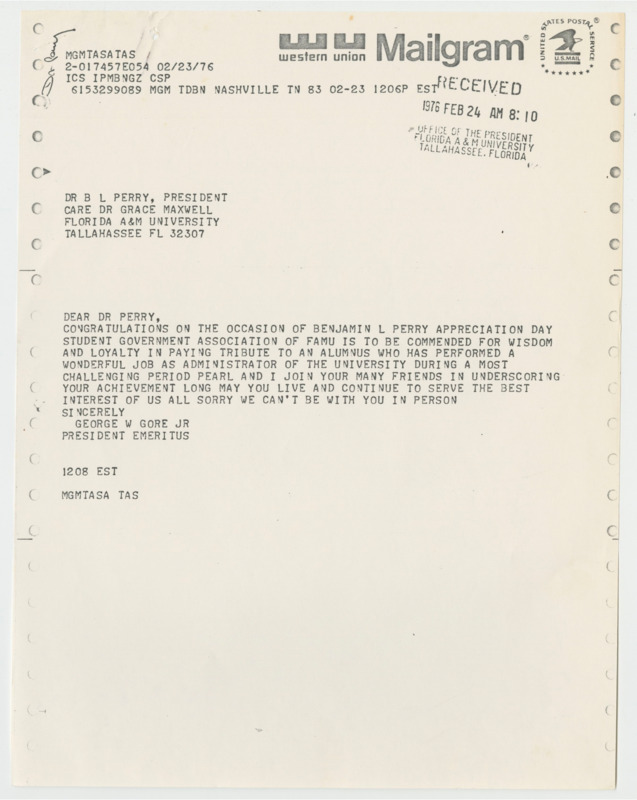
Messages celebrating President B. L. Perry’s Appreciation Day include notes from Former President Gore, who expressed regret for his absence, and C.K. Steele, who praised Perry’s impactful leadership. A convocation pamphlet, sponsored by the Student Government Association, outlines the day’s events honoring President Perry’s dedication to FAMU.